Controls are easy to underestimate because they sound technical. A key is pressed, a mouse moves, a gamepad stick changes position, a touch gesture begins, a camera rotates, an avatar walks. From a developer's perspective, this can look like input processing. From a user's perspective, it is the difference between feeling comfortable and feeling lost. In a virtual world, controls are not technical plumbing. They are user experience.
This matters because movement is one of the first things users test. Before they understand the world, before they use communication, before they interact with objects, they try to move. If movement feels natural enough, they continue exploring. If it feels awkward, unpredictable, or frightening, the platform has already lost confidence. A beautiful environment cannot compensate for controls that make users feel incompetent.
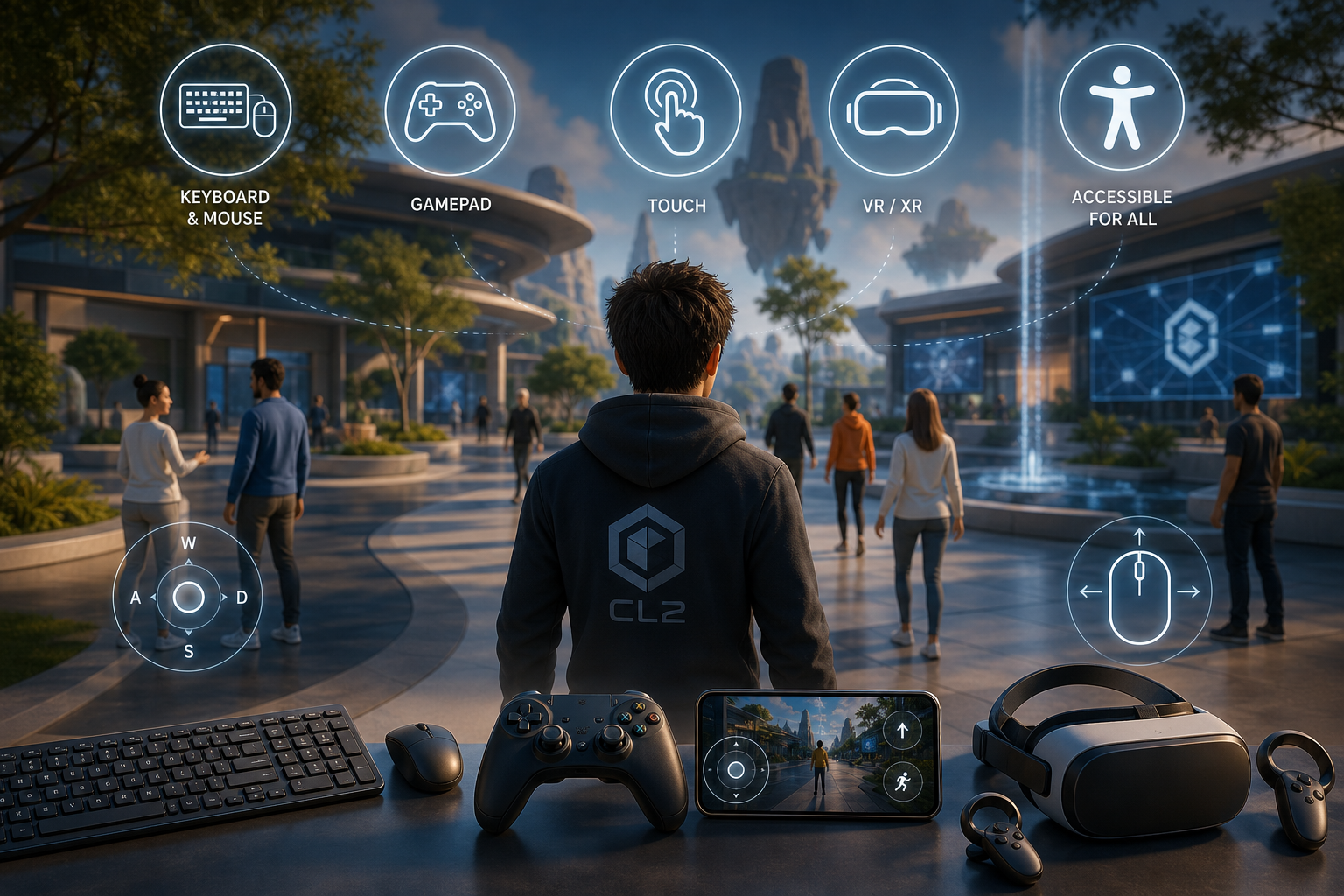
Cybalounge 2 is intended for a broad audience. Some users may have gaming experience and expect familiar WASD movement, mouse camera control, or gamepad support. Others may be business users who rarely navigate 3D environments. Some may join from a laptop without a mouse. Some may use touch devices. Some future users may enter through VR or XR devices. This variety means the platform cannot assume one perfect input method. It must support different ways of moving while keeping the experience understandable.
Predictability is the first principle. Users need to understand what will happen when they press a key or move a stick. If the avatar sometimes turns and sometimes slides, if the camera sometimes follows and sometimes drifts, if forward movement depends on a hidden state, the user loses trust. Predictable controls allow users to build muscle memory. They stop thinking about input and start thinking about the world.
Forgiveness is the second principle. Users will make mistakes. They will press the wrong key, move the camera too far, get too close to an obstacle, or try to walk into something. A good control system should help them recover. It should avoid trapping them in corners, disorienting them with sudden camera changes, or punishing small errors. This is especially important for non-gamers and first-time users. The goal is not to test navigation skill. The goal is to let people participate.
Familiarity is the third principle. There is value in using conventions that people already know. Keyboard movement, mouse looking, gamepad sticks, and touch controls all have established patterns. A platform should not invent unusual control schemes unless there is a strong reason. Familiarity reduces learning effort. It also makes onboarding easier because users can bring expectations from other applications.
At the same time, virtual world controls must serve the specific platform. CL2 uses an avatar-centered approach, so movement, camera, and animation belong together. The avatar should not feel separate from the camera. The camera should support the avatar rather than fight it. If the user moves forward, the system should make it clear what forward means. If the camera rotates, orientation should remain understandable. If the avatar runs, walks, or stops, the visual feedback should match the input.
Supporting multiple input methods increases development complexity. Keyboard, mouse, gamepad, touch, and VR controllers all behave differently. They produce different types of signals. A keyboard is digital: pressed or not pressed. A gamepad stick is analog and can express direction and strength. Touch controls may need virtual sticks or gestures. VR controllers add position and orientation. If each input method controls the avatar directly in its own way, the system can become messy quickly.
This is why a unified control concept is important. Input devices should be translated into common movement intentions: move forward, move backward, turn, look, run, jump, interact, and so on. The avatar controller can then respond to intentions rather than raw device events. This keeps the system more maintainable and helps ensure that different input methods create comparable behavior. The user should not feel that each device belongs to a different platform.
Controls also connect to accessibility. Not everyone can use the same input method comfortably. Some users may need keyboard-only navigation. Others may prefer a gamepad. Some may require slower movement, reduced camera sensitivity, or simpler interaction. A platform designed for education, business, public use, or senior communities should not treat accessibility as an afterthought. Control flexibility is one of the most practical forms of accessibility.
There is also an emotional element. A user who can move confidently feels capable. A user who constantly struggles with navigation may feel embarrassed, especially in a shared environment. This matters in training and education, where the platform should support learning rather than create performance anxiety. It also matters in business meetings, where users do not want to look clumsy in front of colleagues. Smooth controls protect dignity.
For Cybalounge 2, the ambition is not to create a complex simulation of human movement. The first goal is more practical: make movement feel stable, readable, and comfortable. As with many parts of the platform, there will be trade-offs. Advanced movement features can come later. The foundation must be reliable. Good controls disappear into the experience. Bad controls define the whole experience. If users remember the controls more than the world, something has gone wrong.
Controls also shape how users interpret the world itself. A narrow doorway feels different if steering is precise. A staircase feels different if the avatar approaches it confidently. A gathering space feels different if users can stop, turn, and face each other without effort. Interaction design begins before a button is clicked; it begins with the way the user arrives.
The same applies to onboarding. A first-time user should not need to study a manual before they can take a few steps, rotate the camera, and understand where they are. Short visual hints, sensible defaults, and forgiving movement can reduce the fear of entering a 3D space. Controls are not only about supporting devices; they are about welcoming people.
The platform also has to avoid surprising experienced users. Defaults should feel familiar, but settings can allow adjustment where needed. Camera sensitivity, running behavior, touch layout, and future VR comfort options can become important without overwhelming the first experience.
Now available on Amazon!
Discover the Metaverse Beyond the Hype
The Metaverse is no longer a futuristic fantasy, it is rapidly becoming a new layer of human society. But what is it really? Where did it come from? And what might it become over the next decade?
The Metaverse – Past, Present, and Future takes readers on a fascinating journey from the earliest virtual worlds and science-fiction visions to today’s emerging immersive platforms, digital economies, and online communities. Along the way, it explores the technologies powering the Metaverse, the opportunities it creates for education, work, and culture, and the challenges of governance, privacy, inclusion, and sustainability.
Looking beyond today's headlines, the book offers a balanced and inspiring vision of how immersive technologies could transform cities, learning, creativity, and daily life by 2035.
Whether you are a business leader, educator, technologist, policymaker, or simply curious about the future, this book provides the context, insight, and perspective needed to understand one of the most important technological and societal shifts of our time.
The future of the Metaverse is not something we await, it is something we create.
About the Author
Dieter E. Heyne is a Metaverse pioneer and lifelong technologist, born in Munich in 1966. With a master’s degree in applied computer science and over three decades of experience as an IT entrepreneur, software architect, and consultant, he has always been at the frontier of digital innovation. His journey into virtual worlds began in 2007 with Second Life and sparked a deep, ongoing exploration of the Metaverse as a space for education, collaboration, and immersive experiences.
Since 2012, Dieter has been developing and refining a web-based virtual world platform, driven by a vision to make the Metaverse accessible, meaningful, and transformative. As a frequent speaker and thought leader at Metaverse events, he shares his insights on how virtual environments can reshape human interaction, learning, and culture. He is the founder and CEO of Metaverse School GmbH, a company dedicated to promoting Metaverse literacy and helping people and organizations understand the power and promise of these emerging digital realms.
Besides talking and writing non-fiction about the Metaverse and Virtual Worlds, this vast knowledge now went into the creation of The Metaverse Enforcers, an ongoing series of high-tech science fiction novels, showcasing the potential development and dangers of the Metaverse in 2053.
About Metaverse School GmbH
Metaverse School GmbH was founded in 2017 by Dieter E. Heyne, who continues to lead the company as its CEO. The company emerged from decades of consulting experience in software architecture, project management, quality assurance, information security, and data protection. Building on this strong technological foundation, Metaverse School GmbH is dedicated to promoting the responsible and purposeful use of immersive 3D environments, for education, collaboration, training, and simulation.
A core mission of the company is to raise awareness of the Metaverse’s potential across business, education, and society. In support of this goal, Dieter Heyne regularly speaks at national and international conferences as well as Metaverse-focused events. Through real-world examples and deep expertise, he demonstrates how immersive technologies can already create meaningful value today.
Disclaimer
Some portions of this content were created or refined with the assistance of artificial intelligence (AI) using tools such as OpenAI’s ChatGPT. The ideas, structure, and editorial direction remain the responsibility of the author. While every effort has been made to ensure factual accuracy and original expression, readers are encouraged to approach speculative or future-facing statements with critical thought.
This series does not represent the views of any specific company or platform and is intended to inspire open discussion around the evolving concept of the Metaverse.
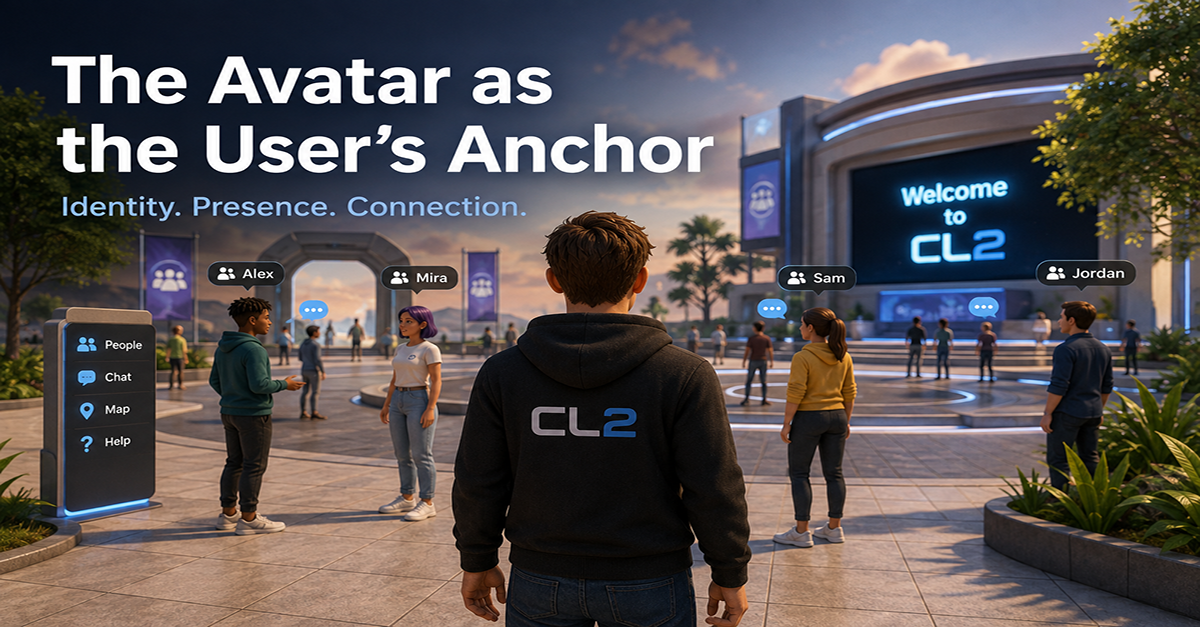
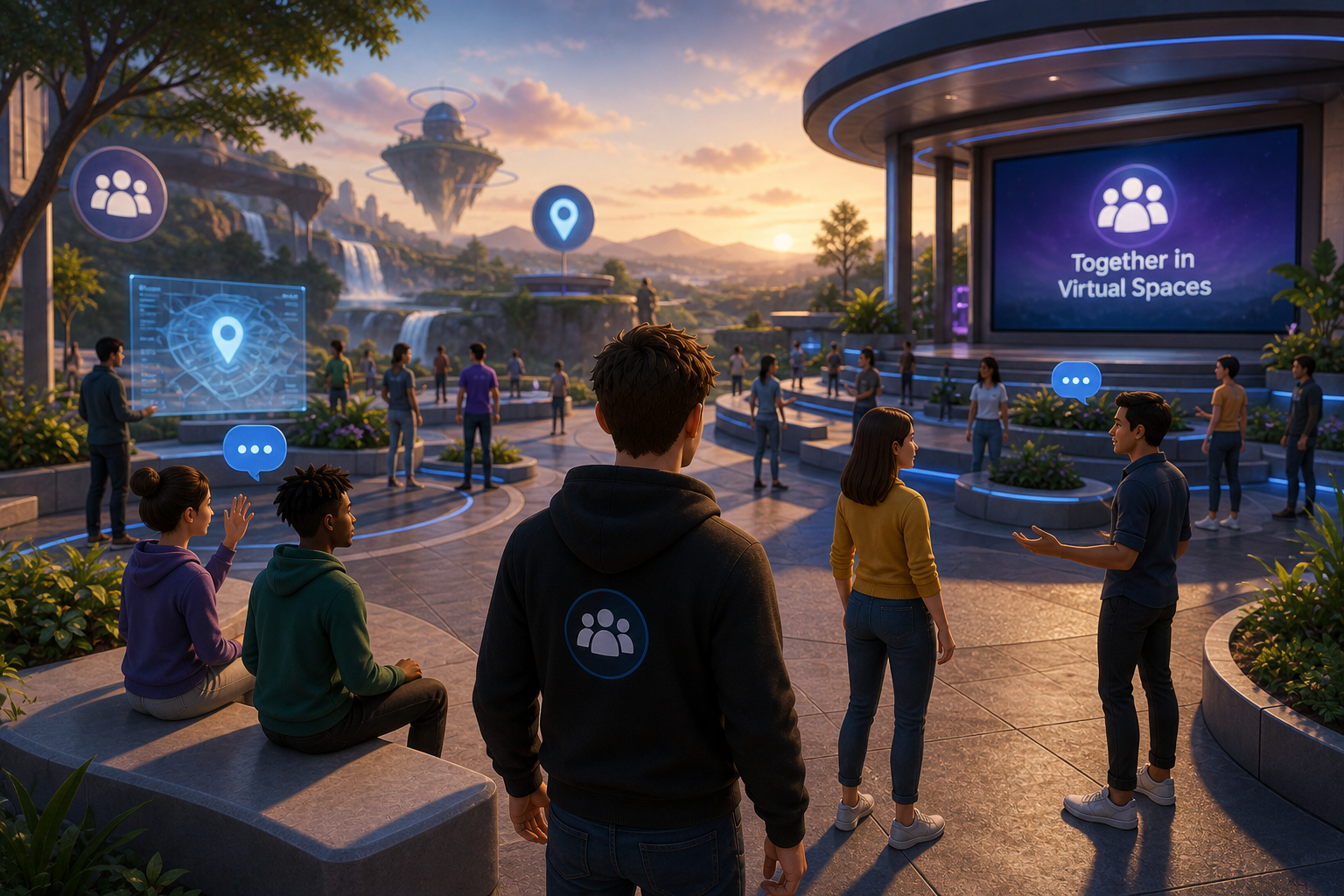
A virtual world begins to feel different from a website when the user has a place inside it. This place is not only a camera position. It is not only a viewpoint. It is a visible and social representation of the user. In Cybalounge 2, the avatar plays this role. It is the user's anchor in the world: the point where identity, movement, orientation, and presence come together.
Without an avatar, a 3D environment can easily feel like a floating camera experience. The user can look around and move, but may not feel embodied. This can be useful for some applications, such as architectural walkthroughs or product views, but it is less suitable for shared social spaces. In a multi-user world, people need to understand not only where they are, but where others are. They need to see direction, distance, movement, attention, and sometimes emotion or intention. The avatar provides these signals.
This is why I do not see the avatar as a decorative feature. It is a functional element of presence. It gives the user a body in the environment. It creates a relationship between the camera and the world. It allows movement to be interpreted as the movement of a person rather than a technical navigation mode. It helps other users recognize that someone is present. Even a simple avatar can transform an empty scene into a shared place.
For CL2, the first goal is not to create the most advanced avatar customization system. That would be an interesting future direction, and an Avatar Studio is definitely part of the long-term vision. But in the early platform, the priority is reliable presence. The avatar should load correctly, move predictably, animate believably enough, cast and receive shadows where appropriate, and support the basic social functions of a shared virtual world. It should give users a sense of being there.
This involves trade-offs. Full customization can be complex. Body shapes, clothing, hair, accessories, animations, facial expressions, and identity options can quickly become a platform within the platform. It may be tempting to build all of that early because avatars are emotionally important. But too much complexity too soon can distract from the core experience. A simple but stable avatar system may be more valuable in the beginning than an ambitious customization system that creates performance, usability, and maintenance problems.
The avatar also influences camera design. In a third-person view, the camera follows the user from outside the body. This can make navigation easier for many users, especially those who are not experienced with first-person 3D environments. It helps users see their own position, direction, and movement. It can reduce disorientation. It also supports a more social feeling because the user sees themselves as part of the scene. For non-gamers, educators, business users, and seniors, this can be more comfortable than being placed directly inside an invisible first-person viewpoint.
Movement is another part of the avatar's role. Walking, running, turning, and stopping are not only mechanical actions. They communicate intention. If an avatar approaches, turns away, waits, or follows, other users interpret that behavior socially. Even when animations are simple, they help make movement readable. A sliding object is less human than a walking avatar. A world with moving avatars feels inhabited. A world with only camera positions feels more like a technical session.
The avatar also supports orientation. In a 3D space, users can easily lose track of direction. Seeing the avatar's body, facing direction, and relationship to the environment helps maintain spatial awareness. This is especially important in larger worlds, training environments, or educational spaces where users may need to follow paths, gather at locations, or interact with specific objects. The avatar becomes a constant reference point.
There is also a social trust aspect. In a shared environment, users want to know who is present. Names, labels, distance, and avatar appearance all contribute to that understanding. The platform does not need to solve every identity question immediately, but it should make presence legible. If someone speaks, moves, or joins a group, others should be able to connect that action to a visible participant. Otherwise, the world can feel confusing or anonymous in a negative way.
For education and business, the avatar can support roles. A trainer, teacher, moderator, guide, learner, visitor, or presenter may not need a different body, but the platform can eventually use avatar labels, indicators, or visual conventions to support role recognition. This connects the avatar to moderation and safety as well. In shared spaces, it should be clear who can help, who is leading, and who has control over the room.
The avatar is also part of emotional engagement. People often remember spaces in relation to themselves. They remember where they stood, where others gathered, which path they took, what they saw from a certain position. An avatar strengthens that memory because it gives the user a body within the experience. This matters for learning, collaboration, events, and community building. Presence is not only visual quality. It is the feeling of being situated.
Over time, the avatar system can grow. More customization, better animations, expressive gestures, accessibility options, identity profiles, and AI-assisted avatar creation may all become valuable. But the foundation should remain clear: the avatar exists to anchor the user. It is not just a 3D model. It is the bridge between person and place, between movement and meaning, between individual presence and social space. Presence begins when the user has a place in the world.
There is also a practical reason to start simple. Every avatar is part of the performance budget. Detailed characters, complex materials, many animations, and high-resolution textures can quickly become expensive in multi-user scenes, especially within a web browser. A platform that wants to work on ordinary devices needs avatar quality that supports identity without overwhelming the system. The best early avatar is not the most detailed one, but the one that reliably helps users feel present.
This does not mean visual individuality is unimportant. It means the platform should earn customization step by step. First, the avatar must support presence. Then it can become more expressive, more personal, and more adaptable without weakening the core experience.
Now available on Amazon!
Discover the Metaverse Beyond the Hype
The Metaverse is no longer a futuristic fantasy, it is rapidly becoming a new layer of human society. But what is it really? Where did it come from? And what might it become over the next decade?
The Metaverse – Past, Present, and Future takes readers on a fascinating journey from the earliest virtual worlds and science-fiction visions to today’s emerging immersive platforms, digital economies, and online communities. Along the way, it explores the technologies powering the Metaverse, the opportunities it creates for education, work, and culture, and the challenges of governance, privacy, inclusion, and sustainability.
Looking beyond today's headlines, the book offers a balanced and inspiring vision of how immersive technologies could transform cities, learning, creativity, and daily life by 2035.
Whether you are a business leader, educator, technologist, policymaker, or simply curious about the future, this book provides the context, insight, and perspective needed to understand one of the most important technological and societal shifts of our time.
The future of the Metaverse is not something we await, it is something we create.
About the Author
Dieter E. Heyne is a Metaverse pioneer and lifelong technologist, born in Munich in 1966. With a master’s degree in applied computer science and over three decades of experience as an IT entrepreneur, software architect, and consultant, he has always been at the frontier of digital innovation. His journey into virtual worlds began in 2007 with Second Life and sparked a deep, ongoing exploration of the Metaverse as a space for education, collaboration, and immersive experiences.
Since 2012, Dieter has been developing and refining a web-based virtual world platform, driven by a vision to make the Metaverse accessible, meaningful, and transformative. As a frequent speaker and thought leader at Metaverse events, he shares his insights on how virtual environments can reshape human interaction, learning, and culture. He is the founder and CEO of Metaverse School GmbH, a company dedicated to promoting Metaverse literacy and helping people and organizations understand the power and promise of these emerging digital realms.
Besides talking and writing non-fiction about the Metaverse and Virtual Worlds, this vast knowledge now went into the creation of The Metaverse Enforcers, an ongoing series of high-tech science fiction novels, showcasing the potential development and dangers of the Metaverse in 2053.
About Metaverse School GmbH
Metaverse School GmbH was founded in 2017 by Dieter E. Heyne, who continues to lead the company as its CEO. The company emerged from decades of consulting experience in software architecture, project management, quality assurance, information security, and data protection. Building on this strong technological foundation, Metaverse School GmbH is dedicated to promoting the responsible and purposeful use of immersive 3D environments, for education, collaboration, training, and simulation.
A core mission of the company is to raise awareness of the Metaverse’s potential across business, education, and society. In support of this goal, Dieter Heyne regularly speaks at national and international conferences as well as Metaverse-focused events. Through real-world examples and deep expertise, he demonstrates how immersive technologies can already create meaningful value today.
Disclaimer
Some portions of this content were created or refined with the assistance of artificial intelligence (AI) using tools such as OpenAI’s ChatGPT. The ideas, structure, and editorial direction remain the responsibility of the author. While every effort has been made to ensure factual accuracy and original expression, readers are encouraged to approach speculative or future-facing statements with critical thought.
This series does not represent the views of any specific company or platform and is intended to inspire open discussion around the evolving concept of the Metaverse.
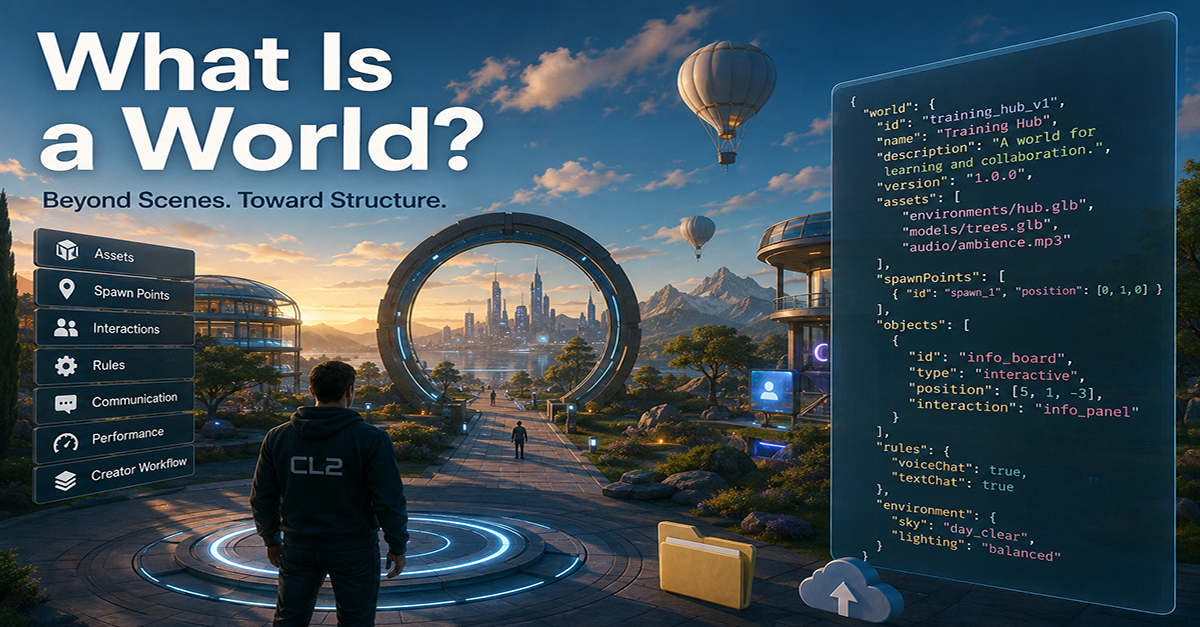
At first glance, the question "What is a world?" seems almost unnecessary. In a virtual world platform, a world is the place users enter. It is the environment they see, the space they move through, and the setting in which they meet others. But for a platform developer, the question is more complicated. A world is not only what appears on the screen. It is also a structure of assets, settings, objects, rules, conventions, and dependencies. If that structure is unclear, the world may look impressive but become difficult to maintain.
This is one of the reasons why Cybalounge 2 treats a world as more than a 3D scene. A scene is a rendering concept. It contains objects, lights, cameras, and materials. A world is a product concept. It includes the scene, but also the intention behind it, the configuration that defines it, the assets it needs, the spawn points where users enter, the rules that govern interaction, the communication context, the performance budget, and the creator workflow. A world should be something that can be understood, copied, tested, published, updated, and archived.
Without this discipline, virtual worlds can become chaotic very quickly. A few models are added here, a script is attached there, lights are changed, textures are replaced, an interaction depends on a hidden object name, a door works only if another file is present, and nobody remembers why an invisible helper object exists. This may work during development, but it becomes fragile over time. The creator may understand it today, but will they understand it six months later? Can another person maintain it? Can it be moved to another server? Can it be optimized without breaking something?
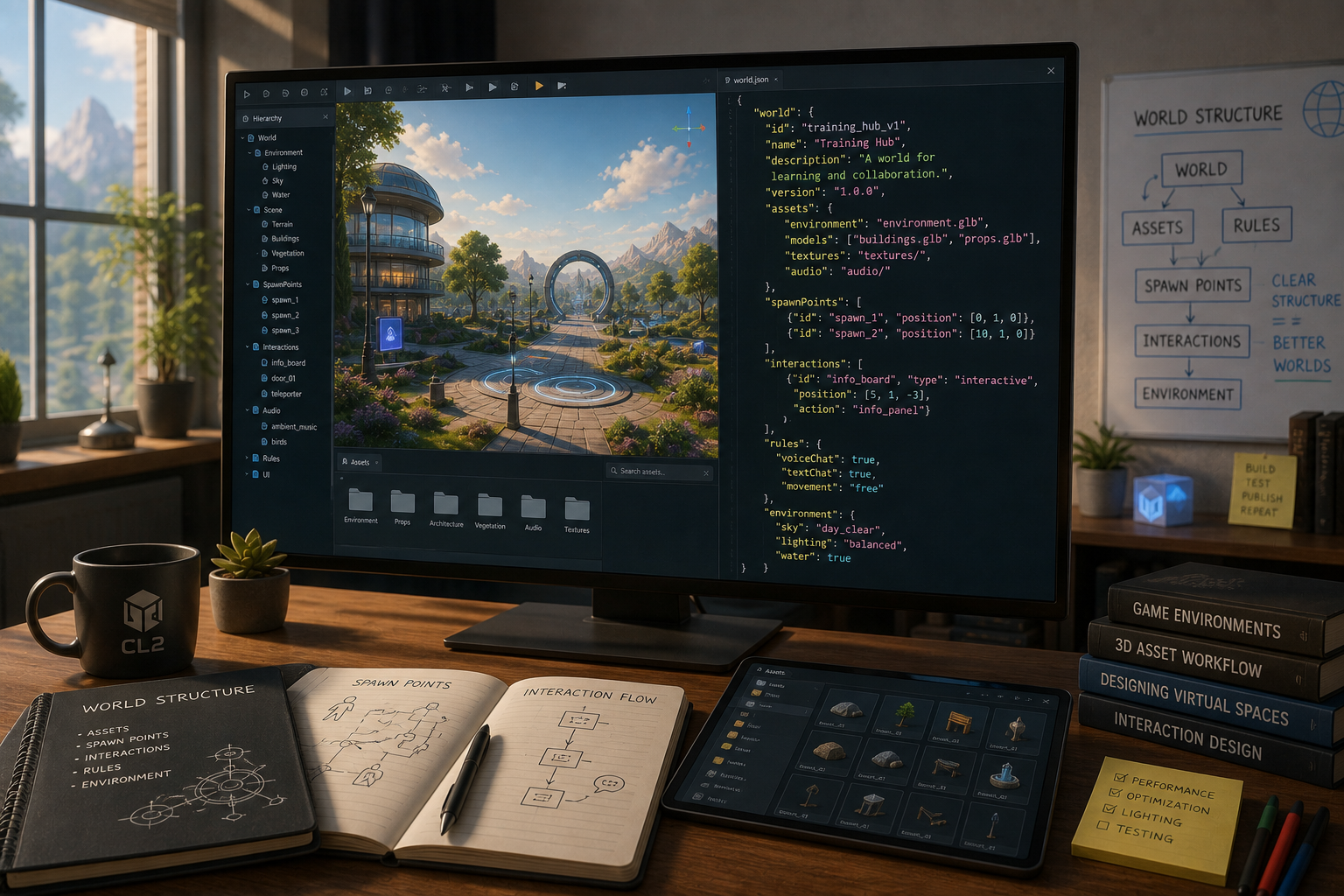
The answer depends on whether the world has a clear structure. In Cybalounge 2, the idea is to describe the world through a structured file, preferably in a form that remains readable and portable. JSON is a practical starting point. It can define which assets are loaded, where objects are placed, how the environment behaves, which sky or water settings are used, which avatars are available, where users start, and how certain objects participate in interaction. JSON is not a complete creator tool by itself, but it creates a transparent foundation.
This foundation supports the server-light philosophy. If a world can be represented as a collection of static assets and a structured description, it does not need to be hidden inside a complex backend. It can be hosted like web content. It can be versioned like a project. It can be backed up as files. It can be tested locally before publication. This is important for low operating costs, but also for creator confidence. Creators should know what belongs to their world.
A structured world description also creates a bridge between technical and non-technical workflows. At first, such a file may be edited by developers or technically confident creators. Later, tools can generate it. A visual builder, a low-code interaction editor, or an AI-assisted world creation system could all produce or modify the same underlying structure. This is one reason why descriptions matter. They separate the platform runtime from the authoring experience. The same world structure can be created by different tools over time.
Of course, this approach requires conventions. If every world description is written differently, structure becomes illusion. The platform needs consistent naming, clear asset references, predictable units, object roles, behavior definitions, and validation. Creators need guidance. They need to know how large models should be built and optimized, how objects are positioned, how interactions are named, how audio is referenced, how lighting is configured, and how world versions are managed. Structure does not eliminate documentation. It makes documentation possible.
This is also where the creator experience begins. A creator-friendly platform is not only one with a nice editor. It is one where the underlying logic is understandable. If something goes wrong, the creator should have a chance to find it. If a model is missing, the reference should be clear. If performance is poor, the world structure should help identify heavy assets. If an object is interactive, its role should not be hidden in an obscure script. The more visible the world structure is, the more independent creators can become.
Thinking of worlds as product artifacts also changes how updates are handled. A world may have versions. It may have a development copy and a published copy. It may need a backup before a major change. It may need to be restored after an error. It may need to be moved from a local machine to a test server and then to production. These are not glamorous topics, but they are essential for real use. A beautiful world that cannot be maintained is not a sustainable product.
This perspective also helps with use cases. A training world is not just a 3D room; it is a learning environment with goals, paths, communication needs, and possibly assessment points. A digital twin is not just a model; it is a representation of something real, with scale, orientation, and context. A senior community space is not just a scene; it is a place where users need comfort, clarity, and easy navigation. A world structure should be flexible enough to support different intentions without becoming unmanageable.
There is a trade-off. A structured approach can feel slower at the beginning. It requires discipline before the platform has all the tools that will later make creation easier. It may be tempting to place objects manually, patch behavior directly, or solve problems with quick custom code. Sometimes that is necessary during exploration. But if the goal is a platform, not a one-off demo, structure must win. The world must survive beyond the moment of creation.
For CL2, a world should therefore be more than a scene. It should be a manageable product artifact. It should be visible enough for creators to understand, structured enough for tools to support, portable enough to move, and disciplined enough to maintain. This may sound less exciting than talking about visual effects or avatars, but it is one of the foundations that makes practical virtual worlds possible.
Now available on Amazon!
Discover the Metaverse Beyond the Hype
The Metaverse is no longer a futuristic fantasy, it is rapidly becoming a new layer of human society. But what is it really? Where did it come from? And what might it become over the next decade?
The Metaverse – Past, Present, and Future takes readers on a fascinating journey from the earliest virtual worlds and science-fiction visions to today’s emerging immersive platforms, digital economies, and online communities. Along the way, it explores the technologies powering the Metaverse, the opportunities it creates for education, work, and culture, and the challenges of governance, privacy, inclusion, and sustainability.
Looking beyond today's headlines, the book offers a balanced and inspiring vision of how immersive technologies could transform cities, learning, creativity, and daily life by 2035.
Whether you are a business leader, educator, technologist, policymaker, or simply curious about the future, this book provides the context, insight, and perspective needed to understand one of the most important technological and societal shifts of our time.
The future of the Metaverse is not something we await, it is something we create.
About the Author
Dieter E. Heyne is a Metaverse pioneer and lifelong technologist, born in Munich in 1966. With a master’s degree in applied computer science and over three decades of experience as an IT entrepreneur, software architect, and consultant, he has always been at the frontier of digital innovation. His journey into virtual worlds began in 2007 with Second Life and sparked a deep, ongoing exploration of the Metaverse as a space for education, collaboration, and immersive experiences.
Since 2012, Dieter has been developing and refining a web-based virtual world platform, driven by a vision to make the Metaverse accessible, meaningful, and transformative. As a frequent speaker and thought leader at Metaverse events, he shares his insights on how virtual environments can reshape human interaction, learning, and culture. He is the founder and CEO of Metaverse School GmbH, a company dedicated to promoting Metaverse literacy and helping people and organizations understand the power and promise of these emerging digital realms.
Besides talking and writing non-fiction about the Metaverse and Virtual Worlds, this vast knowledge now went into the creation of The Metaverse Enforcers, an ongoing series of high-tech science fiction novels, showcasing the potential development and dangers of the Metaverse in 2053.
About Metaverse School GmbH
Metaverse School GmbH was founded in 2017 by Dieter E. Heyne, who continues to lead the company as its CEO. The company emerged from decades of consulting experience in software architecture, project management, quality assurance, information security, and data protection. Building on this strong technological foundation, Metaverse School GmbH is dedicated to promoting the responsible and purposeful use of immersive 3D environments, for education, collaboration, training, and simulation.
A core mission of the company is to raise awareness of the Metaverse’s potential across business, education, and society. In support of this goal, Dieter Heyne regularly speaks at national and international conferences as well as Metaverse-focused events. Through real-world examples and deep expertise, he demonstrates how immersive technologies can already create meaningful value today.
Disclaimer
Some portions of this content were created or refined with the assistance of artificial intelligence (AI) using tools such as OpenAI’s ChatGPT. The ideas, structure, and editorial direction remain the responsibility of the author. While every effort has been made to ensure factual accuracy and original expression, readers are encouraged to approach speculative or future-facing statements with critical thought.
This series does not represent the views of any specific company or platform and is intended to inspire open discussion around the evolving concept of the Metaverse.
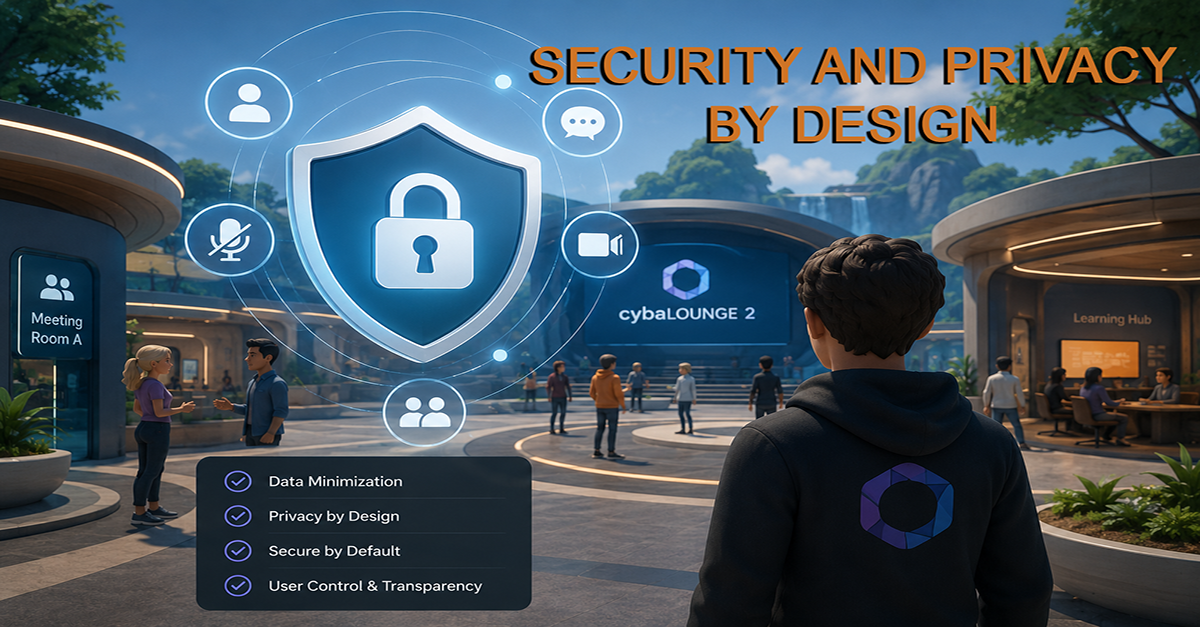
A multi-user virtual world is not an ordinary website. It can be a place where people move, speak, meet, learn, collaborate, teach, present, and sometimes behave more naturally than they would in a form-based application. That makes virtual worlds powerful, but it also makes them sensitive. A platform that handles avatars, communication, presence, voice, video, movement, and interaction can easily collect more information than users expect. This is why security and privacy must be part of the architecture from the beginning.
For Cybalounge 2, the starting principle is data minimization. The platform should not collect data simply because it can. It should not store persistent information simply because storage is technically easy. It should not create detailed behavioral histories without a clear purpose. In a virtual world, even movement patterns can become meaningful. Who meets whom? How long do they stay? Which rooms do they enter? Who speaks? Who listens? Which objects do they interact with? These signals may be useful in some contexts, but they are also sensitive.
This is especially important because the intended use cases include education, business, training, communities, and potentially public or semi-public environments. In a classroom, learners may be minors or may participate in sensitive training. In a business environment, meetings may include confidential information. In a senior community, users may be vulnerable or less confident with technology. In public-sector scenarios, trust and compliance are essential. For all of these audiences, privacy is not a luxury feature. It is a condition for adoption.
A server-light architecture helps, but it does not solve everything automatically. If worlds are delivered as static content and if the backend does not store unnecessary state, the platform reduces some risks by design. Fewer databases mean fewer stored records. Fewer APIs mean fewer attack surfaces. Less persistent data means fewer obligations around retention, deletion, access control, and breach impact. But communication, identity, moderation, uploads, and administration still require careful decisions. Privacy by design is not the same as having no backend. It is the practice of asking what each backend element really needs to know.
One of the most useful privacy questions is: can the platform function without storing this? If the answer is yes, the next question is whether storing it creates enough value to justify the risk. This question can be uncomfortable because stored data often feels useful. It can support convenience, analytics, personalization, reporting, session recovery, administration, or future features. But every stored data element also creates responsibility. It must be protected, explained, limited, and eventually deleted. Data that is never collected cannot be leaked.
This way of thinking affects feature design. User accounts, for example, may be useful, but not every early use case requires a full account system. Some worlds may work with temporary display names or controlled access links. Communication may be integrated in a way that avoids storing conversations unless a clear reason exists. Analytics may begin with coarse technical metrics rather than detailed behavioral tracking. World content may be separated from user data. Each decision should be made deliberately, not by default.
Security follows a similar logic. A platform with fewer moving parts can be easier to secure. Static assets can be served through well-understood web infrastructure. Upload workflows can be isolated and controlled. Administrative functions can be limited to specific areas. Communication services can be selected and configured carefully rather than reinvented without need. None of this eliminates security work, but it helps prevent the architecture from becoming unnecessarily exposed.
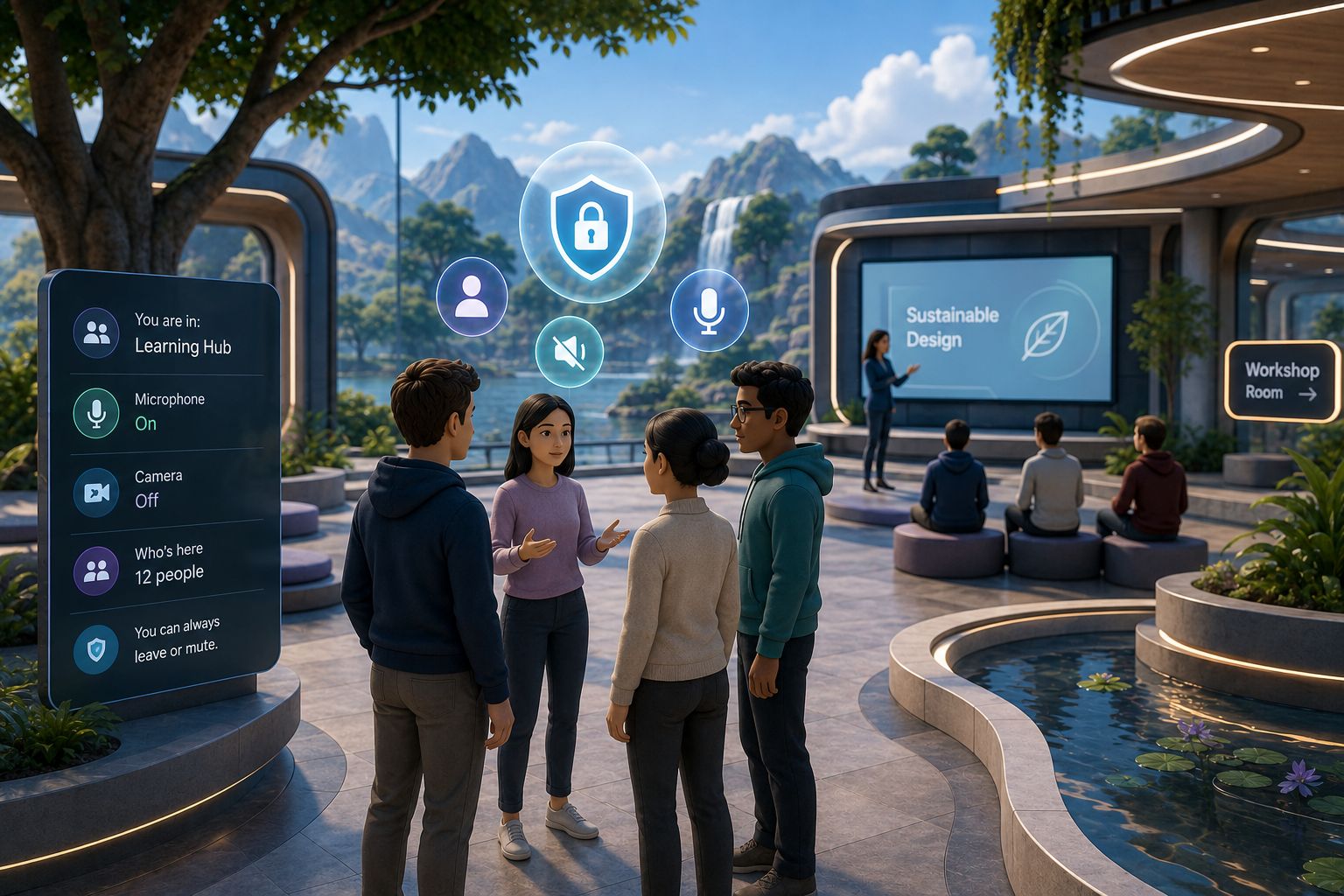
There is also a user experience dimension. Trust is not only created through policies. It is created through clarity. Users should understand when they are visible, when their microphone is active, when video is enabled, who is in the room, what name is shown, and how to leave or mute themselves. In immersive environments, ambiguity can feel uncomfortable. A simple microphone indicator or a clear room boundary can be as important as a technical security control because it helps users feel in control.
For creators and organizations, privacy-friendly design also matters operationally. If a school or company wants to use a virtual world, someone will ask what data is stored, where it is stored, who can access it, how long it is retained, and what happens when a user leaves. The easier those questions are to answer, the easier adoption becomes. A complicated platform with unclear data flows creates hesitation. A simpler architecture with minimized data collection creates confidence.
The trade-off is that some convenience features may take longer to design. Persistent profiles, personal inventories, advanced analytics, recorded sessions, learning progress tracking, or detailed collaboration histories can all be useful. But they should not be added casually. Each of them changes the privacy model. Each of them may require permissions, retention rules, access controls, user communication, and possibly legal review. A platform that aims for trust should not treat those consequences as afterthoughts.
Moderation and safety are also connected to privacy. A multi-user platform needs tools to manage behavior, but those tools must be designed carefully. Reporting, blocking, muting, room control, and identity boundaries can protect users. At the same time, monitoring and logging can become intrusive if overdone. The challenge is to create enough control for safe spaces without building a surveillance environment. That balance must be part of the platform philosophy, not a late patch.
In the end, security and privacy by design mean that trust is built into the shape of the system. It means that the architecture avoids unnecessary data where possible, protects necessary data where unavoidable, and communicates clearly with users and organizations. For Cybalounge 2, this is not only a compliance issue. It is a product issue. A virtual world platform can only become useful in education, business, and community settings if people trust it. Privacy is not a later compliance layer. It is an architectural decision from day one.
This is also why privacy needs to be understandable. A theoretically secure system can still fail if users and organizations cannot explain it. The platform should make its privacy posture visible through simple settings, clear defaults, and documentation that speaks in practical terms. Trust grows when people can see that restraint is not accidental, but designed into the system.
Now available on Amazon!
Discover the Metaverse Beyond the Hype
The Metaverse is no longer a futuristic fantasy, it is rapidly becoming a new layer of human society. But what is it really? Where did it come from? And what might it become over the next decade?
The Metaverse – Past, Present, and Future takes readers on a fascinating journey from the earliest virtual worlds and science-fiction visions to today’s emerging immersive platforms, digital economies, and online communities. Along the way, it explores the technologies powering the Metaverse, the opportunities it creates for education, work, and culture, and the challenges of governance, privacy, inclusion, and sustainability.
Looking beyond today's headlines, the book offers a balanced and inspiring vision of how immersive technologies could transform cities, learning, creativity, and daily life by 2035.
Whether you are a business leader, educator, technologist, policymaker, or simply curious about the future, this book provides the context, insight, and perspective needed to understand one of the most important technological and societal shifts of our time.
The future of the Metaverse is not something we await, it is something we create.
About the Author
Dieter E. Heyne is a Metaverse pioneer and lifelong technologist, born in Munich in 1966. With a master’s degree in applied computer science and over three decades of experience as an IT entrepreneur, software architect, and consultant, he has always been at the frontier of digital innovation. His journey into virtual worlds began in 2007 with Second Life and sparked a deep, ongoing exploration of the Metaverse as a space for education, collaboration, and immersive experiences.
Since 2012, Dieter has been developing and refining a web-based virtual world platform, driven by a vision to make the Metaverse accessible, meaningful, and transformative. As a frequent speaker and thought leader at Metaverse events, he shares his insights on how virtual environments can reshape human interaction, learning, and culture. He is the founder and CEO of Metaverse School GmbH, a company dedicated to promoting Metaverse literacy and helping people and organizations understand the power and promise of these emerging digital realms.
Besides talking and writing non-fiction about the Metaverse and Virtual Worlds, this vast knowledge now went into the creation of The Metaverse Enforcers, an ongoing series of high-tech science fiction novels, showcasing the potential development and dangers of the Metaverse in 2053.
About Metaverse School GmbH
Metaverse School GmbH was founded in 2017 by Dieter E. Heyne, who continues to lead the company as its CEO. The company emerged from decades of consulting experience in software architecture, project management, quality assurance, information security, and data protection. Building on this strong technological foundation, Metaverse School GmbH is dedicated to promoting the responsible and purposeful use of immersive 3D environments, for education, collaboration, training, and simulation.
A core mission of the company is to raise awareness of the Metaverse’s potential across business, education, and society. In support of this goal, Dieter Heyne regularly speaks at national and international conferences as well as Metaverse-focused events. Through real-world examples and deep expertise, he demonstrates how immersive technologies can already create meaningful value today.
Disclaimer
Some portions of this content were created or refined with the assistance of artificial intelligence (AI) using tools such as OpenAI’s ChatGPT. The ideas, structure, and editorial direction remain the responsibility of the author. While every effort has been made to ensure factual accuracy and original expression, readers are encouraged to approach speculative or future-facing statements with critical thought.
This series does not represent the views of any specific company or platform and is intended to inspire open discussion around the evolving concept of the Metaverse.
When thinking about a virtual world platform, it is tempting to imagine a large backend from the beginning. There could be databases for worlds, objects, users, permissions, inventories, sessions, logs, analytics, and configuration. There could be server-side editors, asset management systems, synchronization services, content pipelines, administration dashboards, and many specialized APIs. For some platforms, especially large-scale commercial systems, this may be necessary. But for Cybalounge 2, I want to start with a different question: what does the server really need to do?
This question is important because backend complexity has long-term consequences. A backend is not just something you build once. It must be hosted, secured, monitored, updated, backed up, migrated, documented, and supported. Every new server-side component becomes part of the operational responsibility of the platform. If the goal is to create a lightweight virtual world system with low operating costs, the backend cannot become heavier than the worlds it is meant to serve.
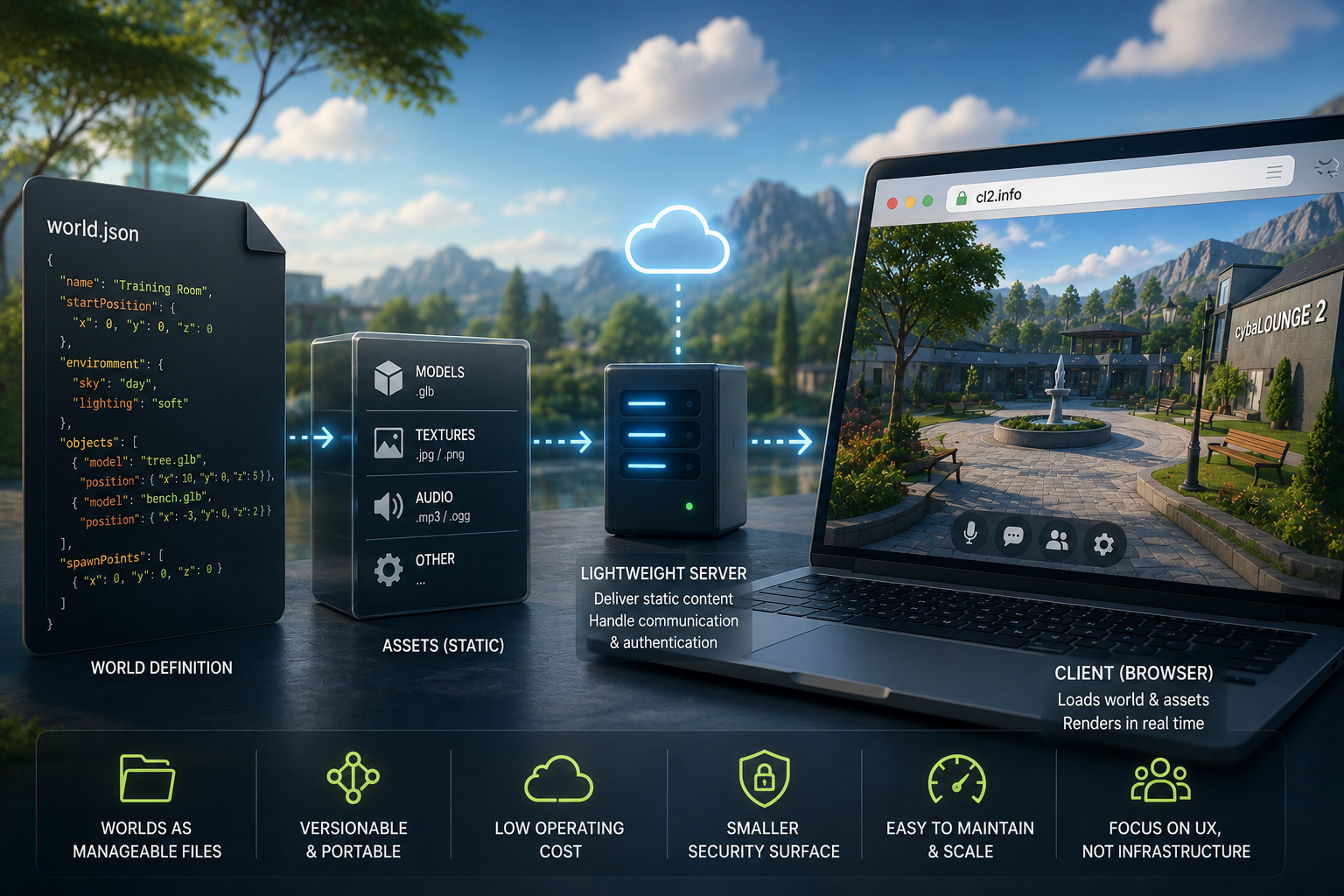
This is why I call the approach server light. It does not mean there is no server. It means the server should be used deliberately. Static content should remain static where possible. World descriptions can be stored as JSON files. Models, textures, audio files, and other assets can be deployed like web content. The client can load the world definition and assemble the scene in the browser. The server does not need to know every object in every world at runtime if the world itself is not changing dynamically during the session.
This approach is strongly connected to the idea that a world should be a manageable artifact. If a world exists as a structured set of files, it can be copied, versioned, tested locally, uploaded, backed up, and moved. That is a familiar model for many web projects. It also gives creators and operators a clearer understanding of what they are managing. A world is not hidden inside a database with many interconnected records. It is visible as a package of content.
The JSON world description is central to this philosophy. It can describe which models are loaded, where they are placed, how the environment is configured, what lights exist, where users start, and which objects have specific roles or interactions. This does not mean JSON is magical or perfect. It requires conventions, validation, documentation, and eventually tools. But it offers transparency. A structured text file can be read, inspected, compared, generated, or edited with many different tools. It keeps the world portable.
The operating cost target makes this approach more than a technical preference. If the platform should be operable at around one US dollar or less per user per month, the architecture must avoid unnecessary server load. Static content is efficient to host. It can be cached. It can be served by ordinary web infrastructure. It does not require a database query for every object. It does not require constant server-side world state for worlds that do not need it. This can make the difference between a platform that is affordable for small organizations and one that requires serious infrastructure budgets.
There is also a security benefit. A smaller backend surface is easier to protect. If fewer things are stored server-side, fewer things can leak. If fewer APIs exist, fewer APIs can be attacked. If worlds can be delivered as static content, the platform can reduce the amount of dynamic server logic exposed to the internet. This does not remove the need for security. Multi-user communication, authentication, uploads, moderation, and administration all require careful design. But it creates a simpler foundation.
The server-light approach also helps maintenance. A complex backend often becomes the part of a platform that consumes the most attention. Databases need schema changes. APIs need versioning. Services need monitoring. Logs need retention policies. Scaling needs planning. Dependencies need updates. By keeping the backend smaller in the early architecture, the project can focus more energy on the user experience, the creator workflow, world rendering, communication, onboarding, accessibility, and performance.
Of course, this approach has trade-offs. A static world model is not the same as a fully live, collaborative, database-driven editing environment. If multiple creators want to edit the same world at the same time in the browser, a server-light architecture will need additional systems. If objects must persistently change for every user, the backend must store state. If complex permissions and workflows are required, the server must take on more responsibility. The point is not to deny those needs. The point is to avoid building them before they are truly required.
In many practical use cases, a static or mostly static world may already be valuable. A training room, a product showroom, a school environment, a museum exhibition, a senior meeting space, an onboarding area, or a digital twin visualization does not always need every object to be edited live by every user. It may need a stable environment, communication, guided interaction, and good performance. For those cases, a server-light model can be not only sufficient, but preferable.
This also changes how creators think about publishing. Instead of entering a complex backend administration system, they can prepare a world, test it locally, optimize it, and upload it as content. That model supports discipline. It encourages creators to treat worlds as products with versions, assets, and release steps. It also makes it easier to separate the platform from the content. The platform provides the runtime; the world package provides the environment.
In the long term, Cybalounge 2 may need more backend features. User management, world libraries, moderation tools, analytics, collaborative building, permissions, and persistent interaction may all become important. But the foundation should not assume that every world needs maximum backend complexity. Less backend can be more when it lowers cost, reduces risk, increases portability, and makes the platform easier to operate. A virtual world platform does not need a heavy backend to create meaningful immersive spaces. It needs the right backend for the right level of use.
This also leaves room for growth. A server-light foundation does not prevent future services; it simply forces them to justify their existence. When a feature truly needs persistent state, accounts, analytics, or dynamic collaboration, the backend can grow in that direction. But it grows from a clear baseline instead of from an early assumption that everything must be centralized.
Now available on Amazon!
Discover the Metaverse Beyond the Hype
The Metaverse is no longer a futuristic fantasy, it is rapidly becoming a new layer of human society. But what is it really? Where did it come from? And what might it become over the next decade?
The Metaverse – Past, Present, and Future takes readers on a fascinating journey from the earliest virtual worlds and science-fiction visions to today’s emerging immersive platforms, digital economies, and online communities. Along the way, it explores the technologies powering the Metaverse, the opportunities it creates for education, work, and culture, and the challenges of governance, privacy, inclusion, and sustainability.
Looking beyond today's headlines, the book offers a balanced and inspiring vision of how immersive technologies could transform cities, learning, creativity, and daily life by 2035.
Whether you are a business leader, educator, technologist, policymaker, or simply curious about the future, this book provides the context, insight, and perspective needed to understand one of the most important technological and societal shifts of our time.
The future of the Metaverse is not something we await, it is something we create.
About the Author
Dieter E. Heyne is a Metaverse pioneer and lifelong technologist, born in Munich in 1966. With a master’s degree in applied computer science and over three decades of experience as an IT entrepreneur, software architect, and consultant, he has always been at the frontier of digital innovation. His journey into virtual worlds began in 2007 with Second Life and sparked a deep, ongoing exploration of the Metaverse as a space for education, collaboration, and immersive experiences.
Since 2012, Dieter has been developing and refining a web-based virtual world platform, driven by a vision to make the Metaverse accessible, meaningful, and transformative. As a frequent speaker and thought leader at Metaverse events, he shares his insights on how virtual environments can reshape human interaction, learning, and culture. He is the founder and CEO of Metaverse School GmbH, a company dedicated to promoting Metaverse literacy and helping people and organizations understand the power and promise of these emerging digital realms.
Besides talking and writing non-fiction about the Metaverse and Virtual Worlds, this vast knowledge now went into the creation of The Metaverse Enforcers, an ongoing series of high-tech science fiction novels, showcasing the potential development and dangers of the Metaverse in 2053.
About Metaverse School GmbH
Metaverse School GmbH was founded in 2017 by Dieter E. Heyne, who continues to lead the company as its CEO. The company emerged from decades of consulting experience in software architecture, project management, quality assurance, information security, and data protection. Building on this strong technological foundation, Metaverse School GmbH is dedicated to promoting the responsible and purposeful use of immersive 3D environments, for education, collaboration, training, and simulation.
A core mission of the company is to raise awareness of the Metaverse’s potential across business, education, and society. In support of this goal, Dieter Heyne regularly speaks at national and international conferences as well as Metaverse-focused events. Through real-world examples and deep expertise, he demonstrates how immersive technologies can already create meaningful value today.
Disclaimer
Some portions of this content were created or refined with the assistance of artificial intelligence (AI) using tools such as OpenAI’s ChatGPT. The ideas, structure, and editorial direction remain the responsibility of the author. While every effort has been made to ensure factual accuracy and original expression, readers are encouraged to approach speculative or future-facing statements with critical thought.
This series does not represent the views of any specific company or platform and is intended to inspire open discussion around the evolving concept of the Metaverse.
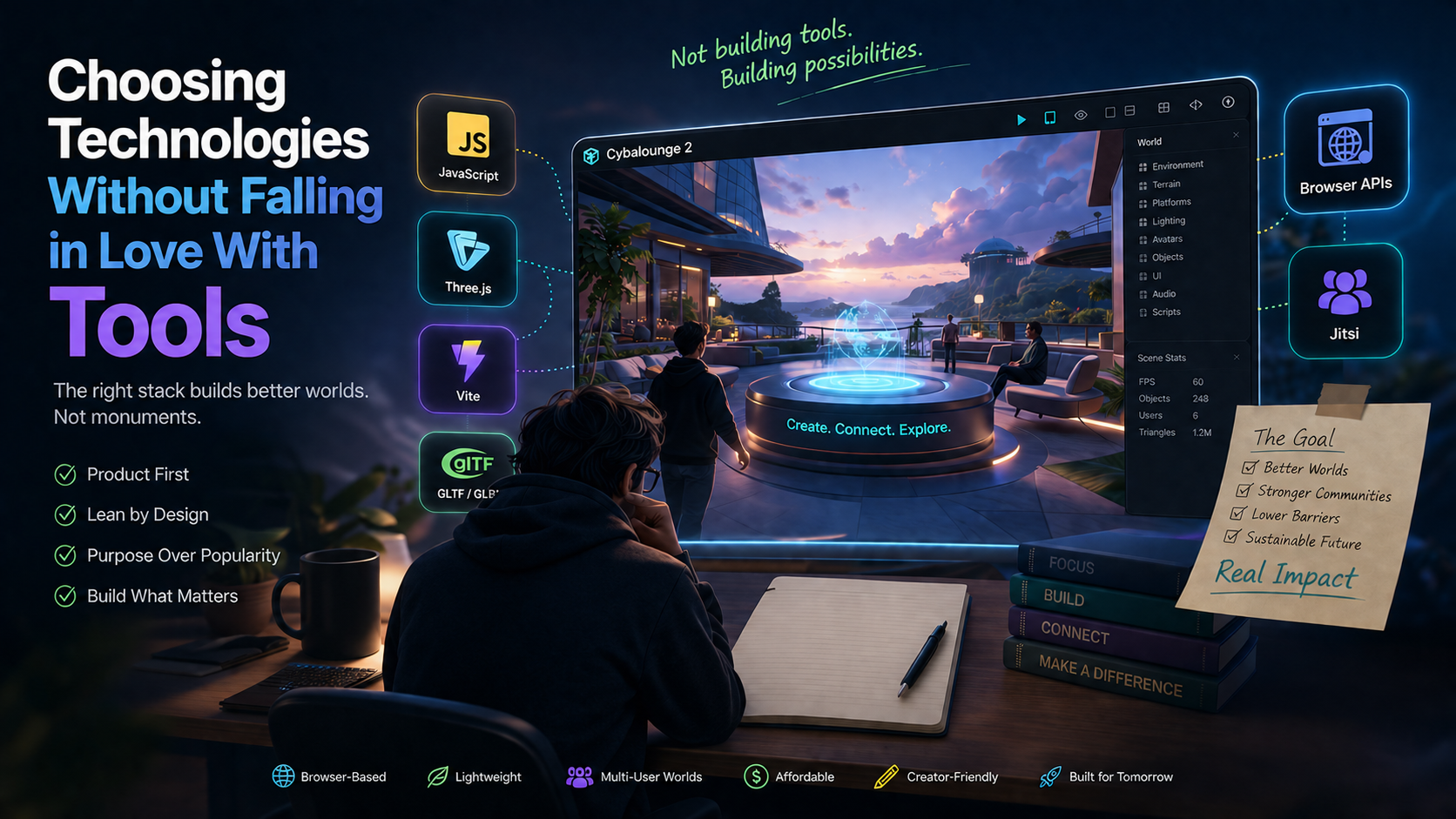
Technology choices are rarely neutral. Developers have preferences, experiences, habits, and sometimes strong opinions about tools. A framework can feel elegant. A language can feel natural. A library can become familiar. An engine can seem powerful enough to solve almost everything. But when building a platform like Cybalounge 2, I try to remind myself that tools are not the product. They are the means by which the product becomes possible.
This sounds obvious, but it is easy to forget. Many projects start with a technology decision and then adapt the product vision to fit that decision. A large framework is chosen, and suddenly the architecture reflects the framework more than the user need. A game engine is selected, and suddenly the product inherits assumptions from games even if the target is education or business collaboration. A backend platform is adopted, and suddenly simple content becomes a database problem. A tool can be useful, but it can also pull the project in a direction that was never intended.
For CL2, the product goal comes first. The platform should be browser-based, lightweight, practical, and affordable to operate. It should support multi-user virtual worlds, but it should not become unnecessarily heavy. It should remain understandable for a small development team. It should allow creators to build and deploy worlds without needing a complex infrastructure. It should be possible to host simple worlds as static content where appropriate. These goals shape the technology choices.
Vite supports the development workflow. It keeps the project modern, fast, and relatively simple. For a platform that should remain understandable, the build system should not become a mystery. Fast feedback is valuable because virtual world development involves a lot of visual iteration. You change something, enter the world, look at movement, lighting, scale, interaction, and performance, then adjust again. A heavy development setup would slow that process down.
JavaScript is a natural foundation because it is the language of the browser. It is not perfect, and like every language it has trade-offs, but it allows the platform to stay close to the runtime environment. With modern JavaScript, the development experience is much better than it used to be. The language is mature enough for structured application development, and the ecosystem offers a wide range of tools without forcing the platform into one monolithic model.
Three.js is an important part of the stack because it provides a practical layer over WebGL. It makes real-time 3D in the browser accessible without hiding every detail. This balance is important. A platform like Cybalounge 2 needs enough control to manage worlds, cameras, avatars, lighting, effects, and performance decisions. At the same time, it should not require writing raw WebGL for every scene. Three.js offers a middle path: powerful enough for serious work, approachable enough to support iterative development.
One important technology decision was not only what to use, but also what not to use yet. WebGPU is a very promising direction for browser-based 3D applications. It offers a more modern path toward graphics and compute performance than the older WebGL generation, and it will almost certainly become increasingly important for demanding browser-native visual experiences. From a purely technical perspective, it would be tempting to jump on it immediately. But Cybalounge 2 is not meant to be a technology showcase. Its first goal is to become a practical, accessible, low-maintenance virtual world platform. For that goal, the safest early choice is to rely on the more established browser graphics path and on a rendering stack that already works reliably across many real-world devices and user environments. The question was not: “What is the newest technology we can use?” The better question was: “What gives users and creators the best chance of entering, testing, building, and operating worlds today?”
That does not mean WebGPU is ignored. Quite the opposite: the architecture will be prepared for a later transition, or at least for a gradual adoption where WebGPU becomes an optional or future rendering path. This is one reason why it is important to keep the platform logic, world descriptions, asset structure, interaction logic, and rendering implementation as cleanly separated as possible. If the world is described in a structured way, and if the renderer is treated as one layer of the platform rather than the whole platform itself, then replacing or extending the rendering backend becomes more realistic. The long-term goal is not to lock CL2 into one graphics technology forever. The goal is to make careful decisions in the right order: build a stable creator and user experience first, keep the internal architecture modular enough to evolve, and move toward newer rendering technologies when they clearly improve the product without making access, maintenance, or compatibility worse.
GLTF and GLB matter because a virtual world platform needs a practical model pipeline. The platform should not invent its own 3D asset format if a strong standard already exists. GLTF/GLB provides a useful bridge between modeling tools and browser rendering. It supports scenes, meshes, materials, animations, and a workflow that creators can understand with the right guidance. Of course, importing models is not the same as using them efficiently. Optimization and conventions remain necessary. But the format gives the platform a sensible foundation.
Browser APIs are another part of the stack, even if they are less glamorous than a rendering library. Audio, video, microphone access, fullscreen behavior, pointer lock, gamepad input, storage, downloads, capture, and other features all shape the platform experience. Staying close to browser APIs means accepting their constraints, security models, and differences. But it also avoids unnecessary abstraction. If the browser already provides a capability, the platform can often use it directly or with a thin layer, instead of adding heavy dependencies.
For communication, Jitsi is an example of a pragmatic tool choice. Voice, video, text, screensharing, and data communication are complex topics. Building everything from scratch would be possible in theory, but it would pull attention away from the platform's core purpose. Integrating a mature communication solution where appropriate allows CL2 to focus on the virtual world experience while still supporting social presence. This is not about avoiding technical work. It is about choosing where custom development creates real value and where integration is more sensible.
The trade-off of this stack is that it stays relatively close to the browser. That creates transparency, but it also means more responsibility. A larger engine or all-in-one platform might provide more built-in systems. It might offer editors, physics, networking, asset pipelines, and deployment patterns out of the box. But it might also bring assumptions, overhead, licensing issues, hosting complexity, or operational costs that do not fit the goal. By staying lean, Cybalounge 2 keeps more control, but it must also make more design decisions explicitly.
This is why technology choices should be evaluated through product questions. Does this tool help lower the entry barrier? Does it support low operating costs? Does it make the platform easier to maintain? Does it fit the creator workflow? Does it reduce unnecessary complexity, or does it add another layer that must be understood forever? Does it make the user experience better, or only the architecture more fashionable? These questions are more useful than asking whether a tool is popular.
The technology stack of CL2 may evolve. Tools change, requirements grow, and new possibilities appear. But the guiding principle should remain stable: tools should serve the platform vision. The goal is not to build a monument to any specific library or framework. The goal is to create practical virtual worlds that people can enter, use, host, and maintain. When the product vision is clear, technology becomes a set of deliberate choices rather than a collection of shiny objects.
Avoiding tool obsession also makes the platform easier to explain. A creator, school, company, or partner does not need to understand every internal detail before they can understand the value proposition. They need to know that the platform is browser-based, lightweight, portable, and maintainable. A lean stack supports that message because it keeps the relationship between architecture and product value visible. Complexity may still exist, but it should not become the first thing people encounter.
Now available on Amazon!
Discover the Metaverse Beyond the Hype
The Metaverse is no longer a futuristic fantasy, it is rapidly becoming a new layer of human society. But what is it really? Where did it come from? And what might it become over the next decade?
The Metaverse – Past, Present, and Future takes readers on a fascinating journey from the earliest virtual worlds and science-fiction visions to today’s emerging immersive platforms, digital economies, and online communities. Along the way, it explores the technologies powering the Metaverse, the opportunities it creates for education, work, and culture, and the challenges of governance, privacy, inclusion, and sustainability.
Looking beyond today's headlines, the book offers a balanced and inspiring vision of how immersive technologies could transform cities, learning, creativity, and daily life by 2035.
Whether you are a business leader, educator, technologist, policymaker, or simply curious about the future, this book provides the context, insight, and perspective needed to understand one of the most important technological and societal shifts of our time.
The future of the Metaverse is not something we await, it is something we create.
About the Author
Dieter E. Heyne is a Metaverse pioneer and lifelong technologist, born in Munich in 1966. With a master’s degree in applied computer science and over three decades of experience as an IT entrepreneur, software architect, and consultant, he has always been at the frontier of digital innovation. His journey into virtual worlds began in 2007 with Second Life and sparked a deep, ongoing exploration of the Metaverse as a space for education, collaboration, and immersive experiences.
Since 2012, Dieter has been developing and refining a web-based virtual world platform, driven by a vision to make the Metaverse accessible, meaningful, and transformative. As a frequent speaker and thought leader at Metaverse events, he shares his insights on how virtual environments can reshape human interaction, learning, and culture. He is the founder and CEO of Metaverse School GmbH, a company dedicated to promoting Metaverse literacy and helping people and organizations understand the power and promise of these emerging digital realms.
Besides talking and writing non-fiction about the Metaverse and Virtual Worlds, this vast knowledge now went into the creation of The Metaverse Enforcers, an ongoing series of high-tech science fiction novels, showcasing the potential development and dangers of the Metaverse in 2053.
About Metaverse School GmbH
Metaverse School GmbH was founded in 2017 by Dieter E. Heyne, who continues to lead the company as its CEO. The company emerged from decades of consulting experience in software architecture, project management, quality assurance, information security, and data protection. Building on this strong technological foundation, Metaverse School GmbH is dedicated to promoting the responsible and purposeful use of immersive 3D environments, for education, collaboration, training, and simulation.
A core mission of the company is to raise awareness of the Metaverse’s potential across business, education, and society. In support of this goal, Dieter Heyne regularly speaks at national and international conferences as well as Metaverse-focused events. Through real-world examples and deep expertise, he demonstrates how immersive technologies can already create meaningful value today.
Disclaimer
Some portions of this content were created or refined with the assistance of artificial intelligence (AI) using tools such as OpenAI’s ChatGPT. The ideas, structure, and editorial direction remain the responsibility of the author. While every effort has been made to ensure factual accuracy and original expression, readers are encouraged to approach speculative or future-facing statements with critical thought.
This series does not represent the views of any specific company or platform and is intended to inspire open discussion around the evolving concept of the Metaverse.
 METAVERSE BLOG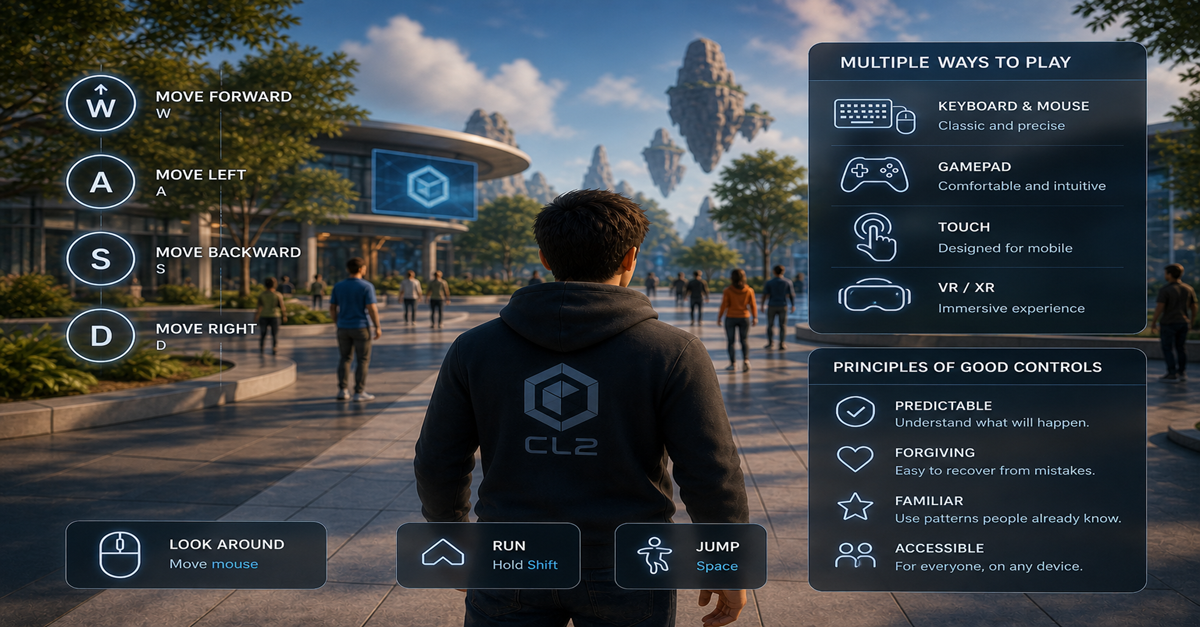
 For creators and organizations, privacy-friendly design also matters operationally. If a school or company wants to use a virtual world, someone will ask what data is stored, where it is stored, who can access it, how long it is retained, and what happens when a user leaves. The easier those questions are to answer, the easier adoption becomes. A complicated platform with unclear data flows creates hesitation. A simpler architecture with minimized data collection creates confidence.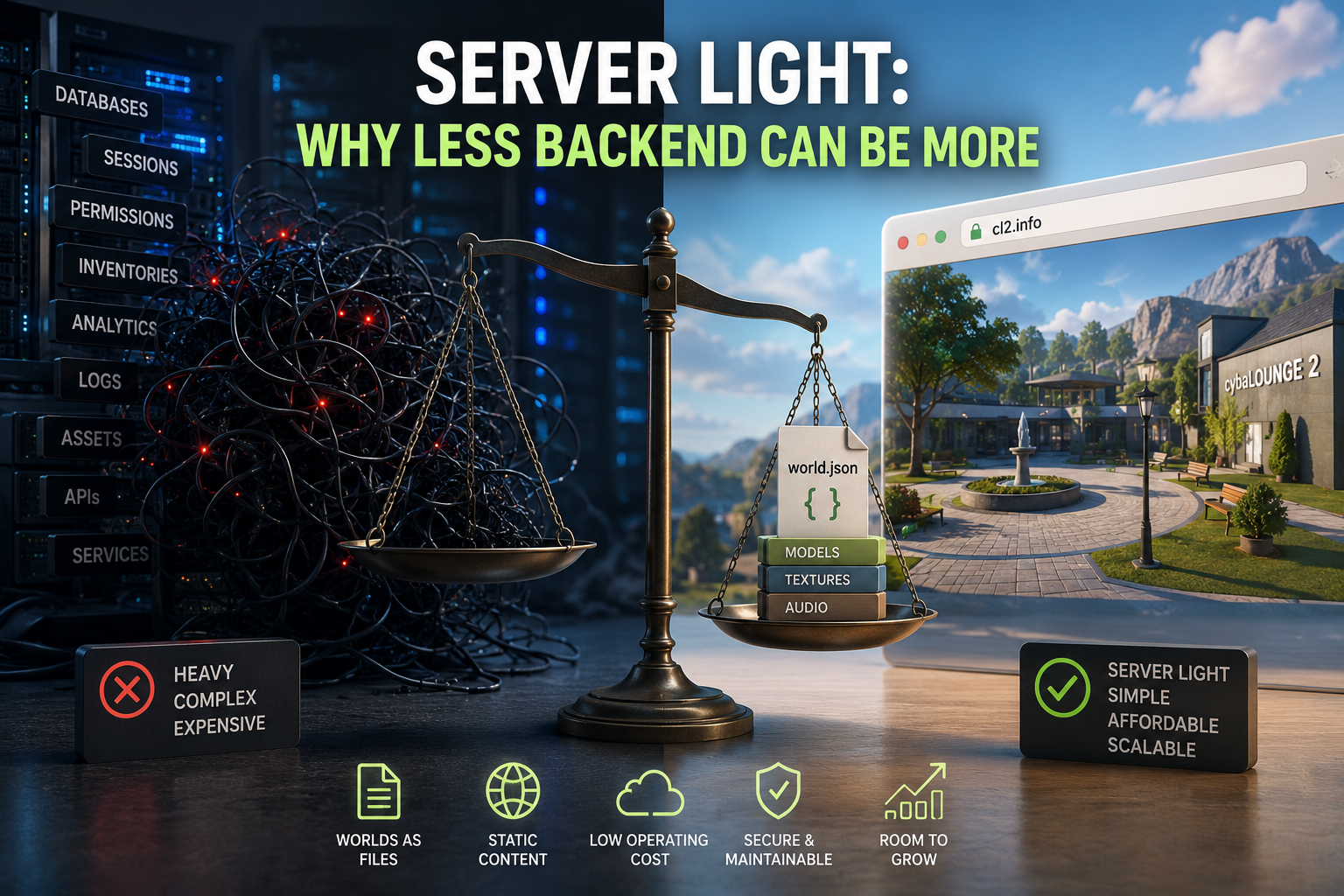
 Technology choices are rarely neutral. Developers have preferences, experiences, habits, and sometimes strong opinions about tools. A framework can feel elegant. A language can feel natural. A library can become familiar. An engine can seem powerful enough to solve almost everything. But when building a platform like Cybalounge 2, I try to remind myself that tools are not the product. They are the means by which the product becomes possible.