 METAVERSE BLOG
Chapter 17: Synchronizing People, Not Just Data
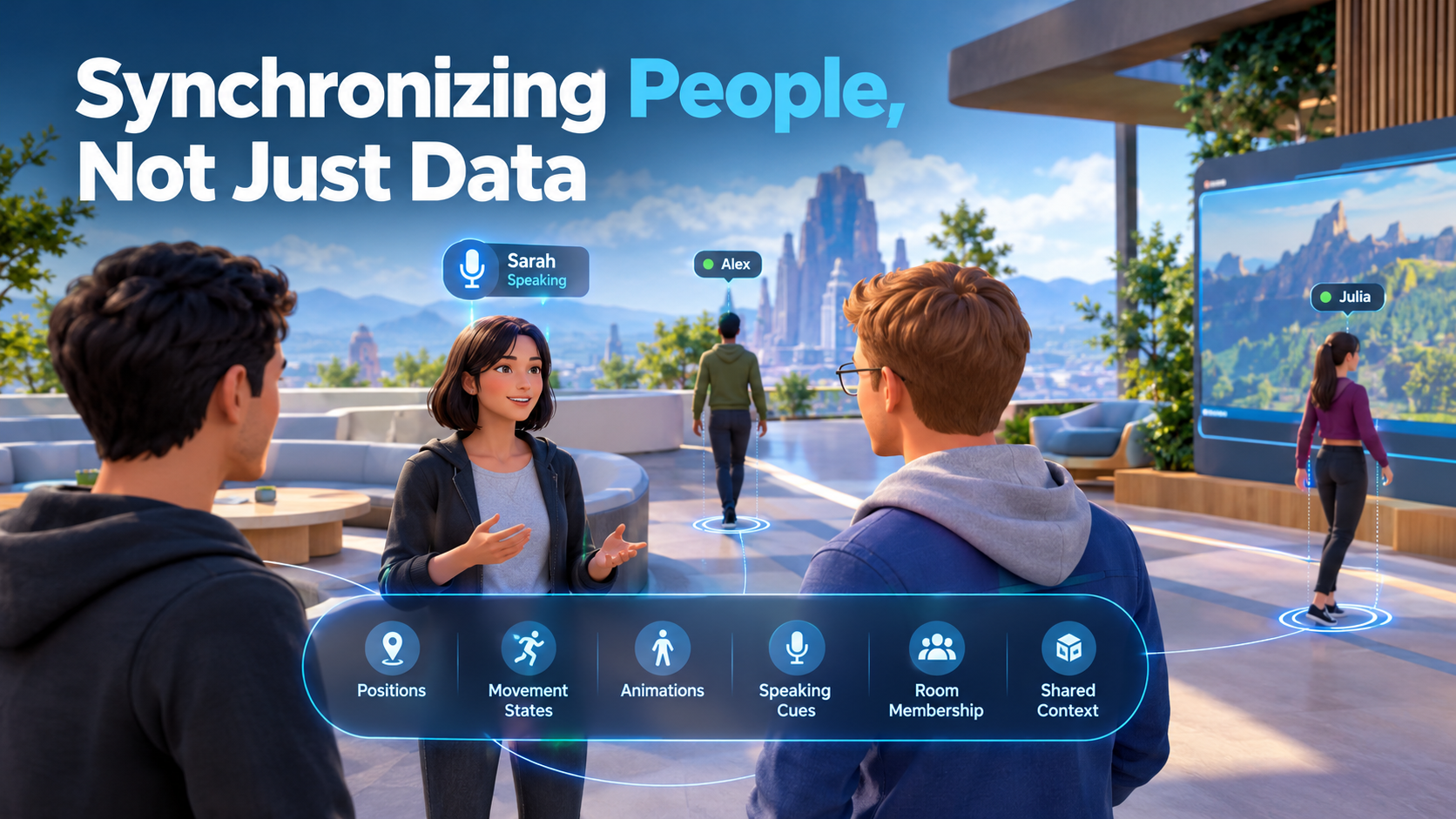
Synchronization is often discussed as if it were only a networking problem. How often should positions be sent? Which protocol should be used? How should latency be handled? What happens when a client disconnects? These questions are important, but they do not capture what users actually experience. Users do not feel data synchronization. They feel whether other people appear to be present.
In a multi-user virtual world, the purpose of synchronization is shared presence. When I see another avatar walking across a room, I should believe that another person is doing something meaningful. When someone turns toward a screen, joins a group, approaches an object or walks away, that movement communicates intention. If the movement is too jerky, delayed or inconsistent, the illusion weakens. If the avatar appears in the wrong place, moves through walls or freezes without explanation, trust declines. The technical system becomes visible at the exact moment it should disappear.
For Cybalounge 2, this leads to a practical design principle: synchronize what matters. Not everything in a world requires real-time precision. A user does not need to know the exact millisecond-by-millisecond position of every remote avatar. They need enough continuity to understand where people are, where they are going and what they are doing. Positions matter. Movement states matter. Basic animation states matter. Speaking cues matter. Room membership matters. Shared context matters. But the platform does not need to replicate every internal detail of every client.
This distinction is important for a lightweight platform. Every synchronized value has a cost. It consumes bandwidth, processing time, implementation effort and debugging attention. In small groups, excessive synchronization may not seem problematic. But as worlds grow, and as operating cost targets become important, unnecessary updates become waste. A platform designed for low operating and maintenance costs must be selective. It must ask not only whether something can be synchronized, but whether synchronizing it improves the experience enough to justify the cost.
There is also a difference between technical accuracy and perceived smoothness. A remote avatar updated only a few times per second can still feel acceptable if interpolation and movement states are handled carefully. On the other hand, a stream of frequent raw updates can still feel bad if movement is jittery or inconsistent. Users judge the result, not the implementation detail. Smooth enough presence is often more valuable than theoretically perfect data.
The phrase “smooth enough” is not an excuse for poor quality. It is a product decision. In a competitive action game, exact synchronization may be critical. In a collaboration space, training room, learning environment or virtual meeting, the requirements are different. People need to orient themselves socially. They need to avoid confusion. They need to know who is nearby, who is speaking and what is happening. The system should feel stable and responsive, but it does not need to simulate every physical detail with extreme precision.
This changes how we think about latency. Some latency is inevitable, especially in browser-based applications and real-world networks. The question is how much latency users notice and how the platform hides or explains it. If a remote avatar continues moving naturally between updates, the user may not notice minor delays. If the avatar jumps, snaps or teleports repeatedly, the delay becomes obvious. Synchronization is therefore partly a visual design problem. The presentation of remote movement matters as much as the delivery of data.
Speaking cues add another layer. In a social world, knowing who is speaking can be more important than knowing exact movement. If several avatars stand together, a clear speaking indicator helps users follow the conversation. Without it, people can feel lost, especially when audio comes through a communication system that is not spatially obvious. Synchronizing speaking state does not simply add a technical detail. It improves social readability.
Room scope is also important. A virtual world platform should not synchronize all users with all other users if they are not meaningfully sharing the same context. Rooms, sessions, areas or communication groups can define who needs updates from whom. This supports scalability and privacy. It also matches user expectations. If I am in a private training session, I should not necessarily be visible to users in another session. Synchronization is not only about performance; it is also about boundaries.
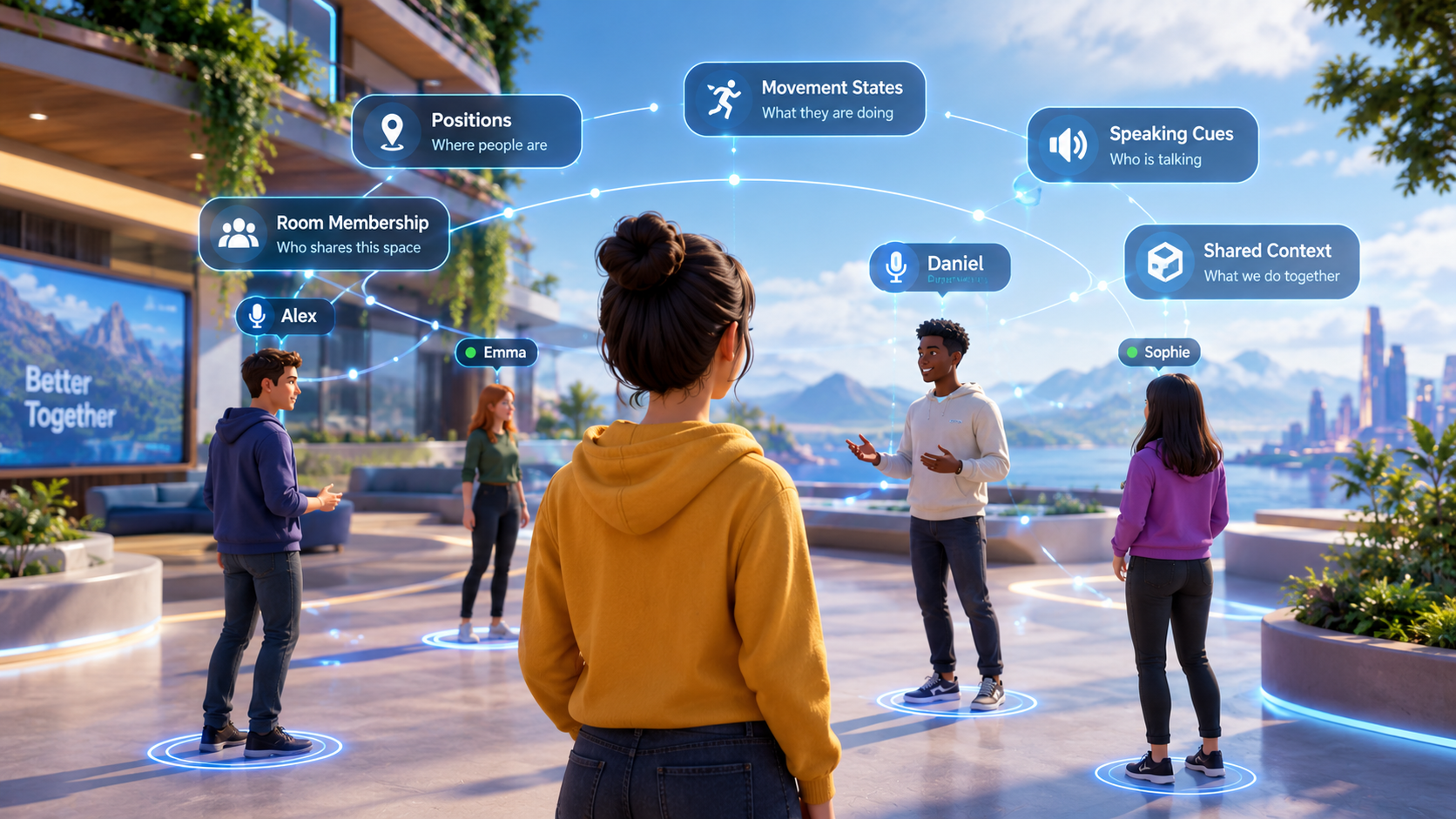
The trade-off is that selective synchronization requires clear decisions. If too little is synchronized, the world feels empty or inconsistent. If too much is synchronized, the system becomes heavier than necessary. Some states are tempting to share because they are technically available. But availability is not the same as value. The platform needs a synchronization model that reflects the experience it wants to create.
Creators and hosts may also need to understand these boundaries. For example, an interactive object used in a training scenario may require shared state. A decorative environmental effect may not. A presentation screen may need synchronization if all participants must see the same content. A local visual effect may not. A low-code interaction system, when introduced, will need rules about which actions are local and which are shared. Otherwise, creators may accidentally build worlds that behave inconsistently across clients.
This is why synchronization must eventually become part of the platform vocabulary, not only the networking layer. A world description could define which objects are shared, which states are persistent, which interactions are local, and which events should be broadcast. The more explicit this model becomes, the easier it is to keep the system understandable and maintainable.
For users, the ideal result is invisible. They do not want to think about update rates or channels. They want to feel that other people are there. They want to walk toward a group, notice who is speaking, follow a guide, watch someone point out an object, or join a training exercise without questioning whether the world is coherent.
In the end, synchronization in a virtual world is not about copying data for its own sake. It is about maintaining a shared reality at the level required for the experience. The platform should synchronize enough to make people feel together, but not so much that the system becomes unnecessarily heavy.
The goal is not perfect data replication. The goal is believable shared presence.
Now available on Amazon!
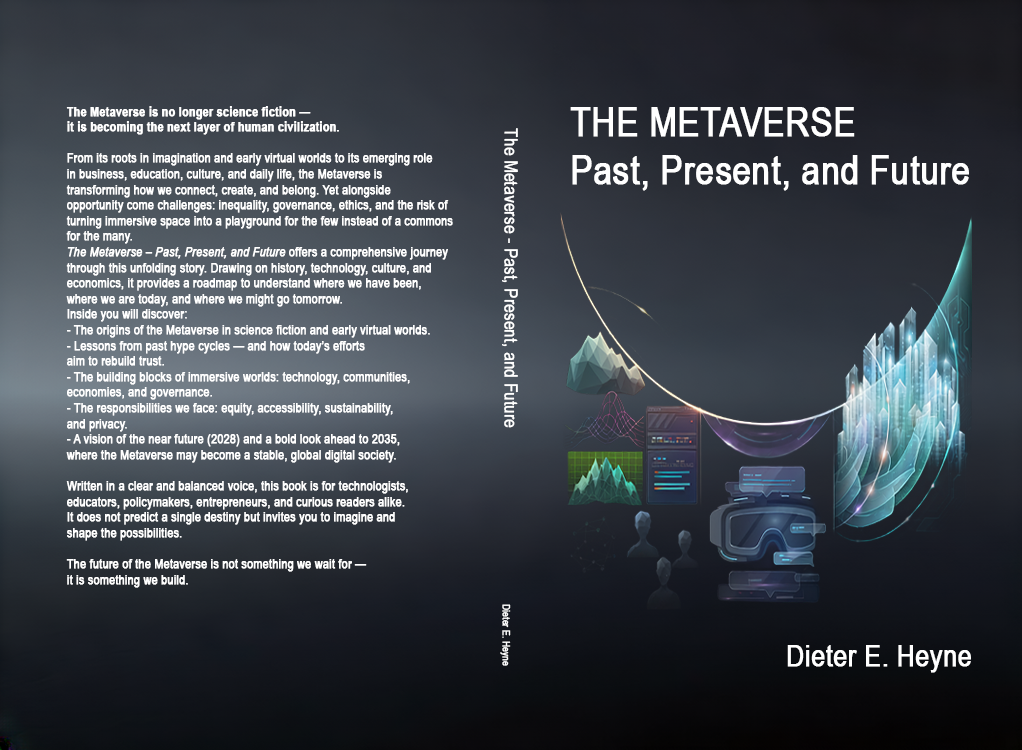
Discover the Metaverse Beyond the Hype
The Metaverse is no longer a futuristic fantasy, it is rapidly becoming a new layer of human society. But what is it really? Where did it come from? And what might it become over the next decade?
The Metaverse – Past, Present, and Future takes readers on a fascinating journey from the earliest virtual worlds and science-fiction visions to today’s emerging immersive platforms, digital economies, and online communities. Along the way, it explores the technologies powering the Metaverse, the opportunities it creates for education, work, and culture, and the challenges of governance, privacy, inclusion, and sustainability.
Looking beyond today's headlines, the book offers a balanced and inspiring vision of how immersive technologies could transform cities, learning, creativity, and daily life by 2035.
Whether you are a business leader, educator, technologist, policymaker, or simply curious about the future, this book provides the context, insight, and perspective needed to understand one of the most important technological and societal shifts of our time.
The future of the Metaverse is not something we await, it is something we create.
About the Author
Dieter E. Heyne is a Metaverse pioneer and lifelong technologist, born in Munich in 1966. With a master’s degree in applied computer science and over three decades of experience as an IT entrepreneur, software architect, and consultant, he has always been at the frontier of digital innovation. His journey into virtual worlds began in 2007 with Second Life and sparked a deep, ongoing exploration of the Metaverse as a space for education, collaboration, and immersive experiences.
Since 2012, Dieter has been developing and refining a web-based virtual world platform, driven by a vision to make the Metaverse accessible, meaningful, and transformative. As a frequent speaker and thought leader at Metaverse events, he shares his insights on how virtual environments can reshape human interaction, learning, and culture. He is the founder and CEO of Metaverse School GmbH, a company dedicated to promoting Metaverse literacy and helping people and organizations understand the power and promise of these emerging digital realms.
Besides talking and writing non-fiction about the Metaverse and Virtual Worlds, this vast knowledge now went into the creation of The Metaverse Enforcers, an ongoing series of high-tech science fiction novels, showcasing the potential development and dangers of the Metaverse in 2053.
About Metaverse School GmbH
Metaverse School GmbH was founded in 2017 by Dieter E. Heyne, who continues to lead the company as its CEO. The company emerged from decades of consulting experience in software architecture, project management, quality assurance, information security, and data protection. Building on this strong technological foundation, Metaverse School GmbH is dedicated to promoting the responsible and purposeful use of immersive 3D environments, for education, collaboration, training, and simulation.
A core mission of the company is to raise awareness of the Metaverse’s potential across business, education, and society. In support of this goal, Dieter Heyne regularly speaks at national and international conferences as well as Metaverse-focused events. Through real-world examples and deep expertise, he demonstrates how immersive technologies can already create meaningful value today.
Disclaimer
Some portions of this content were created or refined with the assistance of artificial intelligence (AI) using tools such as OpenAI’s ChatGPT. The ideas, structure, and editorial direction remain the responsibility of the author. While every effort has been made to ensure factual accuracy and original expression, readers are encouraged to approach speculative or future-facing statements with critical thought.
This series does not represent the views of any specific company or platform and is intended to inspire open discussion around the evolving concept of the Metaverse.
#Metaverse #VirtualWorlds #FutureOfTech #DigitalCommunity #CybaLounge #CL2