 METAVERSE BLOG
Chapter 16: Communication Is Part of the World

A virtual world without communication can become a beautiful empty room. The lighting may be convincing, the avatar may move smoothly, the models may be optimized and the interface may be clean, but if people cannot naturally communicate, the social promise remains incomplete. For many practical use cases, the value of a virtual world is not only that users can see a space. It is that they can share a space.
This is especially true for the kinds of environments Cybalounge 2 is meant to support: learning spaces, training rooms, collaboration areas, onboarding worlds, senior communities, events, support sessions and guided experiences. In these scenarios, communication is not an optional layer placed on top of the world. It is part of the world. People enter not only to look around, but to meet, ask, explain, listen, discuss, demonstrate and feel present with others.
The obvious communication channels are voice, video and text. Each has a role. Voice provides immediacy and emotional nuance. Text provides clarity, accessibility, persistence and usefulness when audio is not possible. Video can support trust and familiar meeting behavior, especially in professional contexts. But in a virtual world, communication is more than channels. It also includes presence cues: where someone is standing, whether they are moving, whether they are looking toward a group, whether they are speaking, whether they appear available, and whether their avatar gives enough social context to understand the situation.
A traditional video conference places faces and voices at the center. A virtual world changes the center. The environment becomes shared context. Users can gather around an object, walk through a model, stand in front of a display, visit a training station, or meet in a spatial arrangement that has meaning. Communication should support this spatial context rather than replace it. If the world becomes only a decorative background for video boxes, much of the value is lost.
This creates an important design question: how should communication be integrated so that it feels natural but not overwhelming? A voice system should be easy to understand. Users need to know whether they are muted or live. They need confidence that they can turn audio off. In educational and business environments, they may need host control, room rules, and predictable behavior. A text chat should be available, but it should not permanently cover the world. Video may be useful, but not every situation needs it, and not every user wants it. Communication must respect both social presence and personal boundaries.
For CL2, the integration of Jitsi is a practical step in this direction. It provides proven communication capabilities without requiring the platform to reinvent voice, video, text and related infrastructure from scratch. This is consistent with the broader philosophy of keeping the platform lightweight and focused. When a reliable component exists, the question is not whether we can build everything ourselves. The question is whether integration can support the product vision without adding unnecessary complexity.
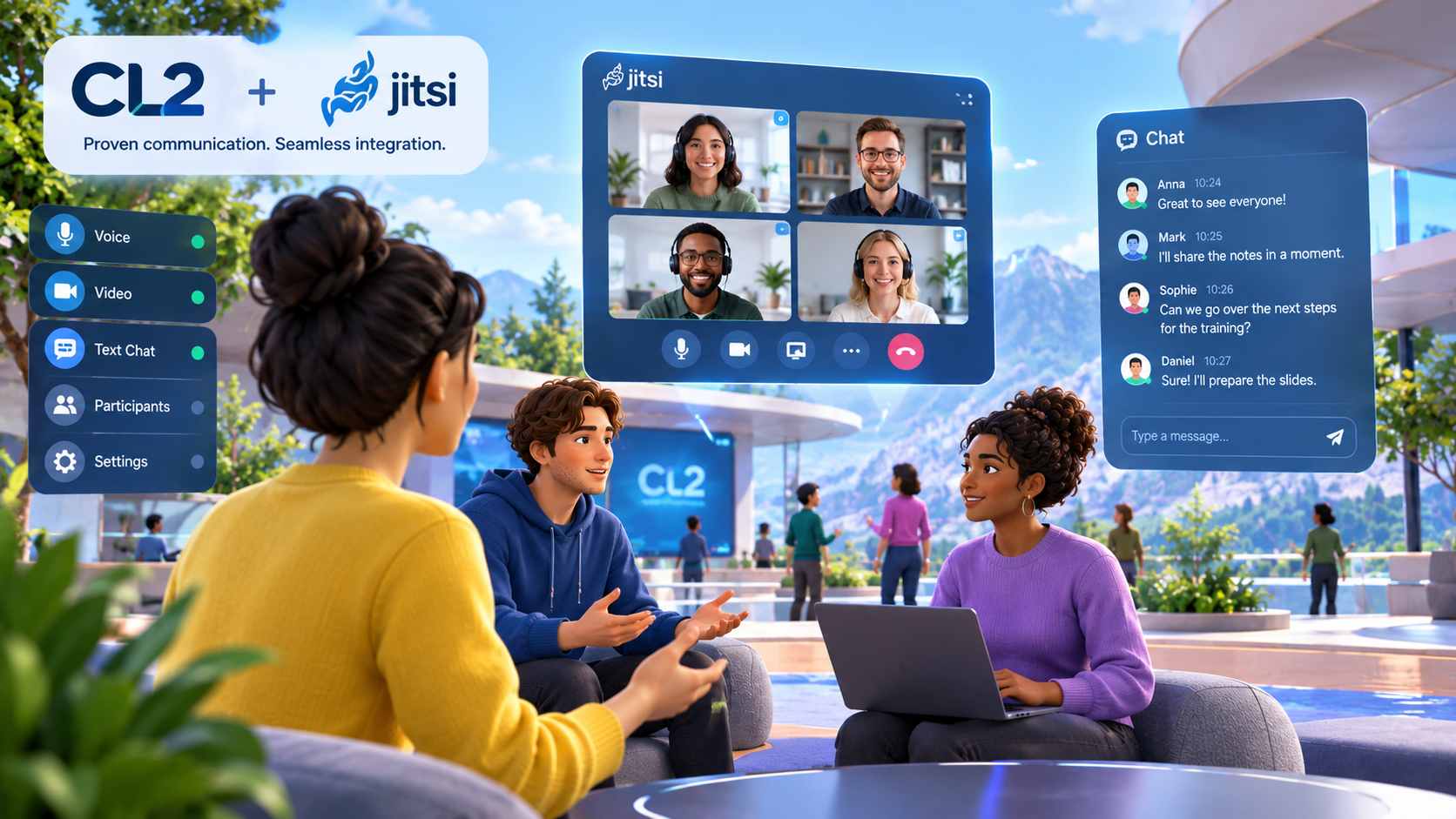
But integrating communication is never only a technical task. Browser permissions, microphone access, camera access, network conditions and user expectations must be handled carefully. A user who enters a world should not be surprised to discover that they are broadcasting audio. A teacher should be able to understand who can speak. A business user should feel that the communication layer is professional and predictable. A senior user should not be forced to interpret cryptic icons. Communication controls are part of trust.
Bandwidth is another trade-off. Rich communication can be expensive in terms of network and processing resources. Video, in particular, can compete with 3D rendering for device performance and user attention. A platform that aims for low operating and maintenance costs must be careful about what is always enabled, what is optional, and what can be configured per use case. A training environment may need voice and screen sharing. A quiet exhibition may need text and occasional guided voice. A senior community may need simple audio controls and gentle visual cues. One communication setup will not fit all worlds.
Moderation also becomes unavoidable. The moment people can talk, write, appear and interact, the platform needs mechanisms to handle misuse, disruption and discomfort. This does not mean turning every world into a heavily controlled space, but it does mean providing room control, muting, role-based permissions and clear expectations. Communication makes a world social; safety makes that social world sustainable.
Another important aspect is social anxiety. Some users like voice. Others prefer text. Some are comfortable on video. Others are not. Some users enter from quiet offices, others from shared homes or classrooms. A good platform should not assume one communication style as the default for every situation. It should allow creators and hosts to design the communication culture of a world: lecture, workshop, meeting, event, guided tour, casual community space or silent exploration.
Communication also changes how users experience distance. In physical spaces, proximity influences conversation. In virtual spaces, the platform must decide how distance matters. Is everyone in the room part of the same conversation? Is there spatial audio? Are there private groups? Can people move away from a discussion? Even if the first implementation is simple, these questions matter because they define the social architecture of the world. Communication is not only a feature; it is a model of how people relate to each other inside the environment.
For creators, communication should be seen as part of world design. A training room should have spaces where people gather and spaces where they can focus. An event space should guide participants toward stages, booths or discussion areas. A classroom should support teacher presence, group work and questions. The world layout and communication tools should work together. If a world looks like a lecture hall but behaves like an unstructured chat room, users will feel the mismatch.
The key principle is that communication should make the world feel alive without making the technology feel intrusive. Users should not have to think constantly about the communication system. They should simply know that they can speak, listen, write, mute, ask and participate. When communication works well, it becomes part of presence. When it works poorly, it becomes the whole problem.
A virtual world becomes social when people can naturally communicate inside it. Not because every channel is always active, but because the platform supports the right kind of connection for the right kind of space.
Now available on Amazon!
Discover the Metaverse Beyond the Hype
The Metaverse is no longer a futuristic fantasy, it is rapidly becoming a new layer of human society. But what is it really? Where did it come from? And what might it become over the next decade?
The Metaverse – Past, Present, and Future takes readers on a fascinating journey from the earliest virtual worlds and science-fiction visions to today’s emerging immersive platforms, digital economies, and online communities. Along the way, it explores the technologies powering the Metaverse, the opportunities it creates for education, work, and culture, and the challenges of governance, privacy, inclusion, and sustainability.
Looking beyond today's headlines, the book offers a balanced and inspiring vision of how immersive technologies could transform cities, learning, creativity, and daily life by 2035.
Whether you are a business leader, educator, technologist, policymaker, or simply curious about the future, this book provides the context, insight, and perspective needed to understand one of the most important technological and societal shifts of our time.
The future of the Metaverse is not something we await, it is something we create.
About the Author
Dieter E. Heyne is a Metaverse pioneer and lifelong technologist, born in Munich in 1966. With a master’s degree in applied computer science and over three decades of experience as an IT entrepreneur, software architect, and consultant, he has always been at the frontier of digital innovation. His journey into virtual worlds began in 2007 with Second Life and sparked a deep, ongoing exploration of the Metaverse as a space for education, collaboration, and immersive experiences.
Since 2012, Dieter has been developing and refining a web-based virtual world platform, driven by a vision to make the Metaverse accessible, meaningful, and transformative. As a frequent speaker and thought leader at Metaverse events, he shares his insights on how virtual environments can reshape human interaction, learning, and culture. He is the founder and CEO of Metaverse School GmbH, a company dedicated to promoting Metaverse literacy and helping people and organizations understand the power and promise of these emerging digital realms.
Besides talking and writing non-fiction about the Metaverse and Virtual Worlds, this vast knowledge now went into the creation of The Metaverse Enforcers, an ongoing series of high-tech science fiction novels, showcasing the potential development and dangers of the Metaverse in 2053.
About Metaverse School GmbH
Metaverse School GmbH was founded in 2017 by Dieter E. Heyne, who continues to lead the company as its CEO. The company emerged from decades of consulting experience in software architecture, project management, quality assurance, information security, and data protection. Building on this strong technological foundation, Metaverse School GmbH is dedicated to promoting the responsible and purposeful use of immersive 3D environments, for education, collaboration, training, and simulation.
A core mission of the company is to raise awareness of the Metaverse’s potential across business, education, and society. In support of this goal, Dieter Heyne regularly speaks at national and international conferences as well as Metaverse-focused events. Through real-world examples and deep expertise, he demonstrates how immersive technologies can already create meaningful value today.
Disclaimer
Some portions of this content were created or refined with the assistance of artificial intelligence (AI) using tools such as OpenAI’s ChatGPT. The ideas, structure, and editorial direction remain the responsibility of the author. While every effort has been made to ensure factual accuracy and original expression, readers are encouraged to approach speculative or future-facing statements with critical thought.
This series does not represent the views of any specific company or platform and is intended to inspire open discussion around the evolving concept of the Metaverse.
#Metaverse #VirtualWorlds #FutureOfTech #DigitalCommunity #CybaLounge #CL2