 METAVERSE BLOG
 Chapter 13: Interface on Demand
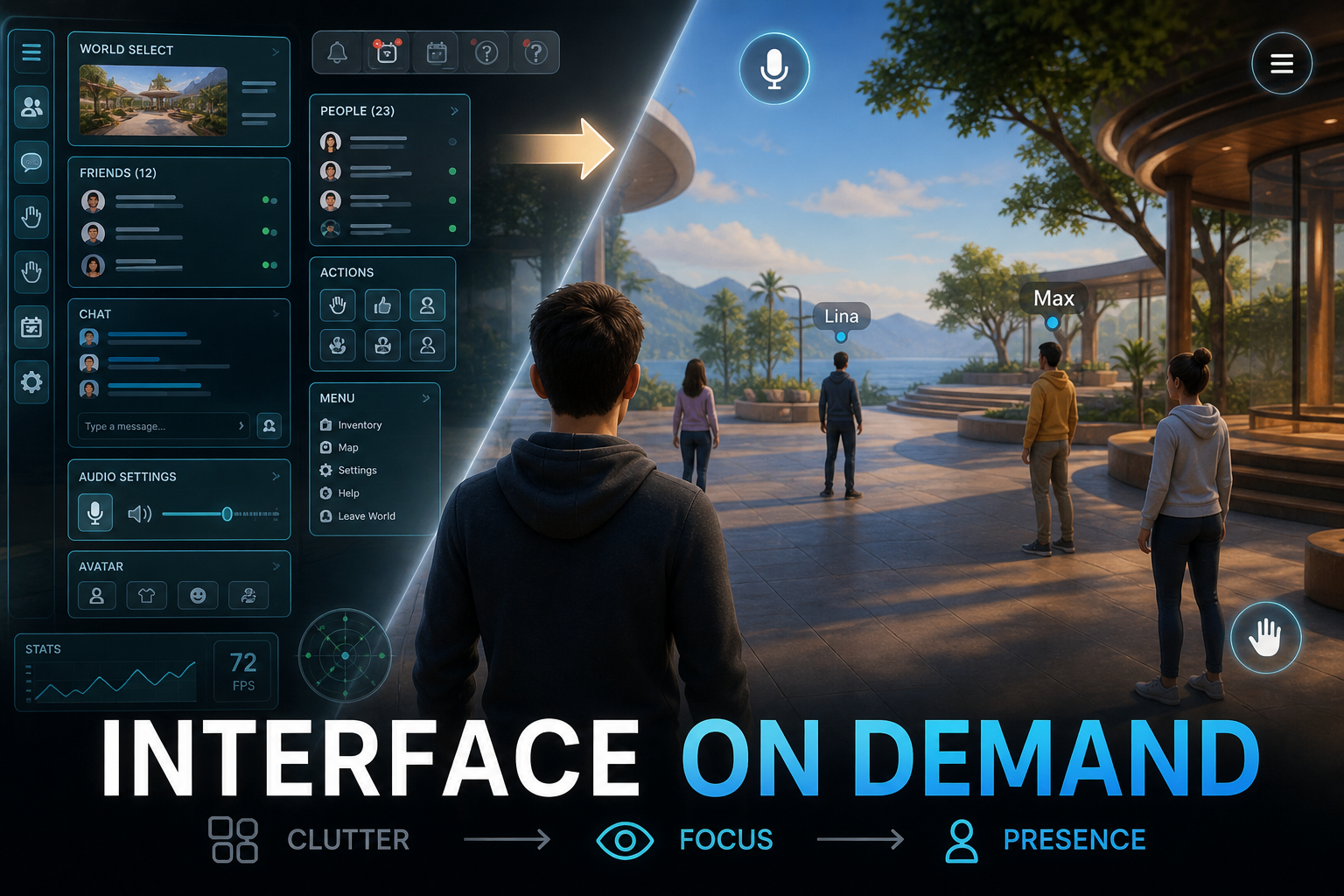
The moment a virtual world opens in the browser, two expectations meet. The first expectation comes from the web: users expect controls, menus, buttons, status indicators and visible choices. The second expectation comes from spatial experience: users want to look around, move naturally, recognize other people, understand the environment and feel that they have entered a place. Both expectations are valid, but they are not always compatible. A traditional web interface wants to be visible. A virtual world often becomes better when the interface knows when to disappear.
This is why the idea of Interface on Demand became important for Cybalounge 2. The goal is not to remove the interface. A hidden interface can be just as frustrating as an overloaded one. Users need to know how to change worlds, select an avatar, communicate, adjust audio, interact with objects, understand names, open menus and leave a session. But they do not need every possible option permanently floating in front of the world. Presence is fragile. When too many panels compete for attention, the virtual world stops feeling like a place and starts feeling like a control room.
In many web applications, more visible functionality can be helpful. A business dashboard, for example, benefits from constant access to filters, charts, buttons and status information. In a virtual world, the same density can become visual noise. A training room, a museum space, a virtual campus or a senior community environment should not require the user to mentally fight through layers of interface before noticing the room itself. The space is the primary interface. The 3D world communicates through layout, scale, light, distance, object placement and movement. The 2D interface should support that experience, not dominate it.
The design principle is simple: show what is needed when it is needed. A microphone button should be visible enough that the user feels in control, especially in social or educational settings. A world selection dialog should appear during entry or transition, not permanently occupy the screen. An avatar label should help people recognize each other, but should not turn a meeting into a cloud of distracting nameplates. A contextual menu should appear near the object or person it refers to, then step away when the task is complete. A progress popup should reassure the user during loading, then disappear as soon as the world becomes usable.
This creates a different kind of interface discipline. Instead of asking which functions exist, we ask when the user needs them, how urgently they need them, and how much attention they should claim. Some interface elements are persistent because they represent safety or immediate control. Others should be temporary because they only matter during a specific decision. Some should be discoverable through context. Others should be available through a calm, central menu. The challenge is to keep functions findable without making them constantly present.
The trade-off is that contextual interface design requires more care. If a button is always visible, users can at least see that the function exists. If it appears only in context, the context must be obvious. The system must teach users gently, especially in the first sessions. A hidden feature is not elegant if nobody finds it. An interface that disappears too aggressively can create uncertainty. Users need feedback, affordances and recovery paths. They need to understand where they are, what can be done, and how to undo or leave an interaction.
This becomes particularly important for audiences that are not composed of gamers or developers. In education, business, public-sector and senior-oriented environments, many users may be entering a virtual 3D space for the first time. They should not have to memorize keyboard shortcuts or guess invisible interaction rules. Interface on Demand must therefore be paired with onboarding, readable labels, clear prompts and forgiving interaction design. The interface may step back, but it must not abandon the user.
For creators, the same principle applies in another way. World builders need tools, settings and feedback, but the end-user world should not display the creator workflow unless the user is actually creating. A platform that mixes creation tools and visitor controls too aggressively can confuse both roles. The creator needs structure; the visitor needs clarity. Interface on Demand allows the platform to present different levels of complexity depending on the task. Visiting, teaching, moderating, building and testing are different modes, and they should not all fight for screen space at once.
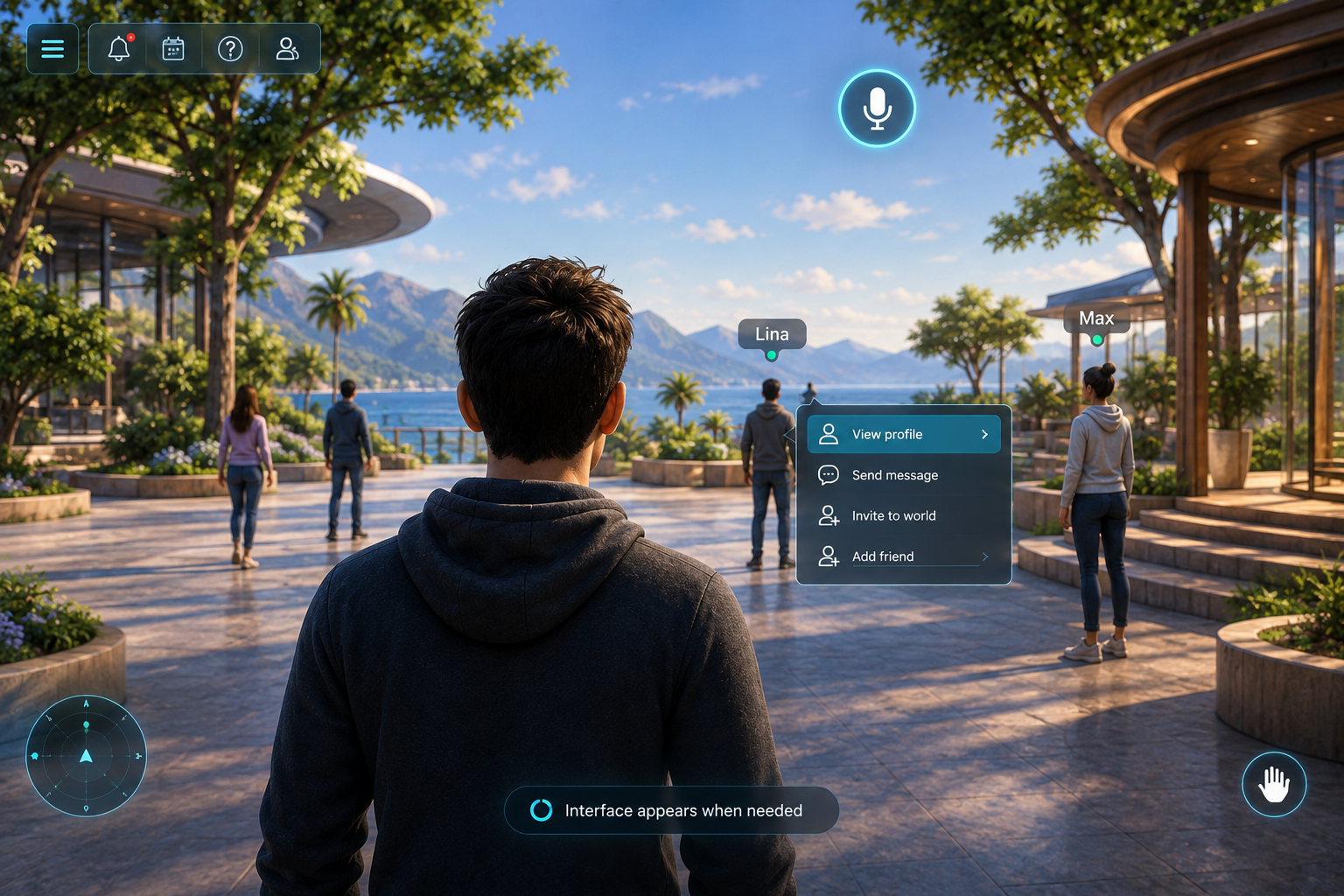
Another advantage is emotional. Visual calm makes a world feel more professional. When a virtual environment is crowded with interface elements, it can feel unfinished, even if the underlying technology works well. When the interface is restrained, the space has room to breathe. The user can notice the architecture, the people, the atmosphere and the purpose of the world. This matters in learning environments, where attention should be directed toward content and interaction. It matters in business environments, where a calm interface communicates reliability. It matters in community spaces, where the world should feel welcoming rather than technical.
The principle also supports future extensibility. As the platform grows, more functions will appear: moderation tools, building tools, scripting options, avatar customization, recording, accessibility settings, guided tours and AI assistants. Without a strong interface philosophy, each new feature would add another permanent element to the screen. Over time, the interface would become the product, and the world would become the background. Interface on Demand provides a way to grow without overwhelming the user.
The most difficult part is restraint. Developers like to make features visible because visibility proves that work has been done. Product teams like visible controls because they demonstrate capability. But immersive design asks a different question: does this visible element make the current experience better? If the answer is no, the function may still be important, but it should probably wait in the background until the right moment.
In Cybalounge 2, Interface on Demand is not a decorative idea. It is part of the platform philosophy. The user should always feel able to act, but not constantly reminded of the software behind the world. A virtual world should not hide its controls so deeply that it becomes mysterious. It should also not expose everything so loudly that it becomes exhausting. The best interface is the one that supports intention, protects attention and then gracefully steps back.
In virtual worlds, the interface should not compete with presence. It should make presence possible.
Now available on Amazon!
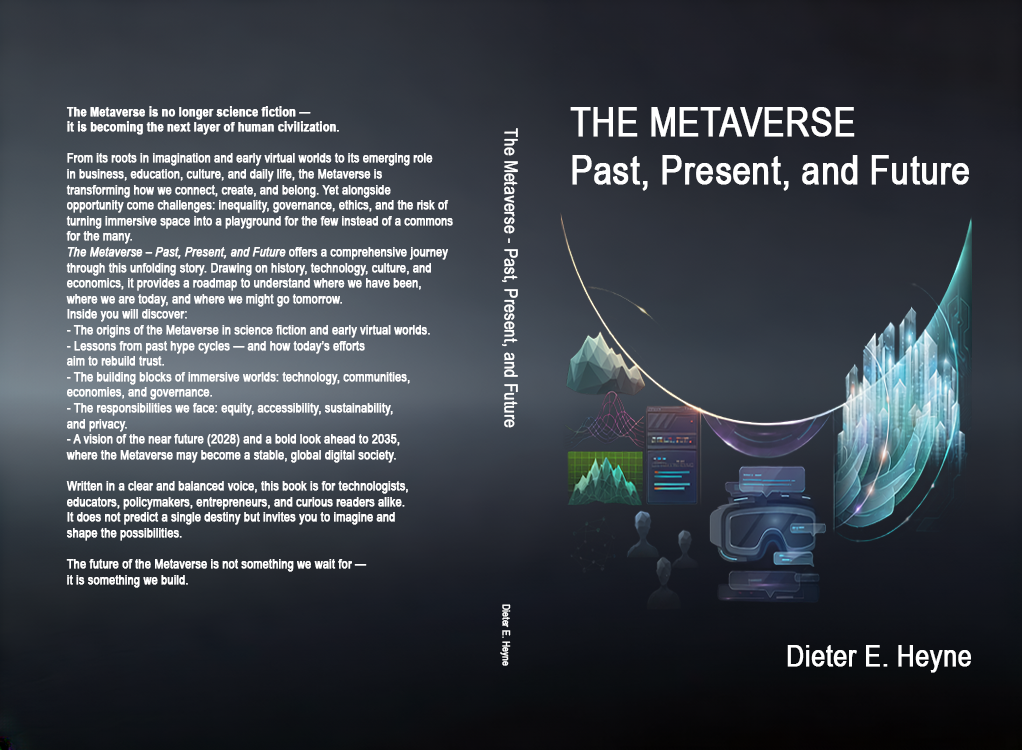
Discover the Metaverse Beyond the Hype
The Metaverse is no longer a futuristic fantasy, it is rapidly becoming a new layer of human society. But what is it really? Where did it come from? And what might it become over the next decade?
The Metaverse – Past, Present, and Future takes readers on a fascinating journey from the earliest virtual worlds and science-fiction visions to today’s emerging immersive platforms, digital economies, and online communities. Along the way, it explores the technologies powering the Metaverse, the opportunities it creates for education, work, and culture, and the challenges of governance, privacy, inclusion, and sustainability.
Looking beyond today's headlines, the book offers a balanced and inspiring vision of how immersive technologies could transform cities, learning, creativity, and daily life by 2035.
Whether you are a business leader, educator, technologist, policymaker, or simply curious about the future, this book provides the context, insight, and perspective needed to understand one of the most important technological and societal shifts of our time.
The future of the Metaverse is not something we await, it is something we create.
About the Author
Dieter E. Heyne is a Metaverse pioneer and lifelong technologist, born in Munich in 1966. With a master’s degree in applied computer science and over three decades of experience as an IT entrepreneur, software architect, and consultant, he has always been at the frontier of digital innovation. His journey into virtual worlds began in 2007 with Second Life and sparked a deep, ongoing exploration of the Metaverse as a space for education, collaboration, and immersive experiences.
Since 2012, Dieter has been developing and refining a web-based virtual world platform, driven by a vision to make the Metaverse accessible, meaningful, and transformative. As a frequent speaker and thought leader at Metaverse events, he shares his insights on how virtual environments can reshape human interaction, learning, and culture. He is the founder and CEO of Metaverse School GmbH, a company dedicated to promoting Metaverse literacy and helping people and organizations understand the power and promise of these emerging digital realms.
Besides talking and writing non-fiction about the Metaverse and Virtual Worlds, this vast knowledge now went into the creation of The Metaverse Enforcers, an ongoing series of high-tech science fiction novels, showcasing the potential development and dangers of the Metaverse in 2053.
About Metaverse School GmbH
Metaverse School GmbH was founded in 2017 by Dieter E. Heyne, who continues to lead the company as its CEO. The company emerged from decades of consulting experience in software architecture, project management, quality assurance, information security, and data protection. Building on this strong technological foundation, Metaverse School GmbH is dedicated to promoting the responsible and purposeful use of immersive 3D environments, for education, collaboration, training, and simulation.
A core mission of the company is to raise awareness of the Metaverse’s potential across business, education, and society. In support of this goal, Dieter Heyne regularly speaks at national and international conferences as well as Metaverse-focused events. Through real-world examples and deep expertise, he demonstrates how immersive technologies can already create meaningful value today.
Disclaimer
Some portions of this content were created or refined with the assistance of artificial intelligence (AI) using tools such as OpenAI’s ChatGPT. The ideas, structure, and editorial direction remain the responsibility of the author. While every effort has been made to ensure factual accuracy and original expression, readers are encouraged to approach speculative or future-facing statements with critical thought.
This series does not represent the views of any specific company or platform and is intended to inspire open discussion around the evolving concept of the Metaverse.
#Metaverse #VirtualWorlds #FutureOfTech #DigitalCommunity #CybaLounge #CL2