A Dream Reborn: The Metaverse as a Living, Evolving Space From hollow promises to human potential
With the broken promises of the past behind us and the foundations for a better future finally being laid, a new dream begins to emerge. Not one imposed by corporations or driven by speculation, but one shaped organically by people.
This new vision of the Metaverse isn’t about escapism, but expansion. It’s not a replacement for reality, but a vibrant extension of it, a canvas as infinite as imagination itself. The goal? To build a virtual world that evolves through the desires, needs, and values of its inhabitants.
A World Built by Its People
The new Metaverse doesn’t start with polished ads or grand unveilings. It starts with the individual user, the artist, the coder, the teacher, the dreamer. Everyone who enters brings their story, and every story contributes to the shared world.
This approach embraces diversity and complexity. It invites the formation of communities, groups of likeminded individuals coming together around shared values, goals, and visions. These communities may be:
Creators all over the world collaborating on digital art festivals
Learning hubs where virtual classrooms offer immersive history, science, or language lessons
Virtual coworking towers where global teams meet, brainstorm, and build across countries
Town squares for political discussion, activism, or philosophical debate
Each part of the Metaverse will reflect the people who live there. Like real-world cities and cultures, no two virtual spaces will be alike. This is its power and its promise.
Work, Life, and Presence in the Virtual Age
A core aspect of this dream is redefining what it means to “go to work.”
In the near future, it may be as normal to log in and walk into your virtual workspace as it is to commute to a physical office. Your avatar, your tools, your team, all present in a shared space that transcends borders, disabilities, and even language barriers.
Such spaces offer far more than videoconferencing or chats ever could. They allow for:
Spontaneous hallway conversations with coworkers
Detailed collaboration on virtual whiteboards or prototypes
Personalized environments that support productivity and well-being
The boundaries between the physical and digital workplace will fade. What matters is not where you work, but how you work and who you can work with, regardless of geography.
An Extension, Not an Escape
Let us be clear: the Metaverse must never become a substitute for the real world. Instead, it should enrich it.
The goal is not to retreat into a digital shell, but to extend human experience into new realms. To use the virtual world, similar to existing social networks but amplified by the immersiveness, to:
Enhance learning with simulations and immersive environments
Expand social connections through shared activities and storytelling
Allow marginalized voices to find community and visibility
Provide safe spaces for creativity, healing, and exploration
Done right, the Metaverse becomes not a distraction, but a mirror, and a magnifier, of the best aspects of the real world.
The Hope: A Kinder, Smarter, More Tolerant Future
What if we could try again? What if we could build a society, even a virtual one, that learns from our past mistakes?
The Metaverse holds the hope of a better humanity, not because it makes us different, but because it gives us a chance to choose differently.
We can choose to:
Build with sustainability in mind
Moderate with fairness and empathy
Design systems that reward contribution and cooperation
Treat newcomers not as strangers but as neighbors
And maybe, just maybe, we can build digital worlds where kindness is the default, not the exception.
The Metaverse won’t fix us. But it might inspire us to be better.
Conclusion: A Living Story
The new Metaverse is not a product to be launched, but a story to be told. It is a living, evolving entity shaped by its people, guided by shared dreams, and expanded by collective creativity.
If we get it right, the Metaverse will be more than code, it will be community. It will be more than platforms, it will be places. And above all, it will be more than technology, it will be human.
The next chapter is waiting to be written, by all of us.
Join the Conversation
If this article sparked your curiosity or passion for the future of the Metaverse, I warmly invite you to join an open discussion in a virtual world setting. Let’s meet face-to-face (or avatar-to-avatar) to exchange ideas, share visions, and connect with others who believe in building something better. The next live meetup will take place on the 21st of November at 9 p.m. (UTC+2) in our Metaverse Meeting Point. Whether you’re a developer, creator, thinker, or explorer, your perspective matters. Come help shape the next chapter of the Metaverse!
About the Author
Dieter E. Heyne is a Metaverse pioneer and lifelong technologist, born in Munich in 1966. With a master’s degree in applied computer science and over three decades of experience as an IT entrepreneur, software architect, and consultant, he has always been at the frontier of digital innovation. His journey into virtual worlds began in 2007 with Second Life and sparked a deep, ongoing exploration of the Metaverse as a space for education, collaboration, and immersive experiences.
Since 2012, Dieter has been developing and refining a web-based virtual world platform, driven by a vision to make the Metaverse accessible, meaningful, and transformative. As a frequent speaker and thought leader at Metaverse events, he shares his insights on how virtual environments can reshape human interaction, learning, and culture. He is the founder and CEO of Metaverse School GmbH, a company dedicated to promoting Metaverse literacy and helping people and organizations understand the power and promise of these emerging digital realms.
About Metaverse School GmbH
Metaverse School GmbH was founded in 2017 by Dieter E. Heyne, who continues to lead the company as its CEO. The company emerged from decades of consulting experience in software architecture, project management, quality assurance, information security, and data protection. Building on this strong technological foundation, Metaverse School GmbH is dedicated to promoting the responsible and purposeful use of immersive 3D environments—for education, collaboration, training, and simulation.
A core mission of the company is to raise awareness of the Metaverse’s potential across business, education, and society. In support of this goal, Dieter Heyne regularly speaks at national and international conferences as well as Metaverse-focused events. Through real-world examples and deep expertise, he demonstrates how immersive technologies can already create meaningful value today.
Disclaimer Some portions of this content were created or refined with the assistance of artificial intelligence (AI) using tools such as OpenAI’s ChatGPT. The ideas, structure, and editorial direction remain the responsibility of the author. While every effort has been made to ensure factual accuracy and original expression, readers are encouraged to approach speculative or future-facing statements with critical thought.
This series does not represent the views of any specific company or platform and is intended to inspire open discussion around the evolving concept of the Metaverse.
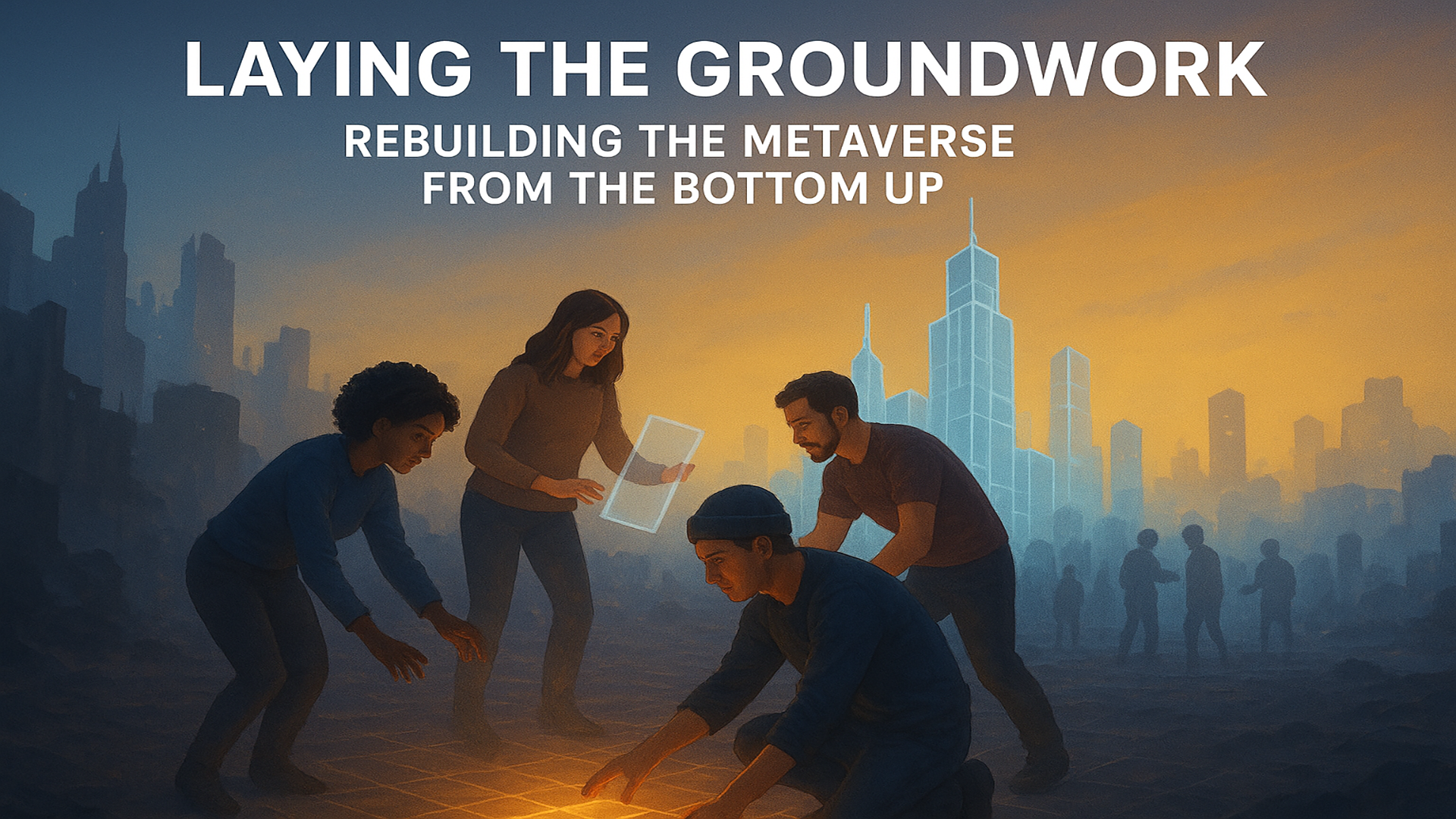
Laying the Groundwork: Rebuilding the Metaverse from the Bottom Up Escaping false promises, embracing collaboration, and creating a future worth logging into
The post-hype Metaverse stands at a crossroads. After the dazzling promises, speculative mania, and inevitable backlash, many are wondering: Can it still be saved? Can the Metaverse evolve into something more than a buzzword or corporate moonshot, into something genuinely useful, empowering, and transformative?
The answer is yes, but not without a fundamental reset.
The Metaverse will not be built by money alone. It cannot be willed into existence through splashy announcements or vague promises of “next-gen experiences.” The foundations must be carefully laid by technologists, designers, users, and communities alike. The road ahead is long, but if done right, we might finally escape the cycle of boom and bust and start building something sustainable, inclusive, and meaningful.
Technology: A Prerequisite, Not the Purpose
The first myth to dismantle is that technology itself is the Metaverse. It isn’t.
Yes, we need fast networks, powerful GPUs, advanced rendering engines, and scalable infrastructure. We need low-latency VR and AR, cloud and edge computing, AI to enhance creativity, accessibility, and safety, and secure identity layers. But none of this matters if it isn’t in service of something greater, the human experience.
Technology is the foundation, not the final product. We should think of the Metaverse not as a technology stack, but as a human-centered space where people can connect, create, and collaborate. If the tools are powerful but the outcomes are hollow, we’ve built a cathedral with no soul.
Interoperability: A World of Many Worlds
If there is one lesson from the past two decades, it’s this: No one company will create the Metaverse.
It must be a network of interconnected experiences and not a monolithic product. Interoperability is key: avatars, assets, identities, and experiences must move freely across platforms. The Metaverse should be like the Internet, a protocol-driven ecosystem, not a walled garden.
This means open standards, APIs, and shared data models. It means collaboration over competition. It means resisting the urge to lock users into a single platform, and instead giving them the tools to carry their digital self wherever they choose to go.
We don’t need one Metaverse, we need many that speak the same language.
Accessibility and Inclusion: A Metaverse for All
A truly meaningful Metaverse must be for everyone, not just the wealthy, the tech-savvy, or the early adopters.
That means, developers need to account for different aspects, such as:
Device diversity: Not everyone will have a $500 VR headset. The Metaverse must be accessible on smartphones, PCs, tablets, and even low-bandwidth connections.
Disability inclusion: Interfaces must account for visual, auditory, cognitive, and mobility differences.
Global representation: Platforms must reflect cultural, linguistic, and economic diversity in their design and content. Avatars, environments, and experiences should portray a broad range of cultural perspectives and not just a Western-centric fantasy.
Safety and moderation: Inclusive spaces require robust community tools, user empowerment, and proactive moderation, not just reactionary bans.
If only a privileged few can participate, the Metaverse will replicate the inequalities of the offline world rather than offering an alternative.
Community-Led Creation: The Real Engine of Growth
Here’s the secret to a thriving Metaverse: users.
Not as passive consumers, but as co-creators. Builders. Storytellers. World designers. Coders. Artists. Educators. Hobbyists. The real power of the Metaverse lies in the ability of everyday people to shape it.
The Metaverse should be seen as a mostly empty book, waiting to be written. Every user should be given the tools to write their own chapter, to create spaces, experiences, and stories that reflect their values and cultures.
This means:
Easy-to-use world-building tools
Open-source components and modding support
Shared marketplaces and fair economic models
Education and support for digital literacy and creation
If we want innovation and diversity, we must democratize access to creation.
A Shared Responsibility: Building the Metaverse Together
To rebuild the Metaverse into something sustainable, we need a broad coalition: technologists, researchers, artists, entrepreneurs, regulators, educators, and users. Everyone has a role to play.
Tech companies should focus on infrastructure and tooling, not just glossy demos.
Standards bodies should accelerate work on open protocols and identities.
Governments should support innovation while safeguarding rights and accessibility.
Communities should be empowered to self-govern and self-organize.
This is not just a product roadmap. It’s a social contract, one that values people over profits, openness over silos, and meaning over marketing.
Because the Metaverse, if it’s to endure, must function like shared digital infrastructure, not a string of walled gardens. Tech companies should prioritize infrastructure and tooling because platforms live or die on reliability, safety, and developer leverage; robust tools compound innovation, reduce vendor lock-in, and create larger markets than any single glossy demo ever could.
Standards bodies should accelerate open protocols and identities because interoperability is the engine of network effects: it lowers integration costs, prevents monopoly choke points, enables portability of assets and reputation, and unlocks competition on experience rather than enclosure.
Governments should foster innovation while safeguarding rights and accessibility because the stakes are societal: economic competitiveness, digital sovereignty, safety, and equal participation. Clear guardrails and incentives de-risk private investment, protect citizens, and expand the talent and customer base.
Communities should be empowered to self-govern because legitimacy and resilience emerge from participation; when users co-create norms and moderate spaces, trust rises, abuse drops, and cultures become sustainable rather than extractive.
In short, each actor’s “should” aligns with self-interest and the public good: open, durable infrastructure grows markets; rights and access grow adoption; community agency grows trust; and standards grow the pie for everyone.
That is why this is a social contract, not just a roadmap.
From Hype to Hope
If the Metaverse is ever to fulfill its promise, we must leave behind the false expectations and easy solutions. We must stop chasing trends and start building foundations.
The path forward is less glamorous but more essential: Interoperability. Accessibility. Inclusion. Shared governance. Human-centered design.
It’s not about who can launch the flashiest platform, but who can help others build meaningful experiences within it. If we succeed, the Metaverse won’t be defined by companies or technologies, it will be defined by its people.
And that’s how it should be.
Join the Conversation
If this article sparked your curiosity or passion for the future of the Metaverse, I warmly invite you to join an open discussion in a virtual world setting. Let’s meet face-to-face (or avatar-to-avatar) to exchange ideas, share visions, and connect with others who believe in building something better. The next live meetup will take place on the 7th of November at 9 p.m. (UTC+2) in our Metaverse Meeting Point. Whether you’re a developer, creator, thinker, or explorer, your perspective matters. Come help shape the next chapter of the Metaverse!
About the Author
Dieter E. Heyne is a Metaverse pioneer and lifelong technologist, born in Munich in 1966. With a master’s degree in applied computer science and over three decades of experience as an IT entrepreneur, software architect, and consultant, he has always been at the frontier of digital innovation. His journey into virtual worlds began in 2007 with Second Life and sparked a deep, ongoing exploration of the Metaverse as a space for education, collaboration, and immersive experiences.
Since 2012, Dieter has been developing and refining a web-based virtual world platform, driven by a vision to make the Metaverse accessible, meaningful, and transformative. As a frequent speaker and thought leader at Metaverse events, he shares his insights on how virtual environments can reshape human interaction, learning, and culture. He is the founder and CEO of Metaverse School GmbH, a company dedicated to promoting Metaverse literacy and helping people and organizations understand the power and promise of these emerging digital realms.
About Metaverse School GmbH
Metaverse School GmbH was founded in 2017 by Dieter E. Heyne, who continues to lead the company as its CEO. The company emerged from decades of consulting experience in software architecture, project management, quality assurance, information security, and data protection. Building on this strong technological foundation, Metaverse School GmbH is dedicated to promoting the responsible and purposeful use of immersive 3D environments—for education, collaboration, training, and simulation.
A core mission of the company is to raise awareness of the Metaverse’s potential across business, education, and society. In support of this goal, Dieter Heyne regularly speaks at national and international conferences as well as Metaverse-focused events. Through real-world examples and deep expertise, he demonstrates how immersive technologies can already create meaningful value today.
Disclaimer Some portions of this content were created or refined with the assistance of artificial intelligence (AI) using tools such as OpenAI’s ChatGPT. The ideas, structure, and editorial direction remain the responsibility of the author. While every effort has been made to ensure factual accuracy and original expression, readers are encouraged to approach speculative or future-facing statements with critical thought.
This series does not represent the views of any specific company or platform and is intended to inspire open discussion around the evolving concept of the Metaverse.
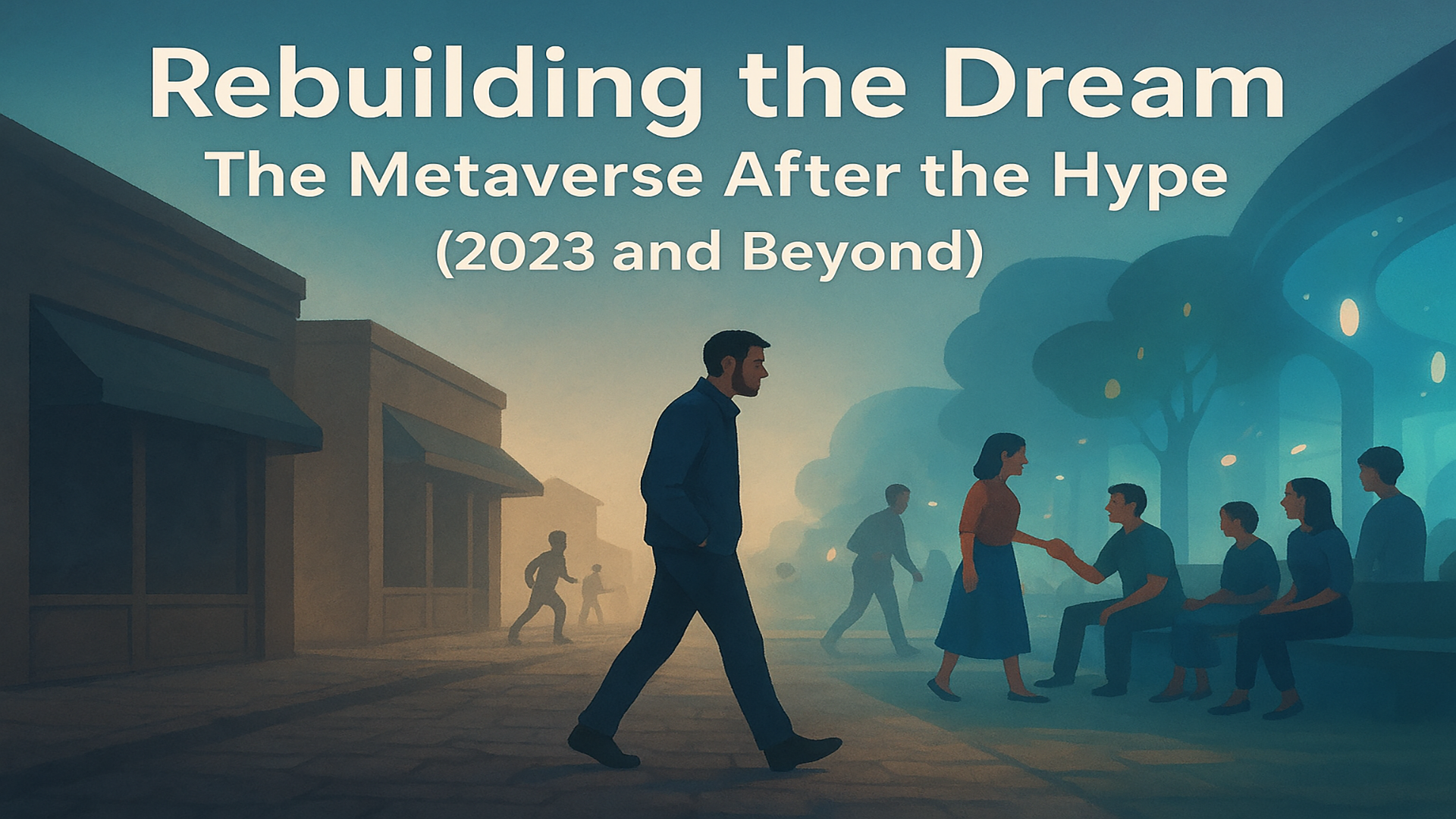
Rebuilding the Dream: The Metaverse After the Hype (2023 and Beyond) The speculative fog has lifted. What comes next may finally matter.
As the whirlwind of hype began to settle in late 2022 and through 2023, the Metaverse was left in a precarious state. Burned investors, declining user bases, and disillusioned developers painted a bleak picture. The narrative had shifted, from euphoria and limitless potential to skepticism and budget cuts. Media outlets that once hailed the Metaverse as the next internet now reported its failures, and big-tech companies quietly restructured or rebranded their ambitions.
Yet, beneath the rubble of failed promises and speculative gold rushes, a quieter, more sustainable vision began to take form. The question was no longer "How do we get rich off the Metaverse?" but rather: "How do we make it meaningful, useful, and lasting?"
The Post-Hype Landscape: Opportunities in the Silence
With the market noise dialed down, a more honest appraisal of the Metaverse's strengths and weaknesses became possible. It turned out that many of the core ideas, like presence, persistence, identity, and co-creation, still held real value. What had been missing was a sense of purpose and direction beyond commerce.
The platforms that survived the collapse, some older like Second Life and VRChat, others newer and more community-focused, shared one thing in common: they empowered their users. Not as consumers or spectators, but as creators, citizens, and contributors. These spaces didn’t merely offer content; they offered tools and freedom.
The Empty Book: A New Metaphor for the Metaverse
Rather than seeing the Metaverse as a finished product, we can begin to see it as a vast, mostly empty book. The foundational chapters may be written by platform developers, but the real story, the parts people care about, are meant to be written by users.
Every avatar, every interaction, every virtual meeting or digital creation becomes part of that collective narrative. It is not a movie we watch but a novel we co-author. For the Metaverse to truly thrive, users must be given both the pen and the permission to author and shape their world.
This means robust creation tools, clear ownership systems (with or without blockchain), and a platform philosophy that values community governance, not corporate control. It means open standards, interoperability, and user-moddable environments. But more than anything, it means trusting users to build.
From Spectator to Stakeholder
If the Metaverse is to survive and grow, the focus must shift away from centralized control and top-down experiences. Instead, developers and investors should look to models that resemble open ecosystems or digital democracies.
This could take many forms:
Creator royalties: Enabling digital artists, educators, world-builders, and performers to earn ongoing revenue from their contributions.
Collaborative moderation: Empowering communities to establish and enforce their own norms, much like open-source projects or Reddit-style governance.
Cross-platform identities: Giving users control over their virtual personas, portable across worlds and platforms.
Narrative participation: Treating users not as background extras, but as protagonists with agency, capable of shaping the stories and events that unfold.
Innovation Through Inclusion
The most innovative experiences in the Metaverse may not come from the largest companies but from the margins, from users with different cultural perspectives, educational goals, or artistic visions. A truly thriving Metaverse is not homogenous; it is diverse, multilingual, and inclusive.
This means making tools accessible to all, regardless of technical skill or financial means. It means supporting niche communities, educational initiatives, and creative experiments without requiring profitability from day one.
The Next Chapter is Ours
We are now in a transitional phase. The speculative phase has passed, but the infrastructure remains. The challenge, and opportunity, lies in rediscovering the soul of the Metaverse.
If we treat it not as a mall or a casino, but as a shared cultural space, a canvas, a library, a city, a theater, then we can begin to unlock its true potential. One where every user, regardless of background, is an author, a builder, and a co-creator.
The Metaverse, like the early internet, may have stumbled out of the gate. But perhaps that stumble is what we needed. To remind us that it isn't about glossy demos or billion-dollar valuations. It's about people.
And people, given the chance, can write extraordinary stories.
Join the Conversation
If this article sparked your curiosity or passion for the future of the Metaverse, I warmly invite you to join an open discussion in a virtual world setting. Let’s meet face-to-face (or avatar-to-avatar) to exchange ideas, share visions, and connect with others who believe in building something better. The next live meetup will take place on the 24th of October at 9 p.m. (UTC+2) in our Metaverse Meeting Point. Whether you’re a developer, creator, thinker, or explorer, your perspective matters. Come help shape the next chapter of the Metaverse!
About the Author
Dieter E. Heyne is a Metaverse pioneer and lifelong technologist, born in Munich in 1966. With a master’s degree in applied computer science and over three decades of experience as an IT entrepreneur, software architect, and consultant, he has always been at the frontier of digital innovation. His journey into virtual worlds began in 2007 with Second Life and sparked a deep, ongoing exploration of the Metaverse as a space for education, collaboration, and immersive experiences.
Since 2012, Dieter has been developing and refining a web-based virtual world platform, driven by a vision to make the Metaverse accessible, meaningful, and transformative. As a frequent speaker and thought leader at Metaverse events, he shares his insights on how virtual environments can reshape human interaction, learning, and culture. He is the founder and CEO of Metaverse School GmbH, a company dedicated to promoting Metaverse literacy and helping people and organizations understand the power and promise of these emerging digital realms.
About Metaverse School GmbH
Metaverse School GmbH was founded in 2017 by Dieter E. Heyne, who continues to lead the company as its CEO. The company emerged from decades of consulting experience in software architecture, project management, quality assurance, information security, and data protection. Building on this strong technological foundation, Metaverse School GmbH is dedicated to promoting the responsible and purposeful use of immersive 3D environments—for education, collaboration, training, and simulation.
A core mission of the company is to raise awareness of the Metaverse’s potential across business, education, and society. In support of this goal, Dieter Heyne regularly speaks at national and international conferences as well as Metaverse-focused events. Through real-world examples and deep expertise, he demonstrates how immersive technologies can already create meaningful value today.
Disclaimer Some portions of this content were created or refined with the assistance of artificial intelligence (AI) using tools such as OpenAI’s ChatGPT. The ideas, structure, and editorial direction remain the responsibility of the author. While every effort has been made to ensure factual accuracy and original expression, readers are encouraged to approach speculative or future-facing statements with critical thought.
This series does not represent the views of any specific company or platform and is intended to inspire open discussion around the evolving concept of the Metaverse.
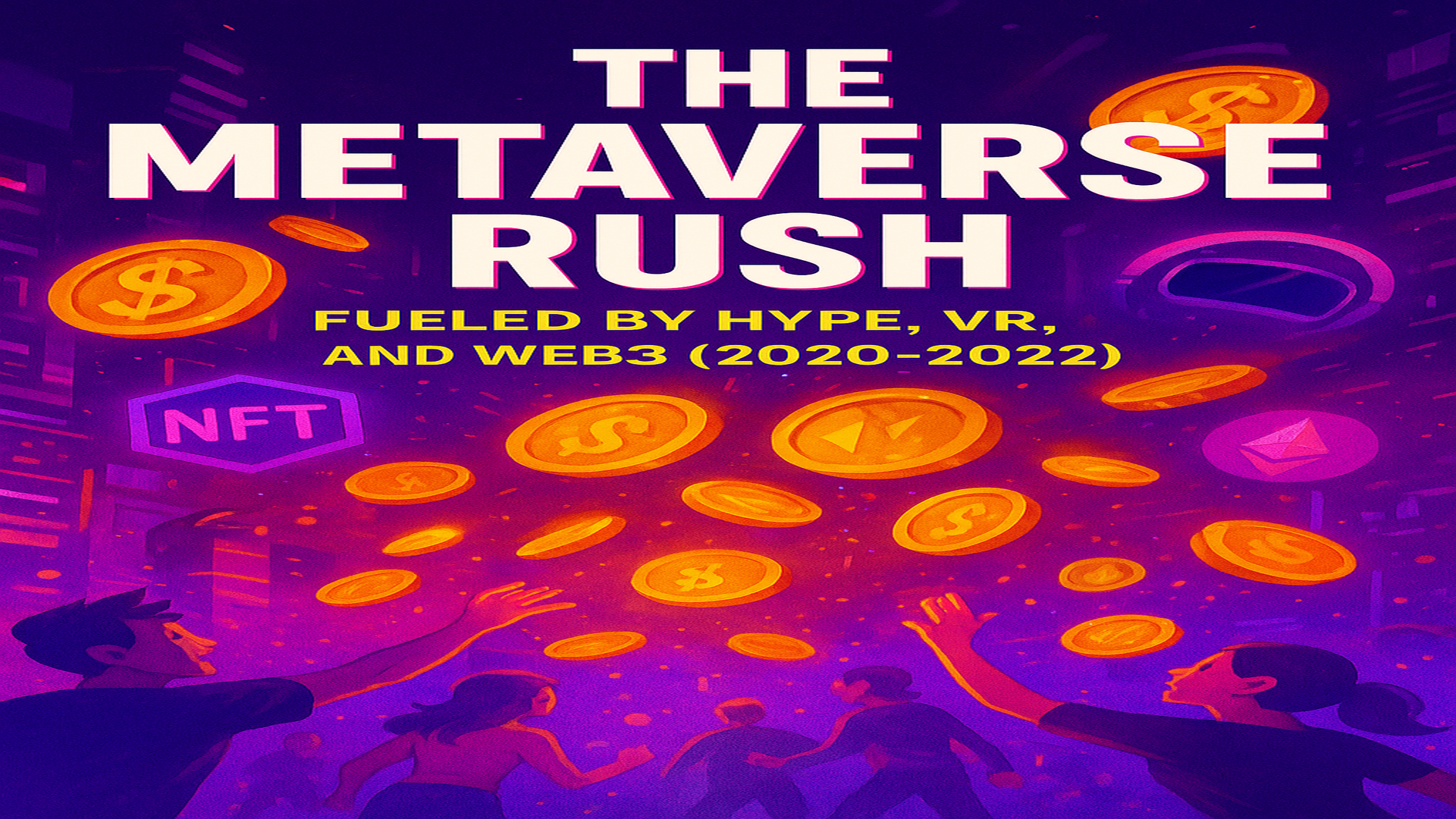
The Metaverse Rush: A Second Boom Fueled by Hype, VR, and Web3 (2020–2022) When the world locked down, the virtual world lit up, but not always for the right reasons.
After a quiet decade of development and niche innovation, the idea of the Metaverse exploded back into the mainstream consciousness in the early 2020s. This resurgence was driven not by a slow buildup of grassroots enthusiasm or revolutionary design improvements, but by a sudden confluence of technologies, social conditions, and market dynamics. Most notably: rapid advancements in Virtual Reality, the maturation of Web3 technologies, and the global disruption caused by the COVID-19 pandemic.
Suddenly, it seemed like everyone was talking about the Metaverse again. Venture capital flowed like water, startups appeared overnight, and the concept became so inflated that nearly any virtual experience was labeled a "Metaverse" product. But this second boom, much like the California Gold Rush of the 1800s, was more about speculation than substance.
COVID-19: A Global Catalyst
When COVID-19 forced billions of people indoors, the need for remote interaction became urgent. Work shifted to Zoom, education to Teams, and casual socialization to platforms like Discord and online games. In this environment, the idea of persistent virtual worlds regained traction.
The Metaverse promised a solution to digital fatigue: immersive, embodied interaction instead of flat, two-dimensional video calls. People imagined working in VR offices, attending concerts as avatars, or gathering in digital towns with friends from across the globe. A captive global audience seemed primed to escape into richer virtual experiences.
Even platforms that had long been written off saw a resurgence. Second Life, the veteran virtual world from the early 2000s, experienced a surprising revival. As people looked for meaningful, customizable, and persistent virtual spaces, many returned to Second Life and a new generation of users discovered its unique social and creative potential. While it lacked the modern VR features of newer platforms, its stability and user-driven content proved unexpectedly attractive.
Web3 Enters the Scene
Simultaneously, blockchain and crypto-based ecosystems were hitting their stride. Ethereum matured as a platform, and NFTs (non-fungible tokens) entered the public imagination in 2021. Suddenly, digital scarcity was possible. Artworks, avatars, virtual land, anything could be tokenized and sold.
Projects like Decentraland, The Sandbox, Cryptovoxels, and Somnium Space became buzzwords overnight. They offered digital plots of land secured by blockchain technology, traded as NFTs, and often purchased with cryptocurrency. Prices skyrocketed.
Investors bought land they had never visited. Celebrities bought avatars they would never wear. Major brands like Adidas, Gucci, and even JPMorgan opened virtual storefronts. A new kind of digital gold rush had begun, promising unimaginable returns for early adopters.
But amid this speculative frenzy, one critical question was rarely asked: Who is this for?
Virtual Reality: Finally Ready?
Hardware had improved. Devices like the Oculus Quest 2 made untethered VR more accessible than ever before. With increasing resolutions, better motion tracking, and lower price points, a consumer-grade virtual experience was finally within reach.
Meta (formerly Facebook) seized the moment, announcing a massive pivot to the Metaverse in 2021. CEO Mark Zuckerberg declared the Metaverse the "next frontier" of the internet and committed billions in funding to develop Horizon Worlds and other VR experiences.
Suddenly, the Metaverse wasn't just a fringe idea or an experimental space for hobbyists. It had the backing of the world's largest social media company and a flood of financial interest. And yet, for all the funding, technical promise, and media attention, adoption remained underwhelming.
Hype Without Humanity
The biggest flaw in this second Metaverse boom was its lack of user-centric design. Projects launched with high entry costs, poor onboarding, fragmented experiences, and no clear value proposition for ordinary users. Most required cryptocurrency wallets, complex interfaces, or VR gear many people didn’t own.
Rather than focusing on compelling reasons for users to return day after day, many projects focused on how much money could be made today. Digital land speculation mimicked real-world real estate bubbles. NFT art collections became more about flipping than appreciating. Every major brand wanted a piece of the Metaverse, yet few contributed to its actual value.
Just like the original gold rush, only a few struck it rich, while many were left holding the equivalent of digital sand.
The Bubble Begins to Wobble
By late 2022, signs of fatigue had begun to set in. NFT sales declined. Crypto markets crashed. Users who had bought into the dream found empty virtual plazas and unstable platforms. Even Meta's Horizon Worlds struggled to gain traction, despite its enormous budget and ecosystem support.
The gap between vision and reality had once again grown too wide. While the promise of the Metaverse remained potent, its implementation was marred by speculative behavior, technological fragmentation, and a fundamental misreading of user needs.
The second boom ended much like the first: with unmet expectations, overbuilt platforms, and a community left wondering what could have been.
Looking Forward
In the next article, we’ll examine the post-hype environment. What happens after the bubble pops? Can the Metaverse survive beyond speculation? And how might a more grounded, human-centered approach finally bring this long-awaited vision to life?
Because one thing is clear: even the Metaverse won't be built on hype alone.
Join the Conversation
If this article sparked your curiosity or passion for the future of the Metaverse, I warmly invite you to join an open discussion in a virtual world setting. Let’s meet face-to-face (or avatar-to-avatar) to exchange ideas, share visions, and connect with others who believe in building something better. The next live meetup will take place on the 10th of October at 9 p.m. (UTC+2) in our Metaverse Meeting Point. Whether you’re a developer, creator, thinker, or explorer, your perspective matters. Come help shape the next chapter of the Metaverse!
About the Author
Dieter E. Heyne is a Metaverse pioneer and lifelong technologist, born in Munich in 1966. With a master’s degree in applied computer science and over three decades of experience as an IT entrepreneur, software architect, and consultant, he has always been at the frontier of digital innovation. His journey into virtual worlds began in 2007 with Second Life and sparked a deep, ongoing exploration of the Metaverse as a space for education, collaboration, and immersive experiences.
Since 2012, Dieter has been developing and refining a web-based virtual world platform, driven by a vision to make the Metaverse accessible, meaningful, and transformative. As a frequent speaker and thought leader at Metaverse events, he shares his insights on how virtual environments can reshape human interaction, learning, and culture. He is the founder and CEO of Metaverse School GmbH, a company dedicated to promoting Metaverse literacy and helping people and organizations understand the power and promise of these emerging digital realms.
About Metaverse School GmbH
Metaverse School GmbH was founded in 2017 by Dieter E. Heyne, who continues to lead the company as its CEO. The company emerged from decades of consulting experience in software architecture, project management, quality assurance, information security, and data protection. Building on this strong technological foundation, Metaverse School GmbH is dedicated to promoting the responsible and purposeful use of immersive 3D environments—for education, collaboration, training, and simulation.
A core mission of the company is to raise awareness of the Metaverse’s potential across business, education, and society. In support of this goal, Dieter Heyne regularly speaks at national and international conferences as well as Metaverse-focused events. Through real-world examples and deep expertise, he demonstrates how immersive technologies can already create meaningful value today.
Disclaimer Some portions of this content were created or refined with the assistance of artificial intelligence (AI) using tools such as OpenAI’s ChatGPT. The ideas, structure, and editorial direction remain the responsibility of the author. While every effort has been made to ensure factual accuracy and original expression, readers are encouraged to approach speculative or future-facing statements with critical thought.
This series does not represent the views of any specific company or platform and is intended to inspire open discussion around the evolving concept of the Metaverse.
Between Two Hypes: The Quiet Years of the Metaverse (2010–2020) How a decade of decline, reinvention, and decentralization kept the Metaverse dream alive, just out of view
After the dizzying rise and slow fade of Second Life in the late 2000s, the Metaverse entered what felt like a long winter. The hype had cooled. The headlines disappeared. Most of the public moved on.
But even as attention shifted toward mobile apps, social media, and the cloud, a small but dedicated group of developers, researchers, and digital idealists kept building. In forgotten forums and niche platforms, the idea of persistent virtual worlds persisted. This decade didn’t produce another media phenomenon, but it laid the groundwork for the Metaverse’s next big evolution.
This was the era of quiet reinvention.
The Long Tail of Second Life
By 2010, Second Life was no longer a cultural sensation. Its user base had plateaued, the media had moved on, and Linden Lab began pivoting toward smaller projects. Yet Second Life never actually died. It kept running and continues to this day. A core group of creators and communities maintained its virtual economy, its events, and even its cultural identity.
But it was clear the platform had reached a ceiling. Its codebase was aging, its UI increasingly outdated, and the technical barriers (hardware requirements, lag, complex tools, poor scalability) and cultural barriers (unclear purpose, fragmented communities, negative media framing, and safety issues) that had once been ignored during the boom years were now glaringly obvious. New users struggled to find relevance in a platform that hadn’t evolved with the times.
Many in the community began looking elsewhere.
OpenSim and the Promise of Federation
Enter OpenSimulator, commonly known as OpenSim, an open-source virtual world platform compatible with Second Life clients and protocols. Launched in the late 2000s and gaining traction through the 2010s, OpenSim offered something Second Life never did: control.
Anyone could spin up their own grid, create their own regions, and set their own rules. OpenSim promised freedom; freedom from Linden Lab’s centralization, freedom from platform fees, and freedom to interconnect independent virtual worlds in a federated model.
On paper, it was the logical next step for the Metaverse. Instead of one giant world, there could be many interoperable ones. Users could host their own space but still travel across the network, an early vision of decentralization that mirrored later Web3 ideals.
But OpenSim never achieved critical mass. It remained mostly in the hands of educators, researchers, and tech-savvy hobbyists. The experience was fragmented, support varied wildly, and the technical barriers were still high. While the vision was bold, the execution struggled with usability and mainstream appeal.
Kitely, High Fidelity, and Niche Reinventions
In the years that followed, other platforms emerged with the aim of modernizing the Metaverse experience. Notable among them was Kitely, a grid built on OpenSim with a cloud-based model, offering scalable, affordable regions on demand. Kitely tried to strike a balance between user control and ease of access, adding features like a marketplace and social tools.
Meanwhile, High Fidelity, founded by Second Life creator Philip Rosedale in 2013, took a different approach, by betting on spatial audio, VR support, and decentralized hosting. It hoped to build a next-generation, immersive communication platform that could replace video calls with rich, 3D interaction.
Both platforms had innovative ideas, and both failed to gain wide traction.
There were many reasons: lack of user-friendly onboarding, niche target audiences, an unclear purpose beyond novelty, and the ever-present challenge of building sustainable, active communities from scratch. The Metaverse, it seemed, remained a solution in search of a problem.
The Cultural Shift: From Worlds to Platforms
During the 2010s, consumer culture began favoring more accessible, lightweight digital experiences. People wanted mobile apps and instant interactions, not sprawling virtual spaces that required downloads, learning curves, and commitment.
This shift gave rise to platforms like Roblox, Minecraft, and VRChat, each capturing parts of the original Metaverse idea, but wrapped in a more accessible, gamified, or social format.
Minecraft became the most successful sandbox world-builder ever, with millions using it as a space for play, education, and creativity.
Roblox enabled a generation of kids to create games, socialize, and even earn money within a structured, mobile-friendly environment.
VRChat allowed for highly expressive social interaction in VR, reviving the avatar-driven social culture of Second Life in a new medium.
These platforms didn’t identify as “Metaverse” projects at the time, but they carried the DNA forward in new directions.
The Web3 Spark: A New Vision for Ownership
Toward the end of the 2010s, a new concept began to emerge: Web3. This new internet paradigm focused on decentralization, user ownership, and blockchain-based technologies. Suddenly, the problems that had plagued previous virtual worlds, such as centralized control, lack of interoperability, and fragile digital economies, seemed solvable.
Projects like Decentraland, Cryptovoxels, and Somnium Space emerged from this movement. Built on blockchain infrastructure, these platforms allowed users to own virtual land, objects, and identities on-chain, in wallets they controlled. Digital property became tokenized. Marketplace transactions were secured via smart contracts.
It was the beginning of a new kind of Metaverse hype: one powered by Web3 ideals of decentralization and scarcity.
However, this new approach didn’t solve the old problems, such as a steep learning curve, low technical quality, lack of clear purpose, overpromised returns, as well as poor moderation and safety. Many new and more complex ones would arise, but it reinjected energy into a space that had been quietly surviving for years.
A Decade of Foundations
While the 2010s may be remembered as a “lost decade” for the Metaverse in popular culture, it was anything but inactive. It was a time of:
Technological experimentation: Cloud hosting, VR, spatial audio, open protocols
Cultural migration: From dedicated virtual worlds to embedded platforms (Minecraft, VRChat)
Community building: Small, tight-knit communities that kept the vision alive
Most importantly, it was a decade in which the Metaverse matured away from media hype and toward something more thoughtful, albeit still searching for its breakthrough moment.
Looking Ahead
As the 2020s began, a perfect storm was brewing: advances in VR hardware, renewed investor interest, the COVID-19 pandemic driving demand for digital presence and the rise of crypto-fueled enthusiasm for digital property.
In the next article, we’ll explore this second Metaverse boom, with Meta (formerly Facebook), NFTs, and the Web3 explosion and how once again, old dreams returned in a new skin.
But we’ll also ask: Did anybody learn anything from the last time?
Join the Conversation
If this article sparked your curiosity or passion for the future of the Metaverse, I warmly invite you to join an open discussion in a virtual world setting. Let’s meet face-to-face (or avatar-to-avatar) to exchange ideas, share visions, and connect with others who believe in building something better. The next live meetup will take place on the 26th of September at 9 p.m. (UTC+2) in our Metaverse Meeting Point. Whether you’re a developer, creator, thinker, or explorer, your perspective matters. Come help shape the next chapter of the Metaverse!
About the Author
Dieter E. Heyne is a Metaverse pioneer and lifelong technologist, born in Munich in 1966. With a master’s degree in applied computer science and over three decades of experience as an IT entrepreneur, software architect, and consultant, he has always been at the frontier of digital innovation. His journey into virtual worlds began in 2007 with Second Life and sparked a deep, ongoing exploration of the Metaverse as a space for education, collaboration, and immersive experiences.
Since 2012, Dieter has been developing and refining a web-based virtual world platform, driven by a vision to make the Metaverse accessible, meaningful, and transformative. As a frequent speaker and thought leader at Metaverse events, he shares his insights on how virtual environments can reshape human interaction, learning, and culture. He is the founder and CEO of Metaverse School GmbH, a company dedicated to promoting Metaverse literacy and helping people and organizations understand the power and promise of these emerging digital realms.
About Metaverse School GmbH
Metaverse School GmbH was founded in 2017 by Dieter E. Heyne, who continues to lead the company as its CEO. The company emerged from decades of consulting experience in software architecture, project management, quality assurance, information security, and data protection. Building on this strong technological foundation, Metaverse School GmbH is dedicated to promoting the responsible and purposeful use of immersive 3D environments—for education, collaboration, training, and simulation.
A core mission of the company is to raise awareness of the Metaverse’s potential across business, education, and society. In support of this goal, Dieter Heyne regularly speaks at national and international conferences as well as Metaverse-focused events. Through real-world examples and deep expertise, he demonstrates how immersive technologies can already create meaningful value today.
Disclaimer Some portions of this content were created or refined with the assistance of artificial intelligence (AI) using tools such as OpenAI’s ChatGPT. The ideas, structure, and editorial direction remain the responsibility of the author. While every effort has been made to ensure factual accuracy and original expression, readers are encouraged to approach speculative or future-facing statements with critical thought.
This series does not represent the views of any specific company or platform and is intended to inspire open discussion around the evolving concept of the Metaverse.
The First Hype Cycle: When the Metaverse Became Real (and Then Faded) How Second Life sparked global fascination, why it couldn’t sustain the momentum, and what we can learn from its decline
In the mid-2000s, something extraordinary happened. A virtual world called Second Life exploded into the public consciousness. It wasn’t a game, exactly. It wasn’t a website. It was something new: an entire digital society where people could create, buy, sell, work, perform, and socialize through avatars in a persistent, user-generated 3D world.
For a time, it felt like the future had arrived early. Mainstream media heralded Second Life as the next evolution of the internet. Universities opened virtual campuses. Embassies launched digital outposts. Musicians held concerts. Even CNN set up a bureau in-world to report on virtual events. And at the heart of it all was a radical proposition: you could make real money.
The Golden Age of Second Life
Launched by Linden Lab in 2003, Second Life positioned itself not as a game, but as a “platform” or a “society.” Unlike traditional MMOs, it had no predefined goals, missions, or enemies. The world was a blank canvas. Users, called “Residents”, could build homes, design clothing, script interactive objects, run businesses, and host events. The in-world currency, the Linden Dollar, could be exchanged for real-world money.
Entrepreneurs quickly emerged. Some users became virtual landlords, renting digital real estate to others. Others sold avatar clothing, animations, or architectural services. There were fashion shows, casinos, sex clubs, classrooms, and full-fledged cities. By 2007, some reports claimed that dozens of users were earning six-figure incomes entirely within Second Life.
The media took notice. Headlines proclaimed the “digital gold rush.” Magazine covers featured screenshots of pixelated avatars next to bold titles like “My Virtual Life” and “Get Rich in the Metaverse.”
And the public, intrigued by the possibility of living differently, signed up in droves.
The Rise of Competition
The early success of Second Life ignited a wave of imitators and would-be successors. Developers envisioned their own virtual utopias, some focused on education, others on commerce or gaming. Platforms like There, Kaneva, and IMVU competed for attention, while larger corporations began exploring virtual worlds for marketing, training, and collaboration.
Even the tech giants dipped their toes in the water. Microsoft and Google experimented with virtual presence. Startups emerged promising interoperable digital economies and realistic avatars. The phrase “Metaverse” began to shift from Sci-Fi reference to industry goal.
But beneath the surface, cracks were forming.
A World of Infinite Possibility (But Limited Appeal)
Despite the boom in attention, Second Life and its competitors never broke through to the mainstream in the way many predicted. By 2009, the hype was fading. Major media outlets began withdrawing their coverage. Corporate presences were quietly abandoned. User growth slowed, and while a dedicated core remained, most casual users drifted away.
Why?
Steep Learning Curve Second Life was complex. Building required learning in-world scripting languages. Navigation was unintuitive. New users often found themselves lost, both literally and socially.
Low Technical Quality Even by the standards of the time, graphics and performance were underwhelming. Lag was frequent. Avatars moved awkwardly. Computers needed considerable power to run the software smoothly.
Lack of Clear Purpose The openness that made Second Life visionary also made it confusing. There was no central reason to stay beyond curiosity. Without strong social hooks or gameplay mechanics, retention was low.
Overpromised Returns While some users earned money, the majority didn’t. As in many speculative markets, the promise of income attracted more people than the actual economy could support. Disillusionment followed.
Poor Moderation and Safety The world’s openness also made it chaotic. Harassment, adult content, and griefing were common. For many, it wasn’t a comfortable space to spend time, let alone build a digital life.
And yet, in hindsight, many of these flaws sound familiar. Early websites were clunky. Internet connections were slow. The user experience was confusing. However, the internet didn’t fail, it matured. Perhaps Second Life was more a prototype ahead of its time.
Lessons from the First Metaverse Wave
The decline of Second Life doesn’t mean it failed entirely. It still exists today, with a loyal user base and a functioning economy. It proved that digital societies could exist, but it also revealed how hard they are to sustain.
Importantly, it marked the first time that people seriously engaged with the question: What does it mean to live, work, and earn in a virtual world? It opened debates about identity, property, law, and community in digital spaces, debates we are still having today.
A Missed Opportunity for Growth
One of the biggest missed opportunities was the lack of evolution. Instead of improving usability, accessibility, and purpose, many platforms doubled down on monetization. They focused on niche audiences (such as adult content or real estate speculation) and failed to attract new users with compelling, relatable experiences.
The tech world moved on. Attention shifted to social media, smartphones, and mobile apps. The Metaverse faded into the background.
Until, years later, it would rise again. This time with a new face, a new name, and new billionaires behind it.
Looking Back, Moving Forward
The first Metaverse boom was a mixture of brilliance and blind spots. It showed the world what was possible, but also how fragile that possibility can be without structure, clarity, and care.
As we consider today’s Metaverse initiatives, we would do well to remember this history. Technology alone isn’t enough. You need purpose. You need culture. You need reasons for people to stay, not just reasons to log in.
In the next article, we’ll look at the second wave of Metaverse hype, the one built on VR headsets, blockchain tokens, and tech giants like Meta. But no matter how futuristic those visions become, they still echo the same questions first asked in Second Life:
What are we building?
Who is it for?
And why would anyone want to live there?
Join the Conversation
If this article sparked your curiosity or passion for the future of the Metaverse, I warmly invite you to join an open discussion in a virtual world setting. Let’s meet face-to-face (or avatar-to-avatar) to exchange ideas, share visions, and connect with others who believe in building something better. The next live meetup will take place on the 12th of September at 9 p.m. (UTC+2) in our Metaverse Meeting Point. Whether you’re a developer, creator, thinker, or explorer, your perspective matters. Come help shape the next chapter of the Metaverse!
About the Author
Dieter E. Heyne is a Metaverse pioneer and lifelong technologist, born in Munich in 1966. With a master’s degree in applied computer science and over three decades of experience as an IT entrepreneur, software architect, and consultant, he has always been at the frontier of digital innovation. His journey into virtual worlds began in 2007 with Second Life and sparked a deep, ongoing exploration of the Metaverse as a space for education, collaboration, and immersive experiences.
Since 2012, Dieter has been developing and refining a web-based virtual world platform, driven by a vision to make the Metaverse accessible, meaningful, and transformative. As a frequent speaker and thought leader at Metaverse events, he shares his insights on how virtual environments can reshape human interaction, learning, and culture. He is the founder and CEO of Metaverse School GmbH, a company dedicated to promoting Metaverse literacy and helping people and organizations understand the power and promise of these emerging digital realms.
About Metaverse School GmbH
Metaverse School GmbH was founded in 2017 by Dieter E. Heyne, who continues to lead the company as its CEO. The company emerged from decades of consulting experience in software architecture, project management, quality assurance, information security, and data protection. Building on this strong technological foundation, Metaverse School GmbH is dedicated to promoting the responsible and purposeful use of immersive 3D environments—for education, collaboration, training, and simulation.
A core mission of the company is to raise awareness of the Metaverse’s potential across business, education, and society. In support of this goal, Dieter Heyne regularly speaks at national and international conferences as well as Metaverse-focused events. Through real-world examples and deep expertise, he demonstrates how immersive technologies can already create meaningful value today.
Disclaimer
Some portions of this content were created or refined with the assistance of artificial intelligence (AI) using tools such as OpenAI’s ChatGPT. The ideas, structure, and editorial direction remain the responsibility of the author. While every effort has been made to ensure factual accuracy and original expression, readers are encouraged to approach speculative or future-facing statements with critical thought.
This series does not represent the views of any specific company or platform and is intended to inspire open discussion around the evolving concept of the Metaverse.
 METAVERSE BLOG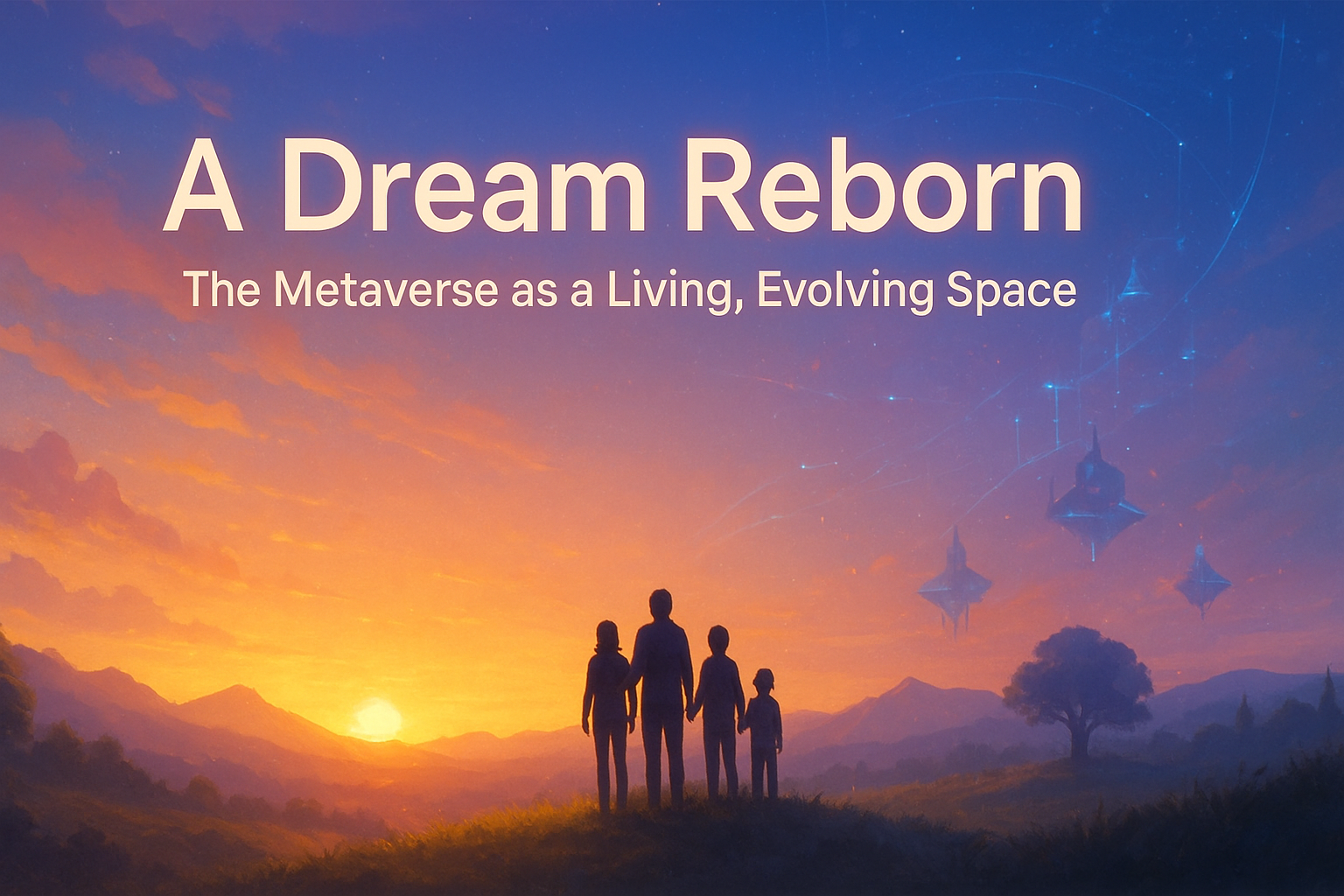
.png)
.png)
.png)
.png)
.png)
v2.png) The First Hype Cycle: When the Metaverse Became Real (and Then Faded)
The First Hype Cycle: When the Metaverse Became Real (and Then Faded).png)