 METAVERSE BLOG
 The Metaverse in 2026
The Metaverse in 2026: Less Hype, More Humanity
There is a sentence I have heard many times over the last couple of years: “The Metaverse is dead.”
I understand why people say it.
The word ‘Metaverse’ was overused. It was inflated by corporate presentations, speculative investment decks, NFT fever, headset marketing, and unrealistic promises of a near-future internet where everyone would spend their working and social lives inside immersive 3D spaces. Then came the hangover. Some platforms disappeared. Others reduced their ambitions. Budgets were cut. The media moved on to the next big story: generative AI.
But I do not believe the Metaverse is dead.
I believe the Metaverse has entered a more honest phase.
The Metaverse of 2026 is not the simple, unified, headset-first vision that many companies tried to sell a few years ago. It is fragmented, uneven, sometimes disappointing, but also quietly alive. It exists in creator platforms, social VR communities, virtual economies, digital twins, immersive learning environments, game worlds, events, simulations, and persistent online places where people meet not just to consume content, but to do things together.
And perhaps that is the healthier definition.
The Metaverse was never supposed to be only a high-end technology stack. It was never supposed to be just VR headsets, corporate campuses, photorealistic avatars, blockchain ownership, or branded virtual showrooms. At its best, it is a human environment: a place people can build, extend, inhabit, and shape together.
That distinction matters more in 2026 than ever.
A market after the fever
The current state of the Metaverse is contradictory.
On the one hand, some of the best-known social VR and virtual world projects have either shut down, changed direction, or reduced their original ambitions. Microsoft shut down AltspaceVR in March 2023 and shifted focus toward Microsoft Mesh and workplace-oriented immersive experiences (Road to VR). Mozilla ended support for Mozilla Hubs on May 31, 2024, although the codebase continues under the Hubs Foundation (Mozilla Support). Meta discontinued Horizon Workrooms as a standalone app on February 16, 2026, deleting associated Workrooms data after that date (Meta). Rec Room, one of the better-known cross-platform social creation worlds, announced that it would close on June 1, 2026, despite reporting that it had reached more than 150 million players and creators over its lifetime (Rec Room).
Spatial is another useful example, although it should be described carefully. The company is not shutting down entirely. Instead, Spatial announced that, effective July 27, 2026, it will sunset its Free and Pro subscription tiers and discontinue 3D World hosting for those Creator platform users. Enterprise customers, according to Spatial, are not affected. The reason given was not a lack of imagination or a simple rejection of immersive worlds, but economics: the cost of hosting and scaling open multiplayer 3D environments had grown significantly, and Spatial said that revised pricing models, tiered hosting, or partnerships would still have pushed costs to a level that independent creators and small studios could not reasonably absorb. This makes Spatial’s decision especially relevant for the wider Metaverse discussion. It shows that creator-driven virtual worlds are not only a design challenge, but also an infrastructure and sustainability challenge. If a platform depends on persistent hosting, multiplayer access, asset storage, moderation, and user support, the business model must be as carefully designed as the world itself (A Note to Our Creator Community — Spatial).
These are not small signals. They show that running a persistent, social, creator-driven world is difficult. It is not enough to have a strong idea, a beautiful demo, or even a passionate early community. These platforms need sustainable economics, strong moderation, reliable infrastructure, accessible creation tools, and a clear reason for people to return again and again.
On the other hand, it would be wrong to conclude that immersive worlds have failed. Roblox remains a massive user-generated 3D platform, and its creator economy continues to be significant. Roblox reported that creators earned more than $1 billion globally through DevEx from March 2024 to March 2025 (Roblox). Fortnite’s creator ecosystem, especially through Creative and UEFN, has become another important model for large-scale participatory 3D content, with Epic distributing a portion of eligible revenue through engagement payouts (Epic Games Developers). VRChat continues to show that social presence, identity, performance, avatar culture, and community-led creation can still attract a serious audience; Steam data in 2026 shows tens of thousands of concurrent VRChat users even before counting non-Steam access (Steam Charts). Resonite, while much smaller and more technically demanding, is interesting because it represents a highly creator-focused branch of social VR, with in-world building and scripting at its core (Road to VR).
So the story is not “the Metaverse failed.”
The story is that some Metaverse strategies failed.
The distinction is important.

AI has changed the conversation
The strongest trend in 2026 is not VR. It is AI.
That may sound strange in an article about the Metaverse, but it may actually be the key to the next phase. Generative AI changes who can build, how fast they can build, and what kind of worlds can be created by small teams or even individuals.
Roblox has introduced Cube 3D, a generative AI system designed to create 3D models and environments directly from text, with future support for image inputs (Roblox). This points toward a very different creator workflow. Instead of every virtual object requiring traditional 3D modeling skills, AI can become a co-creator: a sketching partner, prototyping tool, asset generator, scripting assistant, and world-building accelerator.
NVIDIA’s Omniverse has also shifted the discussion toward “physical AI,” industrial digital twins, robotics simulation, and physically grounded virtual environments (NVIDIA). This is a very different kind of Metaverse from the consumer social VR fantasy. It is less about dancing avatars and more about factories, logistics, manufacturing, robotics, engineering, and training. But it is still part of the wider immersive computing landscape.
Apple’s Vision Pro and visionOS have helped push the language toward “spatial computing,” with spatial widgets, more expressive Personas, shared spatial experiences, and enterprise APIs for spatial applications (Apple). Whether or not high-end headsets become mass-market devices soon, spatial computing has influenced how the industry thinks about blending digital content with physical space.
This is why I believe the next Metaverse will not be built by hardware alone.
It will be built by the combination of AI-assisted creation, accessible virtual world platforms, persistent communities, spatial interfaces, and practical use cases.
AI may lower the barrier to entry. But that does not automatically solve the deeper problem.
A world that is easy to generate is not automatically a world worth visiting.
Why some platforms struggle
The failures and shutdowns of recent years should not make us cynical. They should make us more precise.
Many Metaverse projects struggled because they were designed around technology first and human behavior second.
They assumed that people would adopt headsets because the experience was impressive. They assumed that presence alone would justify friction. They assumed that corporate backing could replace organic community growth. They assumed that “immersive” automatically meant “better.”
But people are practical.
They ask simple questions: Why should I go there? Who is waiting for me? What can I do there that I cannot do more easily somewhere else? Can I build something? Can I belong? Can I return tomorrow and find continuity?
This is where many projects failed.
They offered spaces, but not enough purpose. They offered avatars, but not enough identity. They offered events, but not enough community before and after the event. They offered tools, but not enough creative ownership. They offered impressive technology, but not enough human reason.
There were also operational problems. Persistent virtual worlds are expensive to run. Moderation is hard. Safety is hard. Identity management is hard. Creator economies are hard. Cross-platform access is hard. Performance optimization is hard. Community management is hard. And once a platform has real users, every technical decision becomes social.
A virtual world is not just software.
It is a living system.
That is why mature platforms are so interesting.
The Second Life lesson
Second Life is still one of the most important examples in this conversation.
Not because it is the newest. It is not.
Not because it is the most technologically fashionable. It is not.
But because it has survived.
Launched in 2003, Second Life has outlived several waves of Metaverse hype. It has seen brands arrive and leave, journalists discover and rediscover it, competitors promise to replace it, and new technologies claim to make it obsolete. Yet it is still there: a user-created virtual world with communities, places, events, economies, identities, and stories.
Linden Lab’s current mobile work is especially interesting because Second Life Mobile is now available free for everyone, with thousands of user-created places described on the official mobile page (secondlife.com). The platform also still has a meaningful creator economy. GamesBeat reported that Linden Lab had spent $1.3 billion building Second Life since 2003 and had paid $1.1 billion to creators (GamesBeat).
Second Life’s age may actually be one of its strengths.
It has accumulated culture. It has habits. It has residents rather than just users. It has a memory. It has communities that were not created for a quarterly product launch. And it has creators who understand that the value of a virtual world is not only in the graphics engine, but in what people do with it.
Of course, Second Life also has challenges. Any mature platform does. It has technical legacy, onboarding friction, a learning curve, and cultural complexity. But it proves something crucial: people will stay in a virtual world when they feel that it belongs to them.
That is a lesson newer platforms should take seriously.

New does not always mean better
When people ask about new Metaverse platforms in 2026, I think we need to be honest. There are interesting developments, but there is no single new platform that has clearly replaced the old dream.
Instead, the field has split.
Roblox and Fortnite show the power of mass-market creator ecosystems. VRChat shows the strength of avatar identity, social presence, and community-driven culture. Resonite shows what highly capable in-world creation can look like for a smaller but serious creator audience. Second Life shows the durability of mature user ownership and world-building. Industrial digital twin platforms show the enterprise value of simulation. Spatial computing shows how immersive interaction may move beyond the headset-only model.
This fragmented landscape may disappoint people who wanted one universal Metaverse.
But perhaps fragmentation is not a failure.
Perhaps it is a sign that the Metaverse is becoming less of a product category and more of a design pattern.
A virtual world for teenagers creating games is not the same as a virtual simulation for factory planning. A social VR club is not the same as an immersive classroom. A digital twin of a city is not the same as a fantasy roleplay region. A corporate training space is not the same as a creator marketplace.
They should not all look the same.
The question is not: Which platform wins?
The better question is: Which human need are we designing for?
The way forward: less spectacle, more usefulness
For me, the future of the Metaverse depends on a shift in priorities.
We need fewer technology-first projects and more human-first environments.
That means starting with people, not devices. It means asking what users actually need: learning, belonging, collaboration, creativity, confidence, social contact, practice, exploration, expression, or shared decision-making. Then we choose the technology that supports that need.
Sometimes that technology will be VR.
Sometimes it will be a browser-based 3D world.
Sometimes it will be a desktop client.
Sometimes it will be mobile.
Sometimes it will be a simple multiplayer environment with voice, chat, objects, and shared tasks.
And sometimes the most powerful element will not be technology at all. It will be the scenario, the facilitation, the community rules, the story, the onboarding, the rituals, the shared goals, and the imagination of the participants.
This is especially important for education, training, senior communities, SME collaboration, public participation, and cultural projects. These use cases do not always need photorealism. They do not always need expensive headsets. They do not always need blockchain ownership or AI-generated everything.
They need reliability.
They need low barriers.
They need understandable interfaces.
They need moderation and trust.
They need operating costs that make sense after the pilot project is over.
They need people who maintain the environment, not just people who launch it.
This is where I see real opportunity.
The Metaverse should be built by humans for humans
One of the biggest mistakes of the last Metaverse hype cycle was the idea that the future would be delivered from the top down.
A large company would build the platform. Users would arrive. Brands would rent spaces. Work would move there. Entertainment would move there. Education would move there. Somehow, the new internet would be centrally designed and globally adopted.
But virtual worlds rarely work that way.
The strongest ones grow from participation.
People need the ability to shape the world. They need to create objects, rooms, rituals, events, businesses, performances, and stories. They need to bring their own culture. They need to feel that they are not merely entering someone else’s product, but helping to build a shared place.
This is why creator tools matter.
It is also why governance matters.
If the Metaverse is to become meaningful, it cannot be only a collection of high-end environments controlled by a few corporations. It should include spaces that can be planned, built, extended, and maintained by communities, educators, SMEs, artists, local organizations, developers, and users themselves.
That does not mean every platform must be open source. It does mean we should care about portability, interoperability, content ownership, export options, moderation tools, transparent rules, and economic fairness.
A virtual world without agency is just a 3D website.
A virtual world with agency can become a place.
Simpler may be stronger
There is a temptation in this field to always chase the next technical milestone: better graphics, better avatars, better AI, better physics, better headsets, better tracking, better rendering.
All of that is valuable.
But I increasingly believe that the most important Metaverse projects of the next few years may be simpler than expected.
They may be browser-accessible.
They may run on normal laptops.
They may support mobile access.
They may use stylized graphics rather than photorealism.
They may focus on small groups instead of massive concurrency.
They may prioritize building tools over visual perfection.
They may use AI to assist creators, not replace them.
They may be designed for low operating and maintenance costs from the beginning.
This is not a step backward. It may be a realistic path forward for many use cases.
A virtual world that ten people can maintain and one thousand people can use creatively is more valuable than a spectacular demo that disappears when the funding round ends.
A platform that allows teachers, trainers, small businesses, museums, communities, and local organizers to build meaningful spaces may have more long-term impact than another glossy corporate showroom.
Imagination can be more important than technology.
Because imagination gives people a reason to enter.
Technology only opens the door.
A more optimistic view
So where does that leave us in 2026?
The Metaverse is no longer the shiny promise it was during the hype years. Good. That promise was too simple.
What remains is more interesting.
We have learned that headsets alone do not create adoption. We have learned that corporate investment alone does not create community. We have learned that virtual presence must be useful, social, creative, or emotionally meaningful. We have learned that platforms need sustainable economics. We have learned that people care less about the word “Metaverse” than about what they can actually do together.
And we have also learned that virtual worlds do not disappear just because hype cycles end.
Some close. Some evolve. Some quietly grow. Some survive for decades.
The next phase should be less about claiming ownership of “the Metaverse” and more about building good virtual places.
Places where people can learn by doing.
Places where remote teams can make decisions faster.
Places where seniors can find companionship.
Places where creators can earn.
Places where students can experiment.
Places where communities can gather.
Places where imagination is not locked behind expensive hardware or corporate permission.
That, to me, is still a future worth working on.
Not because the Metaverse must become the next internet.
But because human beings have always built shared spaces for meaning, cooperation, play, learning, trade, art, and belonging.
Sometimes those spaces are physical.
Sometimes they are digital.
And sometimes, if we design them well, they can become something in between: not an escape from the human world, but an extension of it.
Coming Next Week
I am starting a new 24-part LinkedIn article series: The Making of a Virtual World Platform.
The series follows my development journey behind Cybalounge 2, a lightweight browser-based virtual world platform for learning, work, and community. It is not a coding tutorial and not a collection of technical tricks. Instead, it looks at the decisions behind the platform: why simplicity matters, why browser-first access lowers barriers, why operating costs must stay manageable, and why creator experience is just as important as user experience.
Across the series, I will explore architecture, avatars, controls, collision detection, communication, onboarding, accessibility, atmosphere, world building, low-code interaction, moderation, performance, and future ideas such as AI, an Avatar Studio, and Machinima production.
The central question is simple:
Can virtual worlds become practical again if we make them easier to enter, easier to build, easier to trust, and easier to operate?
Now available on Amazon!
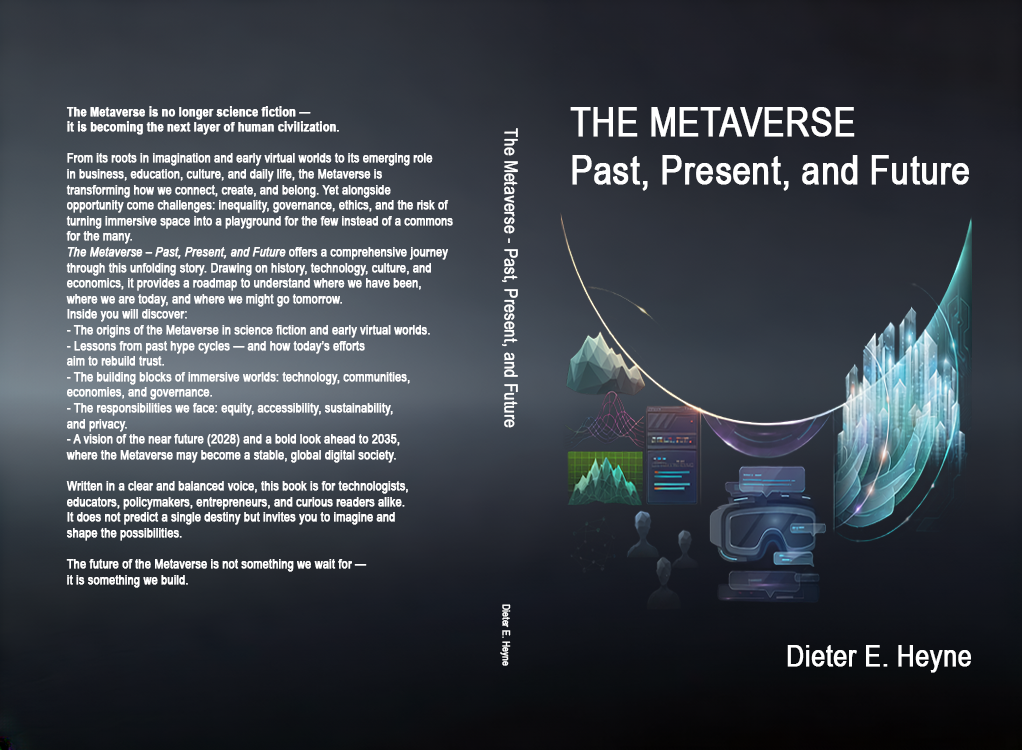
Discover the Metaverse Beyond the Hype
The Metaverse is no longer a futuristic fantasy, it is rapidly becoming a new layer of human society. But what is it really? Where did it come from? And what might it become over the next decade?
The Metaverse – Past, Present, and Future takes readers on a fascinating journey from the earliest virtual worlds and science-fiction visions to today’s emerging immersive platforms, digital economies, and online communities. Along the way, it explores the technologies powering the Metaverse, the opportunities it creates for education, work, and culture, and the challenges of governance, privacy, inclusion, and sustainability.
Looking beyond today's headlines, the book offers a balanced and inspiring vision of how immersive technologies could transform cities, learning, creativity, and daily life by 2035.
Whether you are a business leader, educator, technologist, policymaker, or simply curious about the future, this book provides the context, insight, and perspective needed to understand one of the most important technological and societal shifts of our time.
The future of the Metaverse is not something we await, it is something we create.
About the Author
Dieter E. Heyne is a Metaverse pioneer and lifelong technologist, born in Munich in 1966. With a master’s degree in applied computer science and over three decades of experience as an IT entrepreneur, software architect, and consultant, he has always been at the frontier of digital innovation. His journey into virtual worlds began in 2007 with Second Life and sparked a deep, ongoing exploration of the Metaverse as a space for education, collaboration, and immersive experiences.
Since 2012, Dieter has been developing and refining a web-based virtual world platform, driven by a vision to make the Metaverse accessible, meaningful, and transformative. As a frequent speaker and thought leader at Metaverse events, he shares his insights on how virtual environments can reshape human interaction, learning, and culture. He is the founder and CEO of Metaverse School GmbH, a company dedicated to promoting Metaverse literacy and helping people and organizations understand the power and promise of these emerging digital realms.
About Metaverse School GmbH
Metaverse School GmbH was founded in 2017 by Dieter E. Heyne, who continues to lead the company as its CEO. The company emerged from decades of consulting experience in software architecture, project management, quality assurance, information security, and data protection. Building on this strong technological foundation, Metaverse School GmbH is dedicated to promoting the responsible and purposeful use of immersive 3D environments, for education, collaboration, training, and simulation.
A core mission of the company is to raise awareness of the Metaverse’s potential across business, education, and society. In support of this goal, Dieter Heyne regularly speaks at national and international conferences as well as Metaverse-focused events. Through real-world examples and deep expertise, he demonstrates how immersive technologies can already create meaningful value today.
Disclaimer
Some portions of this content were created or refined with the assistance of artificial intelligence (AI) using tools such as OpenAI’s ChatGPT. The ideas, structure, and editorial direction remain the responsibility of the author. While every effort has been made to ensure factual accuracy and original expression, readers are encouraged to approach speculative or future-facing statements with critical thought.
This series does not represent the views of any specific company or platform and is intended to inspire open discussion around the evolving concept of the Metaverse.