 METAVERSE BLOG
 Chapter 02: Simplicity Is Not a Limitation - It Is a Product Strategy
 Whenever I start thinking about a new feature for Cybalounge 2, there is a small but important question in the background: does this make the platform better, or does it only make the platform bigger? The difference matters. Bigger systems are not automatically better systems. In software development, and especially in platform development, it is surprisingly easy to confuse growth with progress. A new menu, a new mode, a new backend component, a new configuration option, a new editor, a new service, a new permission layer. Each of these may look useful on its own. But together they can create a system that becomes harder to understand than the problem it was supposed to solve.
This is one reason why simplicity is at the center of my approach to Cybalounge 2. I do not mean simplicity in the sense of being small, weak, or unfinished. I mean simplicity as a deliberate product decision. The goal is not to avoid complexity at all costs, because a virtual world platform is naturally complex in some areas. It needs rendering, movement, avatars, communication, collision detection, user interface, synchronization, content loading, optimization, and many other things. But the question is where complexity is truly necessary and where it is only the result of habit, fear, or premature ambition.
Many platforms become complicated because they try to solve every possible future problem in the first version. They include advanced administration, detailed permissions, powerful editors, plugin systems, databases, dashboards, analytics, identity layers, workflow automation, and complex deployment scenarios before the core experience has proven itself. This can be impressive from an engineering perspective, but it can also make the platform difficult to adopt. A technically powerful system may still fail if small teams cannot operate it, if creators cannot understand it, or if users are overwhelmed before they even enter the world.
Cybalounge 1 was exactly like this. It was huge, powerful, and complicated. And that is why Cybalounge 2 starts from a different point. I want to ask what is necessary to create a convincing, useful, browser-based virtual world experience, and what can wait. This does not mean that advanced features are rejected forever. It means they must earn their place. A feature should not be added only because it is possible, or because another platform has it, or because it sounds good in a feature list. It should be added because it improves the experience for users, creators, operators, or customers in a way that justifies its long-term cost.
The long-term cost is the key. Every feature has a development cost, but that is only the beginning. It also has a maintenance cost. It has a testing cost. It may have a security cost. It may increase the support burden. It may make documentation harder. It may introduce dependencies that need to be updated. It may create additional configuration that someone must understand later. In a platform that should be easy to operate, this matters enormously. A feature that looks small in the code can become expensive over time if it adds hidden operational complexity.
This becomes especially important when I think about the target operating cost. My goal is ambitious: the platform should be operable at around one US dollar or less per user per month. That number is not just a financial target. It is a design constraint. If the platform needs complex backend infrastructure, heavy databases, specialized hosting, constant administration, and expensive scaling from the beginning, that cost target becomes unrealistic. If the system can rely on static content where possible, simple deployment, efficient browser-side logic, and only the backend components that are truly needed, the target becomes much more believable.
Simplicity also helps security and privacy. A smaller backend surface is easier to protect than a large one. Less persistent data means fewer things to secure, fewer things to explain, and fewer things that can go wrong. This does not remove the need for serious security thinking, especially in multi-user environments, but it changes the baseline. Instead of building a complex system and then trying to secure every corner, I prefer to ask whether some corners can be avoided in the first place.
The same principle applies to the creator experience. If a world can be described in a structured JSON file, if assets can be organized in a clear folder structure, if worlds can be built locally and uploaded as static content, then creators gain transparency. They can see what belongs to a world. They can copy it, version it, test it, archive it, and move it. That may sound less glamorous than a huge online editor in the first version, but it may be more useful for many real projects. A simple workflow that creators understand is often more valuable than a powerful workflow they are afraid to touch.

Of course, simplicity always involves trade-offs. Some features will be postponed. Some ideas will be implemented in a more modest way at first. Some automation may be replaced by clear conventions. Some advanced customization may wait until the foundation is stable. This can be frustrating, especially for a developer who enjoys solving difficult technical problems. But a platform is not a collection of engineering achievements. It is a product that must be usable, maintainable, and trustworthy. Sometimes the more mature decision is not to add something yet.
There is also an emotional side to simplicity. Users do not usually admire architecture diagrams. They feel whether a system is clear or confusing. They feel whether a world loads reliably, whether controls make sense, whether the interface stays out of the way, whether they can find the microphone button, whether they can invite someone, whether they understand what is happening. Creators feel whether they can build something without asking the original developer for help every time. Operators feel whether the system can be hosted without constant attention. In all these areas, simplicity is experienced as quality.
This does not mean Cybalounge 2 should remain minimal forever. The platform should grow. It should gain better tools, richer worlds, stronger communication, more atmospheric effects, better onboarding, better accessibility, and eventually low-code or no-code interaction. But growth should be guided. The core should remain understandable. The architecture should not be sacrificed for short-term feature excitement. The user experience should not be buried under options. The operating model should not become heavier than the organizations it is meant to serve.
For me, this is the heart of the KISS principle in this project. Keep it simple does not mean avoid ambition. It means protect ambition from collapsing under its own weight. If virtual worlds are to become useful for education, training, collaboration, senior communities, events, digital twins, and other practical scenarios, they need to be sustainable. They need to be affordable. They need to be approachable. They need to be manageable by real people in real organizations. Simplicity is not the opposite of that vision. It is the discipline that makes the vision possible.
Now available on Amazon!
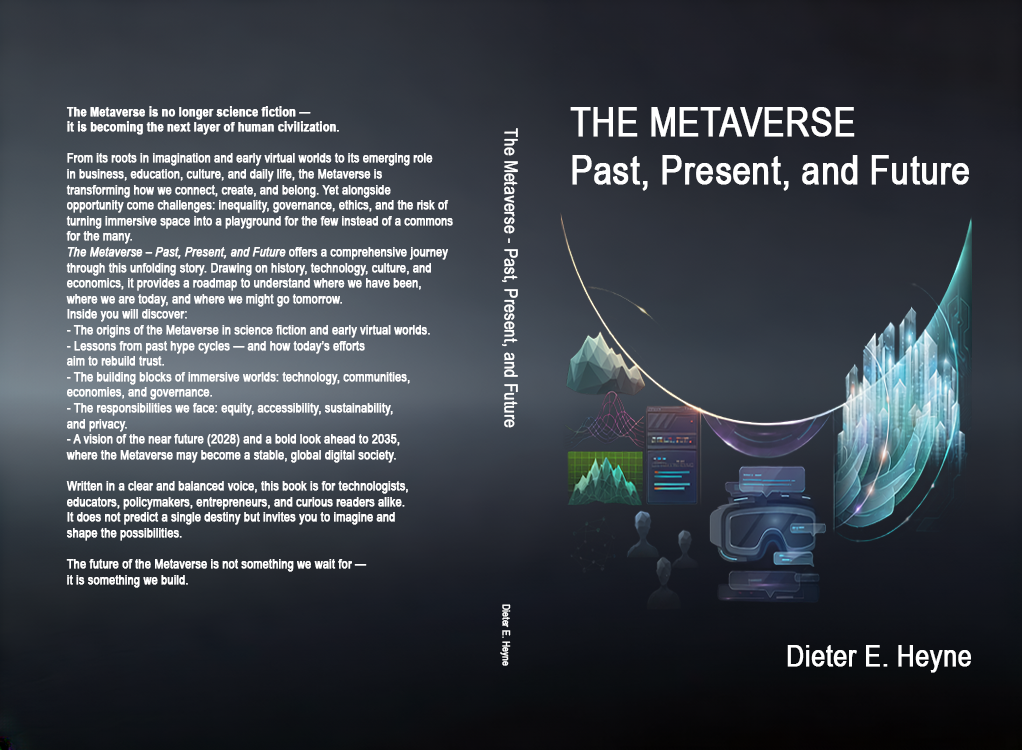
Discover the Metaverse Beyond the Hype
The Metaverse is no longer a futuristic fantasy, it is rapidly becoming a new layer of human society. But what is it really? Where did it come from? And what might it become over the next decade?
The Metaverse – Past, Present, and Future takes readers on a fascinating journey from the earliest virtual worlds and science-fiction visions to today’s emerging immersive platforms, digital economies, and online communities. Along the way, it explores the technologies powering the Metaverse, the opportunities it creates for education, work, and culture, and the challenges of governance, privacy, inclusion, and sustainability.
Looking beyond today's headlines, the book offers a balanced and inspiring vision of how immersive technologies could transform cities, learning, creativity, and daily life by 2035.
Whether you are a business leader, educator, technologist, policymaker, or simply curious about the future, this book provides the context, insight, and perspective needed to understand one of the most important technological and societal shifts of our time.
The future of the Metaverse is not something we await, it is something we create.
About the Author
Dieter E. Heyne is a Metaverse pioneer and lifelong technologist, born in Munich in 1966. With a master’s degree in applied computer science and over three decades of experience as an IT entrepreneur, software architect, and consultant, he has always been at the frontier of digital innovation. His journey into virtual worlds began in 2007 with Second Life and sparked a deep, ongoing exploration of the Metaverse as a space for education, collaboration, and immersive experiences.
Since 2012, Dieter has been developing and refining a web-based virtual world platform, driven by a vision to make the Metaverse accessible, meaningful, and transformative. As a frequent speaker and thought leader at Metaverse events, he shares his insights on how virtual environments can reshape human interaction, learning, and culture. He is the founder and CEO of Metaverse School GmbH, a company dedicated to promoting Metaverse literacy and helping people and organizations understand the power and promise of these emerging digital realms.
Besides talking and writing non-fiction about the Metaverse and Virtual Worlds, this vast knowledge now went into the creation of The Metaverse Enforcers, an ongoing series of high-tech science fiction novels, showcasing the potential development and dangers of the Metaverse in 2053.
About Metaverse School GmbH
Metaverse School GmbH was founded in 2017 by Dieter E. Heyne, who continues to lead the company as its CEO. The company emerged from decades of consulting experience in software architecture, project management, quality assurance, information security, and data protection. Building on this strong technological foundation, Metaverse School GmbH is dedicated to promoting the responsible and purposeful use of immersive 3D environments, for education, collaboration, training, and simulation.
A core mission of the company is to raise awareness of the Metaverse’s potential across business, education, and society. In support of this goal, Dieter Heyne regularly speaks at national and international conferences as well as Metaverse-focused events. Through real-world examples and deep expertise, he demonstrates how immersive technologies can already create meaningful value today.
Disclaimer
Some portions of this content were created or refined with the assistance of artificial intelligence (AI) using tools such as OpenAI’s ChatGPT. The ideas, structure, and editorial direction remain the responsibility of the author. While every effort has been made to ensure factual accuracy and original expression, readers are encouraged to approach speculative or future-facing statements with critical thought.
This series does not represent the views of any specific company or platform and is intended to inspire open discussion around the evolving concept of the Metaverse.
#Metaverse #VirtualWorlds #FutureOfTech #DigitalCommunity #CybaLounge #CL2