 METAVERSE BLOG
 Chapter 04: Browser First: Lowering the Entry Barrier
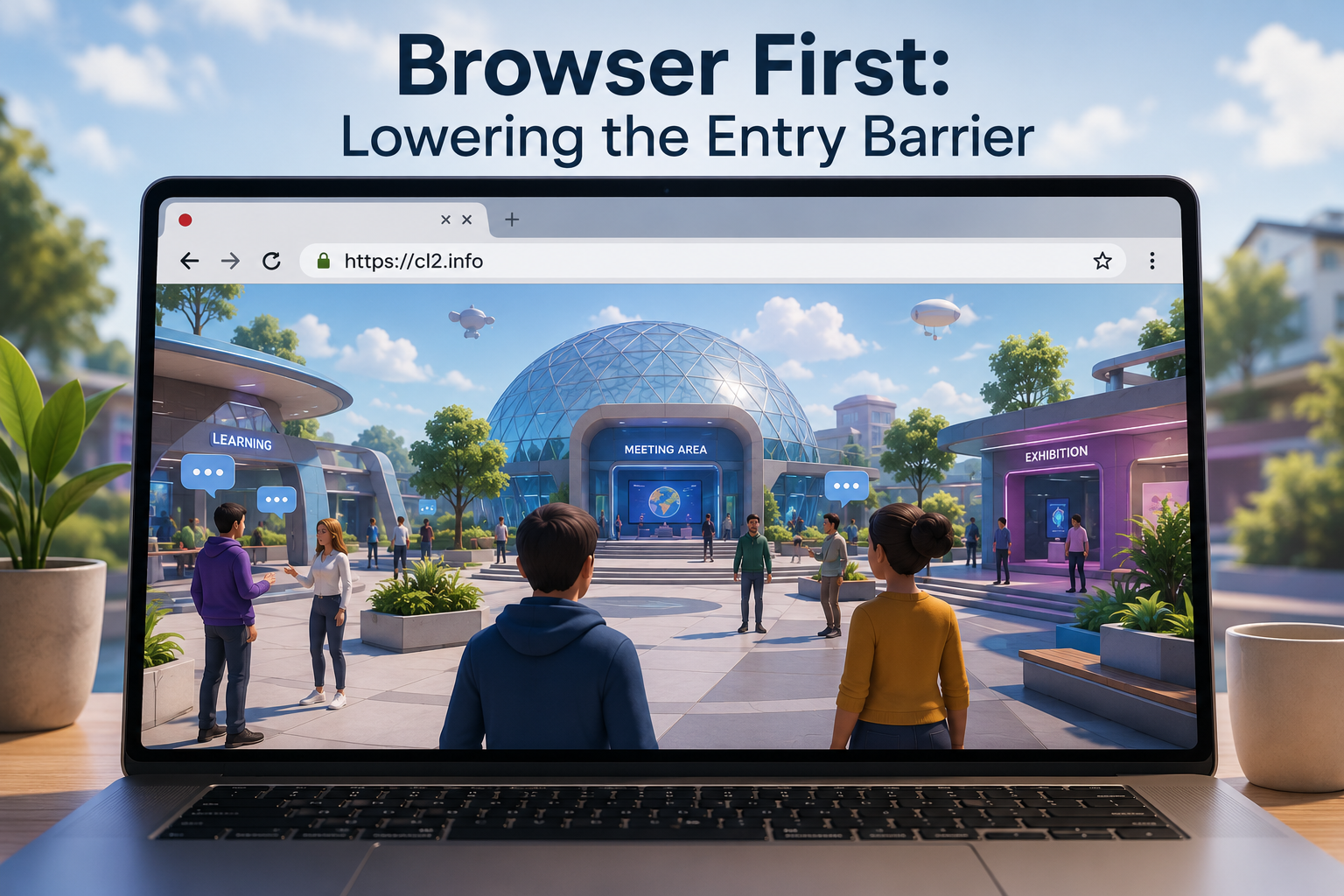
A virtual world can be beautifully designed, technically impressive, and full of meaningful possibilities. But if users cannot enter it easily, most of that value remains theoretical. This is one of the reasons why Cybalounge 2 is being built with a browser-first mindset. The browser is not only a runtime environment. It is an access strategy. It is the difference between "please install this first" and "open this link". For many real-world use cases, that difference is decisive.
Every additional step before entry creates friction. A download creates friction. Installation creates friction. Administrator permissions create friction. A plugin creates friction. A large update creates friction. A device requirement creates friction. A registration process creates friction. In some markets, users tolerate this. Gamers may install large clients. Professionals may install specialized tools if the value is clear. But in schools, training sessions, community projects, public sector environments, senior initiatives, and many business contexts, friction reduces participation. The easier the entry, the broader the audience.
The browser has become the most familiar digital doorway we have. People understand links. They understand opening a page. They may not understand graphics settings, runtime dependencies, or application permissions, but they understand a URL. That familiarity matters. If a teacher wants to invite learners into a virtual training environment, a link is easier than an installation guide. If a company wants to test an onboarding world, a browser-based entry is easier than coordinating software deployment. If a senior community wants to meet in a virtual space, the technical threshold must be as low as possible.
This does not mean the browser is an easy choice from a development perspective. Web-based 3D applications must live within real constraints. Performance varies between devices. Browsers differ. Memory is limited. Mobile behavior can be unpredictable. Access to hardware is controlled for good security reasons. Audio must often be unlocked through user interaction. Video, microphone, fullscreen, pointer lock, gamepad input, and WebXR each have their own details. A browser-first platform must accept these limits and work with them rather than pretend they do not exist.
There is also a temptation to compare browser-based worlds directly with high-end game engines. That comparison can be misleading. A native game engine can often offer deeper rendering control, more predictable performance, and more powerful tooling. But CL2 is not trying to become a game engine replacement. It is trying to become a practical virtual world platform. The relevant question is not whether the browser can match every high-end engine feature. The relevant question is whether the browser can deliver enough immersion, presence, communication, and interaction for meaningful use cases with much lower access friction.
For many scenarios, the answer is yes. A browser-based world can support spatial exploration, avatars, communication, basic interaction, environmental atmosphere, learning spaces, meeting areas, showcases, exhibitions, training rooms, and simple simulations. It can be deployed through normal web infrastructure. It can be updated centrally. It can be tested quickly. It can be shared with a link. This does not solve every problem, but it makes experimentation much easier. And experimentation is important because many organizations still need to discover what virtual worlds can do for them.
The browser-first approach also supports the operating cost goal. If the client does much of the rendering and interaction locally, and if worlds can be served as static content where possible, the backend can remain light. This matters when the target is one US dollar or less per user per month. A platform that requires heavy cloud infrastructure for every world, every object, and every interaction will struggle to reach that target. A platform that uses the browser effectively has a better chance of remaining affordable.
There is an important psychological aspect as well. A browser-based virtual world feels less like a separate universe that demands commitment and more like an extension of the web. This can make it less intimidating. Users can enter, try, leave, return, and share. For first-time users, especially those without a gaming background, this lowers the emotional barrier. They do not feel they are installing a complex system. They are visiting a place.
Of course, browser-first does not mean browser-only in every future scenario. There may be cases where optional VR support, specialized devices, or deeper integrations make sense. But optional is the key word. The default path should remain accessible. A platform that requires VR hardware before it becomes useful excludes many potential users. A platform that works on a normal desktop browser and can later extend into VR has a much broader base. For practical adoption, the simplest entry path should not be treated as a secondary version.

This also affects design decisions inside the platform. Controls must work with keyboard and mouse. Interfaces must be readable on common screens. Performance must be acceptable on normal devices. Asset sizes must be reasonable. World builders must understand that not every user has a high-end machine. Browser-first design therefore becomes a discipline that keeps the platform grounded. It constantly reminds the developer that the real target is not the ideal test setup, but the diverse reality of user devices.
For education and training, this grounding is essential. A virtual classroom that only works for half the learners is not a solution. A business onboarding world that requires IT support before every session is not practical. A senior community space that begins with installation problems may lose the very people it is meant to support. Browser-first access does not guarantee success, but it removes one of the largest adoption barriers before the experience begins.
In the end, the browser-first decision reflects a broader belief: the value of a virtual world starts at the entrance. The platform can have beautiful visuals, clever architecture, and rich interaction, but none of that matters if people do not get in. The best virtual world is not necessarily the one with the most features. It is the one people can actually enter, understand, and use. For Cybalounge 2, that means starting with the browser as the doorway.
Now available on Amazon!
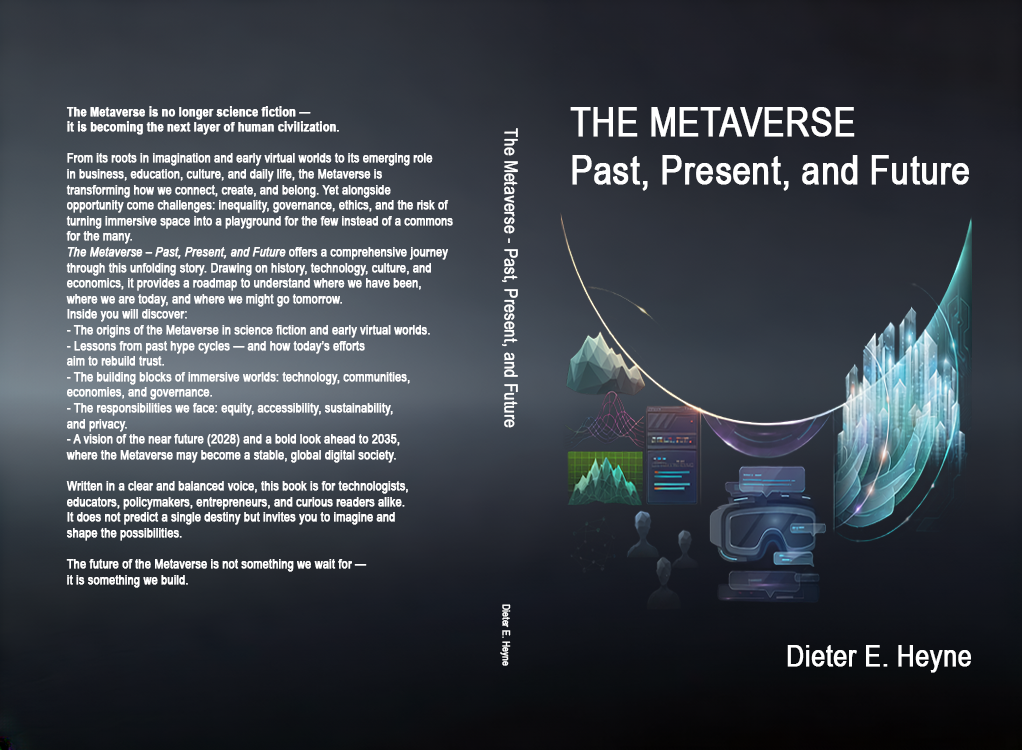
Discover the Metaverse Beyond the Hype
The Metaverse is no longer a futuristic fantasy, it is rapidly becoming a new layer of human society. But what is it really? Where did it come from? And what might it become over the next decade?
The Metaverse – Past, Present, and Future takes readers on a fascinating journey from the earliest virtual worlds and science-fiction visions to today’s emerging immersive platforms, digital economies, and online communities. Along the way, it explores the technologies powering the Metaverse, the opportunities it creates for education, work, and culture, and the challenges of governance, privacy, inclusion, and sustainability.
Looking beyond today's headlines, the book offers a balanced and inspiring vision of how immersive technologies could transform cities, learning, creativity, and daily life by 2035.
Whether you are a business leader, educator, technologist, policymaker, or simply curious about the future, this book provides the context, insight, and perspective needed to understand one of the most important technological and societal shifts of our time.
The future of the Metaverse is not something we await, it is something we create.
About the Author
Dieter E. Heyne is a Metaverse pioneer and lifelong technologist, born in Munich in 1966. With a master’s degree in applied computer science and over three decades of experience as an IT entrepreneur, software architect, and consultant, he has always been at the frontier of digital innovation. His journey into virtual worlds began in 2007 with Second Life and sparked a deep, ongoing exploration of the Metaverse as a space for education, collaboration, and immersive experiences.
Since 2012, Dieter has been developing and refining a web-based virtual world platform, driven by a vision to make the Metaverse accessible, meaningful, and transformative. As a frequent speaker and thought leader at Metaverse events, he shares his insights on how virtual environments can reshape human interaction, learning, and culture. He is the founder and CEO of Metaverse School GmbH, a company dedicated to promoting Metaverse literacy and helping people and organizations understand the power and promise of these emerging digital realms.
Besides talking and writing non-fiction about the Metaverse and Virtual Worlds, this vast knowledge now went into the creation of The Metaverse Enforcers, an ongoing series of high-tech science fiction novels, showcasing the potential development and dangers of the Metaverse in 2053.
About Metaverse School GmbH
Metaverse School GmbH was founded in 2017 by Dieter E. Heyne, who continues to lead the company as its CEO. The company emerged from decades of consulting experience in software architecture, project management, quality assurance, information security, and data protection. Building on this strong technological foundation, Metaverse School GmbH is dedicated to promoting the responsible and purposeful use of immersive 3D environments, for education, collaboration, training, and simulation.
A core mission of the company is to raise awareness of the Metaverse’s potential across business, education, and society. In support of this goal, Dieter Heyne regularly speaks at national and international conferences as well as Metaverse-focused events. Through real-world examples and deep expertise, he demonstrates how immersive technologies can already create meaningful value today.
Disclaimer
Some portions of this content were created or refined with the assistance of artificial intelligence (AI) using tools such as OpenAI’s ChatGPT. The ideas, structure, and editorial direction remain the responsibility of the author. While every effort has been made to ensure factual accuracy and original expression, readers are encouraged to approach speculative or future-facing statements with critical thought.
This series does not represent the views of any specific company or platform and is intended to inspire open discussion around the evolving concept of the Metaverse.
#Metaverse #VirtualWorlds #FutureOfTech #DigitalCommunity #CybaLounge #CL2