AI Didn’t Kill the Metaverse. It May Be What the Metaverse Was Missing.
For a while, it seemed as if somebody had quietly changed the PowerPoint template used by the entire technology industry.
In 2021 and 2022, almost every strategy presentation needed a Metaverse slide. Companies appointed Heads of Metaverse. Brands bought virtual land. Consultants produced Metaverse maturity models. Retailers opened virtual stores. Banks created branches in virtual worlds. Corporations experimented with VR meetings, virtual events, NFTs and digital twins.
Then the vocabulary changed.
Suddenly, every company needed an AI strategy.
Artificial intelligence moved from research departments into boardrooms almost overnight. CEOs were asked how they intended to use generative AI. Investors wanted to know which companies would benefit from it, and which would be disrupted by it. Software vendors hurried to put an AI assistant into virtually every product they sold.
The Metaverse, meanwhile, seemed to disappear from the conversation.
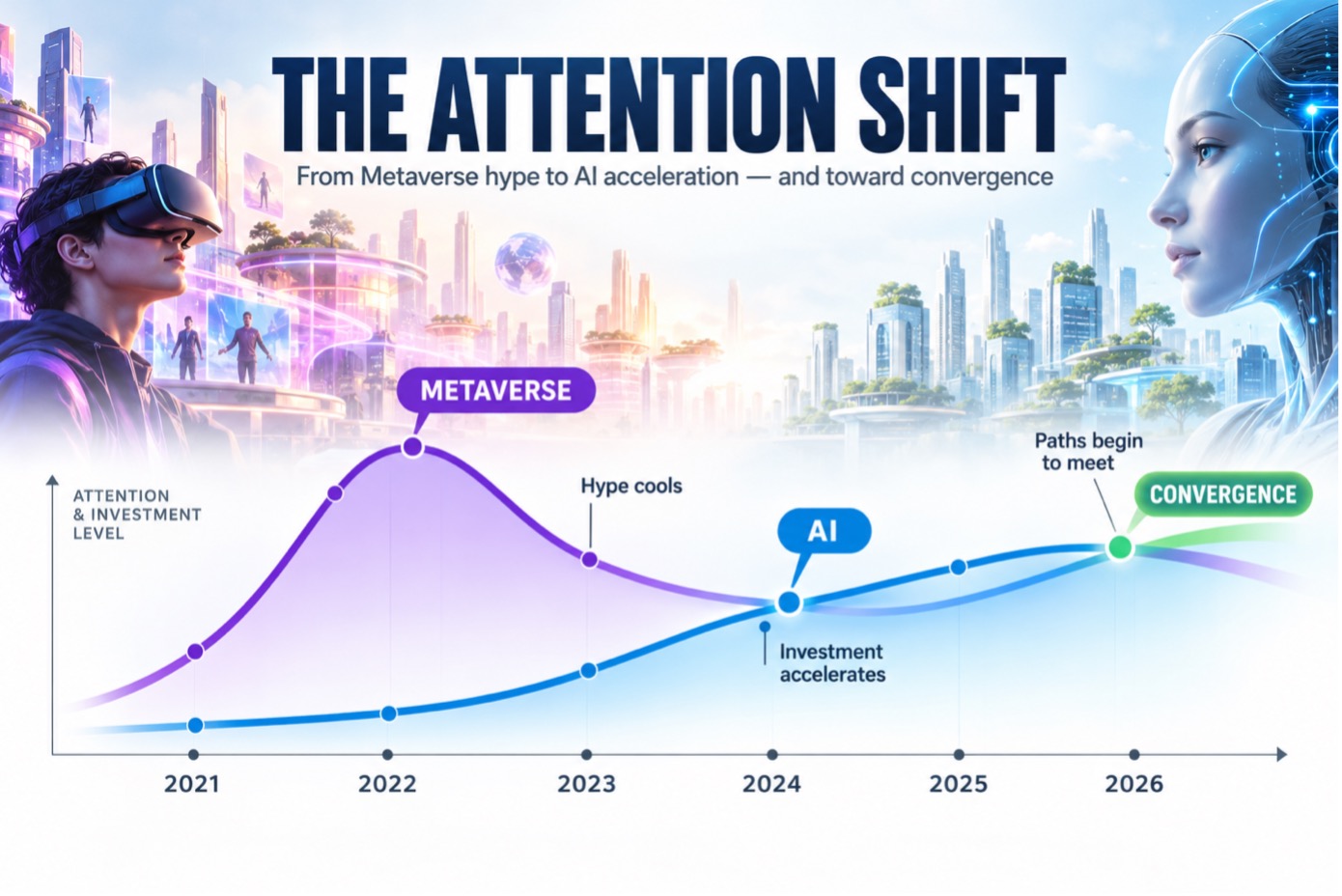
The financial numbers reflect part of that change. Crunchbase reported that funding for startups in virtual reality, augmented reality and virtual worlds fell 77 percent between the final quarter of 2021 and the first quarter of 2023. By 2023, Metaverse-related venture investment had reached a multiyear low. AI moved in the opposite direction. CB Insights calculated that generative-AI companies alone raised $21.8 billion across 426 deals in 2023, five times the funding of the previous year. In 2024, more than $100 billion in global venture funding went to AI-related companies, according to Crunchbase.
Corporate adoption followed the money. Stanford's 2025 AI Index reported that 78 percent of surveyed organizations were using AI in 2024, compared with 55 percent a year earlier. Reported use of generative AI in at least one business function more than doubled in the same period.
So perhaps the verdict is obvious.
AI won. The Metaverse lost. Except I don't think that is what happened at all.
I increasingly believe we have been comparing two technologies that were never meaningful competitors in the first place. Worse, by discussing the Metaverse versus AI, we may be missing one of the most interesting developments in digital technology:
AI may turn out to be one of the technologies the Metaverse was missing all along.
Why AI Won the Attention War
There were perfectly rational reasons why companies shifted their attention.
One of the biggest differences between the first wave of corporate Metaverse projects and generative AI can be demonstrated in about five seconds.
Open an AI chatbot. Type a question. Something happens. There is almost no conceptual barrier between the user and the technology.
The first experience may be impressive, disappointing or occasionally ridiculous, but the user immediately understands the basic proposition. Ask something. Get something.
The Metaverse rarely offered that simplicity.
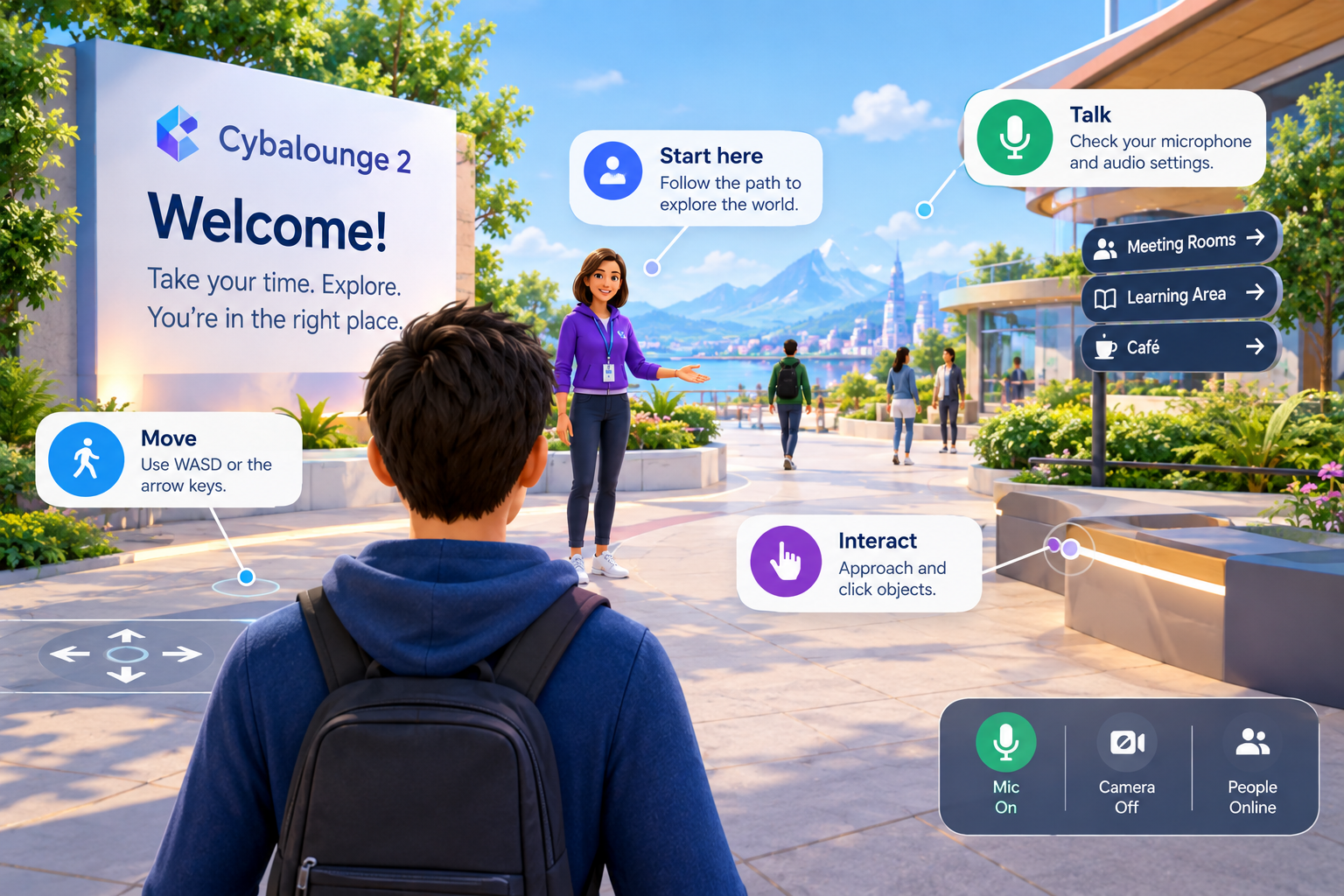
A typical immersive experience could require creating an account, choosing an avatar, learning unfamiliar navigation, downloading software, granting microphone permissions and working out why the camera was pointing at the ceiling before the user had experienced any actual value.
VR could add another layer: buy hardware, configure it, wear it, perhaps feel slightly sick, and then discover why you were supposed to be there.
That matters.
AI also had another decisive advantage: it attached itself to existing workflows. You didn't have to create an entirely new digital universe to use it.
AI could help write an email, summarize a meeting, analyze a spreadsheet, generate software code, translate documentation, create marketing copy, search information or answer a customer question. It entered processes companies already understood, and budgets companies already had.
The first corporate Metaverse projects frequently did the opposite. They began with the technology.
“We need a Metaverse presence.”
Fine. Why? Far too often, there was no convincing answer.
A company might spend substantial amounts of money building a beautiful 3D showroom and then discover the uncomfortable truth that the world did not contain a reason to visit it.
The result was what I like to call the expensive empty room problem.
The graphics could be excellent. The architecture could be spectacular. The avatars could be beautifully designed.
But if there was nothing particularly useful, interesting or compelling to do there, why would anyone return?
Technology had been mistaken for a use case. That was never going to end well.
At the same time, expectations surrounding the Metaverse became wildly inflated. We were told that enormous parts of our working, social and commercial lives would soon move into persistent virtual worlds. Headsets would become ubiquitous. Virtual real estate would become an entirely new asset class. Every brand apparently needed a piece of digital land.
Reality was rather less dramatic. People did not abandon browsers, smartphones, video meetings and physical offices to spend their entire working lives as avatars.
That did not prove that immersive training was useless. It did not prove that virtual communities had no future. It did not prove that digital twins, simulation, virtual events or spatial collaboration were bad ideas.
It proved that “the Metaverse” was not, by itself, a business model.
There is a difference. And this difference is important because something else was happening underneath the collapse of the hype.
The technologies continued to evolve.
Apple deliberately chose the language of spatial computing rather than the Metaverse when it introduced Vision Pro. Yet the enterprise applications Apple itself highlights include collaborative 3D design, immersive training, product visualization and guided work, concepts that would have comfortably appeared in a Metaverse presentation only a few years earlier. Apple also explicitly describes machine learning and AI as foundational to capabilities such as hand tracking, room mapping and Personas.
Siemens and NVIDIA went even further in the other direction: they continued to use the term Industrial Metaverse, while increasingly combining it with AI, digital twins, simulation and real-world industrial data.
Roblox never needed to wait for the word Metaverse to become fashionable again. It continued operating a huge ecosystem of persistent social 3D experiences and increasingly began injecting generative AI directly into the tools used to create them.
Perhaps the Metaverse did not disappear. Perhaps the label cooled while the underlying ideas became more practical. And perhaps AI is about to accelerate that process dramatically.
We Are Asking the Wrong Question
Here is my hypothesis:
AI and the Metaverse were never natural competitors because they solve fundamentally different problems.
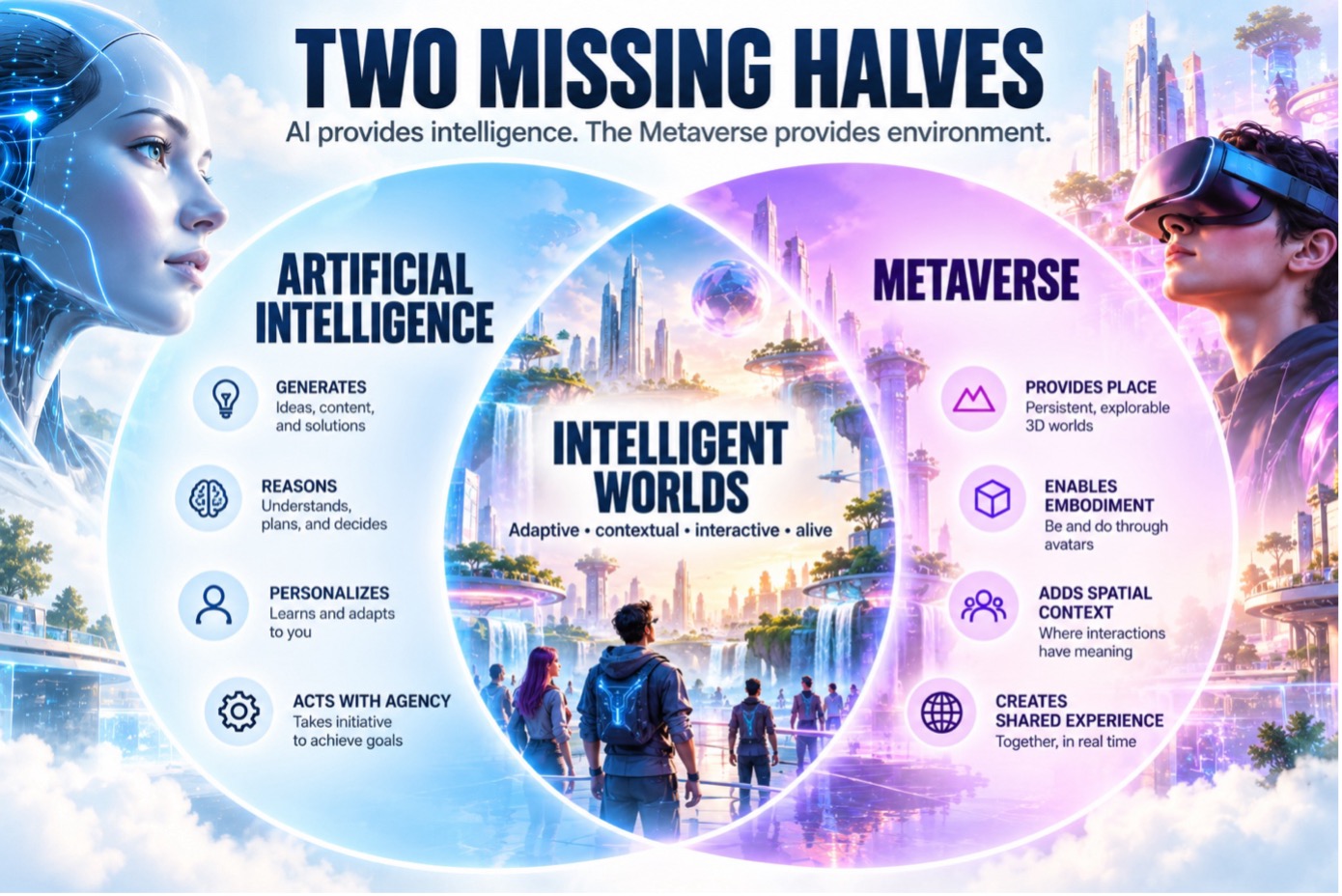
AI provides intelligence. The Metaverse provides environment.
AI can understand, generate, predict, interpret and increasingly act. Immersive environments provide place, embodiment, spatial relationships, interaction and shared experience.
An AI system can explain how an industrial machine works. A virtual environment can put you in front of that machine.
Combine the two and something different becomes possible.
An AI instructor can stand beside the virtual machine. It can understand which component you are looking at, recognize which procedure you are attempting, answer questions, detect mistakes, generate a malfunction and adjust the difficulty according to your previous performance.
The learner is no longer reading about a situation. The learner is inside the situation. And the situation can respond intelligently.
That is the convergence we should be talking about.
The first generation of virtual worlds created digital places. The current generation of AI creates digital intelligence. Put intelligence into places and we start moving from virtual worlds toward intelligent worlds.
From Interactive Worlds to Adaptive Worlds
One of the greatest weaknesses of traditional virtual environments is also one of the least discussed.
They are expensive to build.
Someone must create the buildings, furniture, objects, characters, animations, sound, interfaces and interactions. Someone must write the dialogue. Someone must script the quests. Someone must translate the content.
A sophisticated immersive environment may require programmers, 3D artists, level designers, animators, writers, sound designers and subject-matter experts.
That immediately limits who can create one.
Generative AI could change the economics dramatically.
Roblox provides an interesting glimpse of that future. Its Cube 3D foundation model, introduced in 2025, generates native 3D objects from prompts and is intended to evolve toward scene generation and what Roblox calls “4D creation”: objects and environments that are not merely three-dimensional but understand relationships and interactions. In July 2026, Roblox announced Build, allowing users to describe an idea and generate the beginnings of a playable experience, while professional tools are being expanded with AI agents for playtesting, analytics and experimentation.
This is more significant than simply generating a nicer chair. Imagine telling a creation system:
“Build me a small cybersecurity training office for ten participants. Include a reception area, four offices, a server room and a meeting room. Place fifteen security vulnerabilities throughout the building. Make five obvious, five moderately difficult and five hard to discover. Create an AI receptionist who knows which employees are allowed into which rooms. Then generate three different attack scenarios.”
That is no longer asset generation. That begins to resemble world generation.
And if the barrier to creating immersive experiences falls from a specialist project costing tens or hundreds of thousands of dollars to something a trainer, teacher, designer or small business can prototype with AI assistance, the creator economy changes.
The important transformation may not be that AI allows professionals to build virtual worlds faster. It may be that people who could never previously afford to build a world can build one at all.
The End of the Empty World?
Then there is the other problem: worlds need inhabitants.
Websites do not feel lonely.
Virtual worlds do.
Build a conference center for 500 people and put eight people inside it. The architecture suddenly works against you. Huge halls communicate absence. Empty booths feel abandoned. The impressive virtual city becomes a ghost town.
AI changes this equation.
For decades, games have used non-player characters. But traditional NPCs are essentially carefully disguised decision trees. They say what somebody wrote for them. They walk where somebody programmed them to walk. They react to conditions anticipated by the designer.
Generative agents introduce a different possibility.
A Stanford and Google research project published at UIST 2023 placed 25 generative agents into a small, simulated town. The agents maintained memories, reflected on experiences, planned activities, communicated and demonstrated emergent social behavior. A single initial idea that one character wanted to organize a Valentine's Day party eventually propagated through the community as agents invited others, rearranged plans and coordinated attendance.
NVIDIA has meanwhile been developing ACE technology from conversational NPCs toward autonomous game characters able to perceive, plan and act.
Now transfer that idea from games into business environments.
You enter the virtual showroom of a car manufacturer. Instead of clicking through menus, you speak to an AI product specialist.
“I have two children. I drive about 25,000 kilometers per year. We go skiing in winter and camping in summer. I need enough luggage space, but I don't want a huge SUV. What should I look at?”
The AI does not have to produce another chatbot answer. It can say:
“Come with me.”
It walks across the showroom. A vehicle changes configuration as you approach. The boot opens. Your typical luggage appears inside it. The AI highlights the ski hatch, folds the rear seats, changes the wheels, compares two battery options and asks whether you would like to try a simulated journey to the Alps.
Suddenly, product information has become an experience. This is where immersive commerce becomes interesting. Not because we rebuilt a website in 3D. Because the environment itself can respond to intent.
Personalization Changes the Nature of the World
Most digital experiences still work like theatre.
The scenery has been built in advance.
The script has been written.
You may choose different paths, but somebody anticipated those paths.
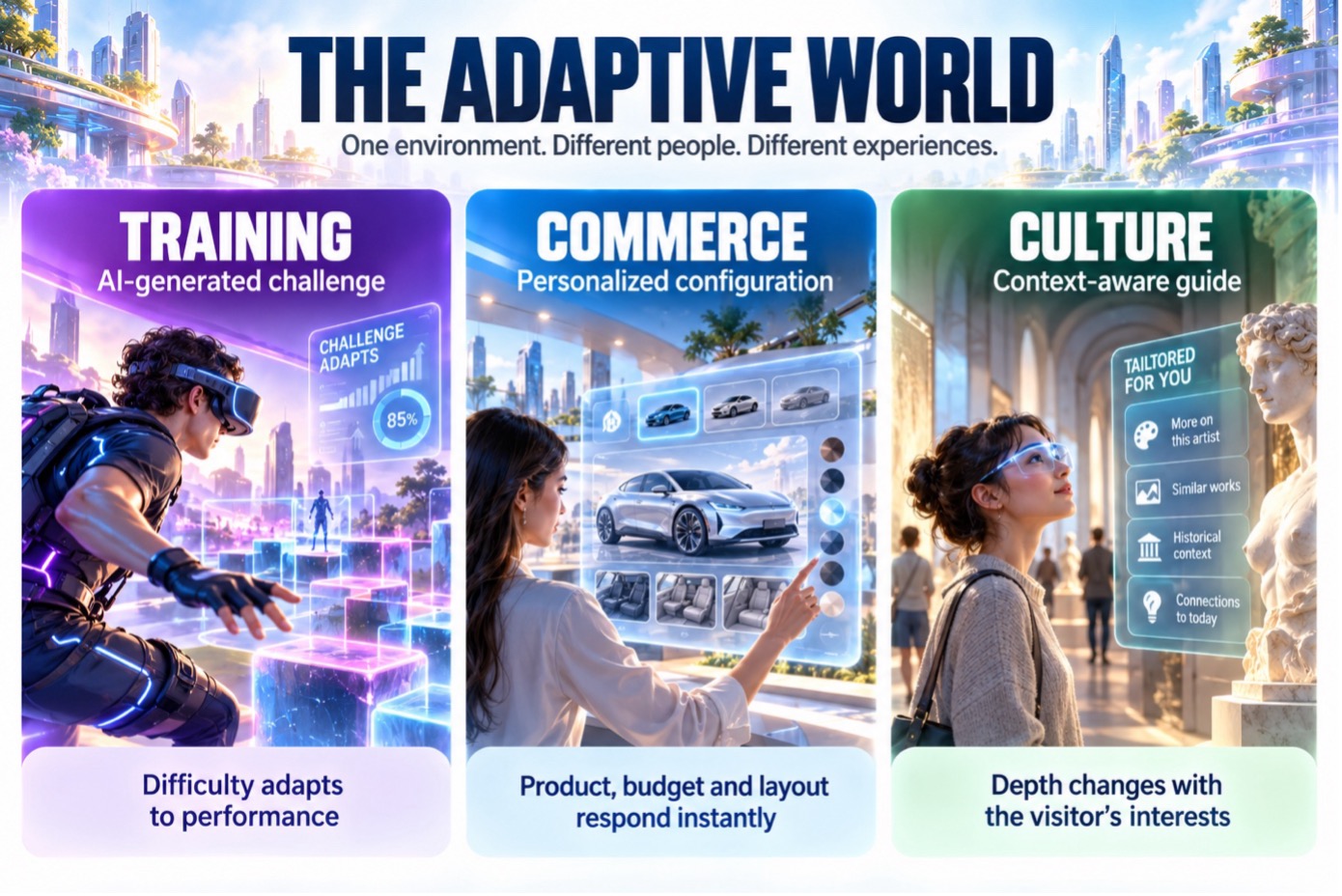
AI allows the environment to become adaptive.
A museum could recognize whether the visitor is a child encountering ancient Rome for the first time or an archaeologist interested in construction methods.
The room does not necessarily have to change. The experience can.
A virtual tutor can change its vocabulary. A simulation can increase its difficulty. A historical character can answer questions that were never included in a script. A training scenario can react to a participant who repeatedly makes the same mistake.
Imagine cybersecurity awareness training in which every participant receives exactly the same phishing exercise.
Now imagine the same environment noticing that one participant repeatedly identifies malicious email links but routinely misses social-engineering attacks involving authority.
The next scenario changes.
A convincing AI-generated manager enters the virtual office and asks for urgent help.
Now we are no longer simply measuring whether someone remembers information. We are testing whether that person can apply knowledge under pressure.
That is a transition from interactive learning to adaptive learning.
The same principle applies to sales, onboarding, tourism, entertainment, events and simulations.
AI Can Become Part of the Infrastructure
There is another convergence that may prove less spectacular visually but more important economically.
AI does not have to appear as a humanoid avatar standing behind a virtual reception desk. It can operate the world itself.
Virtual communities require moderation. Events need support. New users become lost. Content must be translated. Operators need to know which areas are used and which are ignored. Questions repeat. Problems occur outside office hours.
An AI layer can potentially support many of those functions.
It can guide newcomers without forcing everyone through the same tutorial. It can summarize conversations and events. It can help moderators identify problematic behavior. It can translate communication between participants. It can analyze where users abandon a training experience. It can explain controls when somebody gets stuck. It can recommend relevant sessions or people to meet.
And this matters because the operational economics of virtual worlds are difficult. A community of 100,000 active users can justify significant staffing. A professional community of 300 may not. But that smaller community may be enormously valuable.
AI could make smaller, specialized virtual worlds economically sustainable by reducing the amount of routine human intervention required to keep them useful.
The goal should not be to remove humans. It should be to reserve human attention for the moments where human attention actually matters.
The Relationship Works in the Other Direction
So far, this sounds like a story about AI saving the Metaverse. That would still underestimate the convergence. Because virtual worlds can give AI something it increasingly needs:
an environment.
Large language models are extraordinarily capable at manipulating abstractions. They work with text, images, code, documents, databases and increasingly audio and video.
But the physical world is not a document.
A warehouse is spatial.
A production line is spatial.
A hospital is spatial.
A city is spatial.
Objects have locations. Machines have states. Humans move around them. Actions produce physical consequences.
For an AI system expected to interact with reality, understanding that environment becomes essential.
This is where digital twins become particularly interesting.
A digital twin is not merely a beautiful 3D model of a factory. At its most useful, it combines geometry, state, sensor information, simulation and operational data.
Give AI access to such an environment and it can ask questions that are difficult to answer from spreadsheets alone.
What happens if this conveyor runs twenty percent faster?
Where will congestion occur?
Can this robot move safely through the warehouse while humans are working?
What happens to output if this machine fails?
Can we reorganize this production cell before moving the real equipment?
Simulation allows the answer to be tested before reality must pay for the mistake.
The Metaverse May Become Important to Machines
This may lead to one of the stranger consequences of the convergence:
Virtual worlds may eventually become as important to machines as they are to humans.
Perhaps more important.
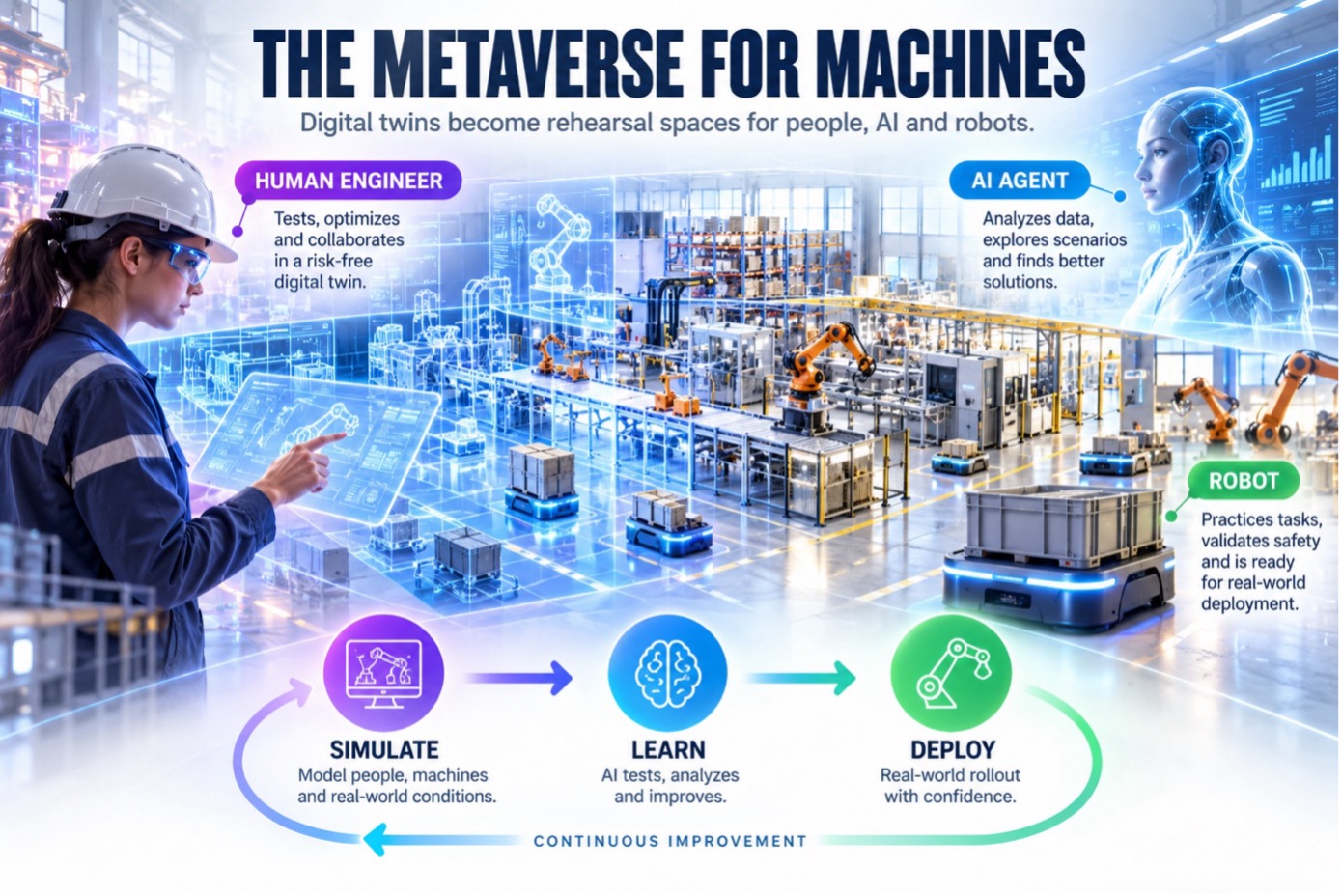
NVIDIA already treats digital twins and simulation as fundamental components of physical AI. Its current robotics workflows use Omniverse and Isaac technologies to create environments in which robots can learn navigation, perception and interaction before deployment into physical facilities. NVIDIA describes digital twins as environments for generating synthetic data, training robotic systems and developing sim-to-real workflows.
This changes the meaning of a virtual world. It is no longer simply somewhere we visit. It becomes somewhere an AI can learn.
A robot does not need to damage a thousand real warehouse shelves while learning how to navigate a distribution center.
A self-driving machine does not need to encounter every dangerous situation for the first time in reality.
An industrial AI can simulate alternatives inside a digital representation of the factory.
The virtual world becomes rehearsal space for the physical world.
And when people and machines share that simulation, something even more interesting happens.
Engineers can work inside the same digital environment in which AI agents model alternatives and robots are trained.
That begins to resemble the original idea of the Industrial Metaverse far more closely than a virtual nightclub ever did.
We Are Already Seeing the Convergence in Industry
The collaboration between Siemens and NVIDIA is particularly useful because it moves this discussion out of science fiction.
At CES 2026, Siemens introduced its Digital Twin Composer, combining Siemens digital-twin technology and engineering data with NVIDIA Omniverse libraries and simulation. Siemens explicitly describes the resulting environments as an Industrial Metaverse in which organizations can apply industrial AI, simulation and real-world data.
One early implementation with PepsiCo is especially interesting.
According to Siemens, digital twins of selected manufacturing and warehouse facilities allowed teams to recreate machines, conveyors, pallet routes and operator paths with physics-level accuracy. AI agents could then simulate and refine changes before anything was physically modified.
Siemens reports that the initial deployment delivered a 20 percent throughput increase, identified up to 90 percent of potential issues before physical changes and contributed to projected capital-expenditure reductions of 10 to 15 percent. These are vendor-reported results and should be treated accordingly, but even with that qualification the example illustrates the central point beautifully.
Nobody involved needs to decide whether this is an AI project or a Metaverse project. That distinction becomes almost meaningless. The value comes from combining the two.
And That Changes the Business Model
This is where the discussion becomes particularly interesting for operators and creators. AI does not simply make existing immersive experiences better. It could change what can be sold inside them.
Consider the humble NPC.
Historically, an NPC is content. Someone pays to build the character, writes the dialogue and places it inside the world.
An intelligent character can become a service.
A language-learning world could offer different AI tutors.
A professional training environment could provide specialist coaches.
A historical simulation could allow users to interact with carefully constrained AI representations of historical figures.
A game could offer an AI game master that creates adventures dynamically.
A corporate campus could provide product experts, onboarding guides or technical-support characters.
Suddenly the economic model starts looking less like selling static content and more like providing expertise on demand.
The same applies to personalization. Why should every user receive exactly the same experience?
A training provider might offer a standard simulation and a premium adaptive version in which AI monitors performance, creates new scenarios and produces an individualized assessment.
An event organizer might offer a basic conference ticket and a premium AI concierge that remembers interests, recommends sessions, introduces relevant participants and creates a personalized summary afterwards.
A tourism environment could offer ordinary exploration or a private AI guide tailored to architecture, history, food, family activities or accessibility needs.
The product becomes variable.
That creates room for subscriptions, premium tiers and usage-based services.
Creators may pay for advanced world generation, higher-quality assets, AI-assisted scripting, animation, voice synthesis, localization, automated testing or analytics.
Roblox's 2026 announcement is already heading in this direction: a base level of its new Build system is intended to be free, while additional capabilities are planned as paid options for power users.
This model is familiar from cloud computing. A creator does not necessarily buy a tool once. They consume capabilities.
Generate the environment.
Create fifty characters.
Translate them into twelve languages.
Run automated playtesting.
Simulate 500 virtual visitors.
Analyze the results.
Optimize the experience.
Publish.
AI becomes part of the production infrastructure, and therefore part of the platform economy.
From Virtual Showrooms to Intelligent Commerce
Commerce is another area where the convergence could finally solve one of the oldest Metaverse problems.
For years, companies created virtual stores because virtual stores sounded futuristic.
Unfortunately, many of them reproduced the least interesting parts of physical retail. Walk across a digital shop. Look at a digital shelf. Click something. Open a web page.
Why not simply open the web page in the first place? Intelligent spatial commerce can be different.
Imagine designing a kitchen.
You stand inside it at full scale.
“Make the cabinets darker.”
They change.
“Reduce the island by 30 centimeters.”
It changes.
“I need appliances but keep the total budget below €15,000.”
The AI proposes alternatives.
“Show me what this looks like at night.”
The lighting changes.
“Will the refrigerator door collide with the island?”
Open it.
Now the environment is not decoration around an online shop. The environment is the interface.
And conversational AI removes one of the biggest weaknesses of complex 3D interfaces: users no longer need to understand every menu. They can simply describe what they want.
Events That Don't End
There is one use case I find especially compelling: the persistent event.
Physical and virtual events share a strange weakness. Months of work go into creating them. Then they happen. And then they are over.
Presentations may survive as recordings. Slides may be uploaded. Perhaps there is an archive page nobody visits. But most of the event's value disappears with the audience.
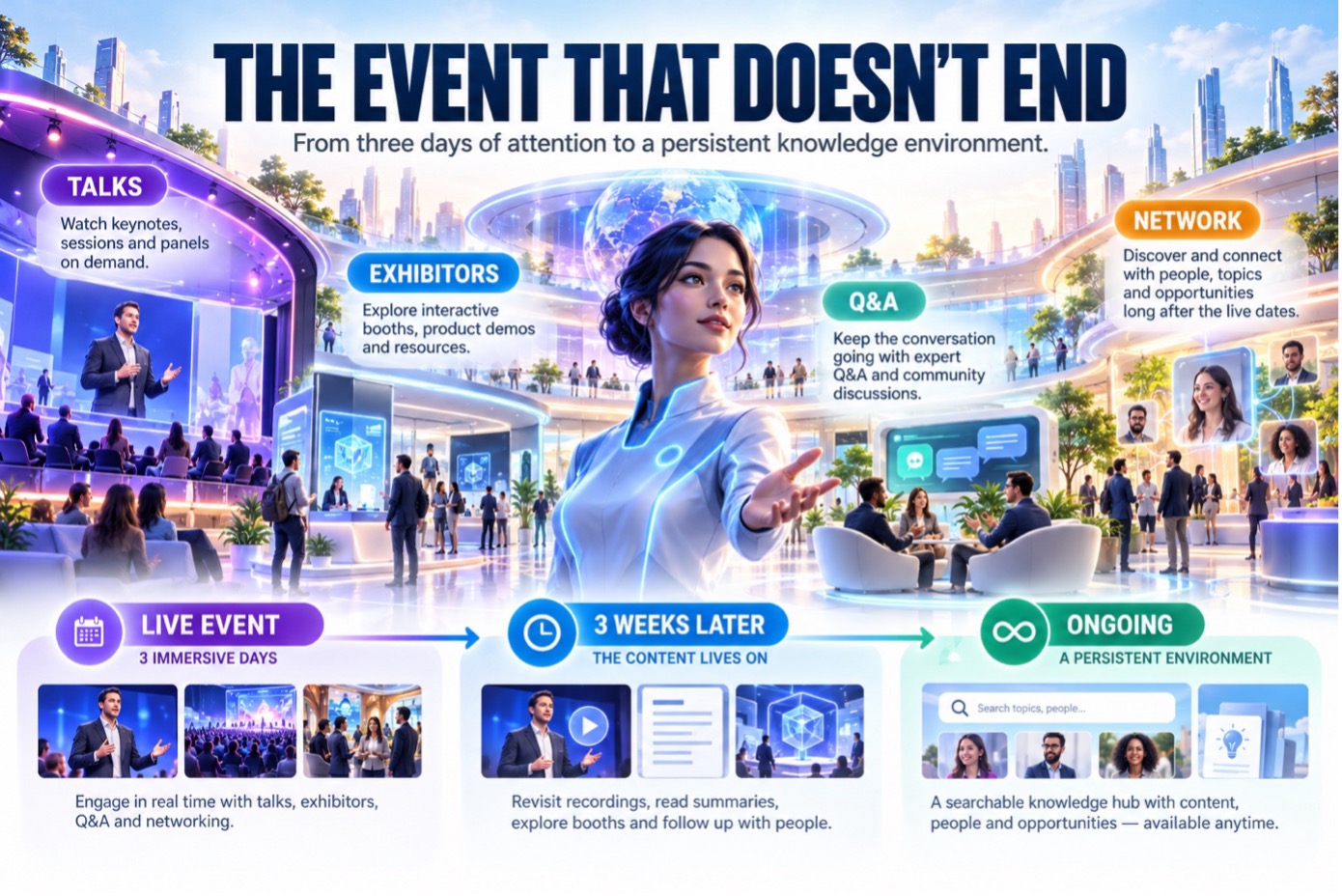
AI combined with a persistent immersive environment can change that. Imagine returning to a conference three weeks later. The exhibition booths are still there. The product demonstrations still work.
An intelligent host greets you.
“What were the most important discussions about cybersecurity during the event?”
It summarizes them.
“Show me the presentation about post-quantum cryptography.”
It takes you to the auditorium and starts the relevant section.
“Were there any companies presenting solutions relevant to smaller manufacturers?”
It identifies three exhibitors and guides you to their booths.
“What questions did visitors ask most frequently about this product?”
The booth's AI specialist knows.
A three-day event has become a continuously accessible knowledge environment. That creates a completely different commercial proposition. Sponsors are no longer buying three days of visibility. Visitors are no longer buying access to a moment.
The operator can sell continuing access, premium archives, intelligent knowledge services, updated product spaces or ongoing community membership.
The event does not have to end because the calendar says Sunday evening.
But AI Will Not Automatically Fix the Metaverse
There is a dangerous conclusion we should avoid.
Adding AI to a bad virtual world does not magically create a good one. If the purpose is unclear, AI will not provide it. If navigation is frustrating, an AI concierge may simply become an expensive apology for poor interface design. If nobody wants the experience, generating more content will not make the experience valuable.
And AI introduces its own substantial problems.
Generative systems hallucinate. They can produce incorrect product information. AI characters can behave unexpectedly. Privacy becomes more complicated when systems observe behavior in spatial environments. Moderation becomes harder when dialogue is generated rather than scripted. Copyright, identity, deepfakes and ownership remain unresolved in many contexts.
There is also an enormous risk of quantity replacing quality.
If anyone can generate a virtual world in five minutes, we may soon discover that the world does not actually need another ten million mediocre virtual worlds.
Roblox itself acknowledges this concern. In announcing its 2026 creation tools, it stressed that its discovery systems would continue rewarding experiences people actually play and return to rather than simply promoting AI-generated volume.
That principle matters far beyond games.
Creation becoming cheap does not make attention cheap.
If anything, the opposite happens.
When content becomes abundant, relevance becomes scarcer.
And one more distinction is essential.
A virtual world populated with 500 AI agents is not necessarily more social than a virtual world containing five humans. We should not use AI to simulate community where genuine community is the purpose.
AI should support human interaction, not become an excuse to remove humans from every interaction. An AI bartender may keep the virtual pub from feeling abandoned. It is still not your friend waiting at the bar.
Technology Is Still Not the Use Case
This brings us back to the mistake companies made during the first Metaverse wave.
Technology is not an end in itself.
The same warning now applies to AI.
“We need AI” is no more useful as a strategy than “we need a Metaverse” was four years ago.
For every project, we should still ask the boring questions.
What problem are we solving?
For whom?
Why is this better than the simpler alternative?
What value does immersion add?
What value does AI add?
Would either technology be better without the other?
And, most importantly:
Would anybody voluntarily use this twice?
That last question is brutally effective. Novelty can generate the first visit. Value creates the second.
Perhaps We Encountered Them in the Wrong Order
Looking back, there is another way to interpret what happened.
Perhaps the first Metaverse boom arrived before some of the technologies required to make its grander promises practical.
We built environments before we had affordable intelligence to populate them.
We built virtual stores before customers could simply tell the environment what they wanted.
We built training simulations that required every scenario to be manually scripted.
We built events that became empty when the staff went home.
We built creator platforms that still demanded substantial technical expertise.
We built digital places.
Then AI arrived. And AI has the opposite problem. It is extraordinarily capable, but much of our interaction with it still happens through something remarkably old-fashioned:
a rectangular text box.
For all the sophistication inside modern AI systems, their interface often resembles an unusually intelligent command line.
Spatial computing can give that intelligence context.
Simulation can give it consequences.
Avatars can give it presence.
Virtual worlds can give it a place to operate.
Digital twins can connect that place with reality.
And AI, in return, can make those worlds cheaper to create, easier to operate, more adaptive, more useful and far less empty.
Perhaps these technologies were never supposed to compete.
Perhaps they were waiting for each other.
From Virtual Worlds to Intelligent Worlds
The Metaverse did lose the attention war.
There is little point pretending otherwise.
Investment moved. Corporate priorities changed. Expectations collapsed. Some projects disappeared because they never had a compelling reason to exist in the first place.
That correction was probably necessary.
But the underlying idea, that digital environments can become places in which people meet, learn, work, experiment, create and interact with information spatially, did not suddenly become meaningless because a new technology captured the headlines.
If anything, AI makes that proposition more interesting. AI can give virtual environments intelligence, agency, personalization and dramatically cheaper creation.
Virtual environments can give AI embodiment, spatial context, simulation and a way to interact with humans and machines beyond the chat window.
Together they can create adaptive classrooms, intelligent showrooms, persistent events, living simulations, AI-assisted communities, autonomous characters, industrial digital twins and virtual training grounds for robots.
And they can create business models we have barely started exploring.
That does not mean the Metaverse hype of 2021 was right.
It may mean it was early.
The interesting question for the next few years is therefore no longer:
Will AI replace the Metaverse?
It is not even:
Will the Metaverse make a comeback?
Both questions are too obsessed with labels.
The more interesting question is what happens when artificial intelligence leaves the chat window and enters environments in which it can see context, understand space, inhabit characters, operate systems and interact with people.
Because at that point, we are no longer talking about AI on one side and the Metaverse on the other.
We are talking about something new.
Intelligent worlds.
And those may finally deliver some of the value that the first Metaverse wave promised, not because the technology became more fashionable, but because the worlds themselves finally became useful.
AI didn't kill the Metaverse.
It may be what the Metaverse was missing.
About the Author
Dieter E. Heyne is a Metaverse pioneer and lifelong technologist, born in Munich in 1966. With a master’s degree in applied computer science and over three decades of experience as an IT entrepreneur, software architect, and consultant, he has always been at the frontier of digital innovation. His journey into virtual worlds began in 2007 with Second Life and sparked a deep, ongoing exploration of the Metaverse as a space for education, collaboration, and immersive experiences.
Since 2012, Dieter has been developing and refining a web-based virtual world platform, driven by a vision to make the Metaverse accessible, meaningful, and transformative. As a frequent speaker and thought leader at Metaverse events, he shares his insights on how virtual environments can reshape human interaction, learning, and culture. He is the founder and CEO of Metaverse School GmbH, a company dedicated to promoting Metaverse literacy and helping people and organizations understand the power and promise of these emerging digital realms.
Besides talking and writing non-fiction about the Metaverse and Virtual Worlds, this vast knowledge now went into the creation of The Metaverse Enforcers, an ongoing series of high-tech science fiction novels, showcasing the potential development and dangers of the Metaverse in 2053.
About Metaverse School GmbH
Metaverse School GmbH was founded in 2017 by Dieter E. Heyne, who continues to lead the company as its CEO. The company emerged from decades of consulting experience in software architecture, project management, quality assurance, information security, and data protection. Building on this strong technological foundation, Metaverse School GmbH is dedicated to promoting the responsible and purposeful use of immersive 3D environments, for education, collaboration, training, and simulation.
A core mission of the company is to raise awareness of the Metaverse’s potential across business, education, and society. In support of this goal, Dieter Heyne regularly speaks at national and international conferences as well as Metaverse-focused events. Through real-world examples and deep expertise, he demonstrates how immersive technologies can already create meaningful value today.
Disclaimer
Some portions of this content were created or refined with the assistance of artificial intelligence (AI) using tools such as OpenAI’s ChatGPT. The ideas, structure, and editorial direction remain the responsibility of the author. While every effort has been made to ensure factual accuracy and original expression, readers are encouraged to approach speculative or future-facing statements with critical thought.
This series does not represent the views of any specific company or platform and is intended to inspire open discussion around the evolving concept of the Metaverse.
The moment a virtual world becomes multi-user, it becomes social. And the moment it becomes social, it needs safety. This may sound obvious, but many platform discussions still treat moderation as an external issue, something to be added after the rendering works, after avatars move, after communication is integrated and after worlds can be built. That order is understandable from a development perspective, but risky from a product perspective. A shared environment without a safety concept is not ready for many real-world uses.
Education, business, senior communities, public events and training environments all depend on trust. Teachers need to know that students can participate without disruption or harassment. Companies need to know that meetings and onboarding spaces can be controlled. Community hosts need tools to handle inappropriate behavior. Public-sector or cultural projects need predictable boundaries. Users need confidence that they can mute, leave, report or avoid uncomfortable situations. Without these capabilities, the platform may be technically interesting but organizationally unacceptable.
Virtual worlds add specific safety challenges because they combine identity, movement, proximity and communication. In a normal website, misuse may appear as a message, upload or account action. In a virtual world, misuse can be spatial and social: an avatar following someone, blocking access, interrupting a group, spamming chat, misusing voice, appearing with an inappropriate name or avatar, or disrupting an event by movement alone. The sense of shared space makes these behaviors feel more immediate.
This does not mean that every world must be heavily controlled. A small trusted team meeting has different requirements from a public event. A classroom has different requirements from an open exhibition. A senior community has different requirements from a developer test room. But the platform should provide a safety foundation that can be adjusted to the use case. Safety should be configurable, not improvised.
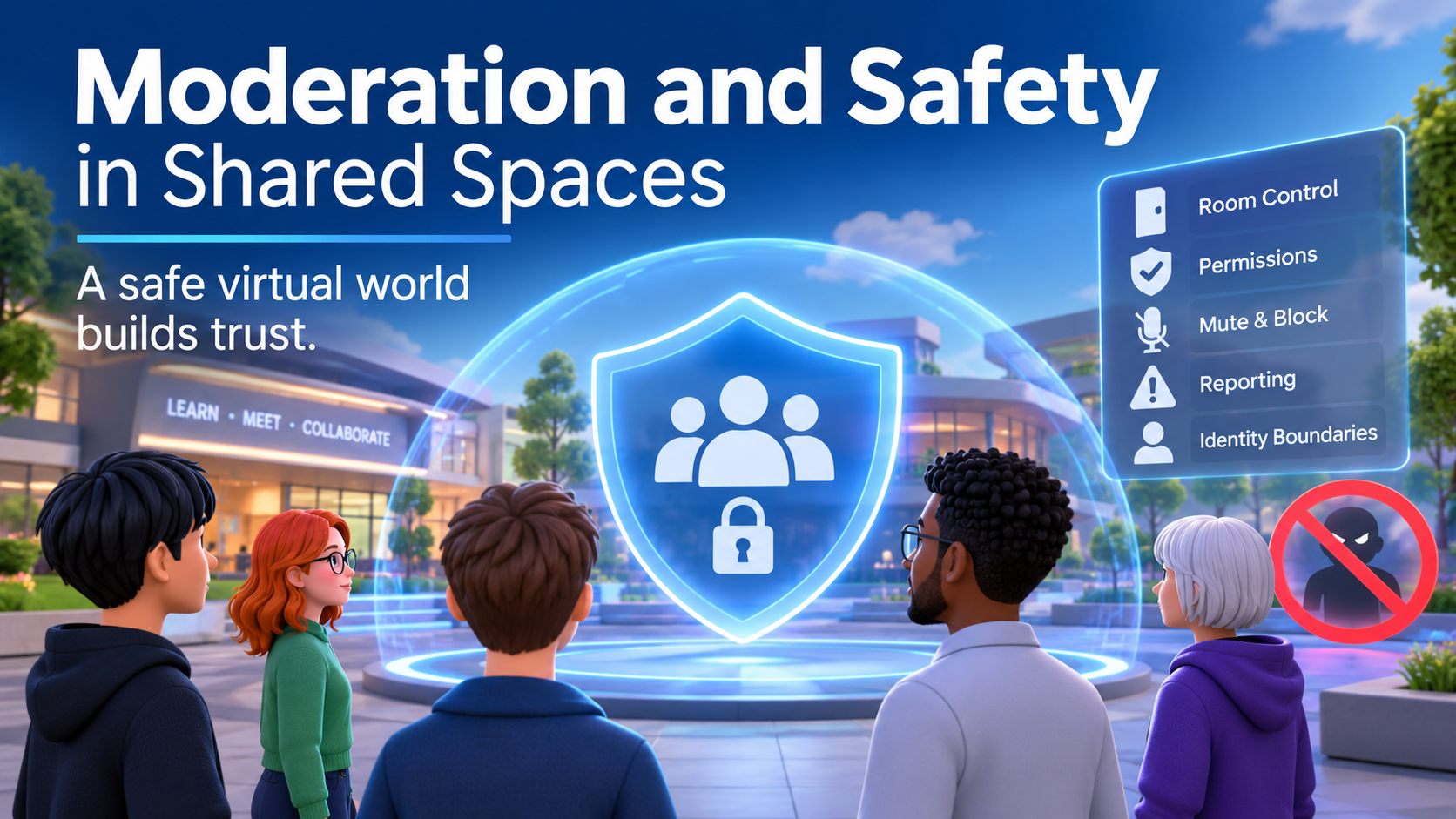
A basic safety concept begins with room control. Who can enter a room? Is it public, private, invitation-based or restricted by role? Can a host remove someone? Can a room be locked after a session begins? Can guests be separated from moderators or presenters? These questions define the boundary of the shared space. Without room control, every other moderation feature becomes weaker.
Permissions are the next layer. Not every user needs the same capabilities. In a training session, the trainer may control presentation objects, voice settings or world transitions. Participants may interact with selected objects but not change the environment. In a classroom, a teacher may need stronger controls. In a public event, moderators may need the ability to manage chat or voice. Permissions prevent the platform from treating all users as equal in situations where the use case requires roles.
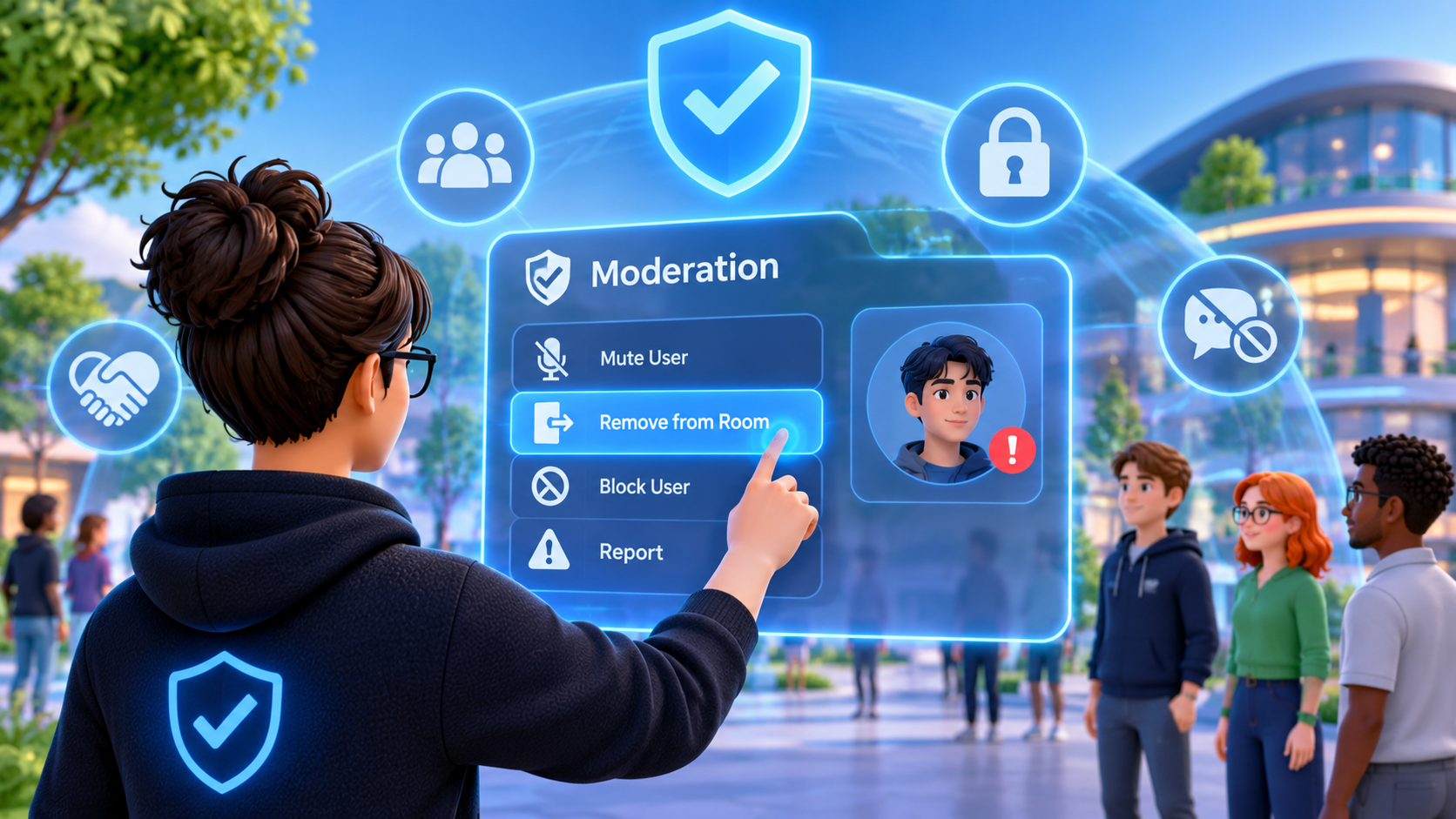
Muting and blocking are essential because communication is powerful. Users should be able to control what they hear and, where appropriate, whom they interact with. Hosts should be able to mute disruptive participants. In some environments, global mute or presenter-only voice may be useful. In others, open conversation may be the point. The platform should allow these patterns without forcing one model onto every world.
Reporting is another important element, even if early versions start simple. Users need a way to signal problems. Administrators need enough information to respond. Reporting must be designed carefully because it can involve sensitive data. It should not collect more than necessary, but it should support accountability. This connects directly to privacy by design: safety and privacy are not opposites. A good platform needs both.
Identity boundaries matter as well. A virtual world can allow flexible avatars while still requiring recognizable roles in certain settings. In a school environment, anonymous entry may be inappropriate. In a public exhibition, lightweight guest access may be desirable. In a business meeting, participants may need to appear with real names or approved display names. The platform should distinguish between avatar appearance and trust context. Identity does not always need to be heavy, but it must be appropriate.
The trade-off is complexity. Every safety feature adds decisions, interface elements, settings and support requirements. A lightweight platform cannot simply copy the administration model of large enterprise systems without becoming too heavy. The challenge is to create safety features that are simple enough to use but serious enough to matter. A host should not need a technical manual to remove a disruptive participant. A teacher should not need developer support to run a controlled classroom. A small organization should not need a full-time administrator to operate a safe world.
This is where product design becomes important. Safety tools must be discoverable for those who need them and unobtrusive for those who do not. A participant should not be distracted by moderation controls. A moderator should have quick access when needed. The interface should reflect roles. This connects back to Interface on Demand: safety functions may remain quiet most of the time, but when a problem occurs, they must be available immediately.
Moderation also includes prevention. Clear onboarding, visible room rules, role labels, controlled entry points and appropriate default settings can reduce problems before they happen. World design can support safety too. A crowded spawn point can create confusion. A classroom without clear teacher position can encourage disorder. A public event without spatial organization can become chaotic. Safety is not only a button; it is part of the social architecture of a world.
For creators, this means safety should be part of the design brief. Who is the world for? Is it private or public? Is communication open? Are there hosts? Are there minors? Are recordings allowed? Is video appropriate? What should happen if someone behaves badly? These questions should be asked before the world goes live, not after the first incident.
In CL2, the long-term goal is a safety model that grows with the platform without betraying its simplicity. Early versions may begin with basic room boundaries and communication controls. Later versions may add stronger role management, reporting workflows, moderation dashboards, permissions for scripted interactions and integration with organizational identity systems. The important point is that the concept exists from the beginning.
A shared virtual world is not only a technical system. It is a social space. Social spaces need rules, roles and recovery mechanisms. If users feel unsafe, they will leave. If organizations feel exposed, they will not adopt the platform. If hosts cannot manage behavior, events and learning sessions become fragile.
Safety is not the opposite of openness. It is what makes meaningful openness possible. A shared virtual world needs social rules as much as technical infrastructure.
Now available on Amazon!
Discover the Metaverse Beyond the Hype
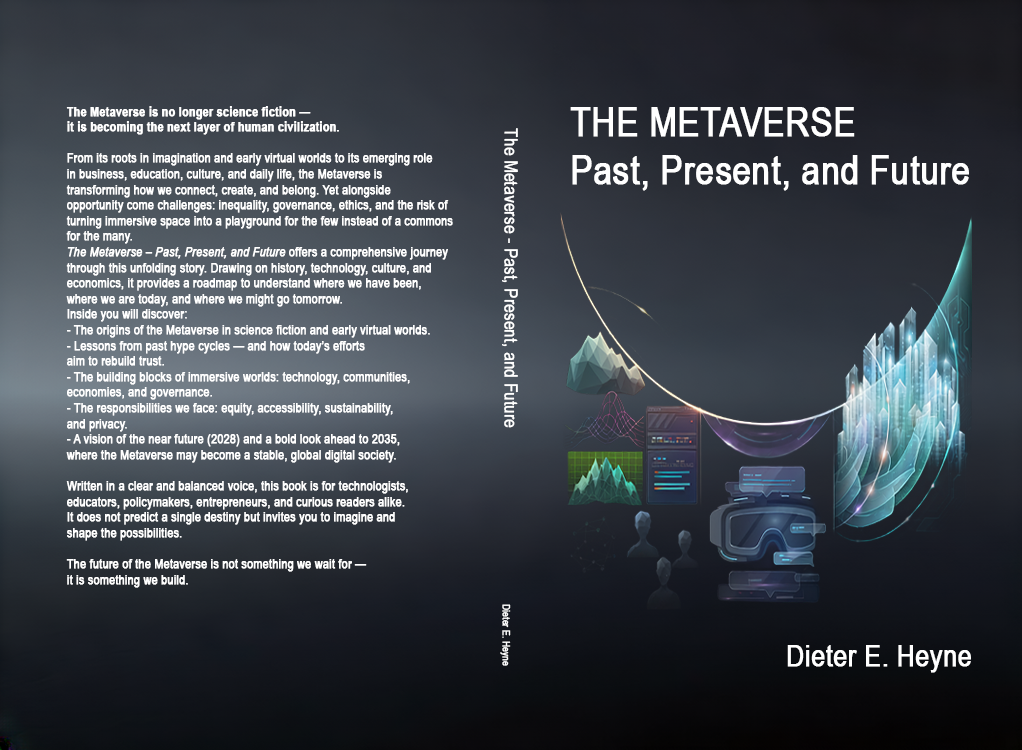
The Metaverse is no longer a futuristic fantasy, it is rapidly becoming a new layer of human society. But what is it really? Where did it come from? And what might it become over the next decade?
The Metaverse – Past, Present, and Future takes readers on a fascinating journey from the earliest virtual worlds and science-fiction visions to today’s emerging immersive platforms, digital economies, and online communities. Along the way, it explores the technologies powering the Metaverse, the opportunities it creates for education, work, and culture, and the challenges of governance, privacy, inclusion, and sustainability.
Looking beyond today's headlines, the book offers a balanced and inspiring vision of how immersive technologies could transform cities, learning, creativity, and daily life by 2035.
Whether you are a business leader, educator, technologist, policymaker, or simply curious about the future, this book provides the context, insight, and perspective needed to understand one of the most important technological and societal shifts of our time.
The future of the Metaverse is not something we await, it is something we create.
About the Author
Dieter E. Heyne is a Metaverse pioneer and lifelong technologist, born in Munich in 1966. With a master’s degree in applied computer science and over three decades of experience as an IT entrepreneur, software architect, and consultant, he has always been at the frontier of digital innovation. His journey into virtual worlds began in 2007 with Second Life and sparked a deep, ongoing exploration of the Metaverse as a space for education, collaboration, and immersive experiences.
Since 2012, Dieter has been developing and refining a web-based virtual world platform, driven by a vision to make the Metaverse accessible, meaningful, and transformative. As a frequent speaker and thought leader at Metaverse events, he shares his insights on how virtual environments can reshape human interaction, learning, and culture. He is the founder and CEO of Metaverse School GmbH, a company dedicated to promoting Metaverse literacy and helping people and organizations understand the power and promise of these emerging digital realms.
Besides talking and writing non-fiction about the Metaverse and Virtual Worlds, this vast knowledge now went into the creation of The Metaverse Enforcers, an ongoing series of high-tech science fiction novels, showcasing the potential development and dangers of the Metaverse in 2053.
About Metaverse School GmbH
Metaverse School GmbH was founded in 2017 by Dieter E. Heyne, who continues to lead the company as its CEO. The company emerged from decades of consulting experience in software architecture, project management, quality assurance, information security, and data protection. Building on this strong technological foundation, Metaverse School GmbH is dedicated to promoting the responsible and purposeful use of immersive 3D environments, for education, collaboration, training, and simulation.
A core mission of the company is to raise awareness of the Metaverse’s potential across business, education, and society. In support of this goal, Dieter Heyne regularly speaks at national and international conferences as well as Metaverse-focused events. Through real-world examples and deep expertise, he demonstrates how immersive technologies can already create meaningful value today.
Disclaimer
Some portions of this content were created or refined with the assistance of artificial intelligence (AI) using tools such as OpenAI’s ChatGPT. The ideas, structure, and editorial direction remain the responsibility of the author. While every effort has been made to ensure factual accuracy and original expression, readers are encouraged to approach speculative or future-facing statements with critical thought.
This series does not represent the views of any specific company or platform and is intended to inspire open discussion around the evolving concept of the Metaverse.
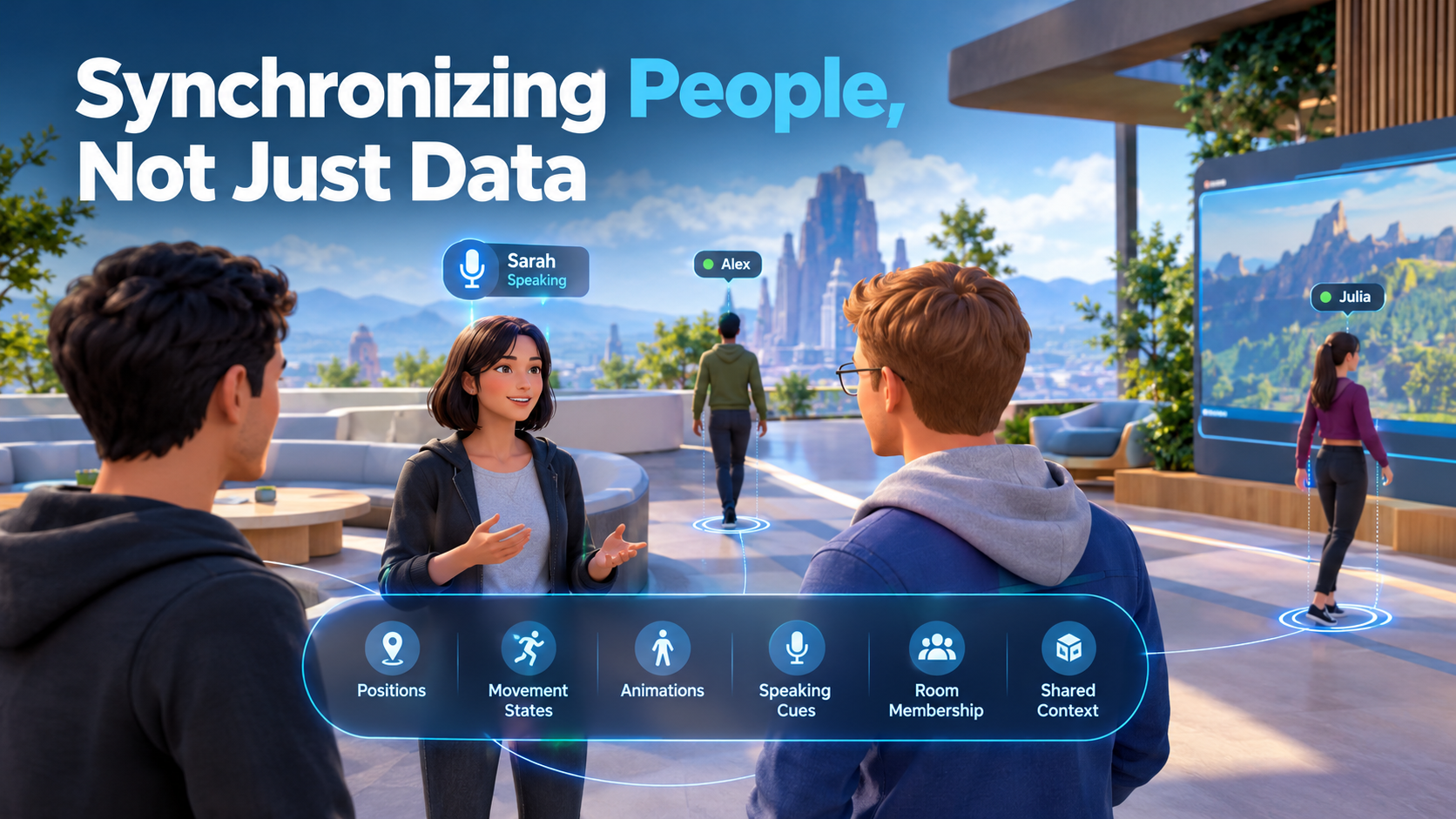
Synchronization is often discussed as if it were only a networking problem. How often should positions be sent? Which protocol should be used? How should latency be handled? What happens when a client disconnects? These questions are important, but they do not capture what users actually experience. Users do not feel data synchronization. They feel whether other people appear to be present.
In a multi-user virtual world, the purpose of synchronization is shared presence. When I see another avatar walking across a room, I should believe that another person is doing something meaningful. When someone turns toward a screen, joins a group, approaches an object or walks away, that movement communicates intention. If the movement is too jerky, delayed or inconsistent, the illusion weakens. If the avatar appears in the wrong place, moves through walls or freezes without explanation, trust declines. The technical system becomes visible at the exact moment it should disappear.
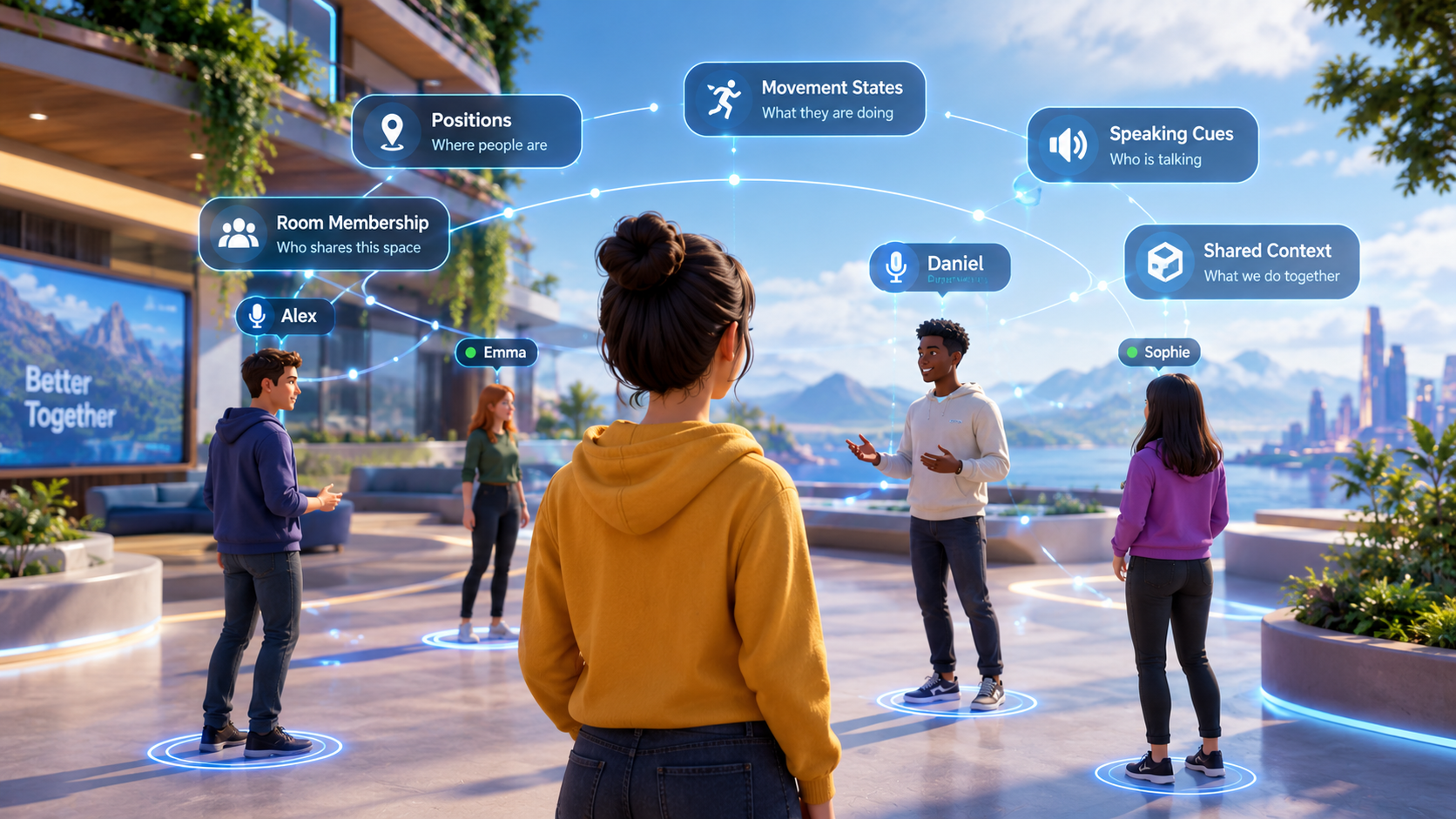
For Cybalounge 2, this leads to a practical design principle: synchronize what matters. Not everything in a world requires real-time precision. A user does not need to know the exact millisecond-by-millisecond position of every remote avatar. They need enough continuity to understand where people are, where they are going and what they are doing. Positions matter. Movement states matter. Basic animation states matter. Speaking cues matter. Room membership matters. Shared context matters. But the platform does not need to replicate every internal detail of every client.
This distinction is important for a lightweight platform. Every synchronized value has a cost. It consumes bandwidth, processing time, implementation effort and debugging attention. In small groups, excessive synchronization may not seem problematic. But as worlds grow, and as operating cost targets become important, unnecessary updates become waste. A platform designed for low operating and maintenance costs must be selective. It must ask not only whether something can be synchronized, but whether synchronizing it improves the experience enough to justify the cost.
There is also a difference between technical accuracy and perceived smoothness. A remote avatar updated only a few times per second can still feel acceptable if interpolation and movement states are handled carefully. On the other hand, a stream of frequent raw updates can still feel bad if movement is jittery or inconsistent. Users judge the result, not the implementation detail. Smooth enough presence is often more valuable than theoretically perfect data.
The phrase “smooth enough” is not an excuse for poor quality. It is a product decision. In a competitive action game, exact synchronization may be critical. In a collaboration space, training room, learning environment or virtual meeting, the requirements are different. People need to orient themselves socially. They need to avoid confusion. They need to know who is nearby, who is speaking and what is happening. The system should feel stable and responsive, but it does not need to simulate every physical detail with extreme precision.
This changes how we think about latency. Some latency is inevitable, especially in browser-based applications and real-world networks. The question is how much latency users notice and how the platform hides or explains it. If a remote avatar continues moving naturally between updates, the user may not notice minor delays. If the avatar jumps, snaps or teleports repeatedly, the delay becomes obvious. Synchronization is therefore partly a visual design problem. The presentation of remote movement matters as much as the delivery of data.
Speaking cues add another layer. In a social world, knowing who is speaking can be more important than knowing exact movement. If several avatars stand together, a clear speaking indicator helps users follow the conversation. Without it, people can feel lost, especially when audio comes through a communication system that is not spatially obvious. Synchronizing speaking state does not simply add a technical detail. It improves social readability.
Room scope is also important. A virtual world platform should not synchronize all users with all other users if they are not meaningfully sharing the same context. Rooms, sessions, areas or communication groups can define who needs updates from whom. This supports scalability and privacy. It also matches user expectations. If I am in a private training session, I should not necessarily be visible to users in another session. Synchronization is not only about performance; it is also about boundaries.
The trade-off is that selective synchronization requires clear decisions. If too little is synchronized, the world feels empty or inconsistent. If too much is synchronized, the system becomes heavier than necessary. Some states are tempting to share because they are technically available. But availability is not the same as value. The platform needs a synchronization model that reflects the experience it wants to create.
Creators and hosts may also need to understand these boundaries. For example, an interactive object used in a training scenario may require shared state. A decorative environmental effect may not. A presentation screen may need synchronization if all participants must see the same content. A local visual effect may not. A low-code interaction system, when introduced, will need rules about which actions are local and which are shared. Otherwise, creators may accidentally build worlds that behave inconsistently across clients.
This is why synchronization must eventually become part of the platform vocabulary, not only the networking layer. A world description could define which objects are shared, which states are persistent, which interactions are local, and which events should be broadcast. The more explicit this model becomes, the easier it is to keep the system understandable and maintainable.
For users, the ideal result is invisible. They do not want to think about update rates or channels. They want to feel that other people are there. They want to walk toward a group, notice who is speaking, follow a guide, watch someone point out an object, or join a training exercise without questioning whether the world is coherent.
In the end, synchronization in a virtual world is not about copying data for its own sake. It is about maintaining a shared reality at the level required for the experience. The platform should synchronize enough to make people feel together, but not so much that the system becomes unnecessarily heavy.
The goal is not perfect data replication. The goal is believable shared presence.
Now available on Amazon!
Discover the Metaverse Beyond the Hype
The Metaverse is no longer a futuristic fantasy, it is rapidly becoming a new layer of human society. But what is it really? Where did it come from? And what might it become over the next decade?
The Metaverse – Past, Present, and Future takes readers on a fascinating journey from the earliest virtual worlds and science-fiction visions to today’s emerging immersive platforms, digital economies, and online communities. Along the way, it explores the technologies powering the Metaverse, the opportunities it creates for education, work, and culture, and the challenges of governance, privacy, inclusion, and sustainability.
Looking beyond today's headlines, the book offers a balanced and inspiring vision of how immersive technologies could transform cities, learning, creativity, and daily life by 2035.
Whether you are a business leader, educator, technologist, policymaker, or simply curious about the future, this book provides the context, insight, and perspective needed to understand one of the most important technological and societal shifts of our time.
The future of the Metaverse is not something we await, it is something we create.
About the Author
Dieter E. Heyne is a Metaverse pioneer and lifelong technologist, born in Munich in 1966. With a master’s degree in applied computer science and over three decades of experience as an IT entrepreneur, software architect, and consultant, he has always been at the frontier of digital innovation. His journey into virtual worlds began in 2007 with Second Life and sparked a deep, ongoing exploration of the Metaverse as a space for education, collaboration, and immersive experiences.
Since 2012, Dieter has been developing and refining a web-based virtual world platform, driven by a vision to make the Metaverse accessible, meaningful, and transformative. As a frequent speaker and thought leader at Metaverse events, he shares his insights on how virtual environments can reshape human interaction, learning, and culture. He is the founder and CEO of Metaverse School GmbH, a company dedicated to promoting Metaverse literacy and helping people and organizations understand the power and promise of these emerging digital realms.
Besides talking and writing non-fiction about the Metaverse and Virtual Worlds, this vast knowledge now went into the creation of The Metaverse Enforcers, an ongoing series of high-tech science fiction novels, showcasing the potential development and dangers of the Metaverse in 2053.
About Metaverse School GmbH
Metaverse School GmbH was founded in 2017 by Dieter E. Heyne, who continues to lead the company as its CEO. The company emerged from decades of consulting experience in software architecture, project management, quality assurance, information security, and data protection. Building on this strong technological foundation, Metaverse School GmbH is dedicated to promoting the responsible and purposeful use of immersive 3D environments, for education, collaboration, training, and simulation.
A core mission of the company is to raise awareness of the Metaverse’s potential across business, education, and society. In support of this goal, Dieter Heyne regularly speaks at national and international conferences as well as Metaverse-focused events. Through real-world examples and deep expertise, he demonstrates how immersive technologies can already create meaningful value today.
Disclaimer
Some portions of this content were created or refined with the assistance of artificial intelligence (AI) using tools such as OpenAI’s ChatGPT. The ideas, structure, and editorial direction remain the responsibility of the author. While every effort has been made to ensure factual accuracy and original expression, readers are encouraged to approach speculative or future-facing statements with critical thought.
This series does not represent the views of any specific company or platform and is intended to inspire open discussion around the evolving concept of the Metaverse.
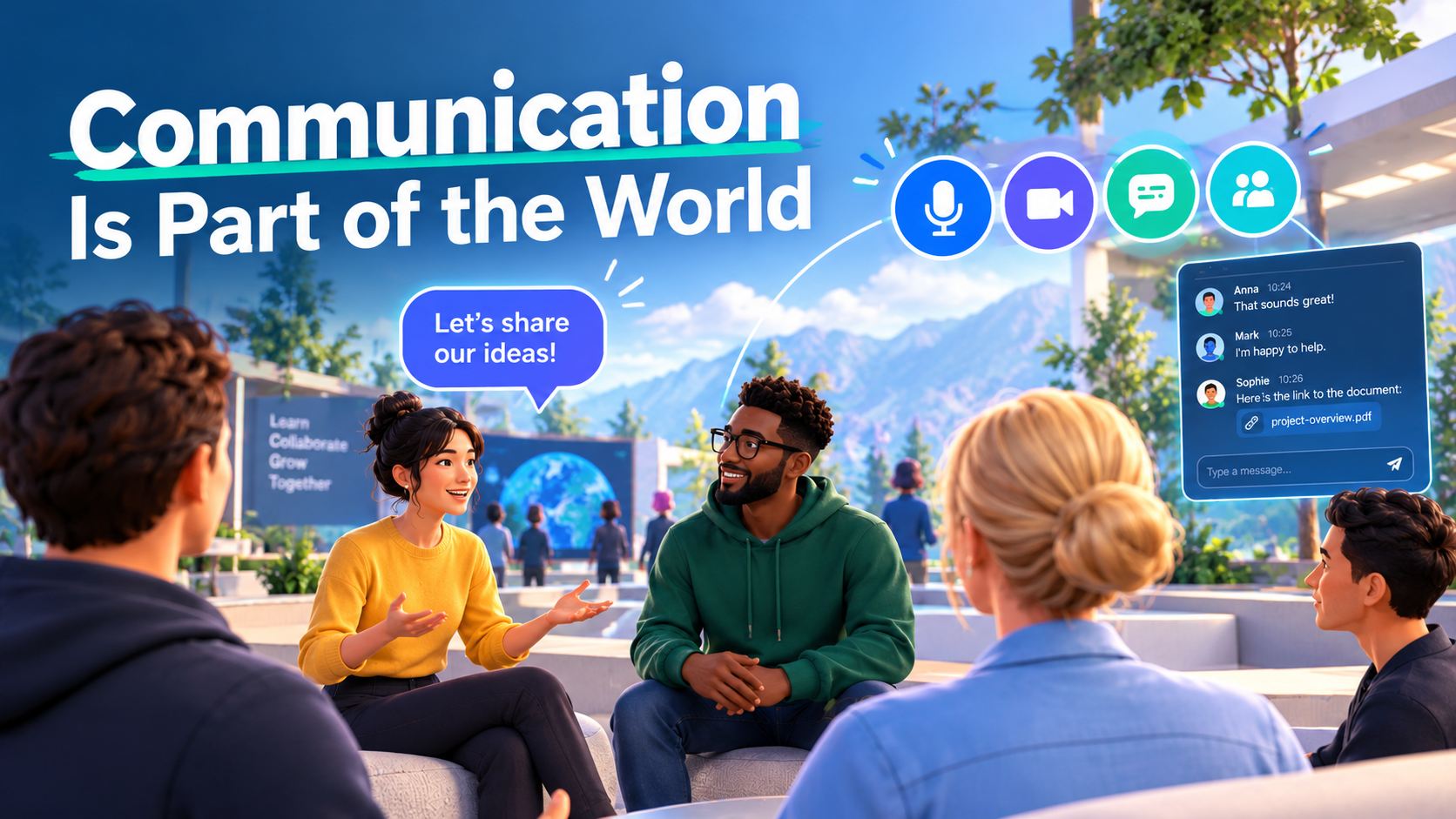
A virtual world without communication can become a beautiful empty room. The lighting may be convincing, the avatar may move smoothly, the models may be optimized and the interface may be clean, but if people cannot naturally communicate, the social promise remains incomplete. For many practical use cases, the value of a virtual world is not only that users can see a space. It is that they can share a space.
This is especially true for the kinds of environments Cybalounge 2 is meant to support: learning spaces, training rooms, collaboration areas, onboarding worlds, senior communities, events, support sessions and guided experiences. In these scenarios, communication is not an optional layer placed on top of the world. It is part of the world. People enter not only to look around, but to meet, ask, explain, listen, discuss, demonstrate and feel present with others.
The obvious communication channels are voice, video and text. Each has a role. Voice provides immediacy and emotional nuance. Text provides clarity, accessibility, persistence and usefulness when audio is not possible. Video can support trust and familiar meeting behavior, especially in professional contexts. But in a virtual world, communication is more than channels. It also includes presence cues: where someone is standing, whether they are moving, whether they are looking toward a group, whether they are speaking, whether they appear available, and whether their avatar gives enough social context to understand the situation.
A traditional video conference places faces and voices at the center. A virtual world changes the center. The environment becomes shared context. Users can gather around an object, walk through a model, stand in front of a display, visit a training station, or meet in a spatial arrangement that has meaning. Communication should support this spatial context rather than replace it. If the world becomes only a decorative background for video boxes, much of the value is lost.
This creates an important design question: how should communication be integrated so that it feels natural but not overwhelming? A voice system should be easy to understand. Users need to know whether they are muted or live. They need confidence that they can turn audio off. In educational and business environments, they may need host control, room rules, and predictable behavior. A text chat should be available, but it should not permanently cover the world. Video may be useful, but not every situation needs it, and not every user wants it. Communication must respect both social presence and personal boundaries.
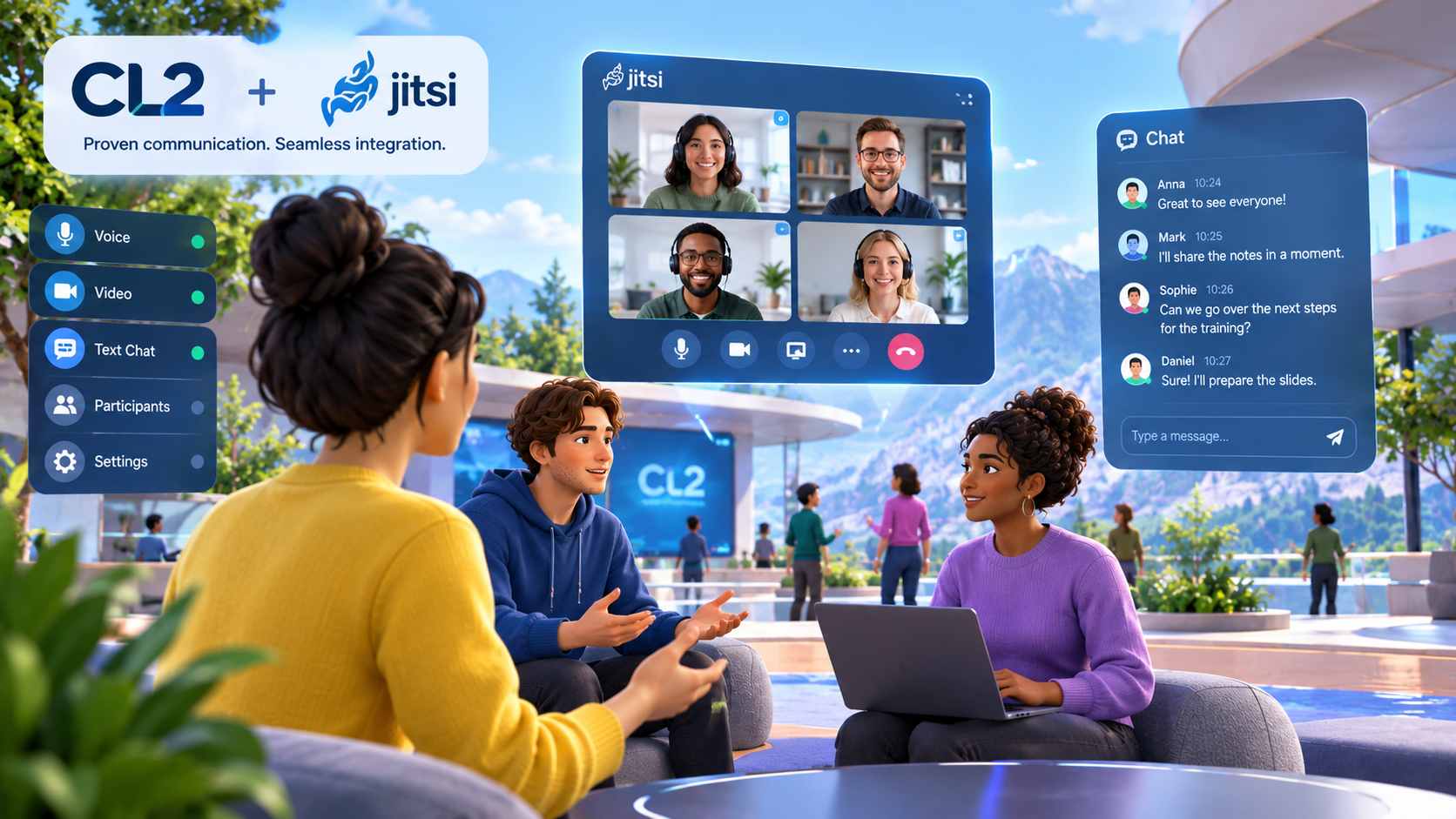
For CL2, the integration of Jitsi is a practical step in this direction. It provides proven communication capabilities without requiring the platform to reinvent voice, video, text and related infrastructure from scratch. This is consistent with the broader philosophy of keeping the platform lightweight and focused. When a reliable component exists, the question is not whether we can build everything ourselves. The question is whether integration can support the product vision without adding unnecessary complexity.
But integrating communication is never only a technical task. Browser permissions, microphone access, camera access, network conditions and user expectations must be handled carefully. A user who enters a world should not be surprised to discover that they are broadcasting audio. A teacher should be able to understand who can speak. A business user should feel that the communication layer is professional and predictable. A senior user should not be forced to interpret cryptic icons. Communication controls are part of trust.
Bandwidth is another trade-off. Rich communication can be expensive in terms of network and processing resources. Video, in particular, can compete with 3D rendering for device performance and user attention. A platform that aims for low operating and maintenance costs must be careful about what is always enabled, what is optional, and what can be configured per use case. A training environment may need voice and screen sharing. A quiet exhibition may need text and occasional guided voice. A senior community may need simple audio controls and gentle visual cues. One communication setup will not fit all worlds.
Moderation also becomes unavoidable. The moment people can talk, write, appear and interact, the platform needs mechanisms to handle misuse, disruption and discomfort. This does not mean turning every world into a heavily controlled space, but it does mean providing room control, muting, role-based permissions and clear expectations. Communication makes a world social; safety makes that social world sustainable.
Another important aspect is social anxiety. Some users like voice. Others prefer text. Some are comfortable on video. Others are not. Some users enter from quiet offices, others from shared homes or classrooms. A good platform should not assume one communication style as the default for every situation. It should allow creators and hosts to design the communication culture of a world: lecture, workshop, meeting, event, guided tour, casual community space or silent exploration.
Communication also changes how users experience distance. In physical spaces, proximity influences conversation. In virtual spaces, the platform must decide how distance matters. Is everyone in the room part of the same conversation? Is there spatial audio? Are there private groups? Can people move away from a discussion? Even if the first implementation is simple, these questions matter because they define the social architecture of the world. Communication is not only a feature; it is a model of how people relate to each other inside the environment.
For creators, communication should be seen as part of world design. A training room should have spaces where people gather and spaces where they can focus. An event space should guide participants toward stages, booths or discussion areas. A classroom should support teacher presence, group work and questions. The world layout and communication tools should work together. If a world looks like a lecture hall but behaves like an unstructured chat room, users will feel the mismatch.
The key principle is that communication should make the world feel alive without making the technology feel intrusive. Users should not have to think constantly about the communication system. They should simply know that they can speak, listen, write, mute, ask and participate. When communication works well, it becomes part of presence. When it works poorly, it becomes the whole problem.
A virtual world becomes social when people can naturally communicate inside it. Not because every channel is always active, but because the platform supports the right kind of connection for the right kind of space.
Now available on Amazon!
Discover the Metaverse Beyond the Hype
The Metaverse is no longer a futuristic fantasy, it is rapidly becoming a new layer of human society. But what is it really? Where did it come from? And what might it become over the next decade?
The Metaverse – Past, Present, and Future takes readers on a fascinating journey from the earliest virtual worlds and science-fiction visions to today’s emerging immersive platforms, digital economies, and online communities. Along the way, it explores the technologies powering the Metaverse, the opportunities it creates for education, work, and culture, and the challenges of governance, privacy, inclusion, and sustainability.
Looking beyond today's headlines, the book offers a balanced and inspiring vision of how immersive technologies could transform cities, learning, creativity, and daily life by 2035.
Whether you are a business leader, educator, technologist, policymaker, or simply curious about the future, this book provides the context, insight, and perspective needed to understand one of the most important technological and societal shifts of our time.
The future of the Metaverse is not something we await, it is something we create.
About the Author
Dieter E. Heyne is a Metaverse pioneer and lifelong technologist, born in Munich in 1966. With a master’s degree in applied computer science and over three decades of experience as an IT entrepreneur, software architect, and consultant, he has always been at the frontier of digital innovation. His journey into virtual worlds began in 2007 with Second Life and sparked a deep, ongoing exploration of the Metaverse as a space for education, collaboration, and immersive experiences.
Since 2012, Dieter has been developing and refining a web-based virtual world platform, driven by a vision to make the Metaverse accessible, meaningful, and transformative. As a frequent speaker and thought leader at Metaverse events, he shares his insights on how virtual environments can reshape human interaction, learning, and culture. He is the founder and CEO of Metaverse School GmbH, a company dedicated to promoting Metaverse literacy and helping people and organizations understand the power and promise of these emerging digital realms.
Besides talking and writing non-fiction about the Metaverse and Virtual Worlds, this vast knowledge now went into the creation of The Metaverse Enforcers, an ongoing series of high-tech science fiction novels, showcasing the potential development and dangers of the Metaverse in 2053.
About Metaverse School GmbH
Metaverse School GmbH was founded in 2017 by Dieter E. Heyne, who continues to lead the company as its CEO. The company emerged from decades of consulting experience in software architecture, project management, quality assurance, information security, and data protection. Building on this strong technological foundation, Metaverse School GmbH is dedicated to promoting the responsible and purposeful use of immersive 3D environments, for education, collaboration, training, and simulation.
A core mission of the company is to raise awareness of the Metaverse’s potential across business, education, and society. In support of this goal, Dieter Heyne regularly speaks at national and international conferences as well as Metaverse-focused events. Through real-world examples and deep expertise, he demonstrates how immersive technologies can already create meaningful value today.
Disclaimer
Some portions of this content were created or refined with the assistance of artificial intelligence (AI) using tools such as OpenAI’s ChatGPT. The ideas, structure, and editorial direction remain the responsibility of the author. While every effort has been made to ensure factual accuracy and original expression, readers are encouraged to approach speculative or future-facing statements with critical thought.
This series does not represent the views of any specific company or platform and is intended to inspire open discussion around the evolving concept of the Metaverse.
Virtual worlds often begin with a promise of freedom. Users can enter spaces, move through environments, meet others, explore objects and experience information spatially. But that promise can break quickly if the platform assumes that every user has perfect eyesight, perfect hearing, precise motor control, modern hardware, fast internet, gaming experience and a high tolerance for movement in 3D. When these assumptions are hidden inside the design, the world may be open in theory but exclusive in practice.
This is why accessibility must be considered from the beginning of a platform like Cybalounge 2. It is not a decorative checklist to be added at the end. It is not only a legal or compliance topic. It is a product-quality topic, a human topic and a practical adoption topic. A platform that wants to serve education, business, senior communities, public spaces and training environments cannot be designed only for technically confident users with ideal devices.
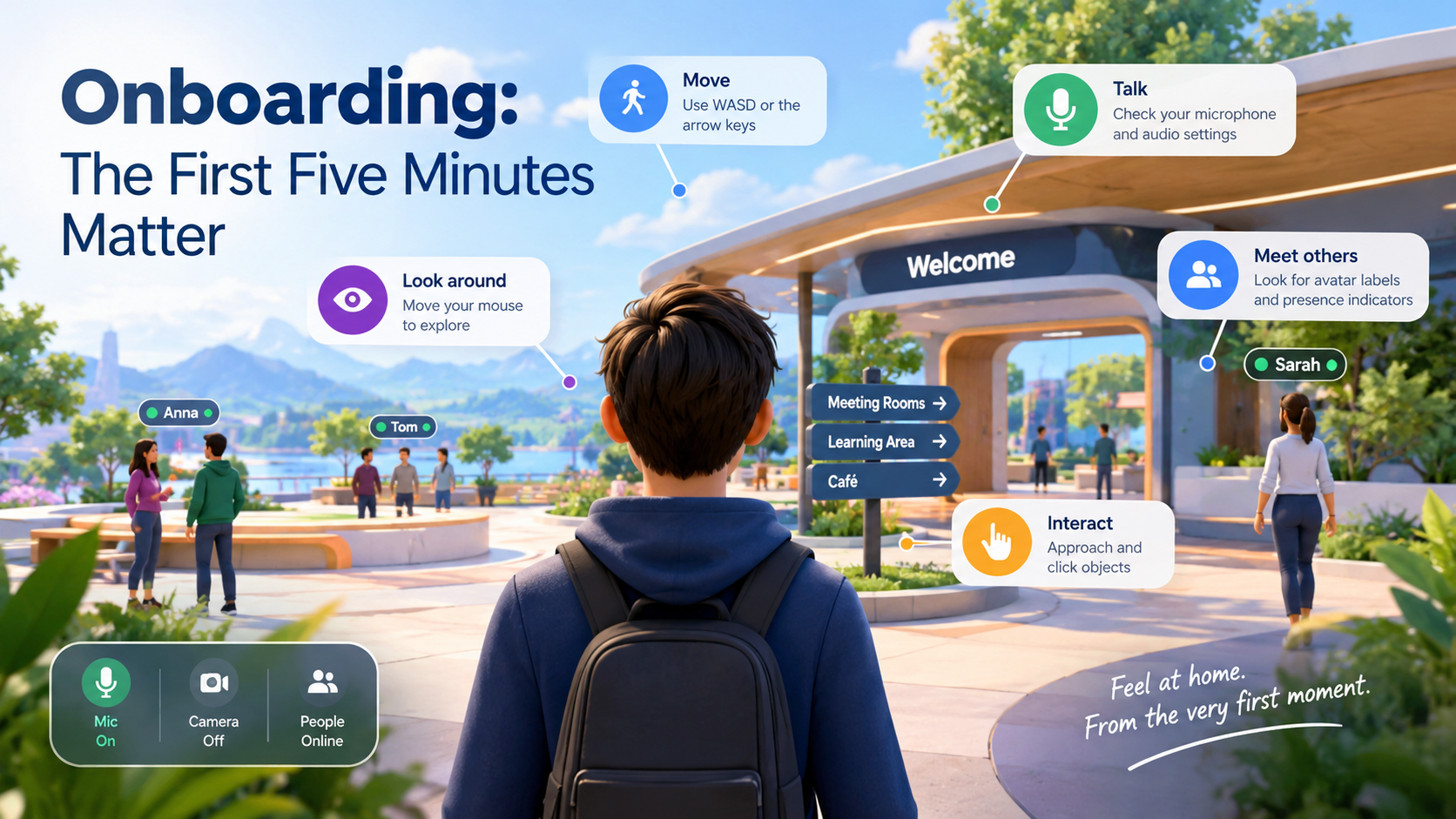
Accessibility starts with entry. A browser-based platform already lowers one barrier by avoiding installation, but access does not end there. The loading process must be understandable. Permission prompts for microphone or camera must be clear. Users should not be forced into audio or video without understanding what is happening. The first screen should not assume that the user knows how to navigate a virtual space. Text should be readable. Buttons should be large enough. Important controls should be visible enough. The user should not have to search for basic safety functions.
Controls are one of the most important accessibility areas. A virtual world that only works well with a specific keyboard layout, a gaming mouse or a controller excludes many users. A platform should support different input preferences where possible: keyboard and mouse, gamepad, touch and eventually VR controllers. But supporting devices is only the first layer. The controls must also be forgiving. Movement speed, camera behavior, turn sensitivity and interaction distance can all influence comfort. Some users prefer fast navigation; others need slower, more stable movement. A single control style rarely fits everyone.
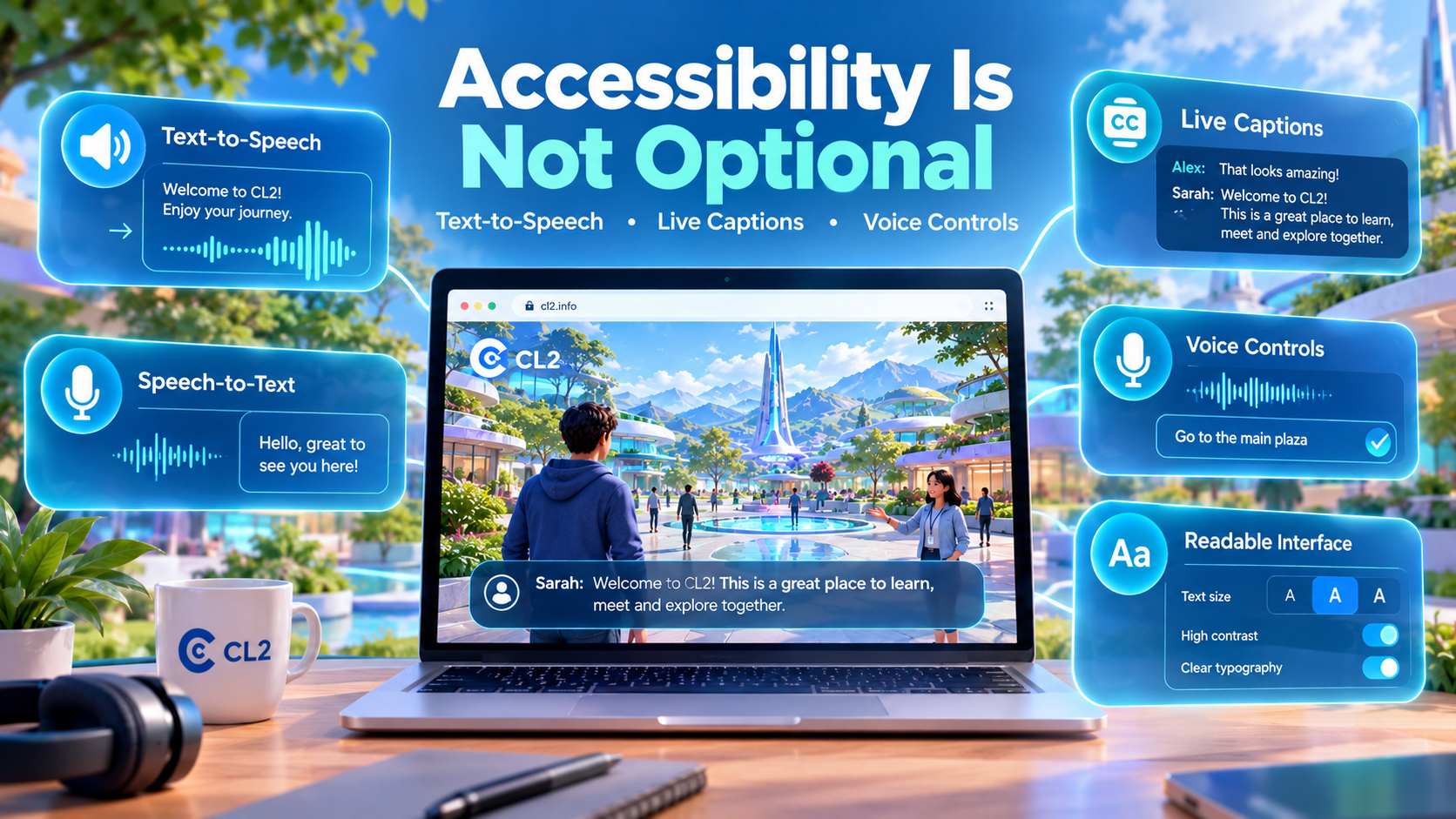
Visual accessibility is just as important. Virtual worlds often rely on atmosphere: low light, fog, reflections, shadows, subtle color differences and cinematic effects. These can make a world beautiful, but they can also reduce readability. If labels, menus or important objects disappear into the background, the world becomes harder to use. Contrast matters. Text size matters. Icon clarity matters. Important states, such as microphone on or off, should not be communicated by color alone. A red or green indicator may be helpful, but it should be paired with text or shape so that the meaning remains clear.
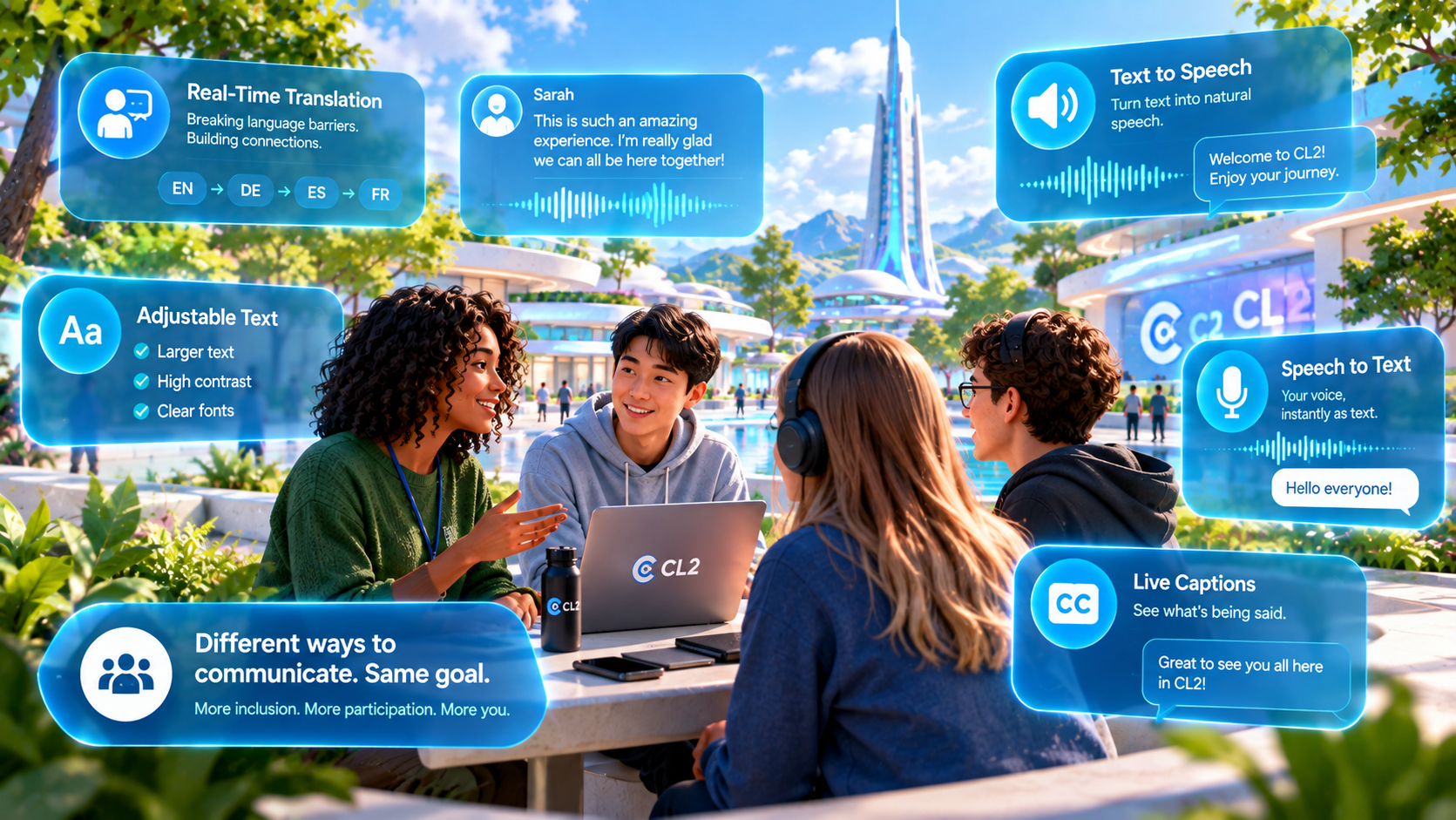
Audio accessibility must also be considered. A world that depends entirely on voice can exclude users who are deaf, hard of hearing, in noisy environments or unable to use audio at that moment. Text chat, captions, visible speaking indicators and clear audio controls can help. Background audio should be controllable, not forced. Sound can enrich presence, but it should not become a barrier. In educational and business contexts, users may enter from offices, homes, classrooms or public spaces. The platform should respect these different situations.
Movement comfort is another area that is easy to underestimate. Some users experience discomfort, nausea or disorientation in 3D environments, especially when camera movement is too fast, too smooth in the wrong way, or too disconnected from the avatar. A third-person camera can help some users because it provides a visible anchor. Predictable movement helps. Sudden camera jumps should be avoided where possible. Options for sensitivity, speed and maybe simplified navigation can make the difference between a usable world and an uncomfortable one.
Accessibility also includes cognitive accessibility. A user should not need to remember too many controls, interpret unclear symbols, or understand technical language to participate. The platform should use plain wording, consistent interaction patterns and progressive disclosure. Show the next relevant action rather than everything at once. Use familiar concepts where possible. Make mistakes recoverable. Avoid making users feel embarrassed for not knowing something.
The trade-off is that accessibility creates constraints. Designers may want a very minimal interface, but some users need clearer controls. Developers may want fast camera movement, but some users need stability. Creators may want dark cinematic lighting, but visitors need readable paths and labels. A pure aesthetic decision may conflict with usability. Taking accessibility seriously means accepting that not every visual or technical choice is neutral. Some choices include people; others exclude them.
There is also a development trade-off. Accessibility features take time. They require testing, options, documentation and sometimes alternative interaction paths. In a lightweight platform, there is always the risk of postponing them in favor of more visible features. But this can become expensive later. If accessibility is ignored in the foundation, retrofitting it becomes harder. Control systems, UI patterns, color choices, audio states and onboarding flows should be designed with flexibility from the start.
For creators, accessibility must become part of world-building culture. A creator should ask: Can users read the signs? Is the path obvious? Are important objects visible? Is the environment too dark? Is there a non-audio way to receive information? Can a first-time user understand where to go? Does the world work on normal devices? Accessibility is not only a platform setting. It is a design habit.
The connection to simplicity is strong. A simpler platform is often a more accessible platform, as long as simplicity does not mean hiding essential functions. Clear controls, readable interface, forgiving movement, understandable onboarding and flexible devices help everyone, not only users with specific accessibility needs. The classic accessibility lesson applies here: features designed for inclusion usually improve the experience for a much wider audience.
In CL2, accessibility is not something to be solved once and forgotten. It is a direction. Each new feature should be examined through the question: who might this exclude, and how can we reduce that barrier without making the system unnecessarily complex? The answer will not always be perfect, especially in early versions. But the question must remain visible.
A virtual world becomes more meaningful when more people can enter it, understand it and participate with confidence. Accessibility is not optional because participation is the point.
Now available on Amazon!
Discover the Metaverse Beyond the Hype
The Metaverse is no longer a futuristic fantasy, it is rapidly becoming a new layer of human society. But what is it really? Where did it come from? And what might it become over the next decade?
The Metaverse – Past, Present, and Future takes readers on a fascinating journey from the earliest virtual worlds and science-fiction visions to today’s emerging immersive platforms, digital economies, and online communities. Along the way, it explores the technologies powering the Metaverse, the opportunities it creates for education, work, and culture, and the challenges of governance, privacy, inclusion, and sustainability.
Looking beyond today's headlines, the book offers a balanced and inspiring vision of how immersive technologies could transform cities, learning, creativity, and daily life by 2035.
Whether you are a business leader, educator, technologist, policymaker, or simply curious about the future, this book provides the context, insight, and perspective needed to understand one of the most important technological and societal shifts of our time.
The future of the Metaverse is not something we await, it is something we create.
About the Author
Dieter E. Heyne is a Metaverse pioneer and lifelong technologist, born in Munich in 1966. With a master’s degree in applied computer science and over three decades of experience as an IT entrepreneur, software architect, and consultant, he has always been at the frontier of digital innovation. His journey into virtual worlds began in 2007 with Second Life and sparked a deep, ongoing exploration of the Metaverse as a space for education, collaboration, and immersive experiences.
Since 2012, Dieter has been developing and refining a web-based virtual world platform, driven by a vision to make the Metaverse accessible, meaningful, and transformative. As a frequent speaker and thought leader at Metaverse events, he shares his insights on how virtual environments can reshape human interaction, learning, and culture. He is the founder and CEO of Metaverse School GmbH, a company dedicated to promoting Metaverse literacy and helping people and organizations understand the power and promise of these emerging digital realms.
Besides talking and writing non-fiction about the Metaverse and Virtual Worlds, this vast knowledge now went into the creation of The Metaverse Enforcers, an ongoing series of high-tech science fiction novels, showcasing the potential development and dangers of the Metaverse in 2053.
About Metaverse School GmbH
Metaverse School GmbH was founded in 2017 by Dieter E. Heyne, who continues to lead the company as its CEO. The company emerged from decades of consulting experience in software architecture, project management, quality assurance, information security, and data protection. Building on this strong technological foundation, Metaverse School GmbH is dedicated to promoting the responsible and purposeful use of immersive 3D environments, for education, collaboration, training, and simulation.
A core mission of the company is to raise awareness of the Metaverse’s potential across business, education, and society. In support of this goal, Dieter Heyne regularly speaks at national and international conferences as well as Metaverse-focused events. Through real-world examples and deep expertise, he demonstrates how immersive technologies can already create meaningful value today.
Disclaimer
Some portions of this content were created or refined with the assistance of artificial intelligence (AI) using tools such as OpenAI’s ChatGPT. The ideas, structure, and editorial direction remain the responsibility of the author. While every effort has been made to ensure factual accuracy and original expression, readers are encouraged to approach speculative or future-facing statements with critical thought.
This series does not represent the views of any specific company or platform and is intended to inspire open discussion around the evolving concept of the Metaverse.
A virtual world can lose a user before the experience has really begun. The scene may load correctly, the avatar may stand in the right place, the controls may work and the communication system may be ready, but if the user does not understand what is happening, the platform has failed at the most important moment. First impressions in 3D environments are not only visual. They are emotional. Users ask themselves, often silently: Where am I? What should I do? Can others see me? Can they hear me? How do I move? How do I stop moving? Can I break something? How do I leave?
This is why the first five minutes matter so much. For people who are already comfortable with games, 3D editors or virtual environments, many interactions feel obvious. WASD movement, mouse look, camera rotation, avatar following and object interaction are familiar patterns. But a platform like Cybalounge 2 is not intended only for this audience. If virtual worlds are to become useful for education, business, senior communities, cultural spaces, public information, onboarding or training, they must welcome people who may never have moved an avatar before.
Onboarding is therefore not just a tutorial. It is a trust-building process. The user should feel that the system is understandable, forgiving and safe. They should not be punished for pressing the wrong key, choosing the wrong button or moving in the wrong direction. They should not feel watched while they are still trying to understand how to exist in the space. They should not be forced to read a long instruction page before anything happens. The entry experience should be calm, guided and respectful.
A useful onboarding flow begins before the world is fully entered. Loading screens should not only show progress; they can set expectations. Avatar selection should not feel like a complicated identity design task if the user only wants to join a meeting. Audio permissions should be explained in human language, not as a technical browser interruption. If a microphone is needed, the user should know why. If it is optional, that should be clear too. The transition from web page to world should feel deliberate rather than abrupt.
Once inside the world, orientation becomes the first challenge. A first-time user needs a clear starting point. The spawn location should not place them inside a crowd, facing a wall, or in the middle of visual complexity. They should arrive somewhere that communicates direction: perhaps near an entrance, a welcome area, a visible sign, or a simple path. Spatial design can reduce the need for interface. A good world layout tells the user where to look and where to go.
Movement is the next challenge. Here the platform must avoid two extremes. On one side, it should not assume that the user knows all controls. On the other, it should not interrupt every movement with instructions. Short, contextual hints can help: move, look around, approach, interact, speak. These hints should be easy to dismiss and easy to rediscover. The goal is not to teach everything immediately, but to give the user enough confidence to continue.
Communication requires special care. Many users are anxious about audio and video. They want to know whether they are muted, whether others can hear them, whether video is active, and how to change that state. In a browser-based platform, permissions can be especially confusing because the browser itself may ask for access to microphone or camera. The platform should not leave users alone with technical prompts. Clear labels, visible states and simple controls reduce stress. A microphone button is not only a function; it is a reassurance.
Social orientation is equally important. In a multi-user world, users need to identify other people. Avatar labels, presence indicators and speaking cues can help, but they must be designed with restraint. Too many labels or indicators can clutter the space, while too few can make the world feel anonymous and uncertain. The onboarding experience should show users how to recognize others and how close they need to be to communicate, interact or participate.
The trade-off is that guidance can become intrusive. A system that constantly explains itself may prevent users from feeling free. Too many popups can make a virtual world feel like compliance training. Too much automation can make users feel controlled. The best onboarding should be gentle, not paternalistic. It should offer help without making the user feel incompetent. It should make early success likely, then gradually step back.
Different audiences need different levels of guidance. A class of students may learn movement quickly but need rules for communication and behavior. A business team may understand meetings but struggle with spatial navigation. Senior users may benefit from slower pacing, larger text, clearer audio states and more explicit reassurance. Public events may require fast entry and minimal explanation. The platform should not force one onboarding style onto all use cases. It should allow creators and administrators to adapt the entry experience to the audience.
Onboarding also matters for creators. A world builder should think about how a person experiences the first minute of a specific world. Where do they appear? What do they see first? What is the first action? What happens if they do nothing? Is there a clear path, host, sign, guide, object or sound cue? A technically correct world can still fail if it has no entry logic. The first five minutes are not only a platform problem; they are also a design responsibility for every world.
For Cybalounge 2, this connects directly to the broader goal of simplicity. A platform with low operating and maintenance costs should not compensate by pushing complexity onto the user. Simplicity must be felt. It must show up in the moment of entry, in the first movement, in the first conversation and in the first successful interaction. If the user feels competent quickly, the platform has earned more time. If the user feels lost, every later feature becomes irrelevant.
The first five minutes decide whether a virtual world feels like an invitation or a barrier. Onboarding is the art of turning arrival into confidence.
Now available on Amazon!
Discover the Metaverse Beyond the Hype
The Metaverse is no longer a futuristic fantasy, it is rapidly becoming a new layer of human society. But what is it really? Where did it come from? And what might it become over the next decade?
The Metaverse – Past, Present, and Future takes readers on a fascinating journey from the earliest virtual worlds and science-fiction visions to today’s emerging immersive platforms, digital economies, and online communities. Along the way, it explores the technologies powering the Metaverse, the opportunities it creates for education, work, and culture, and the challenges of governance, privacy, inclusion, and sustainability.
Looking beyond today's headlines, the book offers a balanced and inspiring vision of how immersive technologies could transform cities, learning, creativity, and daily life by 2035.
Whether you are a business leader, educator, technologist, policymaker, or simply curious about the future, this book provides the context, insight, and perspective needed to understand one of the most important technological and societal shifts of our time.
The future of the Metaverse is not something we await, it is something we create.
About the Author
Dieter E. Heyne is a Metaverse pioneer and lifelong technologist, born in Munich in 1966. With a master’s degree in applied computer science and over three decades of experience as an IT entrepreneur, software architect, and consultant, he has always been at the frontier of digital innovation. His journey into virtual worlds began in 2007 with Second Life and sparked a deep, ongoing exploration of the Metaverse as a space for education, collaboration, and immersive experiences.
Since 2012, Dieter has been developing and refining a web-based virtual world platform, driven by a vision to make the Metaverse accessible, meaningful, and transformative. As a frequent speaker and thought leader at Metaverse events, he shares his insights on how virtual environments can reshape human interaction, learning, and culture. He is the founder and CEO of Metaverse School GmbH, a company dedicated to promoting Metaverse literacy and helping people and organizations understand the power and promise of these emerging digital realms.
Besides talking and writing non-fiction about the Metaverse and Virtual Worlds, this vast knowledge now went into the creation of The Metaverse Enforcers, an ongoing series of high-tech science fiction novels, showcasing the potential development and dangers of the Metaverse in 2053.
About Metaverse School GmbH
Metaverse School GmbH was founded in 2017 by Dieter E. Heyne, who continues to lead the company as its CEO. The company emerged from decades of consulting experience in software architecture, project management, quality assurance, information security, and data protection. Building on this strong technological foundation, Metaverse School GmbH is dedicated to promoting the responsible and purposeful use of immersive 3D environments, for education, collaboration, training, and simulation.
A core mission of the company is to raise awareness of the Metaverse’s potential across business, education, and society. In support of this goal, Dieter Heyne regularly speaks at national and international conferences as well as Metaverse-focused events. Through real-world examples and deep expertise, he demonstrates how immersive technologies can already create meaningful value today.
Disclaimer
Some portions of this content were created or refined with the assistance of artificial intelligence (AI) using tools such as OpenAI’s ChatGPT. The ideas, structure, and editorial direction remain the responsibility of the author. While every effort has been made to ensure factual accuracy and original expression, readers are encouraged to approach speculative or future-facing statements with critical thought.
This series does not represent the views of any specific company or platform and is intended to inspire open discussion around the evolving concept of the Metaverse.
 METAVERSE BLOG