 METAVERSE BLOG
Chapter 18: Moderation and Safety in Shared Spaces
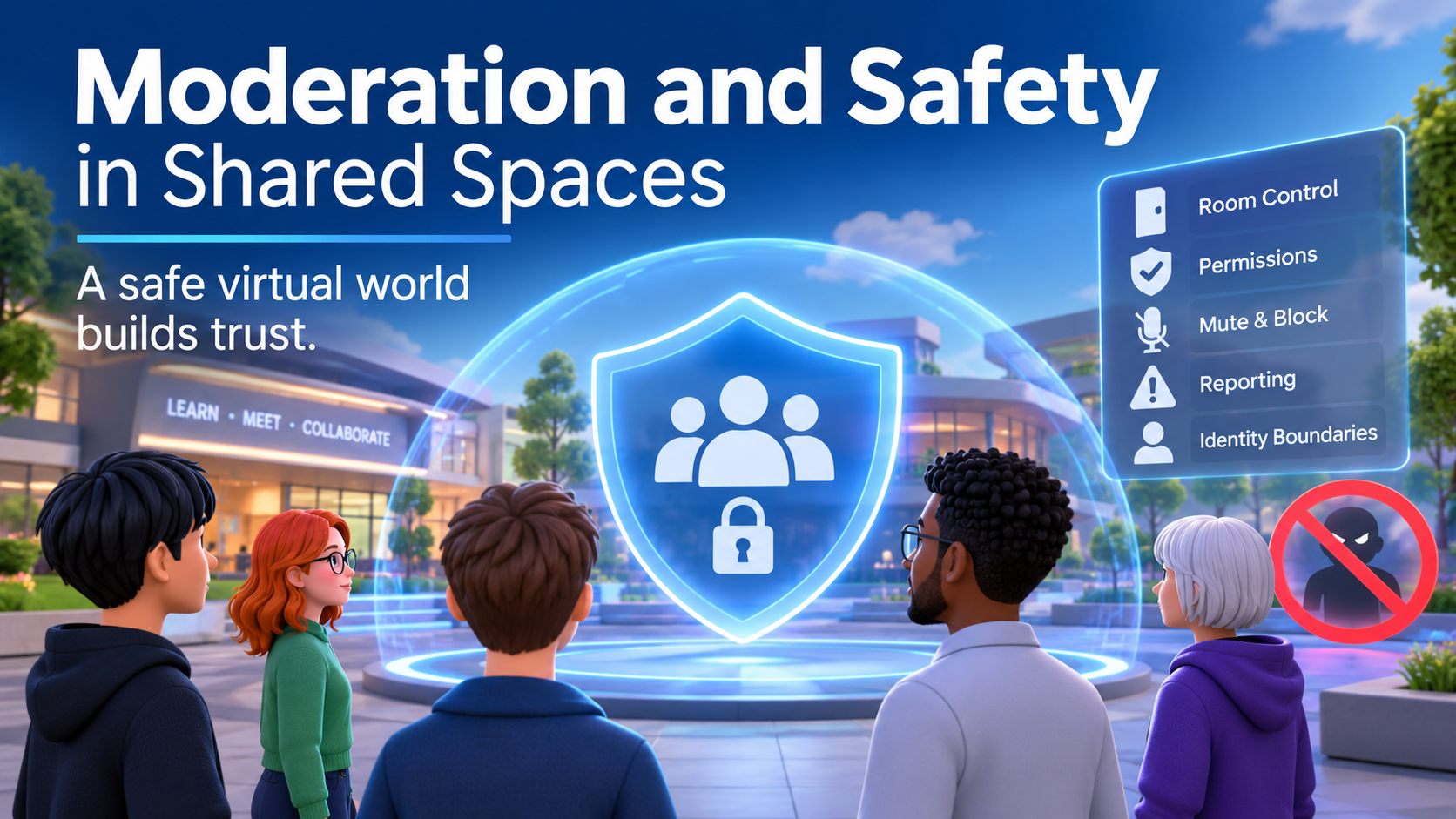
The moment a virtual world becomes multi-user, it becomes social. And the moment it becomes social, it needs safety. This may sound obvious, but many platform discussions still treat moderation as an external issue, something to be added after the rendering works, after avatars move, after communication is integrated and after worlds can be built. That order is understandable from a development perspective, but risky from a product perspective. A shared environment without a safety concept is not ready for many real-world uses.
Education, business, senior communities, public events and training environments all depend on trust. Teachers need to know that students can participate without disruption or harassment. Companies need to know that meetings and onboarding spaces can be controlled. Community hosts need tools to handle inappropriate behavior. Public-sector or cultural projects need predictable boundaries. Users need confidence that they can mute, leave, report or avoid uncomfortable situations. Without these capabilities, the platform may be technically interesting but organizationally unacceptable.
Virtual worlds add specific safety challenges because they combine identity, movement, proximity and communication. In a normal website, misuse may appear as a message, upload or account action. In a virtual world, misuse can be spatial and social: an avatar following someone, blocking access, interrupting a group, spamming chat, misusing voice, appearing with an inappropriate name or avatar, or disrupting an event by movement alone. The sense of shared space makes these behaviors feel more immediate.
This does not mean that every world must be heavily controlled. A small trusted team meeting has different requirements from a public event. A classroom has different requirements from an open exhibition. A senior community has different requirements from a developer test room. But the platform should provide a safety foundation that can be adjusted to the use case. Safety should be configurable, not improvised.
A basic safety concept begins with room control. Who can enter a room? Is it public, private, invitation-based or restricted by role? Can a host remove someone? Can a room be locked after a session begins? Can guests be separated from moderators or presenters? These questions define the boundary of the shared space. Without room control, every other moderation feature becomes weaker.
Permissions are the next layer. Not every user needs the same capabilities. In a training session, the trainer may control presentation objects, voice settings or world transitions. Participants may interact with selected objects but not change the environment. In a classroom, a teacher may need stronger controls. In a public event, moderators may need the ability to manage chat or voice. Permissions prevent the platform from treating all users as equal in situations where the use case requires roles.
Muting and blocking are essential because communication is powerful. Users should be able to control what they hear and, where appropriate, whom they interact with. Hosts should be able to mute disruptive participants. In some environments, global mute or presenter-only voice may be useful. In others, open conversation may be the point. The platform should allow these patterns without forcing one model onto every world.
Reporting is another important element, even if early versions start simple. Users need a way to signal problems. Administrators need enough information to respond. Reporting must be designed carefully because it can involve sensitive data. It should not collect more than necessary, but it should support accountability. This connects directly to privacy by design: safety and privacy are not opposites. A good platform needs both.
Identity boundaries matter as well. A virtual world can allow flexible avatars while still requiring recognizable roles in certain settings. In a school environment, anonymous entry may be inappropriate. In a public exhibition, lightweight guest access may be desirable. In a business meeting, participants may need to appear with real names or approved display names. The platform should distinguish between avatar appearance and trust context. Identity does not always need to be heavy, but it must be appropriate.
The trade-off is complexity. Every safety feature adds decisions, interface elements, settings and support requirements. A lightweight platform cannot simply copy the administration model of large enterprise systems without becoming too heavy. The challenge is to create safety features that are simple enough to use but serious enough to matter. A host should not need a technical manual to remove a disruptive participant. A teacher should not need developer support to run a controlled classroom. A small organization should not need a full-time administrator to operate a safe world.
This is where product design becomes important. Safety tools must be discoverable for those who need them and unobtrusive for those who do not. A participant should not be distracted by moderation controls. A moderator should have quick access when needed. The interface should reflect roles. This connects back to Interface on Demand: safety functions may remain quiet most of the time, but when a problem occurs, they must be available immediately.
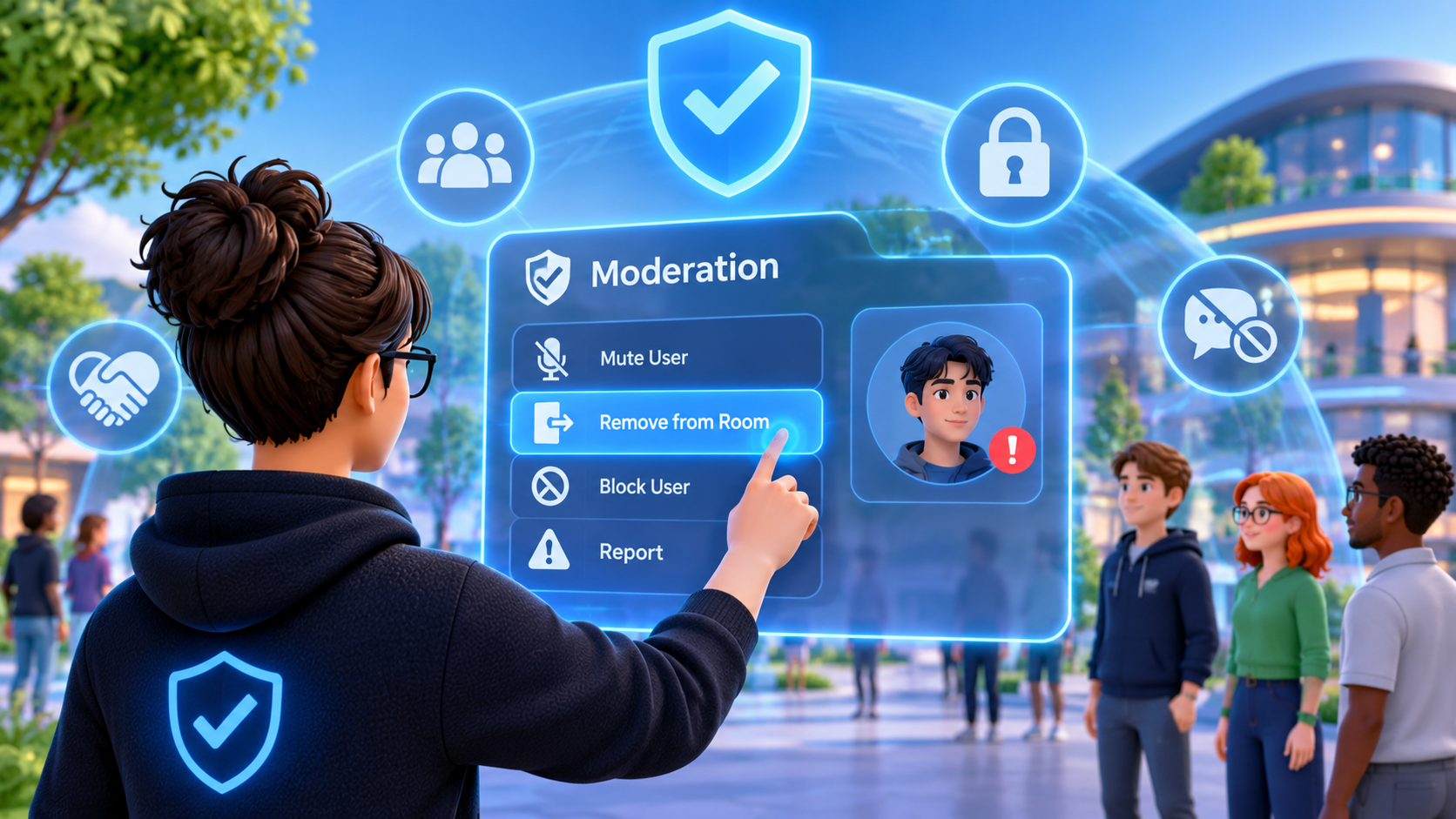
Moderation also includes prevention. Clear onboarding, visible room rules, role labels, controlled entry points and appropriate default settings can reduce problems before they happen. World design can support safety too. A crowded spawn point can create confusion. A classroom without clear teacher position can encourage disorder. A public event without spatial organization can become chaotic. Safety is not only a button; it is part of the social architecture of a world.
For creators, this means safety should be part of the design brief. Who is the world for? Is it private or public? Is communication open? Are there hosts? Are there minors? Are recordings allowed? Is video appropriate? What should happen if someone behaves badly? These questions should be asked before the world goes live, not after the first incident.
In CL2, the long-term goal is a safety model that grows with the platform without betraying its simplicity. Early versions may begin with basic room boundaries and communication controls. Later versions may add stronger role management, reporting workflows, moderation dashboards, permissions for scripted interactions and integration with organizational identity systems. The important point is that the concept exists from the beginning.
A shared virtual world is not only a technical system. It is a social space. Social spaces need rules, roles and recovery mechanisms. If users feel unsafe, they will leave. If organizations feel exposed, they will not adopt the platform. If hosts cannot manage behavior, events and learning sessions become fragile.
Safety is not the opposite of openness. It is what makes meaningful openness possible. A shared virtual world needs social rules as much as technical infrastructure.
Now available on Amazon!
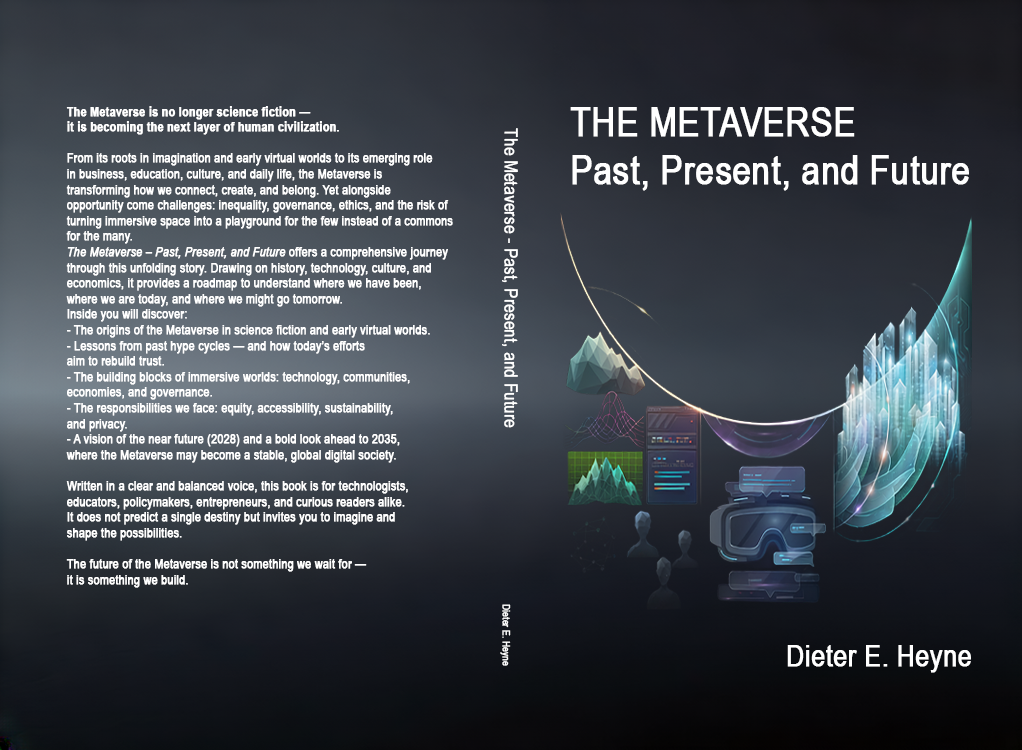
Discover the Metaverse Beyond the Hype
The Metaverse is no longer a futuristic fantasy, it is rapidly becoming a new layer of human society. But what is it really? Where did it come from? And what might it become over the next decade?
The Metaverse – Past, Present, and Future takes readers on a fascinating journey from the earliest virtual worlds and science-fiction visions to today’s emerging immersive platforms, digital economies, and online communities. Along the way, it explores the technologies powering the Metaverse, the opportunities it creates for education, work, and culture, and the challenges of governance, privacy, inclusion, and sustainability.
Looking beyond today's headlines, the book offers a balanced and inspiring vision of how immersive technologies could transform cities, learning, creativity, and daily life by 2035.
Whether you are a business leader, educator, technologist, policymaker, or simply curious about the future, this book provides the context, insight, and perspective needed to understand one of the most important technological and societal shifts of our time.
The future of the Metaverse is not something we await, it is something we create.
About the Author
Dieter E. Heyne is a Metaverse pioneer and lifelong technologist, born in Munich in 1966. With a master’s degree in applied computer science and over three decades of experience as an IT entrepreneur, software architect, and consultant, he has always been at the frontier of digital innovation. His journey into virtual worlds began in 2007 with Second Life and sparked a deep, ongoing exploration of the Metaverse as a space for education, collaboration, and immersive experiences.
Since 2012, Dieter has been developing and refining a web-based virtual world platform, driven by a vision to make the Metaverse accessible, meaningful, and transformative. As a frequent speaker and thought leader at Metaverse events, he shares his insights on how virtual environments can reshape human interaction, learning, and culture. He is the founder and CEO of Metaverse School GmbH, a company dedicated to promoting Metaverse literacy and helping people and organizations understand the power and promise of these emerging digital realms.
Besides talking and writing non-fiction about the Metaverse and Virtual Worlds, this vast knowledge now went into the creation of The Metaverse Enforcers, an ongoing series of high-tech science fiction novels, showcasing the potential development and dangers of the Metaverse in 2053.
About Metaverse School GmbH
Metaverse School GmbH was founded in 2017 by Dieter E. Heyne, who continues to lead the company as its CEO. The company emerged from decades of consulting experience in software architecture, project management, quality assurance, information security, and data protection. Building on this strong technological foundation, Metaverse School GmbH is dedicated to promoting the responsible and purposeful use of immersive 3D environments, for education, collaboration, training, and simulation.
A core mission of the company is to raise awareness of the Metaverse’s potential across business, education, and society. In support of this goal, Dieter Heyne regularly speaks at national and international conferences as well as Metaverse-focused events. Through real-world examples and deep expertise, he demonstrates how immersive technologies can already create meaningful value today.
Disclaimer
Some portions of this content were created or refined with the assistance of artificial intelligence (AI) using tools such as OpenAI’s ChatGPT. The ideas, structure, and editorial direction remain the responsibility of the author. While every effort has been made to ensure factual accuracy and original expression, readers are encouraged to approach speculative or future-facing statements with critical thought.
This series does not represent the views of any specific company or platform and is intended to inspire open discussion around the evolving concept of the Metaverse.
#Metaverse #VirtualWorlds #FutureOfTech #DigitalCommunity #CybaLounge #CL2