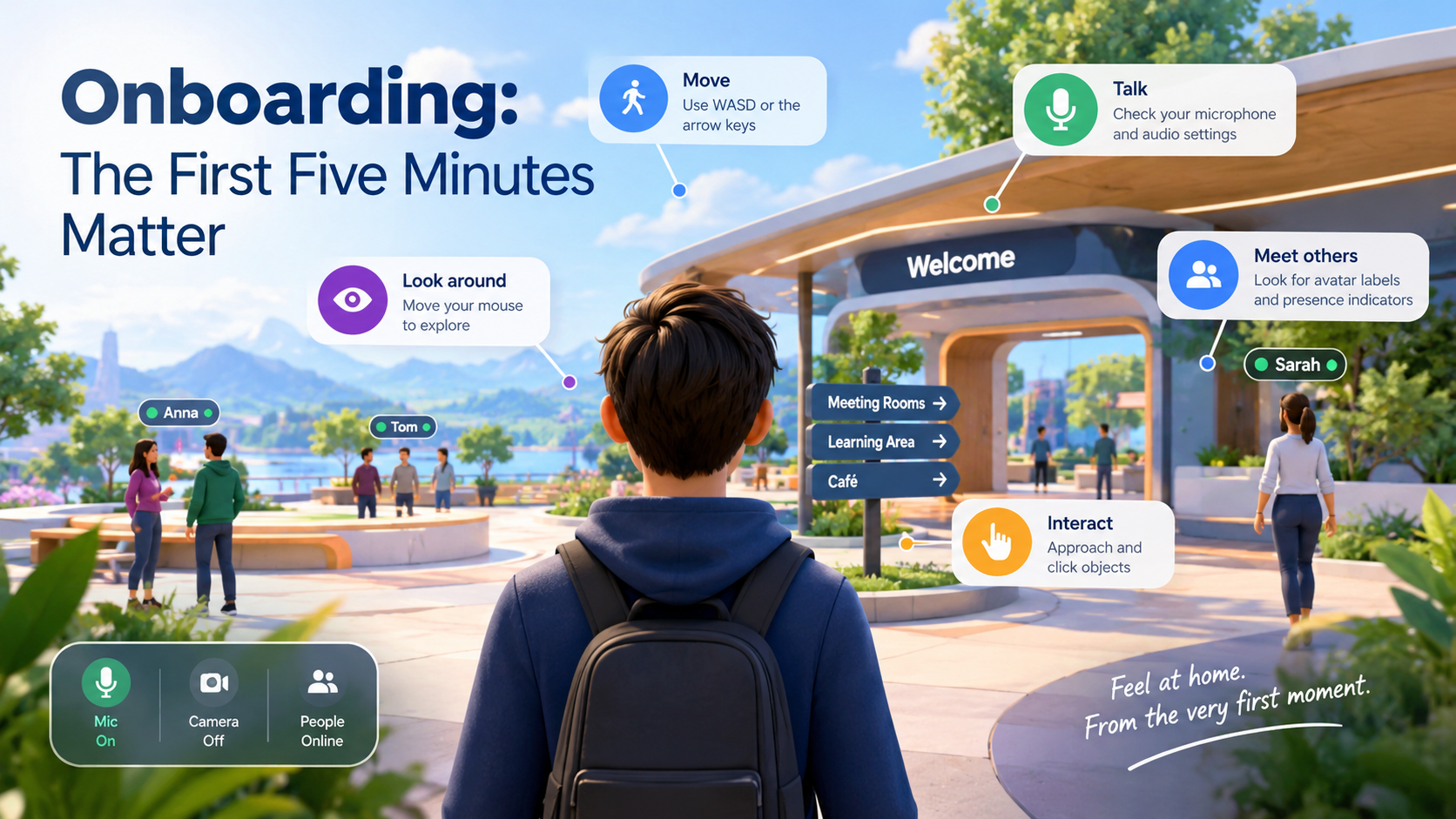
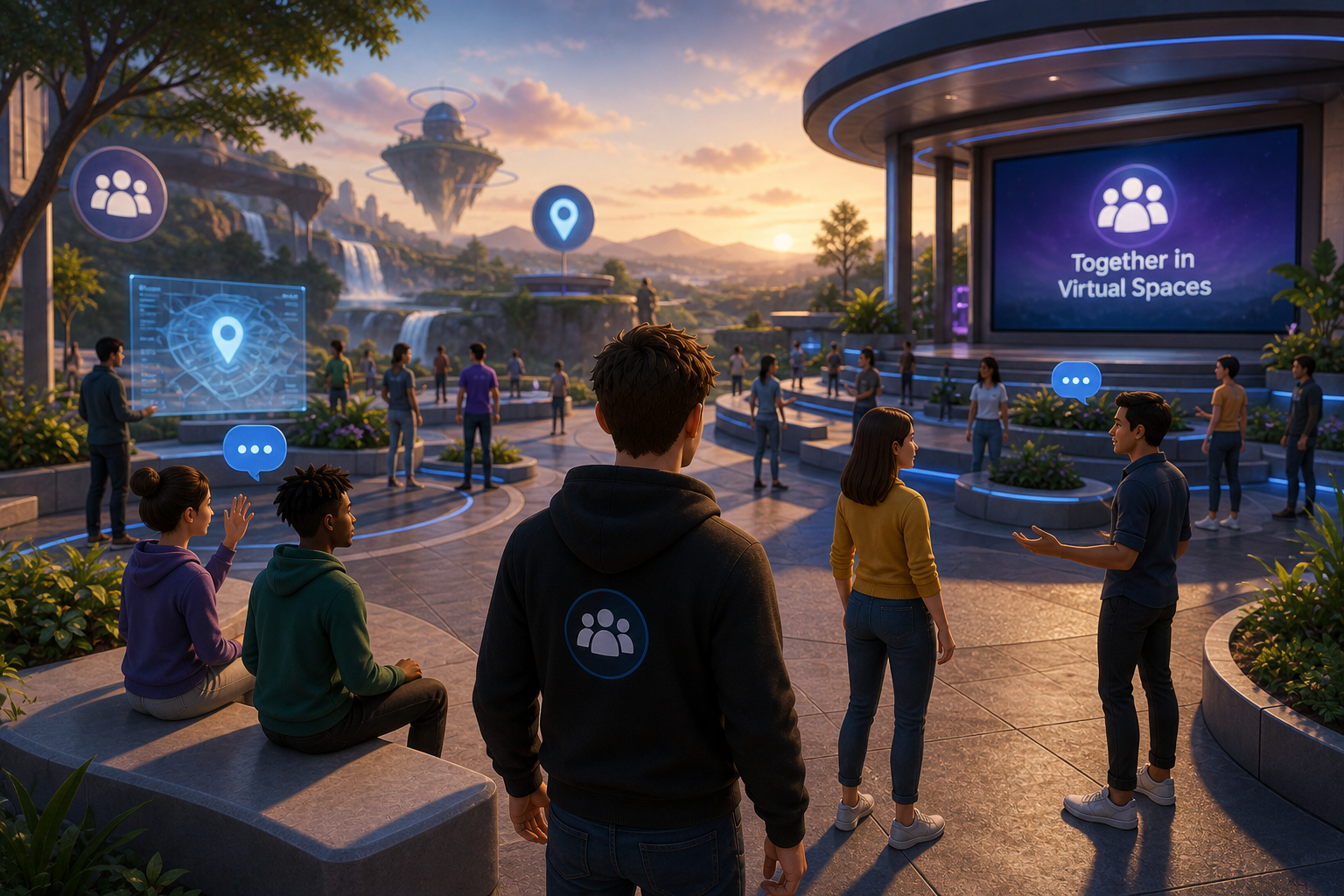
A virtual world can lose a user before the experience has really begun. The scene may load correctly, the avatar may stand in the right place, the controls may work and the communication system may be ready, but if the user does not understand what is happening, the platform has failed at the most important moment. First impressions in 3D environments are not only visual. They are emotional. Users ask themselves, often silently: Where am I? What should I do? Can others see me? Can they hear me? How do I move? How do I stop moving? Can I break something? How do I leave?
This is why the first five minutes matter so much. For people who are already comfortable with games, 3D editors or virtual environments, many interactions feel obvious. WASD movement, mouse look, camera rotation, avatar following and object interaction are familiar patterns. But a platform like Cybalounge 2 is not intended only for this audience. If virtual worlds are to become useful for education, business, senior communities, cultural spaces, public information, onboarding or training, they must welcome people who may never have moved an avatar before.
Onboarding is therefore not just a tutorial. It is a trust-building process. The user should feel that the system is understandable, forgiving and safe. They should not be punished for pressing the wrong key, choosing the wrong button or moving in the wrong direction. They should not feel watched while they are still trying to understand how to exist in the space. They should not be forced to read a long instruction page before anything happens. The entry experience should be calm, guided and respectful.
A useful onboarding flow begins before the world is fully entered. Loading screens should not only show progress; they can set expectations. Avatar selection should not feel like a complicated identity design task if the user only wants to join a meeting. Audio permissions should be explained in human language, not as a technical browser interruption. If a microphone is needed, the user should know why. If it is optional, that should be clear too. The transition from web page to world should feel deliberate rather than abrupt.
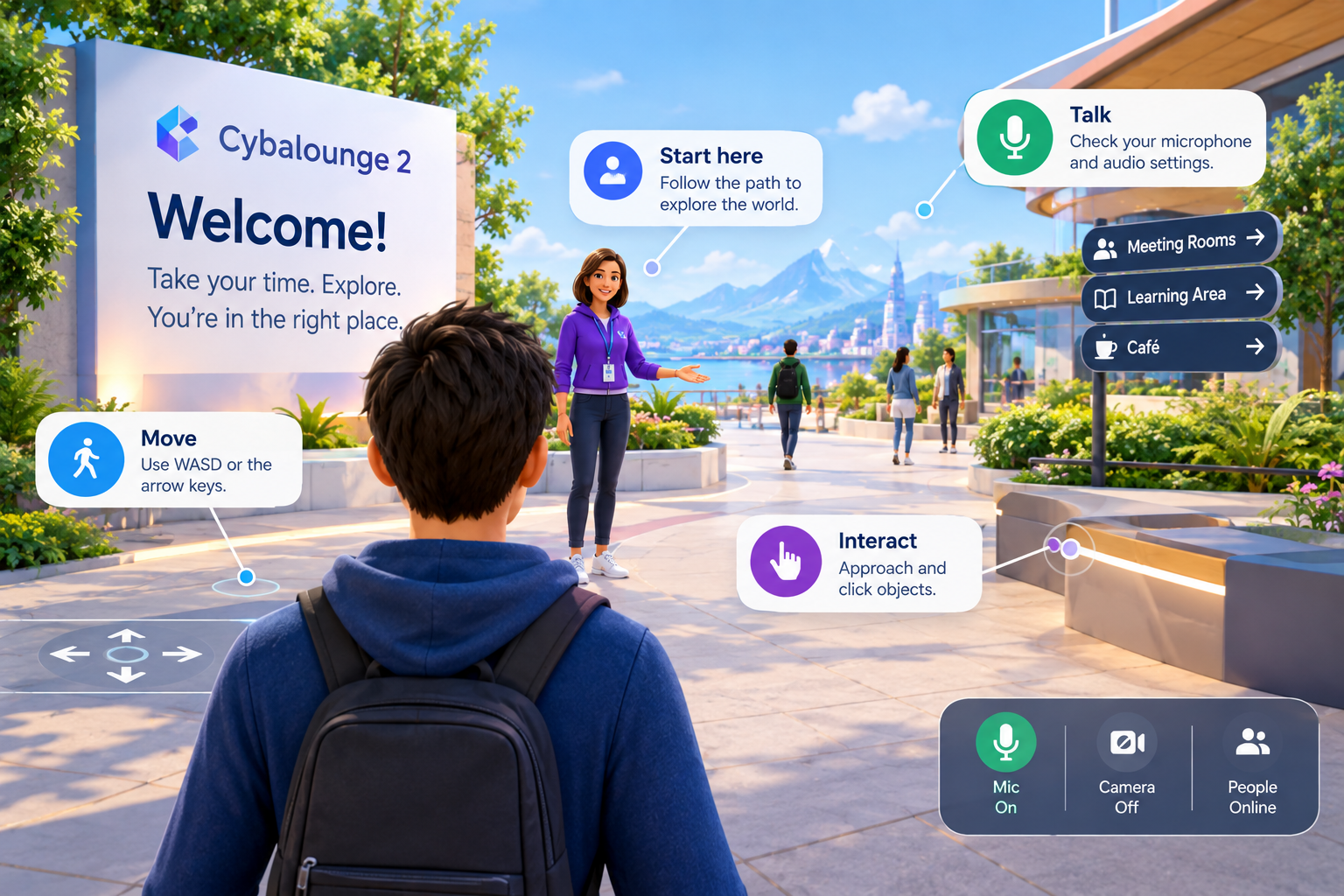
Once inside the world, orientation becomes the first challenge. A first-time user needs a clear starting point. The spawn location should not place them inside a crowd, facing a wall, or in the middle of visual complexity. They should arrive somewhere that communicates direction: perhaps near an entrance, a welcome area, a visible sign, or a simple path. Spatial design can reduce the need for interface. A good world layout tells the user where to look and where to go.
Movement is the next challenge. Here the platform must avoid two extremes. On one side, it should not assume that the user knows all controls. On the other, it should not interrupt every movement with instructions. Short, contextual hints can help: move, look around, approach, interact, speak. These hints should be easy to dismiss and easy to rediscover. The goal is not to teach everything immediately, but to give the user enough confidence to continue.
Communication requires special care. Many users are anxious about audio and video. They want to know whether they are muted, whether others can hear them, whether video is active, and how to change that state. In a browser-based platform, permissions can be especially confusing because the browser itself may ask for access to microphone or camera. The platform should not leave users alone with technical prompts. Clear labels, visible states and simple controls reduce stress. A microphone button is not only a function; it is a reassurance.
Social orientation is equally important. In a multi-user world, users need to identify other people. Avatar labels, presence indicators and speaking cues can help, but they must be designed with restraint. Too many labels or indicators can clutter the space, while too few can make the world feel anonymous and uncertain. The onboarding experience should show users how to recognize others and how close they need to be to communicate, interact or participate.
The trade-off is that guidance can become intrusive. A system that constantly explains itself may prevent users from feeling free. Too many popups can make a virtual world feel like compliance training. Too much automation can make users feel controlled. The best onboarding should be gentle, not paternalistic. It should offer help without making the user feel incompetent. It should make early success likely, then gradually step back.
Different audiences need different levels of guidance. A class of students may learn movement quickly but need rules for communication and behavior. A business team may understand meetings but struggle with spatial navigation. Senior users may benefit from slower pacing, larger text, clearer audio states and more explicit reassurance. Public events may require fast entry and minimal explanation. The platform should not force one onboarding style onto all use cases. It should allow creators and administrators to adapt the entry experience to the audience.
Onboarding also matters for creators. A world builder should think about how a person experiences the first minute of a specific world. Where do they appear? What do they see first? What is the first action? What happens if they do nothing? Is there a clear path, host, sign, guide, object or sound cue? A technically correct world can still fail if it has no entry logic. The first five minutes are not only a platform problem; they are also a design responsibility for every world.
For Cybalounge 2, this connects directly to the broader goal of simplicity. A platform with low operating and maintenance costs should not compensate by pushing complexity onto the user. Simplicity must be felt. It must show up in the moment of entry, in the first movement, in the first conversation and in the first successful interaction. If the user feels competent quickly, the platform has earned more time. If the user feels lost, every later feature becomes irrelevant.
The first five minutes decide whether a virtual world feels like an invitation or a barrier. Onboarding is the art of turning arrival into confidence.
Now available on Amazon!
Discover the Metaverse Beyond the Hype
The Metaverse is no longer a futuristic fantasy, it is rapidly becoming a new layer of human society. But what is it really? Where did it come from? And what might it become over the next decade?
The Metaverse – Past, Present, and Future takes readers on a fascinating journey from the earliest virtual worlds and science-fiction visions to today’s emerging immersive platforms, digital economies, and online communities. Along the way, it explores the technologies powering the Metaverse, the opportunities it creates for education, work, and culture, and the challenges of governance, privacy, inclusion, and sustainability.
Looking beyond today's headlines, the book offers a balanced and inspiring vision of how immersive technologies could transform cities, learning, creativity, and daily life by 2035.
Whether you are a business leader, educator, technologist, policymaker, or simply curious about the future, this book provides the context, insight, and perspective needed to understand one of the most important technological and societal shifts of our time.
The future of the Metaverse is not something we await, it is something we create.
About the Author
Dieter E. Heyne is a Metaverse pioneer and lifelong technologist, born in Munich in 1966. With a master’s degree in applied computer science and over three decades of experience as an IT entrepreneur, software architect, and consultant, he has always been at the frontier of digital innovation. His journey into virtual worlds began in 2007 with Second Life and sparked a deep, ongoing exploration of the Metaverse as a space for education, collaboration, and immersive experiences.
Since 2012, Dieter has been developing and refining a web-based virtual world platform, driven by a vision to make the Metaverse accessible, meaningful, and transformative. As a frequent speaker and thought leader at Metaverse events, he shares his insights on how virtual environments can reshape human interaction, learning, and culture. He is the founder and CEO of Metaverse School GmbH, a company dedicated to promoting Metaverse literacy and helping people and organizations understand the power and promise of these emerging digital realms.
Besides talking and writing non-fiction about the Metaverse and Virtual Worlds, this vast knowledge now went into the creation of The Metaverse Enforcers, an ongoing series of high-tech science fiction novels, showcasing the potential development and dangers of the Metaverse in 2053.
About Metaverse School GmbH
Metaverse School GmbH was founded in 2017 by Dieter E. Heyne, who continues to lead the company as its CEO. The company emerged from decades of consulting experience in software architecture, project management, quality assurance, information security, and data protection. Building on this strong technological foundation, Metaverse School GmbH is dedicated to promoting the responsible and purposeful use of immersive 3D environments, for education, collaboration, training, and simulation.
A core mission of the company is to raise awareness of the Metaverse’s potential across business, education, and society. In support of this goal, Dieter Heyne regularly speaks at national and international conferences as well as Metaverse-focused events. Through real-world examples and deep expertise, he demonstrates how immersive technologies can already create meaningful value today.
Disclaimer
Some portions of this content were created or refined with the assistance of artificial intelligence (AI) using tools such as OpenAI’s ChatGPT. The ideas, structure, and editorial direction remain the responsibility of the author. While every effort has been made to ensure factual accuracy and original expression, readers are encouraged to approach speculative or future-facing statements with critical thought.
This series does not represent the views of any specific company or platform and is intended to inspire open discussion around the evolving concept of the Metaverse.
The moment a virtual world opens in the browser, two expectations meet. The first expectation comes from the web: users expect controls, menus, buttons, status indicators and visible choices. The second expectation comes from spatial experience: users want to look around, move naturally, recognize other people, understand the environment and feel that they have entered a place. Both expectations are valid, but they are not always compatible. A traditional web interface wants to be visible. A virtual world often becomes better when the interface knows when to disappear.
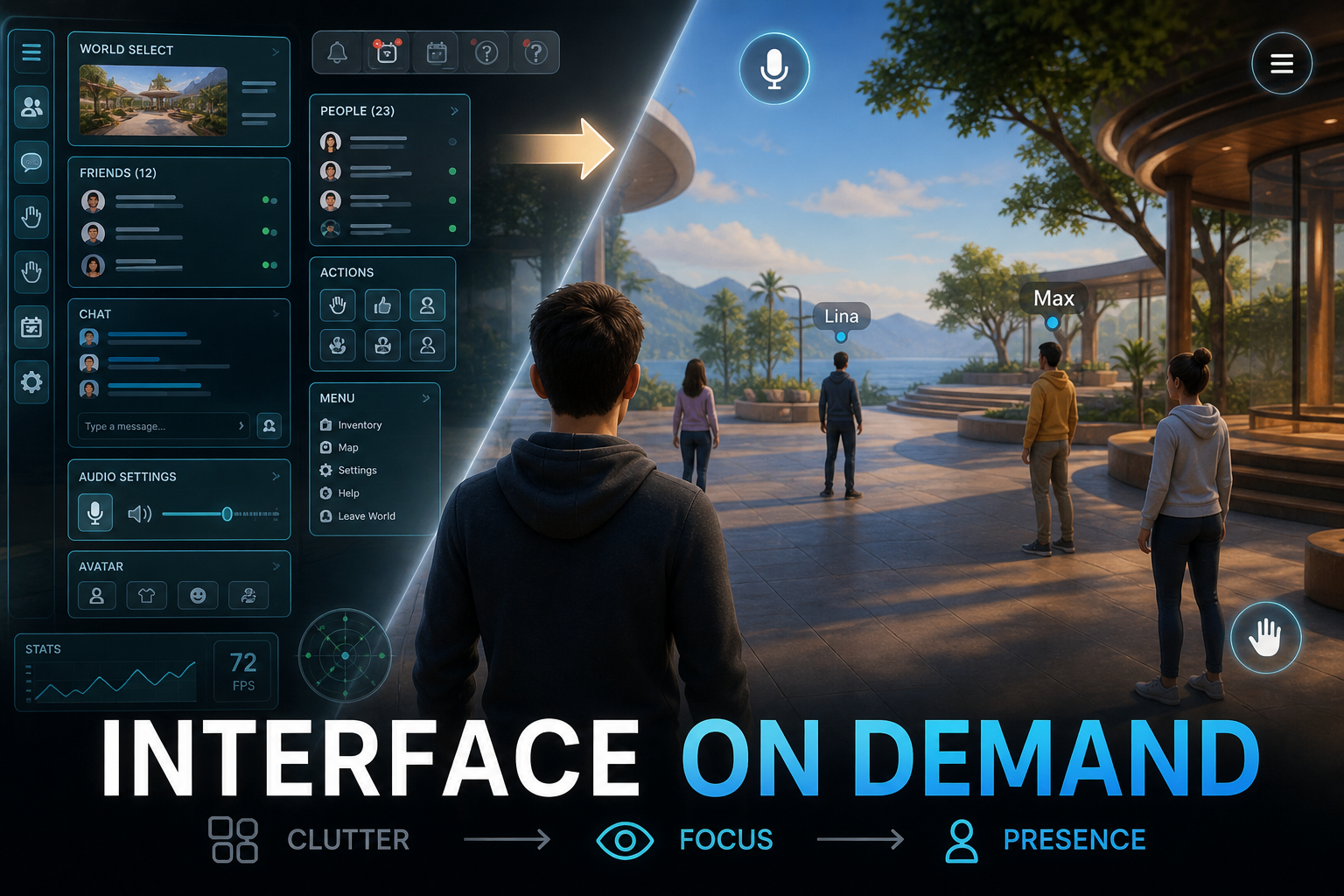
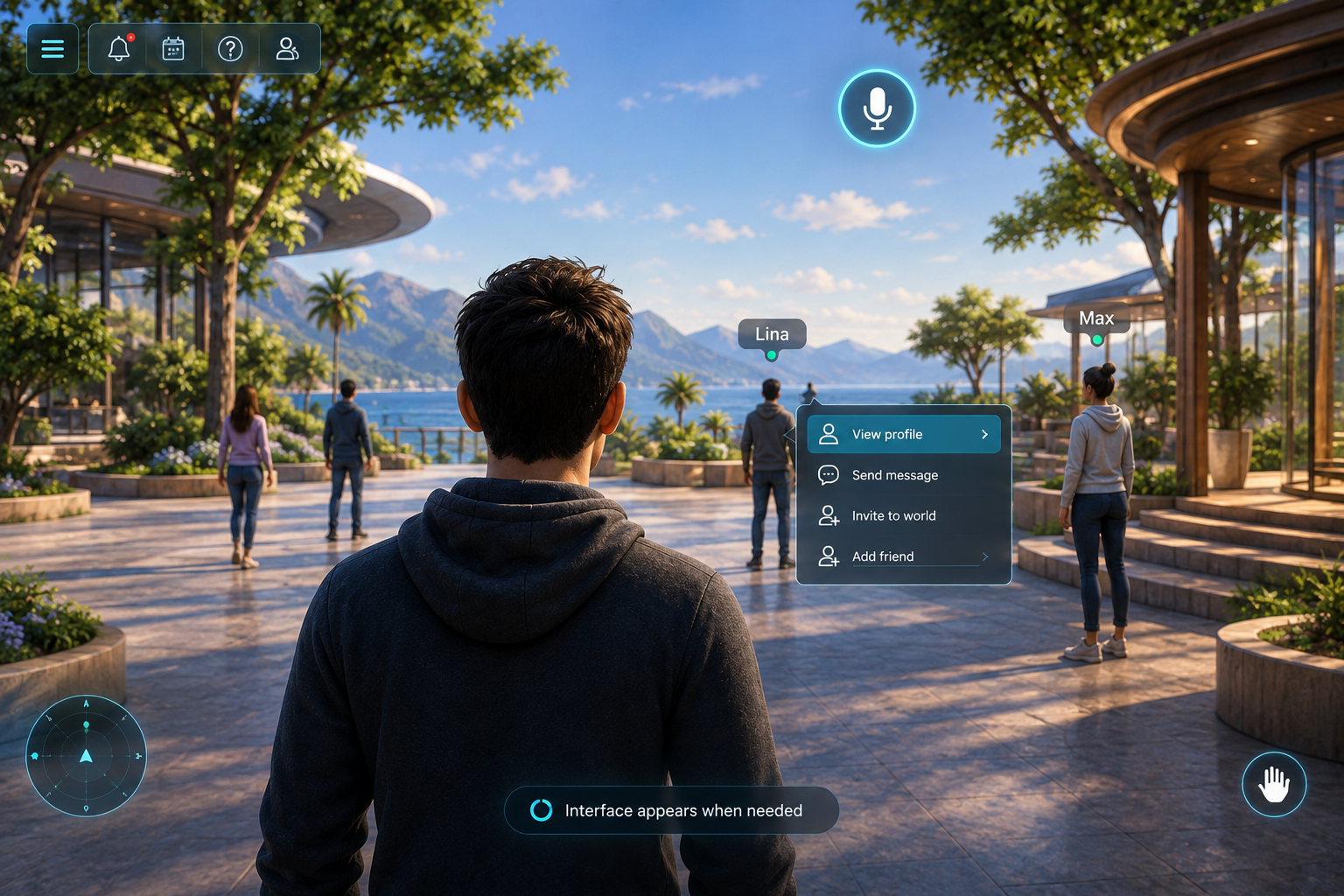
This is why the idea of Interface on Demand became important for Cybalounge 2. The goal is not to remove the interface. A hidden interface can be just as frustrating as an overloaded one. Users need to know how to change worlds, select an avatar, communicate, adjust audio, interact with objects, understand names, open menus and leave a session. But they do not need every possible option permanently floating in front of the world. Presence is fragile. When too many panels compete for attention, the virtual world stops feeling like a place and starts feeling like a control room.
In many web applications, more visible functionality can be helpful. A business dashboard, for example, benefits from constant access to filters, charts, buttons and status information. In a virtual world, the same density can become visual noise. A training room, a museum space, a virtual campus or a senior community environment should not require the user to mentally fight through layers of interface before noticing the room itself. The space is the primary interface. The 3D world communicates through layout, scale, light, distance, object placement and movement. The 2D interface should support that experience, not dominate it.
The design principle is simple: show what is needed when it is needed. A microphone button should be visible enough that the user feels in control, especially in social or educational settings. A world selection dialog should appear during entry or transition, not permanently occupy the screen. An avatar label should help people recognize each other, but should not turn a meeting into a cloud of distracting nameplates. A contextual menu should appear near the object or person it refers to, then step away when the task is complete. A progress popup should reassure the user during loading, then disappear as soon as the world becomes usable.
This creates a different kind of interface discipline. Instead of asking which functions exist, we ask when the user needs them, how urgently they need them, and how much attention they should claim. Some interface elements are persistent because they represent safety or immediate control. Others should be temporary because they only matter during a specific decision. Some should be discoverable through context. Others should be available through a calm, central menu. The challenge is to keep functions findable without making them constantly present.
The trade-off is that contextual interface design requires more care. If a button is always visible, users can at least see that the function exists. If it appears only in context, the context must be obvious. The system must teach users gently, especially in the first sessions. A hidden feature is not elegant if nobody finds it. An interface that disappears too aggressively can create uncertainty. Users need feedback, affordances and recovery paths. They need to understand where they are, what can be done, and how to undo or leave an interaction.
This becomes particularly important for audiences that are not composed of gamers or developers. In education, business, public-sector and senior-oriented environments, many users may be entering a virtual 3D space for the first time. They should not have to memorize keyboard shortcuts or guess invisible interaction rules. Interface on Demand must therefore be paired with onboarding, readable labels, clear prompts and forgiving interaction design. The interface may step back, but it must not abandon the user.
For creators, the same principle applies in another way. World builders need tools, settings and feedback, but the end-user world should not display the creator workflow unless the user is actually creating. A platform that mixes creation tools and visitor controls too aggressively can confuse both roles. The creator needs structure; the visitor needs clarity. Interface on Demand allows the platform to present different levels of complexity depending on the task. Visiting, teaching, moderating, building and testing are different modes, and they should not all fight for screen space at once.
Another advantage is emotional. Visual calm makes a world feel more professional. When a virtual environment is crowded with interface elements, it can feel unfinished, even if the underlying technology works well. When the interface is restrained, the space has room to breathe. The user can notice the architecture, the people, the atmosphere and the purpose of the world. This matters in learning environments, where attention should be directed toward content and interaction. It matters in business environments, where a calm interface communicates reliability. It matters in community spaces, where the world should feel welcoming rather than technical.
The principle also supports future extensibility. As the platform grows, more functions will appear: moderation tools, building tools, scripting options, avatar customization, recording, accessibility settings, guided tours and AI assistants. Without a strong interface philosophy, each new feature would add another permanent element to the screen. Over time, the interface would become the product, and the world would become the background. Interface on Demand provides a way to grow without overwhelming the user.
The most difficult part is restraint. Developers like to make features visible because visibility proves that work has been done. Product teams like visible controls because they demonstrate capability. But immersive design asks a different question: does this visible element make the current experience better? If the answer is no, the function may still be important, but it should probably wait in the background until the right moment.
In Cybalounge 2, Interface on Demand is not a decorative idea. It is part of the platform philosophy. The user should always feel able to act, but not constantly reminded of the software behind the world. A virtual world should not hide its controls so deeply that it becomes mysterious. It should also not expose everything so loudly that it becomes exhausting. The best interface is the one that supports intention, protects attention and then gracefully steps back.
In virtual worlds, the interface should not compete with presence. It should make presence possible.
Now available on Amazon!
Discover the Metaverse Beyond the Hype
The Metaverse is no longer a futuristic fantasy, it is rapidly becoming a new layer of human society. But what is it really? Where did it come from? And what might it become over the next decade?
The Metaverse – Past, Present, and Future takes readers on a fascinating journey from the earliest virtual worlds and science-fiction visions to today’s emerging immersive platforms, digital economies, and online communities. Along the way, it explores the technologies powering the Metaverse, the opportunities it creates for education, work, and culture, and the challenges of governance, privacy, inclusion, and sustainability.
Looking beyond today's headlines, the book offers a balanced and inspiring vision of how immersive technologies could transform cities, learning, creativity, and daily life by 2035.
Whether you are a business leader, educator, technologist, policymaker, or simply curious about the future, this book provides the context, insight, and perspective needed to understand one of the most important technological and societal shifts of our time.
The future of the Metaverse is not something we await, it is something we create.
About the Author
Dieter E. Heyne is a Metaverse pioneer and lifelong technologist, born in Munich in 1966. With a master’s degree in applied computer science and over three decades of experience as an IT entrepreneur, software architect, and consultant, he has always been at the frontier of digital innovation. His journey into virtual worlds began in 2007 with Second Life and sparked a deep, ongoing exploration of the Metaverse as a space for education, collaboration, and immersive experiences.
Since 2012, Dieter has been developing and refining a web-based virtual world platform, driven by a vision to make the Metaverse accessible, meaningful, and transformative. As a frequent speaker and thought leader at Metaverse events, he shares his insights on how virtual environments can reshape human interaction, learning, and culture. He is the founder and CEO of Metaverse School GmbH, a company dedicated to promoting Metaverse literacy and helping people and organizations understand the power and promise of these emerging digital realms.
Besides talking and writing non-fiction about the Metaverse and Virtual Worlds, this vast knowledge now went into the creation of The Metaverse Enforcers, an ongoing series of high-tech science fiction novels, showcasing the potential development and dangers of the Metaverse in 2053.
About Metaverse School GmbH
Metaverse School GmbH was founded in 2017 by Dieter E. Heyne, who continues to lead the company as its CEO. The company emerged from decades of consulting experience in software architecture, project management, quality assurance, information security, and data protection. Building on this strong technological foundation, Metaverse School GmbH is dedicated to promoting the responsible and purposeful use of immersive 3D environments, for education, collaboration, training, and simulation.
A core mission of the company is to raise awareness of the Metaverse’s potential across business, education, and society. In support of this goal, Dieter Heyne regularly speaks at national and international conferences as well as Metaverse-focused events. Through real-world examples and deep expertise, he demonstrates how immersive technologies can already create meaningful value today.
Disclaimer
Some portions of this content were created or refined with the assistance of artificial intelligence (AI) using tools such as OpenAI’s ChatGPT. The ideas, structure, and editorial direction remain the responsibility of the author. While every effort has been made to ensure factual accuracy and original expression, readers are encouraged to approach speculative or future-facing statements with critical thought.
This series does not represent the views of any specific company or platform and is intended to inspire open discussion around the evolving concept of the Metaverse.
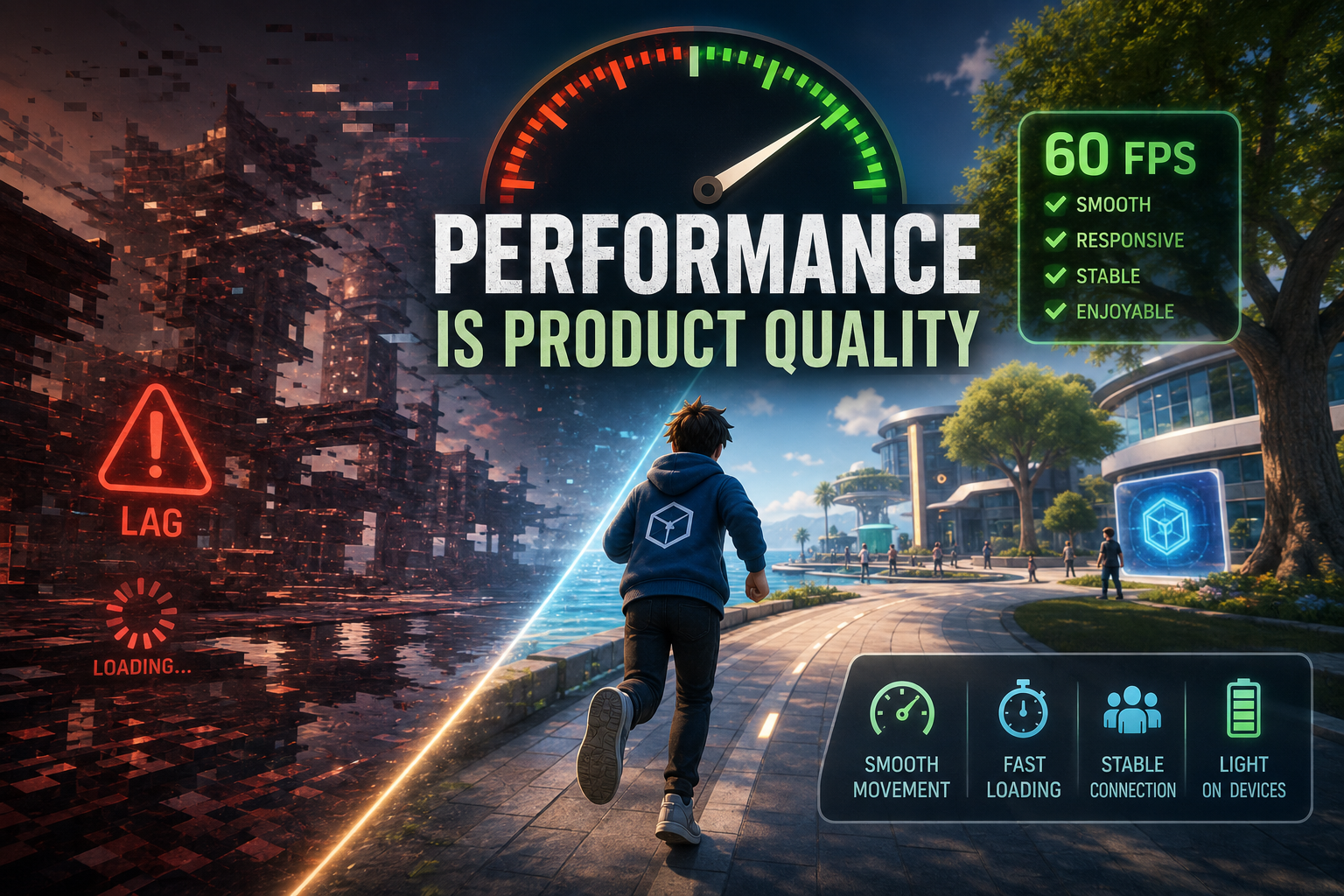
Performance is one of the clearest examples of the gap between developer language and user experience. Developers talk about frame rates, draw calls, triangle counts, texture sizes, memory usage, garbage collection, shader cost, network latency, and loading strategies. Users rarely use those words. They say the world feels slow, heavy, laggy, uncomfortable, or broken. To them, poor performance is not a technical issue. It is (bad) product quality.
This is especially true in virtual worlds because performance is not only visual. It affects comfort, orientation, communication, and trust. A stuttering world makes movement difficult. Low frame rates make camera control feel unpleasant. Long loading times create doubt before the experience begins. Audio or video problems make communication frustrating. Delayed avatar movement reduces social presence. Overheating or battery drain makes the platform feel impractical. Performance is not hidden in the background. It shapes the entire experience.
For CL2, this means optimization cannot be treated as a late-stage cleanup task. It must be part of the platform philosophy from the beginning. The architecture, world structure, model pipeline, rendering choices, communication strategy, and creator workflow all influence performance. If the platform allows creators to import anything without guidance, the result may look good in a single test and fail in real use. If optimization is postponed until after worlds are built, it becomes much harder and more expensive to fix.
The browser-first approach makes this even more important. Users may enter from different devices, browsers, graphics hardware, screen sizes, and network conditions. Some may use powerful desktops. Others may use ordinary laptops, school devices, office machines, or older hardware. If the platform is meant for practical use in education, business, training, communities, and public projects, it cannot assume high-end gaming equipment. It must be designed for the devices people actually have.
This does not mean every world must look simple or flat. Visual quality matters. Atmosphere matters. Models, lighting, sky, water, audio, and effects all contribute to presence. But visual richness must be balanced with performance discipline. A world that looks impressive in a screenshot but performs poorly in a live session is not a successful world. For real use, smooth enough usually beats spectacular but unstable.
Performance also affects operating cost. If the client is efficient, the platform can rely more on browser-side rendering and static delivery. If assets are optimized, bandwidth costs decrease and loading becomes faster. If synchronization is efficient, communication overhead remains manageable. If the backend is light, hosting becomes simpler. These technical choices support the broader goal of operating at around one US dollar or less per user per month. Performance is therefore connected not only to user comfort, but also to the business model.
The creator workflow is one of the most important performance levers. Creators need guidance before they publish worlds. They need to understand that model complexity, texture size, material count, lights, shadows, transparency, particles, and audio all have costs. They need feedback when a scene becomes too heavy. They need conventions for importing models and preparing assets. Without this, performance becomes a problem that appears late, when the world is already built and expectations are already set.
One practical consequence of treating performance as product quality is the decision to provide some optimization support directly inside the platform. In an ideal world, every imported model would already be perfectly prepared before it reaches the virtual world: clean geometry, reasonable polygon count, efficient materials, properly sized textures, and a structure that supports rendering performance. In reality, many creators are not 3D optimization specialists. They may download a model from an asset library, receive it from an external designer, export it from a construction tool, or create it in Blender with the main goal of making it look right. That is understandable. For many creators, the visual result is the first concern. Performance budgets, draw calls, material reuse, mesh merging, and runtime cost are usually not the first things they want to think about.
This is why a platform like Cybalounge 2 should not simply push all responsibility back to the creator. Creator guidelines are important, and professional world builders still need to understand the basics of optimization. But if the platform can reduce some common performance problems automatically, it should do so. A mesh optimizer can help by identifying static meshes with similar properties and merging them where this is safe and useful. In simple terms, the platform tries to reduce the number of separate objects the browser has to handle during rendering. This does not magically turn every heavy model into a perfect real-time asset, but it can make a meaningful difference, especially in worlds built from many repeated or fragmented static objects. It also lowers the entry barrier for creators, because they do not need to solve every optimization issue inside external tools before they can test an idea.
The trade-off is that automatic optimization must be honest about its limits. A platform-side mesh optimizer cannot replace good modeling practice. It cannot reliably fix every complicated asset, every animated model, every custom geometry structure, or every scene with many unique materials and material settings. It may help with static building elements, repeated structures, or models that are already reasonably clean. It may not help much with highly detailed characters, animated assets, or models that are visually beautiful but structurally unsuitable for real-time use. Still, this kind of optimizer fits the philosophy of the platform: keep the creator workflow forgiving without hiding reality. The goal is not to remove responsibility from creators completely, but to support them where the platform can reasonably do so. If CL2 can absorb some technical complexity internally, creators can focus more on designing useful worlds, and users receive the benefit where it matters most: smoother movement, faster loading, more stable frame rates, and a virtual world that feels professional on normal devices.
This can create tension because creators naturally want freedom. They want to use beautiful models, detailed environments, high-resolution textures, atmospheric effects, and interactive elements. That desire is valid. A platform should not feel like a list of restrictions. But unlimited freedom can harm users. If a world is too heavy, users suffer. If performance fails, the creator's intention is lost. Guidelines and limits are not there to reduce creativity. They are there to protect the experience.
One useful way to frame this is performance budgeting. Just as a project has a financial budget, a virtual world has a performance budget. It can spend that budget on geometry, textures, lighting, effects, avatars, communication, and interaction. The question is not whether each element is good in isolation. The question is whether the whole world remains usable. A creator may choose to spend more budget on atmosphere and less on dense decoration, or more on model detail and less on heavy effects. But the budget must exist.
Performance is also closely tied to perception of professionalism. Users may forgive a missing advanced feature if the platform feels stable. They are less likely to forgive constant stutter, long delays, or unreliable movement. In business and education, reliability often matters more than novelty. A training session cannot pause because the world overloaded. A meeting cannot become awkward because avatars freeze. A classroom cannot depend on devices that only a few learners have. Smooth operation creates confidence.
There is also a maintenance side. Optimized worlds are easier to host, easier to update, and easier to scale. They reduce support requests. They make testing more predictable. They help identify problems earlier. A platform that treats performance as a shared responsibility between core system and creators can grow more sustainably. A platform that ignores performance until users complain will always be reacting too late.
For Cybalounge 2, performance is therefore not an afterthought and not a purely technical metric. It is part of the product promise. The platform should feel lightweight because it is lightweight in the right places. It should support atmosphere without becoming heavy. It should give creators expressive power while helping them stay within practical limits. A virtual world feels professional when it runs smoothly on real devices, in real sessions, with real users. Performance is product quality.
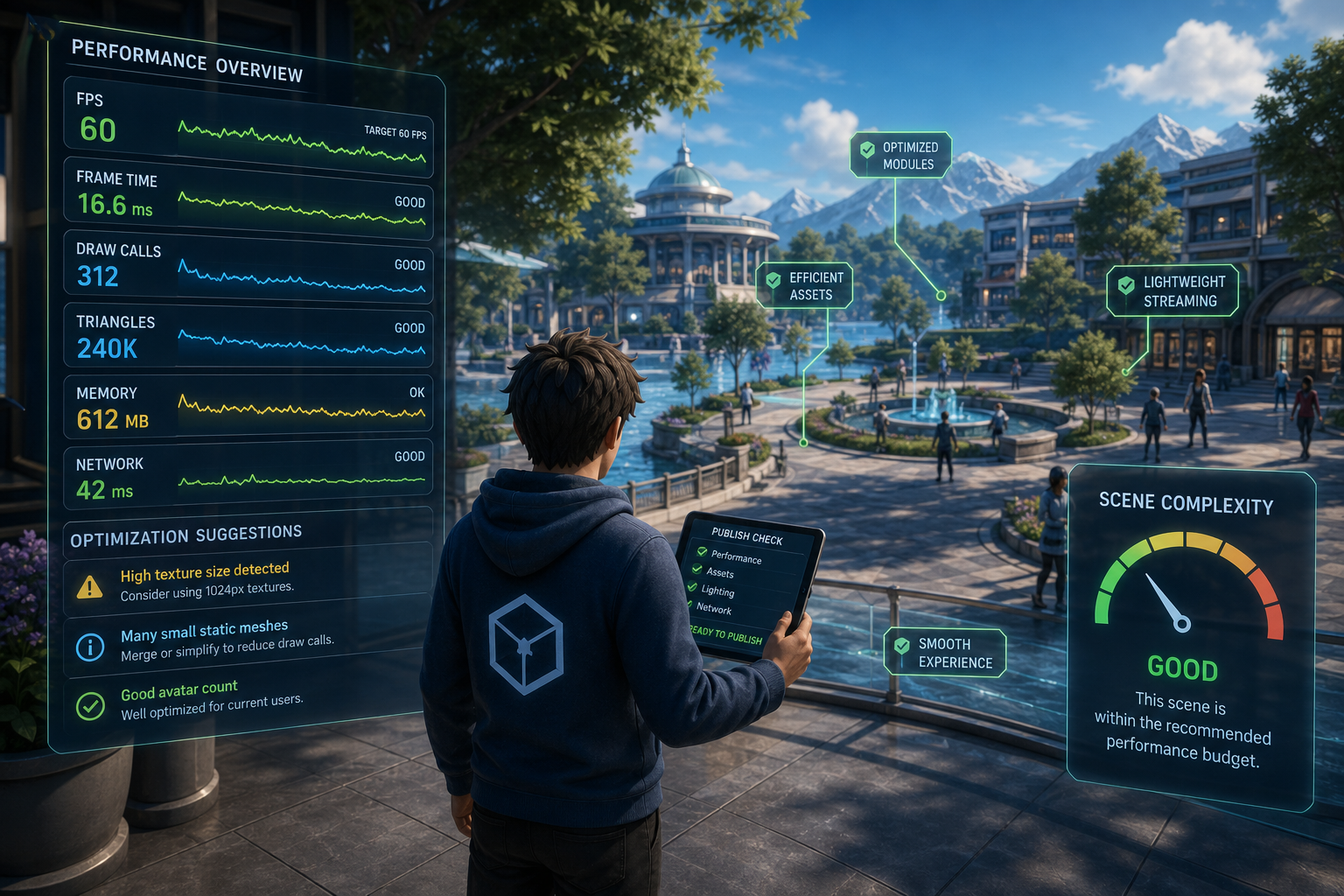
Performance should also be visible during creation. If creators only learn about problems after users complain, the workflow has failed. The platform should move toward practical feedback: asset warnings, scene complexity indicators, optimization suggestions, and simple publishing checks. These tools do not need to be perfect at the beginning, but they express an important principle: quality is built before publication, not repaired afterwards.
In the future, this can grow into a creator dashboard or publishing checklist. The purpose would not be to shame creators with technical numbers, but to translate performance into understandable guidance. If the platform can explain why something is heavy, creators can make better decisions.
Now available on Amazon!
Discover the Metaverse Beyond the Hype
The Metaverse is no longer a futuristic fantasy, it is rapidly becoming a new layer of human society. But what is it really? Where did it come from? And what might it become over the next decade?
The Metaverse – Past, Present, and Future takes readers on a fascinating journey from the earliest virtual worlds and science-fiction visions to today’s emerging immersive platforms, digital economies, and online communities. Along the way, it explores the technologies powering the Metaverse, the opportunities it creates for education, work, and culture, and the challenges of governance, privacy, inclusion, and sustainability.
Looking beyond today's headlines, the book offers a balanced and inspiring vision of how immersive technologies could transform cities, learning, creativity, and daily life by 2035.
Whether you are a business leader, educator, technologist, policymaker, or simply curious about the future, this book provides the context, insight, and perspective needed to understand one of the most important technological and societal shifts of our time.
The future of the Metaverse is not something we await, it is something we create.
About the Author
Dieter E. Heyne is a Metaverse pioneer and lifelong technologist, born in Munich in 1966. With a master’s degree in applied computer science and over three decades of experience as an IT entrepreneur, software architect, and consultant, he has always been at the frontier of digital innovation. His journey into virtual worlds began in 2007 with Second Life and sparked a deep, ongoing exploration of the Metaverse as a space for education, collaboration, and immersive experiences.
Since 2012, Dieter has been developing and refining a web-based virtual world platform, driven by a vision to make the Metaverse accessible, meaningful, and transformative. As a frequent speaker and thought leader at Metaverse events, he shares his insights on how virtual environments can reshape human interaction, learning, and culture. He is the founder and CEO of Metaverse School GmbH, a company dedicated to promoting Metaverse literacy and helping people and organizations understand the power and promise of these emerging digital realms.
Besides talking and writing non-fiction about the Metaverse and Virtual Worlds, this vast knowledge now went into the creation of The Metaverse Enforcers, an ongoing series of high-tech science fiction novels, showcasing the potential development and dangers of the Metaverse in 2053.
About Metaverse School GmbH
Metaverse School GmbH was founded in 2017 by Dieter E. Heyne, who continues to lead the company as its CEO. The company emerged from decades of consulting experience in software architecture, project management, quality assurance, information security, and data protection. Building on this strong technological foundation, Metaverse School GmbH is dedicated to promoting the responsible and purposeful use of immersive 3D environments, for education, collaboration, training, and simulation.
A core mission of the company is to raise awareness of the Metaverse’s potential across business, education, and society. In support of this goal, Dieter Heyne regularly speaks at national and international conferences as well as Metaverse-focused events. Through real-world examples and deep expertise, he demonstrates how immersive technologies can already create meaningful value today.
Disclaimer
Some portions of this content were created or refined with the assistance of artificial intelligence (AI) using tools such as OpenAI’s ChatGPT. The ideas, structure, and editorial direction remain the responsibility of the author. While every effort has been made to ensure factual accuracy and original expression, readers are encouraged to approach speculative or future-facing statements with critical thought.
This series does not represent the views of any specific company or platform and is intended to inspire open discussion around the evolving concept of the Metaverse.
Collision detection is one of those platform features that users usually notice only when it fails. If the avatar walks across a floor, stops at a wall, climbs a small step, or avoids an obstacle, users rarely think about it. The world simply feels solid. But if the avatar falls through the ground, walks through a closed door, gets stuck on invisible geometry, or cannot move over a small edge, the illusion breaks immediately. In that moment, collision detection stops being a technical detail and becomes the user's main experience.
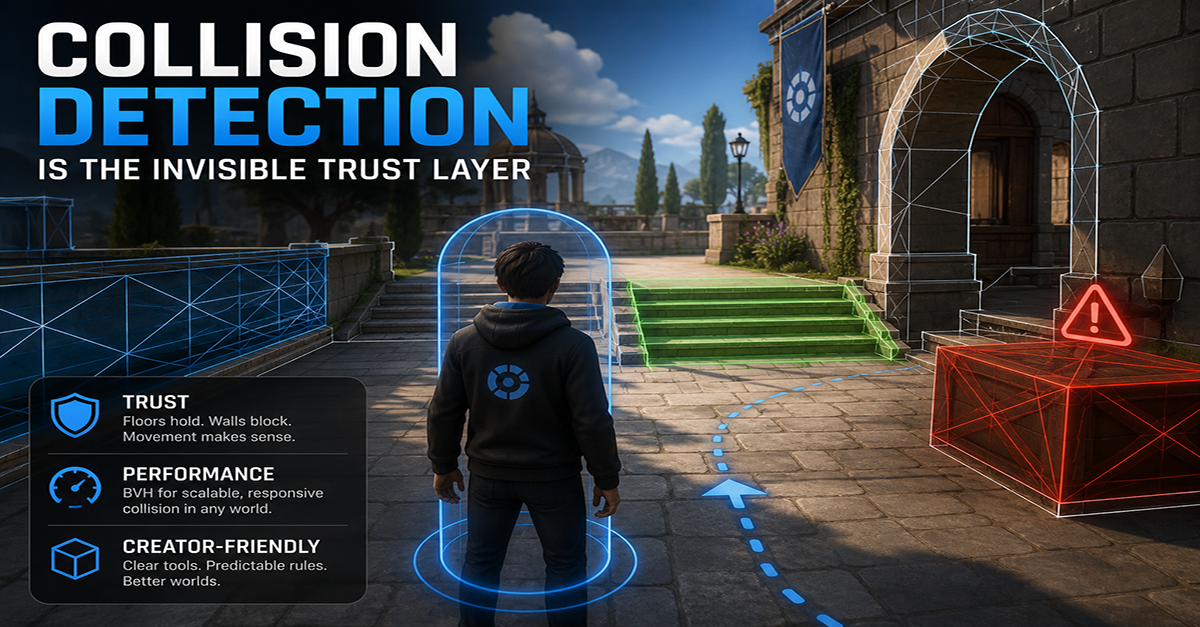
For Cybalounge 2, collision detection is therefore not only about physics. It is about trust. A virtual world needs rules. Floors should support the user. Walls should have meaning. Obstacles should be understandable. Stairs, platforms, and ramps should behave in ways that match visual expectations. When users move through a space, they constantly test whether the environment can be trusted. Most of this testing is unconscious, but it shapes the feeling of quality.
This is especially important in practical use cases. In a training environment, users may need to follow procedures, approach equipment, avoid dangerous zones, or move through realistic spaces. In an educational world, learners may explore a reconstruction, laboratory, museum, or simulation. In a business environment, people may gather in meeting rooms, presentation areas, or digital twins. If the environment behaves inconsistently, the use case loses credibility. Users may still see a 3D scene, but they no longer believe in it as a place.
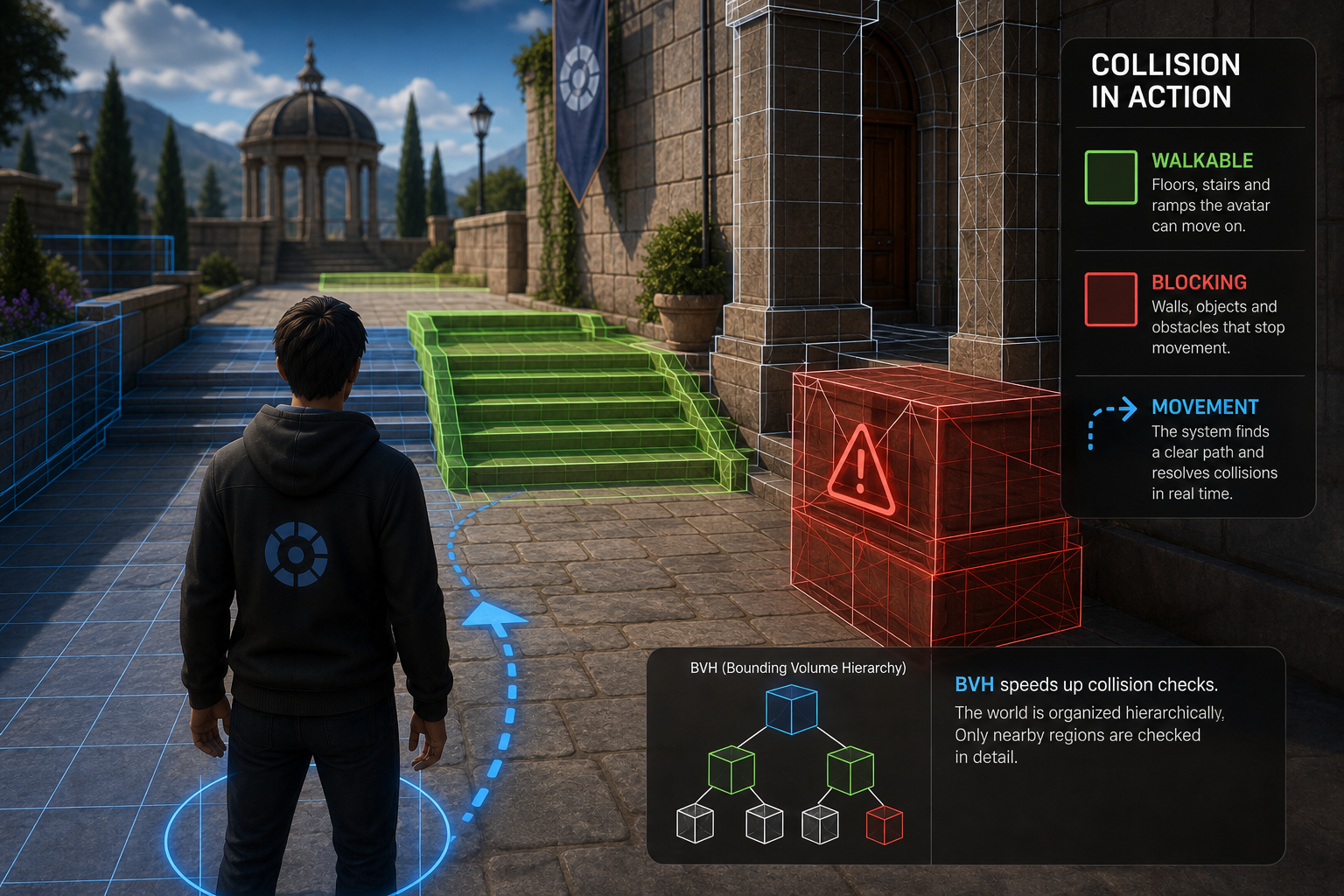
The challenge is that collision detection can become expensive. A virtual world may include imported models with thousands or millions of triangles. Using the visible geometry directly for every collision check can be too slow, especially in a browser. On the other hand, overly simple collision shapes can feel inaccurate. A wall may block movement before the avatar visually reaches it. A staircase may feel like a ramp or a barrier. A complex object may behave like a large invisible box. The platform needs a balance between accuracy and performance.
This balance is not only an algorithmic question. It is a product decision. The platform must decide what kind of collision quality is necessary for its intended use cases. A highly realistic physics simulation may not be required for a meeting space or learning environment. But basic reliability is required. Users should not need to think about the collision system. The world should feel predictable enough that movement becomes natural.
One useful principle is to separate visual detail from collision detail. A model may be visually complex, but the collision representation can often be simpler. A chair, wall, platform, or building does not need every decorative triangle to participate in movement blocking. The challenge is to create or generate collision structures that are simple enough for performance and accurate enough for user trust. This is especially relevant when creators import external models that were not built specifically for real-time browser environments.
Collision also interacts with the avatar. The avatar has a physical presence in the world, even if simplified. It needs a height, width, ground contact, and a way to detect obstacles. It must know whether it is standing on something, whether it is blocked, whether a step is climbable, and how to respond when the camera path is obstructed. These decisions create the feeling of movement. A good collision system does not only say yes or no. It helps classify the world in ways that support comfortable navigation.
Camera collision is another important part of trust, especially in a third-person view. If an object comes between the camera and the avatar, the user may lose sight of themselves. The system needs a way to detect obstacles and adjust the camera so the avatar remains visible. This is not a dramatic feature, but it has a strong effect on comfort. Users should not have to fight the camera because a wall, tree, or object blocks their view.
The invisible nature of collision makes it easy to undervalue. Visual effects are more obvious. Water, sky, particles, lighting, and avatars attract attention. Collision does not look like much in screenshots. But it is one of the foundations of presence. The user believes in a space when the space resists them in expected ways. Solid geometry communicates that the world has structure. Without that structure, the environment becomes a visual backdrop rather than a place.
There is also a creator experience aspect. If creators build worlds, they need to understand how collision works. They do not necessarily need to understand every internal detail, but they need guidance. Which objects block movement? Which models are only decorative? How are floors defined? How are stairs or ramps handled? What happens when a model is too complex? Can collision geometry be generated automatically? Can it be simplified? The platform should make collision manageable, not mysterious.
The trade-off between precision and performance will remain a recurring topic. More accurate collision usually costs more computation. More simplified collision may reduce realism. In a browser-based platform, this trade-off is even more visible because the same system must run on many devices. The right solution is not maximum precision everywhere. The right solution is practical reliability: enough accuracy to support trust, enough performance to keep the world smooth, and enough transparency for creators to work with it.
Good collision design can also reduce support problems. If creators understand which objects block movement and which are decorative, fewer worlds will contain accidental traps, invisible barriers, or broken floors. The platform should eventually help identify these issues before publication. Collision is therefore not only a runtime feature; it is part of quality assurance for world building.
One design decision that belongs into this discussion is the move from simple ray-casting toward a BVH-based approach, a bounding volume hierarchy. At first glance, this sounds like a technical detail, but the motivation behind it is very practical. In a small scene with only a few objects, simple ray-casting can be good enough. The system can ask a direct question: “If the avatar moves in this direction, what does this ray hit?” For prototypes and controlled test environments, this is attractive because it is easy to understand and relatively quick to implement. But as soon as a world becomes larger, more detailed, and more varied, this simple approach can become expensive and imprecise. The system may need to test too many surfaces too often. It may miss important details. Or it may require so many workarounds that the original simplicity starts to disappear.
A BVH changes the way the platform thinks about the geometry of the world. Instead of treating a complex environment as one large collection of surfaces, it organizes the space into a hierarchy of bounding areas. In non-technical terms, it is a way of saying: before checking every detail, first check which larger region is relevant. If the avatar is nowhere near a certain building, tree, wall, or floor section, there is no reason to examine its individual surfaces. This makes collision detection more efficient, especially in larger scenes. It also helps with precision, because once the relevant part of the world is identified, the system can focus its attention there instead of wasting effort everywhere else. For a virtual world platform that should run in the browser and remain usable on normal devices, this matters a great deal. Performance is not only about high frame rates. It is about keeping movement responsive, predictable, and comfortable.
The trade-off is that BVH-based collision detection requires more care. It is not the quickest path. It adds implementation effort, requires testing, and makes the internal handling of world geometry more sophisticated. It also means that creators and developers must think more carefully about static and dynamic objects, optimized meshes, and the way imported models are structured. Not every object benefits equally from the same approach, and animated or highly complex models can introduce additional challenges. But for Cybalounge 2, this felt like the right kind of complexity: not complexity for its own sake, but complexity used to protect simplicity at the user level. The user should not have to think about rays, bounding volumes, or geometry hierarchies. The user should simply feel that the floor is solid, walls behave like walls, stairs can be trusted, and movement remains smooth. That is the real reason behind the decision. The platform accepts more effort internally so that the experience can feel lighter, more stable, and more natural externally.
In the end, collision detection is a promise. It tells the user that the world will behave consistently. It says that floors are floors, walls are walls, obstacles are obstacles, and movement has meaning. When that promise holds, users stop thinking about it. When it breaks, they lose trust immediately. This is why collision detection is not only about physics. It is the invisible trust layer of a virtual world platform.
Now available on Amazon!
Discover the Metaverse Beyond the Hype
The Metaverse is no longer a futuristic fantasy, it is rapidly becoming a new layer of human society. But what is it really? Where did it come from? And what might it become over the next decade?
The Metaverse – Past, Present, and Future takes readers on a fascinating journey from the earliest virtual worlds and science-fiction visions to today’s emerging immersive platforms, digital economies, and online communities. Along the way, it explores the technologies powering the Metaverse, the opportunities it creates for education, work, and culture, and the challenges of governance, privacy, inclusion, and sustainability.
Looking beyond today's headlines, the book offers a balanced and inspiring vision of how immersive technologies could transform cities, learning, creativity, and daily life by 2035.
Whether you are a business leader, educator, technologist, policymaker, or simply curious about the future, this book provides the context, insight, and perspective needed to understand one of the most important technological and societal shifts of our time.
The future of the Metaverse is not something we await, it is something we create.
About the Author
Dieter E. Heyne is a Metaverse pioneer and lifelong technologist, born in Munich in 1966. With a master’s degree in applied computer science and over three decades of experience as an IT entrepreneur, software architect, and consultant, he has always been at the frontier of digital innovation. His journey into virtual worlds began in 2007 with Second Life and sparked a deep, ongoing exploration of the Metaverse as a space for education, collaboration, and immersive experiences.
Since 2012, Dieter has been developing and refining a web-based virtual world platform, driven by a vision to make the Metaverse accessible, meaningful, and transformative. As a frequent speaker and thought leader at Metaverse events, he shares his insights on how virtual environments can reshape human interaction, learning, and culture. He is the founder and CEO of Metaverse School GmbH, a company dedicated to promoting Metaverse literacy and helping people and organizations understand the power and promise of these emerging digital realms.
Besides talking and writing non-fiction about the Metaverse and Virtual Worlds, this vast knowledge now went into the creation of The Metaverse Enforcers, an ongoing series of high-tech science fiction novels, showcasing the potential development and dangers of the Metaverse in 2053.
About Metaverse School GmbH
Metaverse School GmbH was founded in 2017 by Dieter E. Heyne, who continues to lead the company as its CEO. The company emerged from decades of consulting experience in software architecture, project management, quality assurance, information security, and data protection. Building on this strong technological foundation, Metaverse School GmbH is dedicated to promoting the responsible and purposeful use of immersive 3D environments, for education, collaboration, training, and simulation.
A core mission of the company is to raise awareness of the Metaverse’s potential across business, education, and society. In support of this goal, Dieter Heyne regularly speaks at national and international conferences as well as Metaverse-focused events. Through real-world examples and deep expertise, he demonstrates how immersive technologies can already create meaningful value today.
Disclaimer
Some portions of this content were created or refined with the assistance of artificial intelligence (AI) using tools such as OpenAI’s ChatGPT. The ideas, structure, and editorial direction remain the responsibility of the author. While every effort has been made to ensure factual accuracy and original expression, readers are encouraged to approach speculative or future-facing statements with critical thought.
This series does not represent the views of any specific company or platform and is intended to inspire open discussion around the evolving concept of the Metaverse.
Controls are easy to underestimate because they sound technical. A key is pressed, a mouse moves, a gamepad stick changes position, a touch gesture begins, a camera rotates, an avatar walks. From a developer's perspective, this can look like input processing. From a user's perspective, it is the difference between feeling comfortable and feeling lost. In a virtual world, controls are not technical plumbing. They are user experience.
This matters because movement is one of the first things users test. Before they understand the world, before they use communication, before they interact with objects, they try to move. If movement feels natural enough, they continue exploring. If it feels awkward, unpredictable, or frightening, the platform has already lost confidence. A beautiful environment cannot compensate for controls that make users feel incompetent.
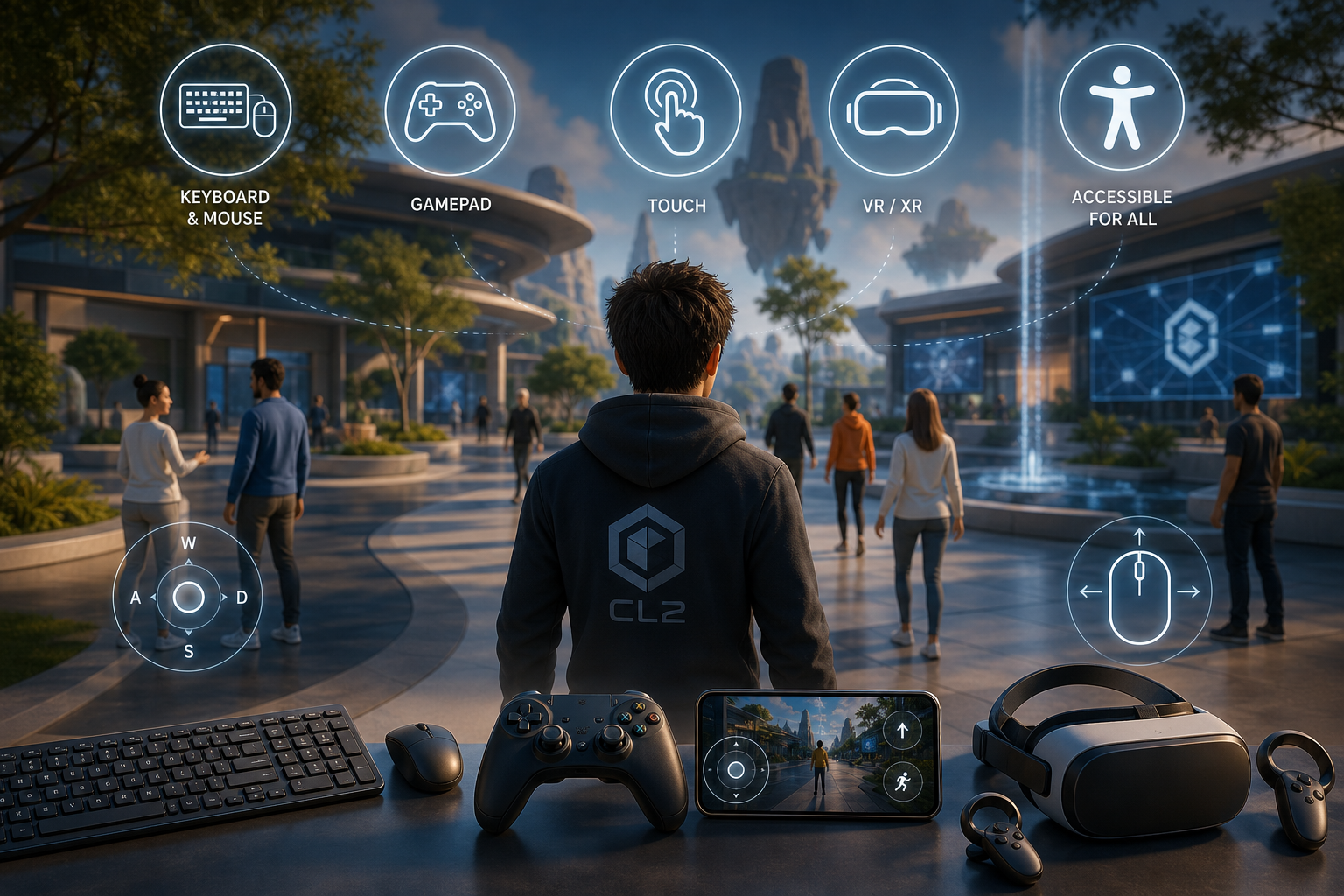
Cybalounge 2 is intended for a broad audience. Some users may have gaming experience and expect familiar WASD movement, mouse camera control, or gamepad support. Others may be business users who rarely navigate 3D environments. Some may join from a laptop without a mouse. Some may use touch devices. Some future users may enter through VR or XR devices. This variety means the platform cannot assume one perfect input method. It must support different ways of moving while keeping the experience understandable.
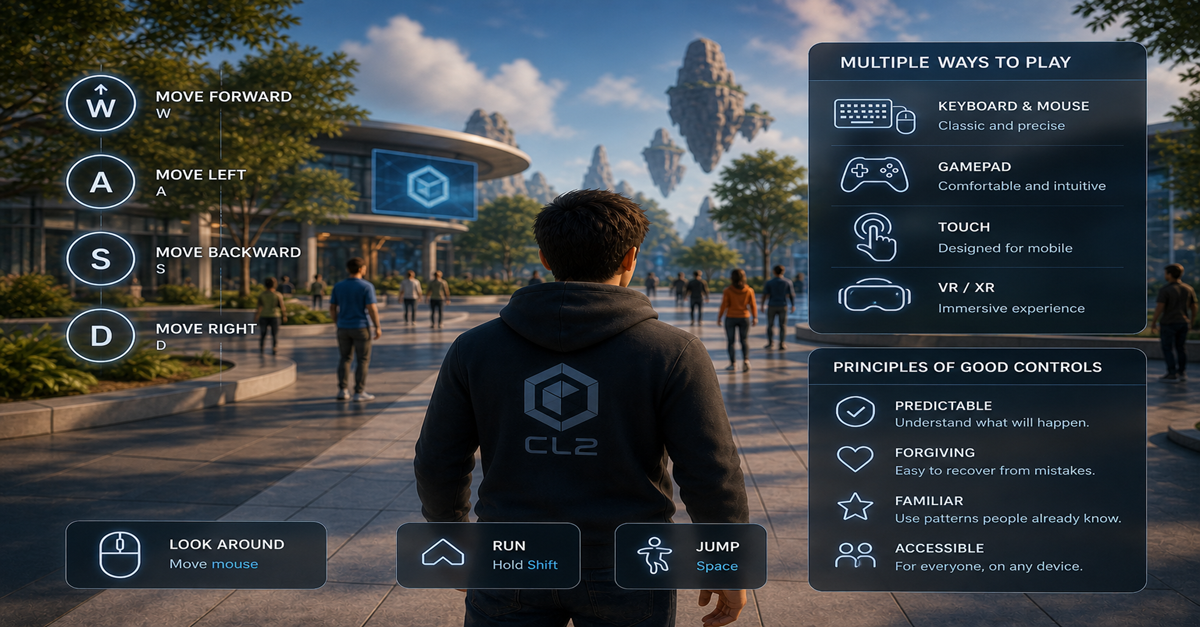
Predictability is the first principle. Users need to understand what will happen when they press a key or move a stick. If the avatar sometimes turns and sometimes slides, if the camera sometimes follows and sometimes drifts, if forward movement depends on a hidden state, the user loses trust. Predictable controls allow users to build muscle memory. They stop thinking about input and start thinking about the world.
Forgiveness is the second principle. Users will make mistakes. They will press the wrong key, move the camera too far, get too close to an obstacle, or try to walk into something. A good control system should help them recover. It should avoid trapping them in corners, disorienting them with sudden camera changes, or punishing small errors. This is especially important for non-gamers and first-time users. The goal is not to test navigation skill. The goal is to let people participate.
Familiarity is the third principle. There is value in using conventions that people already know. Keyboard movement, mouse looking, gamepad sticks, and touch controls all have established patterns. A platform should not invent unusual control schemes unless there is a strong reason. Familiarity reduces learning effort. It also makes onboarding easier because users can bring expectations from other applications.
At the same time, virtual world controls must serve the specific platform. CL2 uses an avatar-centered approach, so movement, camera, and animation belong together. The avatar should not feel separate from the camera. The camera should support the avatar rather than fight it. If the user moves forward, the system should make it clear what forward means. If the camera rotates, orientation should remain understandable. If the avatar runs, walks, or stops, the visual feedback should match the input.
Supporting multiple input methods increases development complexity. Keyboard, mouse, gamepad, touch, and VR controllers all behave differently. They produce different types of signals. A keyboard is digital: pressed or not pressed. A gamepad stick is analog and can express direction and strength. Touch controls may need virtual sticks or gestures. VR controllers add position and orientation. If each input method controls the avatar directly in its own way, the system can become messy quickly.
This is why a unified control concept is important. Input devices should be translated into common movement intentions: move forward, move backward, turn, look, run, jump, interact, and so on. The avatar controller can then respond to intentions rather than raw device events. This keeps the system more maintainable and helps ensure that different input methods create comparable behavior. The user should not feel that each device belongs to a different platform.
Controls also connect to accessibility. Not everyone can use the same input method comfortably. Some users may need keyboard-only navigation. Others may prefer a gamepad. Some may require slower movement, reduced camera sensitivity, or simpler interaction. A platform designed for education, business, public use, or senior communities should not treat accessibility as an afterthought. Control flexibility is one of the most practical forms of accessibility.
There is also an emotional element. A user who can move confidently feels capable. A user who constantly struggles with navigation may feel embarrassed, especially in a shared environment. This matters in training and education, where the platform should support learning rather than create performance anxiety. It also matters in business meetings, where users do not want to look clumsy in front of colleagues. Smooth controls protect dignity.
For Cybalounge 2, the ambition is not to create a complex simulation of human movement. The first goal is more practical: make movement feel stable, readable, and comfortable. As with many parts of the platform, there will be trade-offs. Advanced movement features can come later. The foundation must be reliable. Good controls disappear into the experience. Bad controls define the whole experience. If users remember the controls more than the world, something has gone wrong.
Controls also shape how users interpret the world itself. A narrow doorway feels different if steering is precise. A staircase feels different if the avatar approaches it confidently. A gathering space feels different if users can stop, turn, and face each other without effort. Interaction design begins before a button is clicked; it begins with the way the user arrives.
The same applies to onboarding. A first-time user should not need to study a manual before they can take a few steps, rotate the camera, and understand where they are. Short visual hints, sensible defaults, and forgiving movement can reduce the fear of entering a 3D space. Controls are not only about supporting devices; they are about welcoming people.
The platform also has to avoid surprising experienced users. Defaults should feel familiar, but settings can allow adjustment where needed. Camera sensitivity, running behavior, touch layout, and future VR comfort options can become important without overwhelming the first experience.
Now available on Amazon!
Discover the Metaverse Beyond the Hype
The Metaverse is no longer a futuristic fantasy, it is rapidly becoming a new layer of human society. But what is it really? Where did it come from? And what might it become over the next decade?
The Metaverse – Past, Present, and Future takes readers on a fascinating journey from the earliest virtual worlds and science-fiction visions to today’s emerging immersive platforms, digital economies, and online communities. Along the way, it explores the technologies powering the Metaverse, the opportunities it creates for education, work, and culture, and the challenges of governance, privacy, inclusion, and sustainability.
Looking beyond today's headlines, the book offers a balanced and inspiring vision of how immersive technologies could transform cities, learning, creativity, and daily life by 2035.
Whether you are a business leader, educator, technologist, policymaker, or simply curious about the future, this book provides the context, insight, and perspective needed to understand one of the most important technological and societal shifts of our time.
The future of the Metaverse is not something we await, it is something we create.
About the Author
Dieter E. Heyne is a Metaverse pioneer and lifelong technologist, born in Munich in 1966. With a master’s degree in applied computer science and over three decades of experience as an IT entrepreneur, software architect, and consultant, he has always been at the frontier of digital innovation. His journey into virtual worlds began in 2007 with Second Life and sparked a deep, ongoing exploration of the Metaverse as a space for education, collaboration, and immersive experiences.
Since 2012, Dieter has been developing and refining a web-based virtual world platform, driven by a vision to make the Metaverse accessible, meaningful, and transformative. As a frequent speaker and thought leader at Metaverse events, he shares his insights on how virtual environments can reshape human interaction, learning, and culture. He is the founder and CEO of Metaverse School GmbH, a company dedicated to promoting Metaverse literacy and helping people and organizations understand the power and promise of these emerging digital realms.
Besides talking and writing non-fiction about the Metaverse and Virtual Worlds, this vast knowledge now went into the creation of The Metaverse Enforcers, an ongoing series of high-tech science fiction novels, showcasing the potential development and dangers of the Metaverse in 2053.
About Metaverse School GmbH
Metaverse School GmbH was founded in 2017 by Dieter E. Heyne, who continues to lead the company as its CEO. The company emerged from decades of consulting experience in software architecture, project management, quality assurance, information security, and data protection. Building on this strong technological foundation, Metaverse School GmbH is dedicated to promoting the responsible and purposeful use of immersive 3D environments, for education, collaboration, training, and simulation.
A core mission of the company is to raise awareness of the Metaverse’s potential across business, education, and society. In support of this goal, Dieter Heyne regularly speaks at national and international conferences as well as Metaverse-focused events. Through real-world examples and deep expertise, he demonstrates how immersive technologies can already create meaningful value today.
Disclaimer
Some portions of this content were created or refined with the assistance of artificial intelligence (AI) using tools such as OpenAI’s ChatGPT. The ideas, structure, and editorial direction remain the responsibility of the author. While every effort has been made to ensure factual accuracy and original expression, readers are encouraged to approach speculative or future-facing statements with critical thought.
This series does not represent the views of any specific company or platform and is intended to inspire open discussion around the evolving concept of the Metaverse.
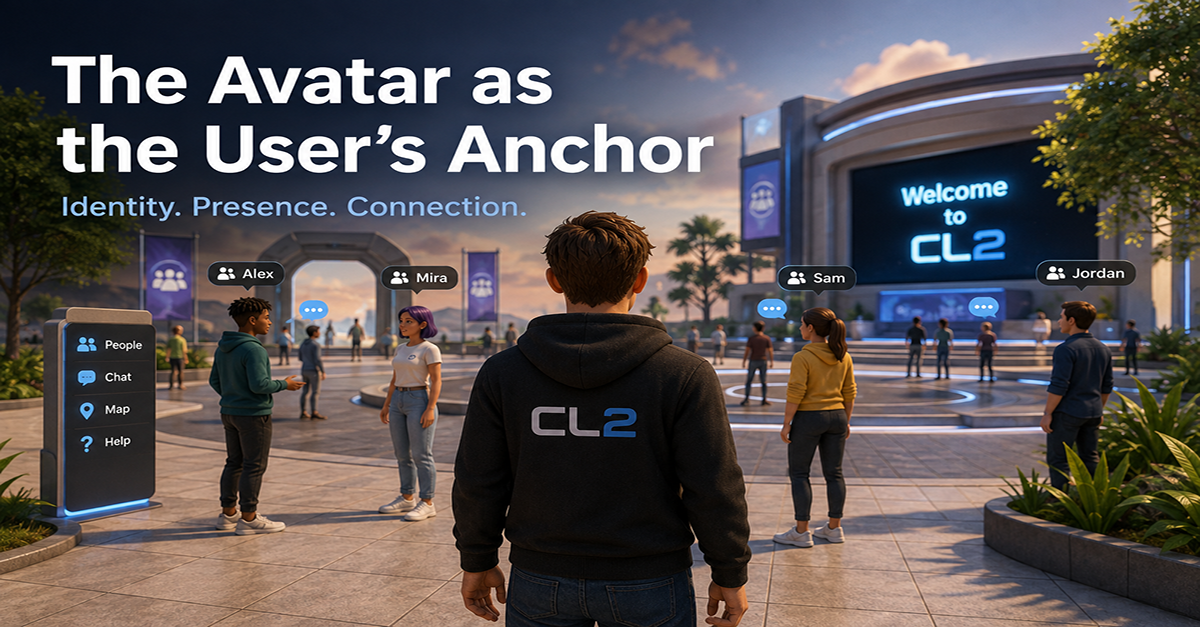
A virtual world begins to feel different from a website when the user has a place inside it. This place is not only a camera position. It is not only a viewpoint. It is a visible and social representation of the user. In Cybalounge 2, the avatar plays this role. It is the user's anchor in the world: the point where identity, movement, orientation, and presence come together.
Without an avatar, a 3D environment can easily feel like a floating camera experience. The user can look around and move, but may not feel embodied. This can be useful for some applications, such as architectural walkthroughs or product views, but it is less suitable for shared social spaces. In a multi-user world, people need to understand not only where they are, but where others are. They need to see direction, distance, movement, attention, and sometimes emotion or intention. The avatar provides these signals.
This is why I do not see the avatar as a decorative feature. It is a functional element of presence. It gives the user a body in the environment. It creates a relationship between the camera and the world. It allows movement to be interpreted as the movement of a person rather than a technical navigation mode. It helps other users recognize that someone is present. Even a simple avatar can transform an empty scene into a shared place.
For CL2, the first goal is not to create the most advanced avatar customization system. That would be an interesting future direction, and an Avatar Studio is definitely part of the long-term vision. But in the early platform, the priority is reliable presence. The avatar should load correctly, move predictably, animate believably enough, cast and receive shadows where appropriate, and support the basic social functions of a shared virtual world. It should give users a sense of being there.
This involves trade-offs. Full customization can be complex. Body shapes, clothing, hair, accessories, animations, facial expressions, and identity options can quickly become a platform within the platform. It may be tempting to build all of that early because avatars are emotionally important. But too much complexity too soon can distract from the core experience. A simple but stable avatar system may be more valuable in the beginning than an ambitious customization system that creates performance, usability, and maintenance problems.
The avatar also influences camera design. In a third-person view, the camera follows the user from outside the body. This can make navigation easier for many users, especially those who are not experienced with first-person 3D environments. It helps users see their own position, direction, and movement. It can reduce disorientation. It also supports a more social feeling because the user sees themselves as part of the scene. For non-gamers, educators, business users, and seniors, this can be more comfortable than being placed directly inside an invisible first-person viewpoint.
Movement is another part of the avatar's role. Walking, running, turning, and stopping are not only mechanical actions. They communicate intention. If an avatar approaches, turns away, waits, or follows, other users interpret that behavior socially. Even when animations are simple, they help make movement readable. A sliding object is less human than a walking avatar. A world with moving avatars feels inhabited. A world with only camera positions feels more like a technical session.
The avatar also supports orientation. In a 3D space, users can easily lose track of direction. Seeing the avatar's body, facing direction, and relationship to the environment helps maintain spatial awareness. This is especially important in larger worlds, training environments, or educational spaces where users may need to follow paths, gather at locations, or interact with specific objects. The avatar becomes a constant reference point.
There is also a social trust aspect. In a shared environment, users want to know who is present. Names, labels, distance, and avatar appearance all contribute to that understanding. The platform does not need to solve every identity question immediately, but it should make presence legible. If someone speaks, moves, or joins a group, others should be able to connect that action to a visible participant. Otherwise, the world can feel confusing or anonymous in a negative way.
For education and business, the avatar can support roles. A trainer, teacher, moderator, guide, learner, visitor, or presenter may not need a different body, but the platform can eventually use avatar labels, indicators, or visual conventions to support role recognition. This connects the avatar to moderation and safety as well. In shared spaces, it should be clear who can help, who is leading, and who has control over the room.
The avatar is also part of emotional engagement. People often remember spaces in relation to themselves. They remember where they stood, where others gathered, which path they took, what they saw from a certain position. An avatar strengthens that memory because it gives the user a body within the experience. This matters for learning, collaboration, events, and community building. Presence is not only visual quality. It is the feeling of being situated.
Over time, the avatar system can grow. More customization, better animations, expressive gestures, accessibility options, identity profiles, and AI-assisted avatar creation may all become valuable. But the foundation should remain clear: the avatar exists to anchor the user. It is not just a 3D model. It is the bridge between person and place, between movement and meaning, between individual presence and social space. Presence begins when the user has a place in the world.
There is also a practical reason to start simple. Every avatar is part of the performance budget. Detailed characters, complex materials, many animations, and high-resolution textures can quickly become expensive in multi-user scenes, especially within a web browser. A platform that wants to work on ordinary devices needs avatar quality that supports identity without overwhelming the system. The best early avatar is not the most detailed one, but the one that reliably helps users feel present.
This does not mean visual individuality is unimportant. It means the platform should earn customization step by step. First, the avatar must support presence. Then it can become more expressive, more personal, and more adaptable without weakening the core experience.
Now available on Amazon!
Discover the Metaverse Beyond the Hype
The Metaverse is no longer a futuristic fantasy, it is rapidly becoming a new layer of human society. But what is it really? Where did it come from? And what might it become over the next decade?
The Metaverse – Past, Present, and Future takes readers on a fascinating journey from the earliest virtual worlds and science-fiction visions to today’s emerging immersive platforms, digital economies, and online communities. Along the way, it explores the technologies powering the Metaverse, the opportunities it creates for education, work, and culture, and the challenges of governance, privacy, inclusion, and sustainability.
Looking beyond today's headlines, the book offers a balanced and inspiring vision of how immersive technologies could transform cities, learning, creativity, and daily life by 2035.
Whether you are a business leader, educator, technologist, policymaker, or simply curious about the future, this book provides the context, insight, and perspective needed to understand one of the most important technological and societal shifts of our time.
The future of the Metaverse is not something we await, it is something we create.
About the Author
Dieter E. Heyne is a Metaverse pioneer and lifelong technologist, born in Munich in 1966. With a master’s degree in applied computer science and over three decades of experience as an IT entrepreneur, software architect, and consultant, he has always been at the frontier of digital innovation. His journey into virtual worlds began in 2007 with Second Life and sparked a deep, ongoing exploration of the Metaverse as a space for education, collaboration, and immersive experiences.
Since 2012, Dieter has been developing and refining a web-based virtual world platform, driven by a vision to make the Metaverse accessible, meaningful, and transformative. As a frequent speaker and thought leader at Metaverse events, he shares his insights on how virtual environments can reshape human interaction, learning, and culture. He is the founder and CEO of Metaverse School GmbH, a company dedicated to promoting Metaverse literacy and helping people and organizations understand the power and promise of these emerging digital realms.
Besides talking and writing non-fiction about the Metaverse and Virtual Worlds, this vast knowledge now went into the creation of The Metaverse Enforcers, an ongoing series of high-tech science fiction novels, showcasing the potential development and dangers of the Metaverse in 2053.
About Metaverse School GmbH
Metaverse School GmbH was founded in 2017 by Dieter E. Heyne, who continues to lead the company as its CEO. The company emerged from decades of consulting experience in software architecture, project management, quality assurance, information security, and data protection. Building on this strong technological foundation, Metaverse School GmbH is dedicated to promoting the responsible and purposeful use of immersive 3D environments, for education, collaboration, training, and simulation.
A core mission of the company is to raise awareness of the Metaverse’s potential across business, education, and society. In support of this goal, Dieter Heyne regularly speaks at national and international conferences as well as Metaverse-focused events. Through real-world examples and deep expertise, he demonstrates how immersive technologies can already create meaningful value today.
Disclaimer
Some portions of this content were created or refined with the assistance of artificial intelligence (AI) using tools such as OpenAI’s ChatGPT. The ideas, structure, and editorial direction remain the responsibility of the author. While every effort has been made to ensure factual accuracy and original expression, readers are encouraged to approach speculative or future-facing statements with critical thought.
This series does not represent the views of any specific company or platform and is intended to inspire open discussion around the evolving concept of the Metaverse.
 METAVERSE BLOG