 METAVERSE BLOG
 The Metaverse Series - Article 11
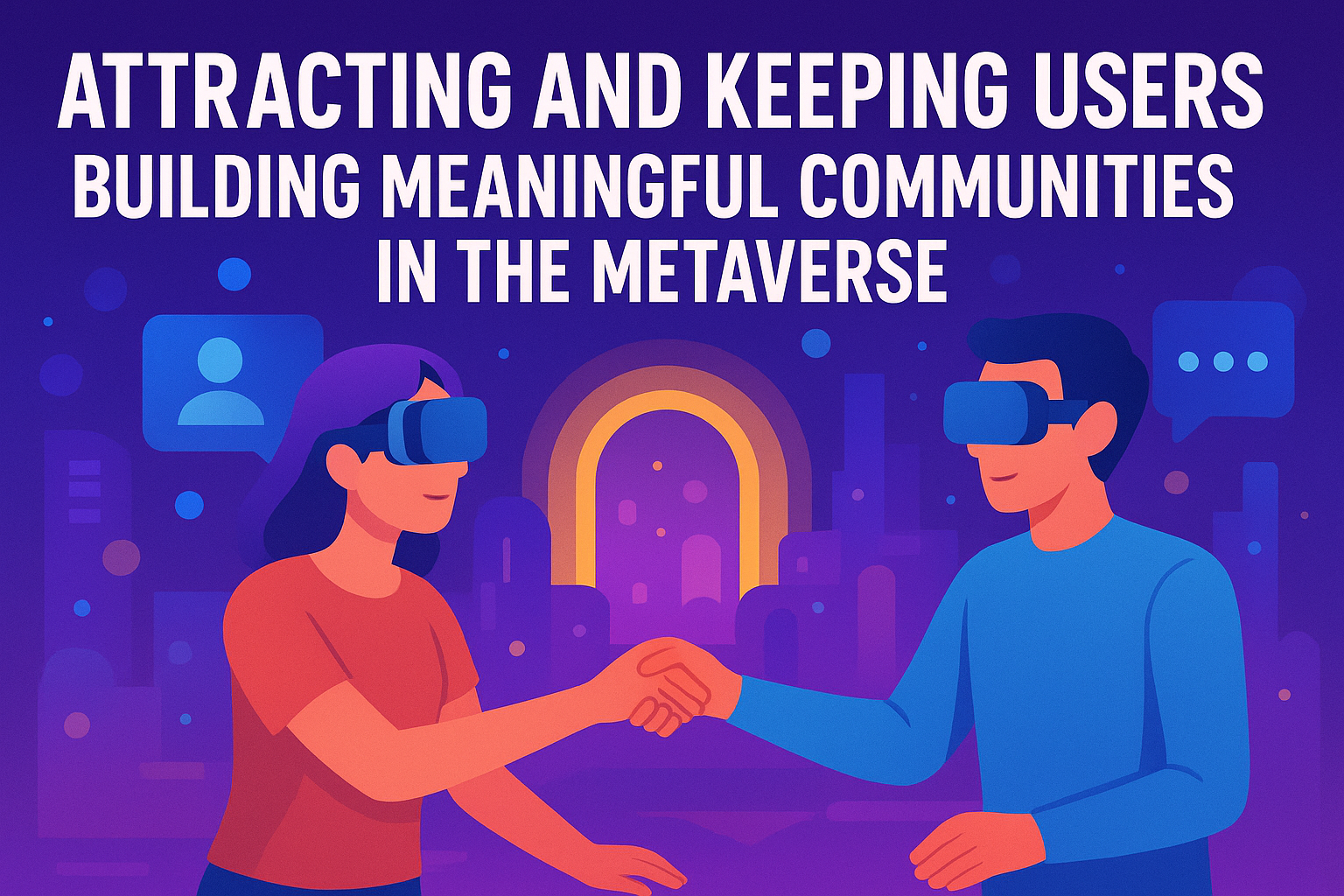
Attracting and Keeping Users – Building Meaningful Communities in the Metaverse
"When avatars meet, people connect."
As the Metaverse evolves from a futuristic concept into a living, breathing digital space, one challenge looms above all others: how to attract and retain users. Technologies, tools, and immersive visuals are only part of the equation. What truly makes a digital world feel alive is the people inside it, and the connections they form.
Communities: The Heart of the Metaverse
At the core of every successful platform lies a community. Whether it’s creators, gamers, educators, or hobbyists, shared interests and values create bonds that turn fleeting visits into long-term engagement. Many legacy platforms still survive, not because of cutting-edge technology, but because of the strong communities that grew within them.
Building the Metaverse must start with nurturing these human networks. Spaces must be created where users can meet, express themselves, and connect. These spaces, whether persistent virtual clubs, co-working lounges, or educational campuses, should foster genuine interaction.
Metaverse communities can outperform legacy social networks because they’re built around shared places and actions, not just feeds. Presence matters: when people meet as embodied avatars in persistent spaces, they gain voice tone, proximity, gesture, and eye contact, social signals text threads and flat video grids rarely convey. This richer bandwidth fosters trust faster, reduces misread intent, and makes collaboration, like co-designing a room, building a prototype, rehearsing a pitch, feel much more natural. Spaces provide context and continuity: clubs, studios, classrooms, plazas that evolve with the group, rather than scattered channels and disappearing posts.
Identity and belongings can be portable across worlds, so reputation, roles, and earned assets stick with members instead of getting locked inside a platform. Communities may be inherited from legacy platforms, by transferring the assets to a new Metaverse platform, using open standards. Governance can be more transparent: rules are embodied in spaces (who can enter, speak, edit), votes can be held in-world, and moderation tools can act spatially (soft walls, quiet zones) instead of blunt bans. Economically, creators can sell experiences, items, or services directly in the place they’re used, aligning incentives with community health rather than ad engagement. Discovery shifts from algorithmic outrage to event-centric participation: you attend, contribute, and build culture together.
Finally, privacy can improve: selective disclosure and pseudonymous presence let people share what’s relevant without oversharing, while worlds keep less personal data by design. Net result: communities that feel like neighborhoods, alive, accountable, and co-owned, rather than noisy comment sections.
Shared Purpose and Social Anchors
Why would someone log in, not once, but every day? The answer lies in purpose.
-
Friends to meet
-
Projects to collaborate on
-
Events to attend
-
Goals to pursue
The Metaverse must offer more than escapism. It must offer belonging. Whether someone is there to learn, build, teach, or play, they should feel that their presence matters and contributes to a larger whole.
Exploration, Collaboration, and Commerce
A rich Metaverse is filled with things to do:
-
Spaces to explore
Mysterious worlds, user-made museums, cultural centers. -
Tools to collaborate
Co-creation of artworks, multiplayer games, or interactive learning experiences. -
Opportunities for commerce
Crafting digital goods, offering services, or running a virtual shop.
These activities must be accessible, meaningful, and socially driven. Every click, every conversation, and every virtual handshake should reinforce the reason to return.
Gaming: A Different Kind of Fun
Games have traditionally been a driver of virtual engagement, but Metaverse gaming faces a unique challenge: it can’t (and shouldn’t try to) compete with the ultra-polished experiences of AAA studios. Instead, casual, social gaming, easy to learn, fun to play, and deeply social. This is the way forward.
Think:
-
Quick cooperative challenges
-
Community treasure hunts
-
Light-hearted roleplaying
These experiences, woven into the daily rhythm of the Metaverse, serve as bonding rituals, helping strangers become friends.
Sustaining the Social Fabric
To maintain a stable user base, Metaverse platforms must:
-
Encourage User Ownership
Let people shape their spaces and own their experiences. -
Empower Moderation
Give communities the tools to manage themselves respectfully. -
Celebrate Milestones
Events, anniversaries, and community spotlights boost morale and visibility. -
Listen and Adapt
Feedback loops are vital; communities must feel heard.
Long-lasting platforms like Second Life, VRChat, and even older MMOs demonstrate this well. People return not just for the content, but for the people.
Conclusion: Avatars Are People Too
In a Metaverse built to last, success won’t be measured by headsets sold or virtual land plots traded. It will be defined by the friendships formed, the projects shared, and the communities that take root and grow.
To attract users, give them a reason to enter.
To retain users, give them a reason to stay.
The Metaverse isn’t just about space, it’s about place.
And when avatars meet, people connect.
Join the Conversation
If this article sparked your curiosity or passion for the future of the Metaverse, I warmly invite you to join an open discussion in a virtual world setting. Let’s meet face-to-face (or avatar-to-avatar) to exchange ideas, share visions, and connect with others who believe in building something better. The next live meetup will take place on the 16th of January 2026 at 9 p.m. (UTC+2) in our Metaverse Meeting Point. Whether you’re a developer, creator, thinker, or explorer, your perspective matters. Come help shape the next chapter of the Metaverse!
.png)
About the Author
Dieter E. Heyne is a Metaverse pioneer and lifelong technologist, born in Munich in 1966. With a master’s degree in applied computer science and over three decades of experience as an IT entrepreneur, software architect, and consultant, he has always been at the frontier of digital innovation. His journey into virtual worlds began in 2007 with Second Life and sparked a deep, ongoing exploration of the Metaverse as a space for education, collaboration, and immersive experiences.
Since 2012, Dieter has been developing and refining a web-based virtual world platform, driven by a vision to make the Metaverse accessible, meaningful, and transformative. As a frequent speaker and thought leader at Metaverse events, he shares his insights on how virtual environments can reshape human interaction, learning, and culture. He is the founder and CEO of Metaverse School GmbH, a company dedicated to promoting Metaverse literacy and helping people and organizations understand the power and promise of these emerging digital realms.
About Metaverse School GmbH
Metaverse School GmbH was founded in 2017 by Dieter E. Heyne, who continues to lead the company as its CEO. The company emerged from decades of consulting experience in software architecture, project management, quality assurance, information security, and data protection. Building on this strong technological foundation, Metaverse School GmbH is dedicated to promoting the responsible and purposeful use of immersive 3D environments—for education, collaboration, training, and simulation.
A core mission of the company is to raise awareness of the Metaverse’s potential across business, education, and society. In support of this goal, Dieter Heyne regularly speaks at national and international conferences as well as Metaverse-focused events. Through real-world examples and deep expertise, he demonstrates how immersive technologies can already create meaningful value today.
Disclaimer
Some portions of this content were created or refined with the assistance of artificial intelligence (AI) using tools such as OpenAI’s ChatGPT. The ideas, structure, and editorial direction remain the responsibility of the author. While every effort has been made to ensure factual accuracy and original expression, readers are encouraged to approach speculative or future-facing statements with critical thought.
This series does not represent the views of any specific company or platform and is intended to inspire open discussion around the evolving concept of the Metaverse.