 METAVERSE BLOG
 The Metaverse Series - Article 07
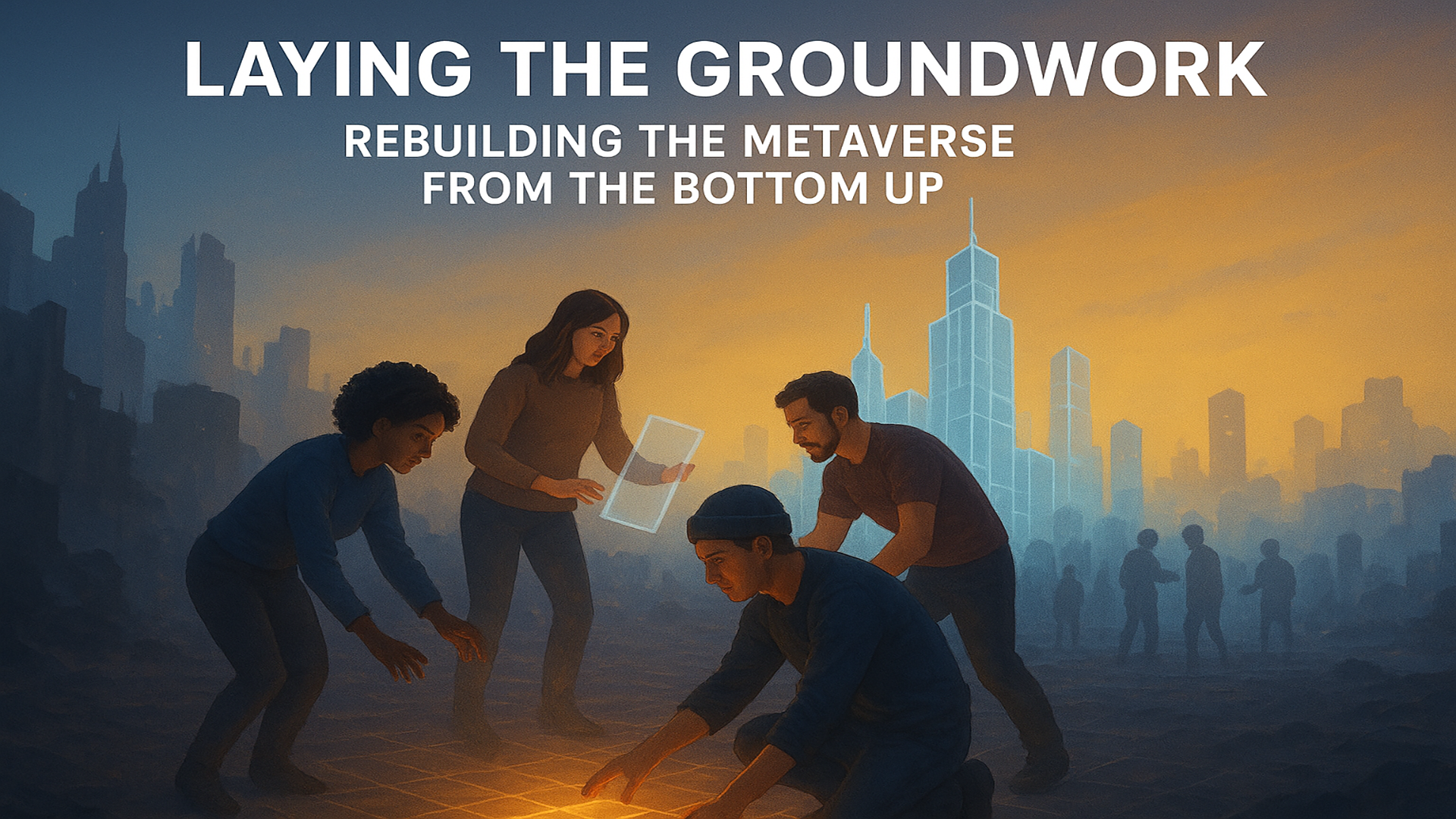
Laying the Groundwork: Rebuilding the Metaverse from the Bottom Up
Escaping false promises, embracing collaboration, and creating a future worth logging into
The post-hype Metaverse stands at a crossroads. After the dazzling promises, speculative mania, and inevitable backlash, many are wondering: Can it still be saved? Can the Metaverse evolve into something more than a buzzword or corporate moonshot, into something genuinely useful, empowering, and transformative?
The answer is yes, but not without a fundamental reset.
The Metaverse will not be built by money alone. It cannot be willed into existence through splashy announcements or vague promises of “next-gen experiences.” The foundations must be carefully laid by technologists, designers, users, and communities alike. The road ahead is long, but if done right, we might finally escape the cycle of boom and bust and start building something sustainable, inclusive, and meaningful.
Technology: A Prerequisite, Not the Purpose
The first myth to dismantle is that technology itself is the Metaverse. It isn’t.
Yes, we need fast networks, powerful GPUs, advanced rendering engines, and scalable infrastructure. We need low-latency VR and AR, cloud and edge computing, AI to enhance creativity, accessibility, and safety, and secure identity layers. But none of this matters if it isn’t in service of something greater, the human experience.
Technology is the foundation, not the final product. We should think of the Metaverse not as a technology stack, but as a human-centered space where people can connect, create, and collaborate. If the tools are powerful but the outcomes are hollow, we’ve built a cathedral with no soul.
Interoperability: A World of Many Worlds
If there is one lesson from the past two decades, it’s this: No one company will create the Metaverse.
It must be a network of interconnected experiences and not a monolithic product. Interoperability is key: avatars, assets, identities, and experiences must move freely across platforms. The Metaverse should be like the Internet, a protocol-driven ecosystem, not a walled garden.
This means open standards, APIs, and shared data models. It means collaboration over competition. It means resisting the urge to lock users into a single platform, and instead giving them the tools to carry their digital self wherever they choose to go.
We don’t need one Metaverse, we need many that speak the same language.
Accessibility and Inclusion: A Metaverse for All
A truly meaningful Metaverse must be for everyone, not just the wealthy, the tech-savvy, or the early adopters.
That means, developers need to account for different aspects, such as:
-
Device diversity:
Not everyone will have a $500 VR headset. The Metaverse must be accessible on smartphones, PCs, tablets, and even low-bandwidth connections. -
Disability inclusion:
Interfaces must account for visual, auditory, cognitive, and mobility differences. -
Global representation:
Platforms must reflect cultural, linguistic, and economic diversity in their design and content. Avatars, environments, and experiences should portray a broad range of cultural perspectives and not just a Western-centric fantasy. -
Safety and moderation:
Inclusive spaces require robust community tools, user empowerment, and proactive moderation, not just reactionary bans.
If only a privileged few can participate, the Metaverse will replicate the inequalities of the offline world rather than offering an alternative.
Community-Led Creation: The Real Engine of Growth
Here’s the secret to a thriving Metaverse: users.
Not as passive consumers, but as co-creators. Builders. Storytellers. World designers. Coders. Artists. Educators. Hobbyists. The real power of the Metaverse lies in the ability of everyday people to shape it.
The Metaverse should be seen as a mostly empty book, waiting to be written. Every user should be given the tools to write their own chapter, to create spaces, experiences, and stories that reflect their values and cultures.
This means:
-
Easy-to-use world-building tools
-
Open-source components and modding support
-
Shared marketplaces and fair economic models
-
Education and support for digital literacy and creation
If we want innovation and diversity, we must democratize access to creation.
A Shared Responsibility: Building the Metaverse Together
To rebuild the Metaverse into something sustainable, we need a broad coalition: technologists, researchers, artists, entrepreneurs, regulators, educators, and users. Everyone has a role to play.
-
Tech companies should focus on infrastructure and tooling, not just glossy demos.
-
Standards bodies should accelerate work on open protocols and identities.
-
Governments should support innovation while safeguarding rights and accessibility.
-
Communities should be empowered to self-govern and self-organize.
This is not just a product roadmap. It’s a social contract, one that values people over profits, openness over silos, and meaning over marketing.
Because the Metaverse, if it’s to endure, must function like shared digital infrastructure, not a string of walled gardens. Tech companies should prioritize infrastructure and tooling because platforms live or die on reliability, safety, and developer leverage; robust tools compound innovation, reduce vendor lock-in, and create larger markets than any single glossy demo ever could.
Standards bodies should accelerate open protocols and identities because interoperability is the engine of network effects: it lowers integration costs, prevents monopoly choke points, enables portability of assets and reputation, and unlocks competition on experience rather than enclosure.
Governments should foster innovation while safeguarding rights and accessibility because the stakes are societal: economic competitiveness, digital sovereignty, safety, and equal participation. Clear guardrails and incentives de-risk private investment, protect citizens, and expand the talent and customer base.
Communities should be empowered to self-govern because legitimacy and resilience emerge from participation; when users co-create norms and moderate spaces, trust rises, abuse drops, and cultures become sustainable rather than extractive.
In short, each actor’s “should” aligns with self-interest and the public good: open, durable infrastructure grows markets; rights and access grow adoption; community agency grows trust; and standards grow the pie for everyone.
That is why this is a social contract, not just a roadmap.
From Hype to Hope
If the Metaverse is ever to fulfill its promise, we must leave behind the false expectations and easy solutions. We must stop chasing trends and start building foundations.
The path forward is less glamorous but more essential: Interoperability. Accessibility. Inclusion. Shared governance. Human-centered design.
It’s not about who can launch the flashiest platform, but who can help others build meaningful experiences within it. If we succeed, the Metaverse won’t be defined by companies or technologies, it will be defined by its people.
And that’s how it should be.
Join the Conversation
If this article sparked your curiosity or passion for the future of the Metaverse, I warmly invite you to join an open discussion in a virtual world setting. Let’s meet face-to-face (or avatar-to-avatar) to exchange ideas, share visions, and connect with others who believe in building something better. The next live meetup will take place on the 7th of November at 9 p.m. (UTC+2) in our Metaverse Meeting Point. Whether you’re a developer, creator, thinker, or explorer, your perspective matters. Come help shape the next chapter of the Metaverse!
.png)
About the Author
Dieter E. Heyne is a Metaverse pioneer and lifelong technologist, born in Munich in 1966. With a master’s degree in applied computer science and over three decades of experience as an IT entrepreneur, software architect, and consultant, he has always been at the frontier of digital innovation. His journey into virtual worlds began in 2007 with Second Life and sparked a deep, ongoing exploration of the Metaverse as a space for education, collaboration, and immersive experiences.
Since 2012, Dieter has been developing and refining a web-based virtual world platform, driven by a vision to make the Metaverse accessible, meaningful, and transformative. As a frequent speaker and thought leader at Metaverse events, he shares his insights on how virtual environments can reshape human interaction, learning, and culture. He is the founder and CEO of Metaverse School GmbH, a company dedicated to promoting Metaverse literacy and helping people and organizations understand the power and promise of these emerging digital realms.
About Metaverse School GmbH
Metaverse School GmbH was founded in 2017 by Dieter E. Heyne, who continues to lead the company as its CEO. The company emerged from decades of consulting experience in software architecture, project management, quality assurance, information security, and data protection. Building on this strong technological foundation, Metaverse School GmbH is dedicated to promoting the responsible and purposeful use of immersive 3D environments—for education, collaboration, training, and simulation.
A core mission of the company is to raise awareness of the Metaverse’s potential across business, education, and society. In support of this goal, Dieter Heyne regularly speaks at national and international conferences as well as Metaverse-focused events. Through real-world examples and deep expertise, he demonstrates how immersive technologies can already create meaningful value today.
Disclaimer
Some portions of this content were created or refined with the assistance of artificial intelligence (AI) using tools such as OpenAI’s ChatGPT. The ideas, structure, and editorial direction remain the responsibility of the author. While every effort has been made to ensure factual accuracy and original expression, readers are encouraged to approach speculative or future-facing statements with critical thought.
This series does not represent the views of any specific company or platform and is intended to inspire open discussion around the evolving concept of the Metaverse.