 METAVERSE BLOG
 The Metaverse Series - Article 06
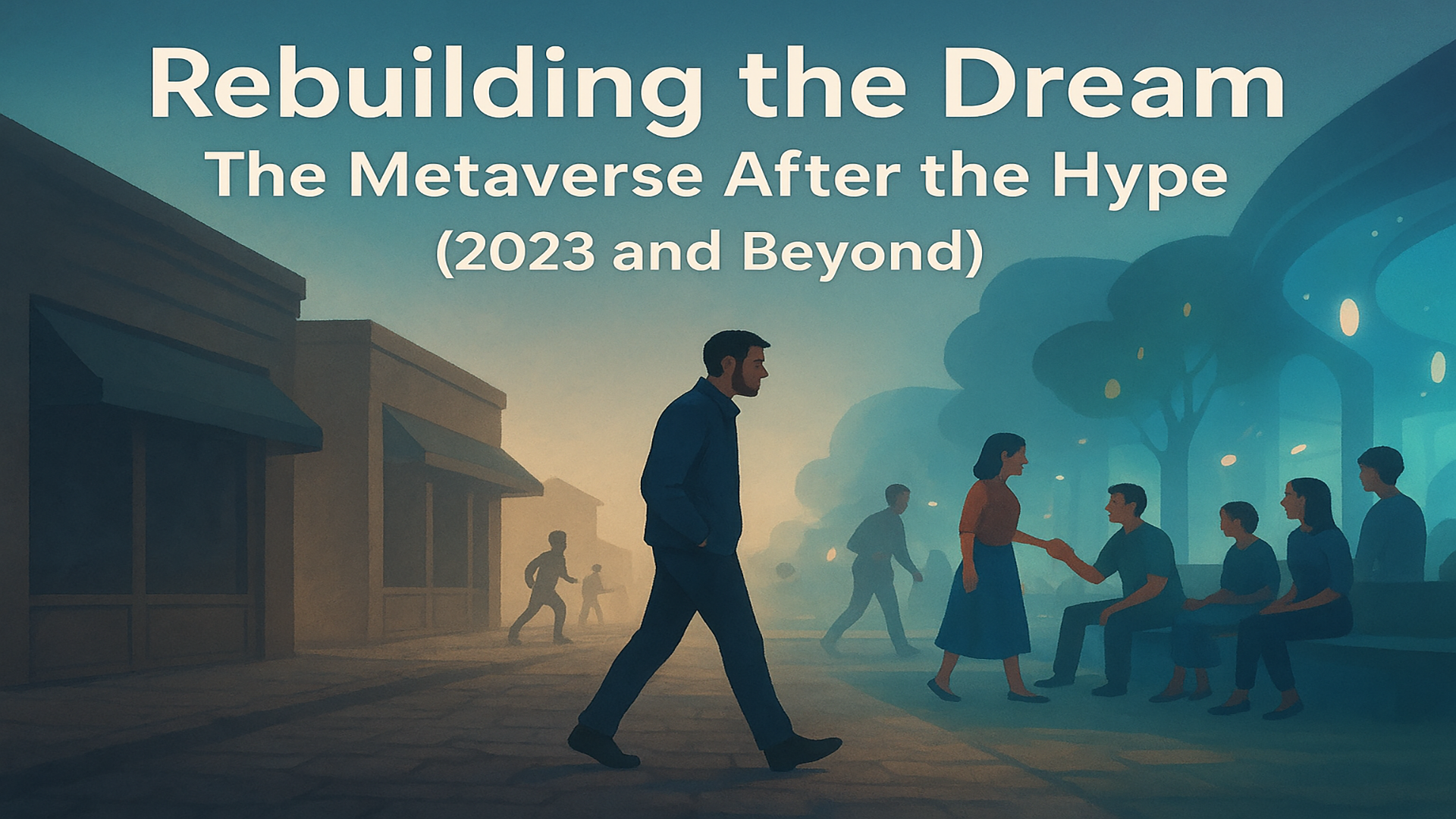
Rebuilding the Dream: The Metaverse After the Hype (2023 and Beyond)
The speculative fog has lifted. What comes next may finally matter.
As the whirlwind of hype began to settle in late 2022 and through 2023, the Metaverse was left in a precarious state. Burned investors, declining user bases, and disillusioned developers painted a bleak picture. The narrative had shifted, from euphoria and limitless potential to skepticism and budget cuts. Media outlets that once hailed the Metaverse as the next internet now reported its failures, and big-tech companies quietly restructured or rebranded their ambitions.
Yet, beneath the rubble of failed promises and speculative gold rushes, a quieter, more sustainable vision began to take form. The question was no longer "How do we get rich off the Metaverse?" but rather: "How do we make it meaningful, useful, and lasting?"
The Post-Hype Landscape: Opportunities in the Silence
With the market noise dialed down, a more honest appraisal of the Metaverse's strengths and weaknesses became possible. It turned out that many of the core ideas, like presence, persistence, identity, and co-creation, still held real value. What had been missing was a sense of purpose and direction beyond commerce.
The platforms that survived the collapse, some older like Second Life and VRChat, others newer and more community-focused, shared one thing in common: they empowered their users. Not as consumers or spectators, but as creators, citizens, and contributors. These spaces didn’t merely offer content; they offered tools and freedom.
The Empty Book: A New Metaphor for the Metaverse
Rather than seeing the Metaverse as a finished product, we can begin to see it as a vast, mostly empty book. The foundational chapters may be written by platform developers, but the real story, the parts people care about, are meant to be written by users.
Every avatar, every interaction, every virtual meeting or digital creation becomes part of that collective narrative. It is not a movie we watch but a novel we co-author. For the Metaverse to truly thrive, users must be given both the pen and the permission to author and shape their world.
This means robust creation tools, clear ownership systems (with or without blockchain), and a platform philosophy that values community governance, not corporate control. It means open standards, interoperability, and user-moddable environments. But more than anything, it means trusting users to build.
From Spectator to Stakeholder
If the Metaverse is to survive and grow, the focus must shift away from centralized control and top-down experiences. Instead, developers and investors should look to models that resemble open ecosystems or digital democracies.
This could take many forms:
-
Creator royalties:
Enabling digital artists, educators, world-builders, and performers to earn ongoing revenue from their contributions. -
Collaborative moderation:
Empowering communities to establish and enforce their own norms, much like open-source projects or Reddit-style governance. -
Cross-platform identities:
Giving users control over their virtual personas, portable across worlds and platforms. -
Narrative participation:
Treating users not as background extras, but as protagonists with agency, capable of shaping the stories and events that unfold.
Innovation Through Inclusion
The most innovative experiences in the Metaverse may not come from the largest companies but from the margins, from users with different cultural perspectives, educational goals, or artistic visions. A truly thriving Metaverse is not homogenous; it is diverse, multilingual, and inclusive.
This means making tools accessible to all, regardless of technical skill or financial means. It means supporting niche communities, educational initiatives, and creative experiments without requiring profitability from day one.
The Next Chapter is Ours
We are now in a transitional phase. The speculative phase has passed, but the infrastructure remains. The challenge, and opportunity, lies in rediscovering the soul of the Metaverse.
If we treat it not as a mall or a casino, but as a shared cultural space, a canvas, a library, a city, a theater, then we can begin to unlock its true potential. One where every user, regardless of background, is an author, a builder, and a co-creator.
The Metaverse, like the early internet, may have stumbled out of the gate. But perhaps that stumble is what we needed. To remind us that it isn't about glossy demos or billion-dollar valuations. It's about people.
And people, given the chance, can write extraordinary stories.
Join the Conversation
If this article sparked your curiosity or passion for the future of the Metaverse, I warmly invite you to join an open discussion in a virtual world setting. Let’s meet face-to-face (or avatar-to-avatar) to exchange ideas, share visions, and connect with others who believe in building something better. The next live meetup will take place on the 24th of October at 9 p.m. (UTC+2) in our Metaverse Meeting Point. Whether you’re a developer, creator, thinker, or explorer, your perspective matters. Come help shape the next chapter of the Metaverse!
.png)
About the Author
Dieter E. Heyne is a Metaverse pioneer and lifelong technologist, born in Munich in 1966. With a master’s degree in applied computer science and over three decades of experience as an IT entrepreneur, software architect, and consultant, he has always been at the frontier of digital innovation. His journey into virtual worlds began in 2007 with Second Life and sparked a deep, ongoing exploration of the Metaverse as a space for education, collaboration, and immersive experiences.
Since 2012, Dieter has been developing and refining a web-based virtual world platform, driven by a vision to make the Metaverse accessible, meaningful, and transformative. As a frequent speaker and thought leader at Metaverse events, he shares his insights on how virtual environments can reshape human interaction, learning, and culture. He is the founder and CEO of Metaverse School GmbH, a company dedicated to promoting Metaverse literacy and helping people and organizations understand the power and promise of these emerging digital realms.
About Metaverse School GmbH
Metaverse School GmbH was founded in 2017 by Dieter E. Heyne, who continues to lead the company as its CEO. The company emerged from decades of consulting experience in software architecture, project management, quality assurance, information security, and data protection. Building on this strong technological foundation, Metaverse School GmbH is dedicated to promoting the responsible and purposeful use of immersive 3D environments—for education, collaboration, training, and simulation.
A core mission of the company is to raise awareness of the Metaverse’s potential across business, education, and society. In support of this goal, Dieter Heyne regularly speaks at national and international conferences as well as Metaverse-focused events. Through real-world examples and deep expertise, he demonstrates how immersive technologies can already create meaningful value today.
Disclaimer
Some portions of this content were created or refined with the assistance of artificial intelligence (AI) using tools such as OpenAI’s ChatGPT. The ideas, structure, and editorial direction remain the responsibility of the author. While every effort has been made to ensure factual accuracy and original expression, readers are encouraged to approach speculative or future-facing statements with critical thought.
This series does not represent the views of any specific company or platform and is intended to inspire open discussion around the evolving concept of the Metaverse.