 METAVERSE BLOG
 Chapter 07: Security and Privacy by Design
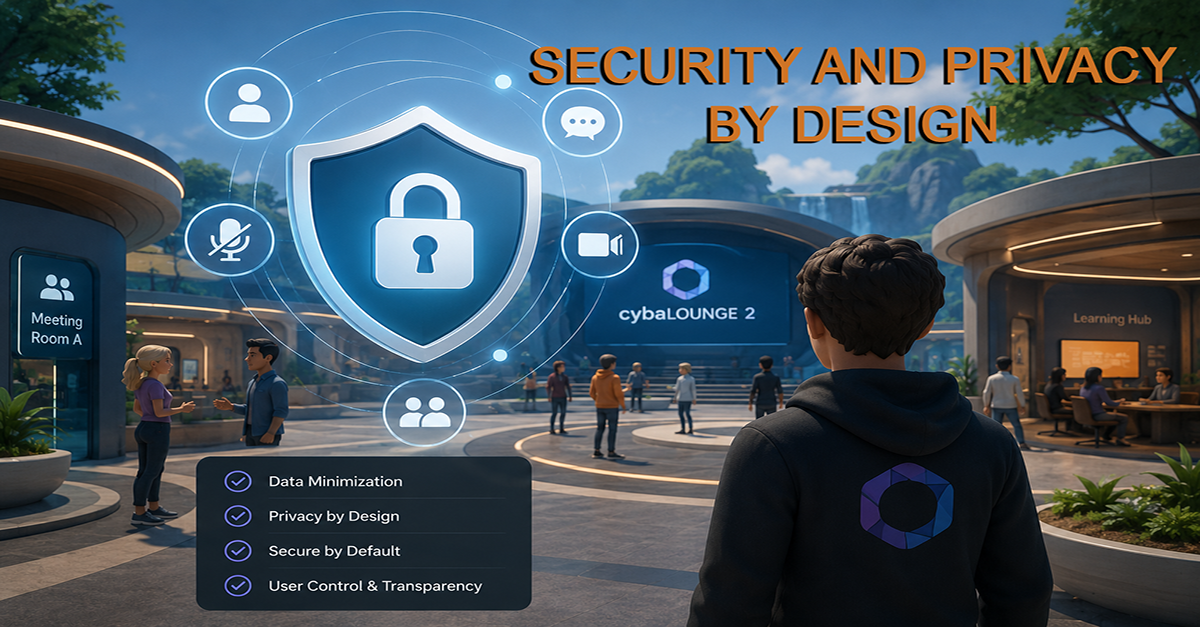
A multi-user virtual world is not an ordinary website. It can be a place where people move, speak, meet, learn, collaborate, teach, present, and sometimes behave more naturally than they would in a form-based application. That makes virtual worlds powerful, but it also makes them sensitive. A platform that handles avatars, communication, presence, voice, video, movement, and interaction can easily collect more information than users expect. This is why security and privacy must be part of the architecture from the beginning.
For Cybalounge 2, the starting principle is data minimization. The platform should not collect data simply because it can. It should not store persistent information simply because storage is technically easy. It should not create detailed behavioral histories without a clear purpose. In a virtual world, even movement patterns can become meaningful. Who meets whom? How long do they stay? Which rooms do they enter? Who speaks? Who listens? Which objects do they interact with? These signals may be useful in some contexts, but they are also sensitive.
This is especially important because the intended use cases include education, business, training, communities, and potentially public or semi-public environments. In a classroom, learners may be minors or may participate in sensitive training. In a business environment, meetings may include confidential information. In a senior community, users may be vulnerable or less confident with technology. In public-sector scenarios, trust and compliance are essential. For all of these audiences, privacy is not a luxury feature. It is a condition for adoption.
A server-light architecture helps, but it does not solve everything automatically. If worlds are delivered as static content and if the backend does not store unnecessary state, the platform reduces some risks by design. Fewer databases mean fewer stored records. Fewer APIs mean fewer attack surfaces. Less persistent data means fewer obligations around retention, deletion, access control, and breach impact. But communication, identity, moderation, uploads, and administration still require careful decisions. Privacy by design is not the same as having no backend. It is the practice of asking what each backend element really needs to know.
One of the most useful privacy questions is: can the platform function without storing this? If the answer is yes, the next question is whether storing it creates enough value to justify the risk. This question can be uncomfortable because stored data often feels useful. It can support convenience, analytics, personalization, reporting, session recovery, administration, or future features. But every stored data element also creates responsibility. It must be protected, explained, limited, and eventually deleted. Data that is never collected cannot be leaked.
This way of thinking affects feature design. User accounts, for example, may be useful, but not every early use case requires a full account system. Some worlds may work with temporary display names or controlled access links. Communication may be integrated in a way that avoids storing conversations unless a clear reason exists. Analytics may begin with coarse technical metrics rather than detailed behavioral tracking. World content may be separated from user data. Each decision should be made deliberately, not by default.
Security follows a similar logic. A platform with fewer moving parts can be easier to secure. Static assets can be served through well-understood web infrastructure. Upload workflows can be isolated and controlled. Administrative functions can be limited to specific areas. Communication services can be selected and configured carefully rather than reinvented without need. None of this eliminates security work, but it helps prevent the architecture from becoming unnecessarily exposed.
There is also a user experience dimension. Trust is not only created through policies. It is created through clarity. Users should understand when they are visible, when their microphone is active, when video is enabled, who is in the room, what name is shown, and how to leave or mute themselves. In immersive environments, ambiguity can feel uncomfortable. A simple microphone indicator or a clear room boundary can be as important as a technical security control because it helps users feel in control.
 For creators and organizations, privacy-friendly design also matters operationally. If a school or company wants to use a virtual world, someone will ask what data is stored, where it is stored, who can access it, how long it is retained, and what happens when a user leaves. The easier those questions are to answer, the easier adoption becomes. A complicated platform with unclear data flows creates hesitation. A simpler architecture with minimized data collection creates confidence.
The trade-off is that some convenience features may take longer to design. Persistent profiles, personal inventories, advanced analytics, recorded sessions, learning progress tracking, or detailed collaboration histories can all be useful. But they should not be added casually. Each of them changes the privacy model. Each of them may require permissions, retention rules, access controls, user communication, and possibly legal review. A platform that aims for trust should not treat those consequences as afterthoughts.
Moderation and safety are also connected to privacy. A multi-user platform needs tools to manage behavior, but those tools must be designed carefully. Reporting, blocking, muting, room control, and identity boundaries can protect users. At the same time, monitoring and logging can become intrusive if overdone. The challenge is to create enough control for safe spaces without building a surveillance environment. That balance must be part of the platform philosophy, not a late patch.
In the end, security and privacy by design mean that trust is built into the shape of the system. It means that the architecture avoids unnecessary data where possible, protects necessary data where unavoidable, and communicates clearly with users and organizations. For Cybalounge 2, this is not only a compliance issue. It is a product issue. A virtual world platform can only become useful in education, business, and community settings if people trust it. Privacy is not a later compliance layer. It is an architectural decision from day one.
This is also why privacy needs to be understandable. A theoretically secure system can still fail if users and organizations cannot explain it. The platform should make its privacy posture visible through simple settings, clear defaults, and documentation that speaks in practical terms. Trust grows when people can see that restraint is not accidental, but designed into the system.
Now available on Amazon!
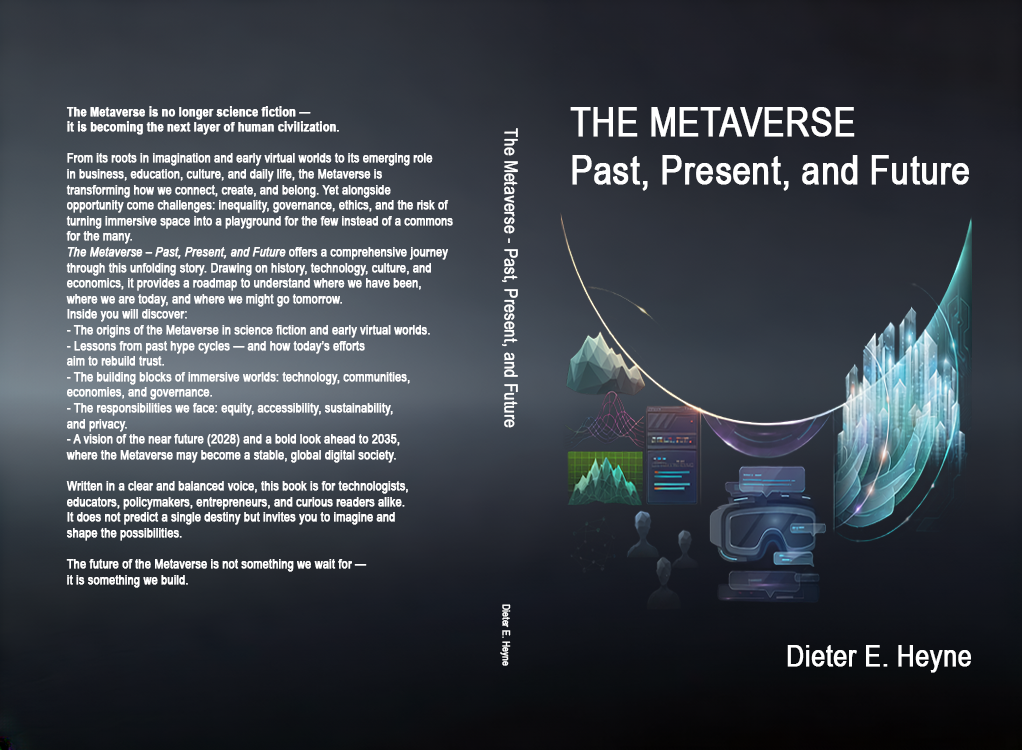
Discover the Metaverse Beyond the Hype
The Metaverse is no longer a futuristic fantasy, it is rapidly becoming a new layer of human society. But what is it really? Where did it come from? And what might it become over the next decade?
The Metaverse – Past, Present, and Future takes readers on a fascinating journey from the earliest virtual worlds and science-fiction visions to today’s emerging immersive platforms, digital economies, and online communities. Along the way, it explores the technologies powering the Metaverse, the opportunities it creates for education, work, and culture, and the challenges of governance, privacy, inclusion, and sustainability.
Looking beyond today's headlines, the book offers a balanced and inspiring vision of how immersive technologies could transform cities, learning, creativity, and daily life by 2035.
Whether you are a business leader, educator, technologist, policymaker, or simply curious about the future, this book provides the context, insight, and perspective needed to understand one of the most important technological and societal shifts of our time.
The future of the Metaverse is not something we await, it is something we create.
About the Author
Dieter E. Heyne is a Metaverse pioneer and lifelong technologist, born in Munich in 1966. With a master’s degree in applied computer science and over three decades of experience as an IT entrepreneur, software architect, and consultant, he has always been at the frontier of digital innovation. His journey into virtual worlds began in 2007 with Second Life and sparked a deep, ongoing exploration of the Metaverse as a space for education, collaboration, and immersive experiences.
Since 2012, Dieter has been developing and refining a web-based virtual world platform, driven by a vision to make the Metaverse accessible, meaningful, and transformative. As a frequent speaker and thought leader at Metaverse events, he shares his insights on how virtual environments can reshape human interaction, learning, and culture. He is the founder and CEO of Metaverse School GmbH, a company dedicated to promoting Metaverse literacy and helping people and organizations understand the power and promise of these emerging digital realms.
Besides talking and writing non-fiction about the Metaverse and Virtual Worlds, this vast knowledge now went into the creation of The Metaverse Enforcers, an ongoing series of high-tech science fiction novels, showcasing the potential development and dangers of the Metaverse in 2053.
About Metaverse School GmbH
Metaverse School GmbH was founded in 2017 by Dieter E. Heyne, who continues to lead the company as its CEO. The company emerged from decades of consulting experience in software architecture, project management, quality assurance, information security, and data protection. Building on this strong technological foundation, Metaverse School GmbH is dedicated to promoting the responsible and purposeful use of immersive 3D environments, for education, collaboration, training, and simulation.
A core mission of the company is to raise awareness of the Metaverse’s potential across business, education, and society. In support of this goal, Dieter Heyne regularly speaks at national and international conferences as well as Metaverse-focused events. Through real-world examples and deep expertise, he demonstrates how immersive technologies can already create meaningful value today.
Disclaimer
Some portions of this content were created or refined with the assistance of artificial intelligence (AI) using tools such as OpenAI’s ChatGPT. The ideas, structure, and editorial direction remain the responsibility of the author. While every effort has been made to ensure factual accuracy and original expression, readers are encouraged to approach speculative or future-facing statements with critical thought.
This series does not represent the views of any specific company or platform and is intended to inspire open discussion around the evolving concept of the Metaverse.
#Metaverse #VirtualWorlds #FutureOfTech #DigitalCommunity #CybaLounge #CL2