 METAVERSE BLOG
 Chapter 10: Controls Are User Experience, Not Technical Plumbing
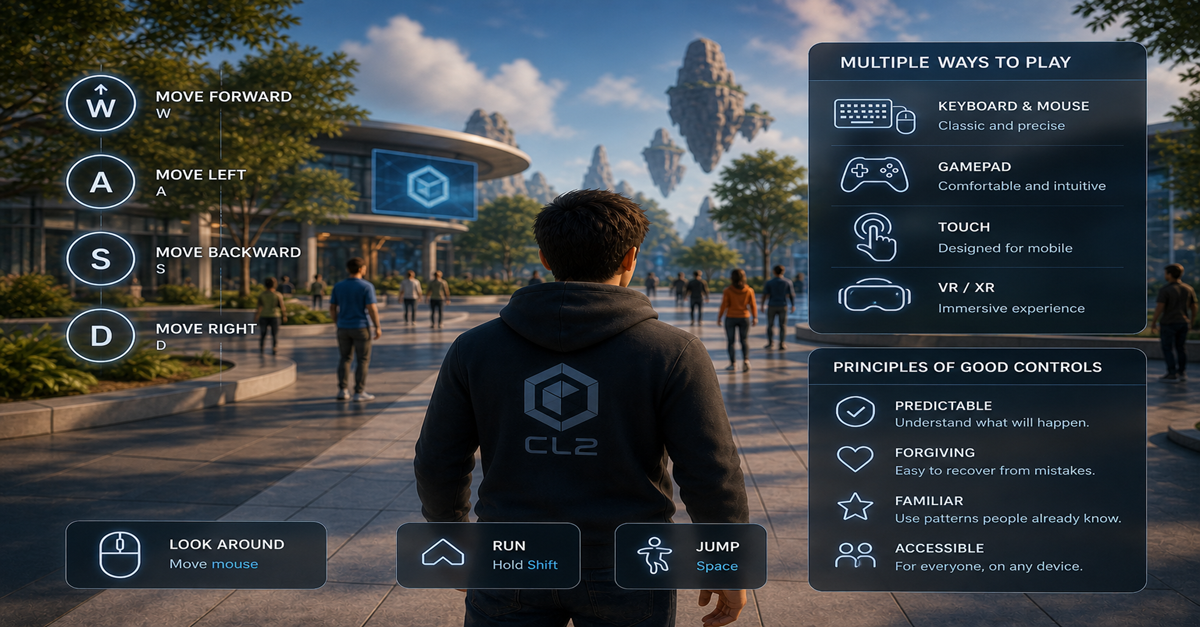
Controls are easy to underestimate because they sound technical. A key is pressed, a mouse moves, a gamepad stick changes position, a touch gesture begins, a camera rotates, an avatar walks. From a developer's perspective, this can look like input processing. From a user's perspective, it is the difference between feeling comfortable and feeling lost. In a virtual world, controls are not technical plumbing. They are user experience.
This matters because movement is one of the first things users test. Before they understand the world, before they use communication, before they interact with objects, they try to move. If movement feels natural enough, they continue exploring. If it feels awkward, unpredictable, or frightening, the platform has already lost confidence. A beautiful environment cannot compensate for controls that make users feel incompetent.
Cybalounge 2 is intended for a broad audience. Some users may have gaming experience and expect familiar WASD movement, mouse camera control, or gamepad support. Others may be business users who rarely navigate 3D environments. Some may join from a laptop without a mouse. Some may use touch devices. Some future users may enter through VR or XR devices. This variety means the platform cannot assume one perfect input method. It must support different ways of moving while keeping the experience understandable.
Predictability is the first principle. Users need to understand what will happen when they press a key or move a stick. If the avatar sometimes turns and sometimes slides, if the camera sometimes follows and sometimes drifts, if forward movement depends on a hidden state, the user loses trust. Predictable controls allow users to build muscle memory. They stop thinking about input and start thinking about the world.
Forgiveness is the second principle. Users will make mistakes. They will press the wrong key, move the camera too far, get too close to an obstacle, or try to walk into something. A good control system should help them recover. It should avoid trapping them in corners, disorienting them with sudden camera changes, or punishing small errors. This is especially important for non-gamers and first-time users. The goal is not to test navigation skill. The goal is to let people participate.
Familiarity is the third principle. There is value in using conventions that people already know. Keyboard movement, mouse looking, gamepad sticks, and touch controls all have established patterns. A platform should not invent unusual control schemes unless there is a strong reason. Familiarity reduces learning effort. It also makes onboarding easier because users can bring expectations from other applications.
At the same time, virtual world controls must serve the specific platform. CL2 uses an avatar-centered approach, so movement, camera, and animation belong together. The avatar should not feel separate from the camera. The camera should support the avatar rather than fight it. If the user moves forward, the system should make it clear what forward means. If the camera rotates, orientation should remain understandable. If the avatar runs, walks, or stops, the visual feedback should match the input.
Supporting multiple input methods increases development complexity. Keyboard, mouse, gamepad, touch, and VR controllers all behave differently. They produce different types of signals. A keyboard is digital: pressed or not pressed. A gamepad stick is analog and can express direction and strength. Touch controls may need virtual sticks or gestures. VR controllers add position and orientation. If each input method controls the avatar directly in its own way, the system can become messy quickly.
This is why a unified control concept is important. Input devices should be translated into common movement intentions: move forward, move backward, turn, look, run, jump, interact, and so on. The avatar controller can then respond to intentions rather than raw device events. This keeps the system more maintainable and helps ensure that different input methods create comparable behavior. The user should not feel that each device belongs to a different platform.
Controls also connect to accessibility. Not everyone can use the same input method comfortably. Some users may need keyboard-only navigation. Others may prefer a gamepad. Some may require slower movement, reduced camera sensitivity, or simpler interaction. A platform designed for education, business, public use, or senior communities should not treat accessibility as an afterthought. Control flexibility is one of the most practical forms of accessibility.
There is also an emotional element. A user who can move confidently feels capable. A user who constantly struggles with navigation may feel embarrassed, especially in a shared environment. This matters in training and education, where the platform should support learning rather than create performance anxiety. It also matters in business meetings, where users do not want to look clumsy in front of colleagues. Smooth controls protect dignity.
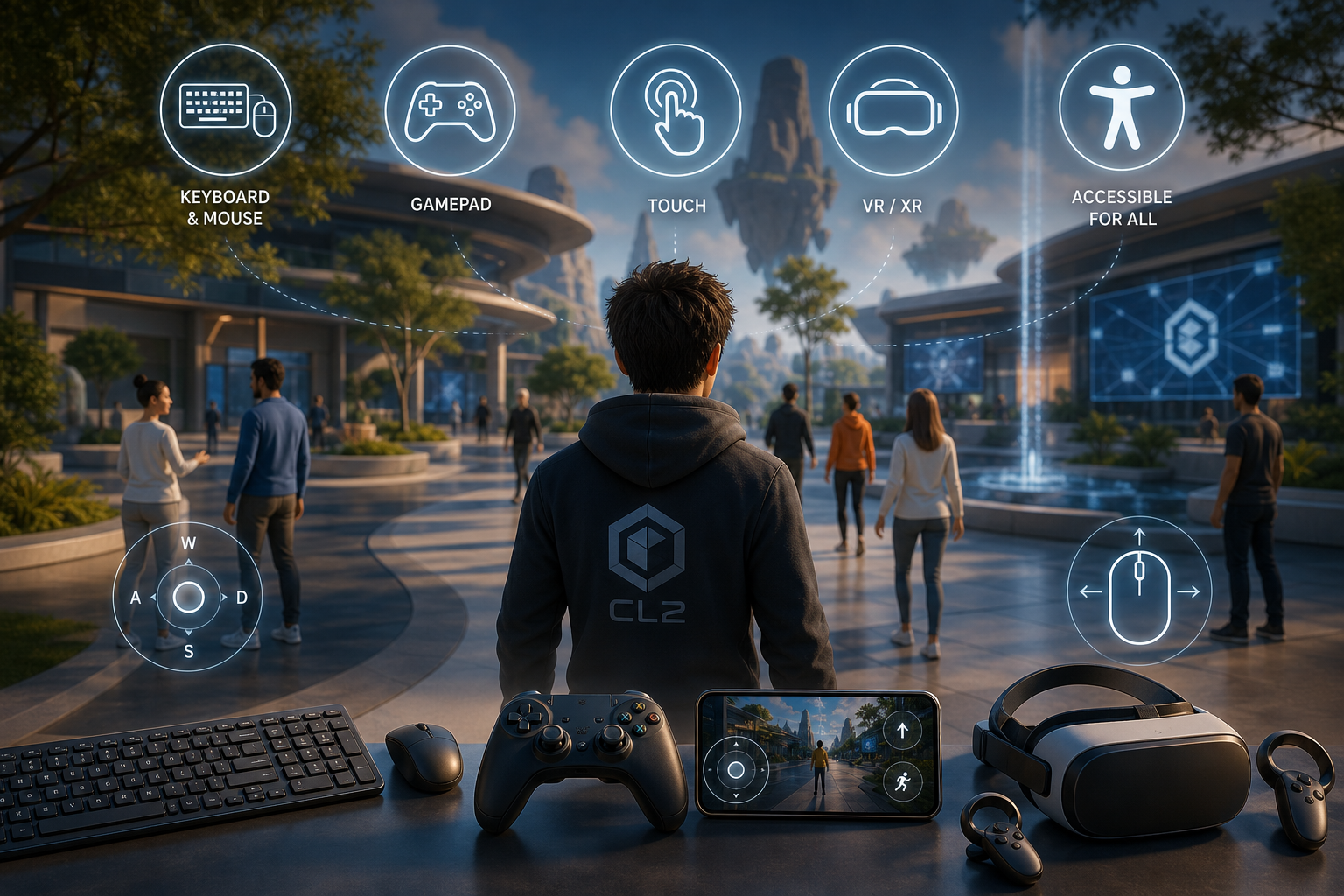
For Cybalounge 2, the ambition is not to create a complex simulation of human movement. The first goal is more practical: make movement feel stable, readable, and comfortable. As with many parts of the platform, there will be trade-offs. Advanced movement features can come later. The foundation must be reliable. Good controls disappear into the experience. Bad controls define the whole experience. If users remember the controls more than the world, something has gone wrong.
Controls also shape how users interpret the world itself. A narrow doorway feels different if steering is precise. A staircase feels different if the avatar approaches it confidently. A gathering space feels different if users can stop, turn, and face each other without effort. Interaction design begins before a button is clicked; it begins with the way the user arrives.
The same applies to onboarding. A first-time user should not need to study a manual before they can take a few steps, rotate the camera, and understand where they are. Short visual hints, sensible defaults, and forgiving movement can reduce the fear of entering a 3D space. Controls are not only about supporting devices; they are about welcoming people.
The platform also has to avoid surprising experienced users. Defaults should feel familiar, but settings can allow adjustment where needed. Camera sensitivity, running behavior, touch layout, and future VR comfort options can become important without overwhelming the first experience.
Now available on Amazon!
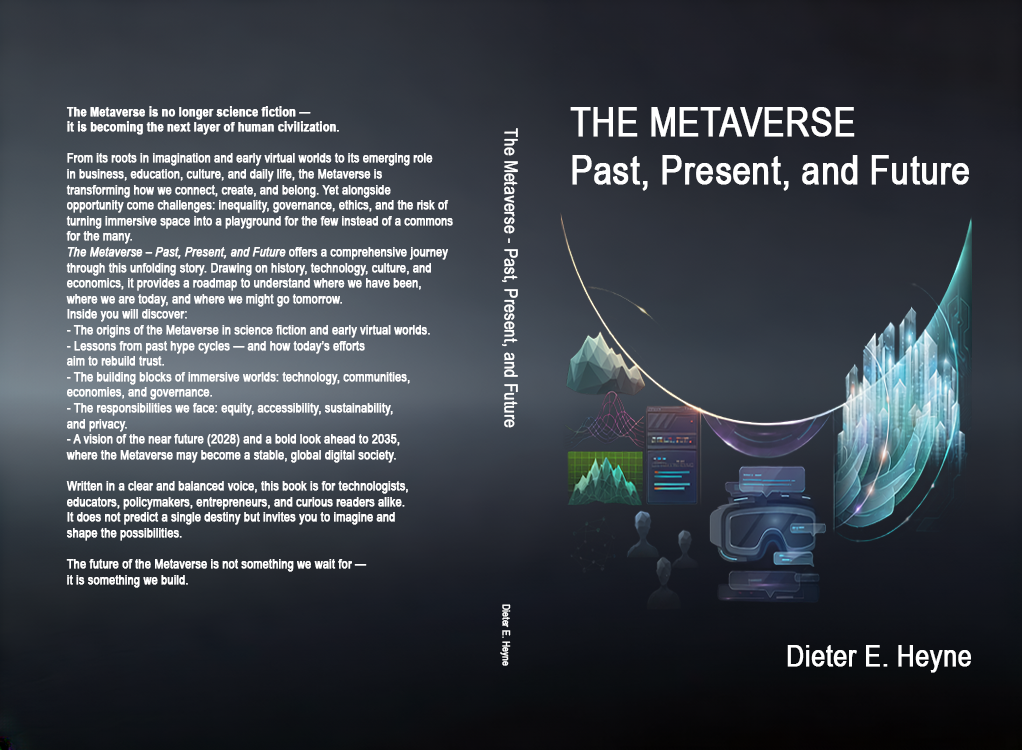
Discover the Metaverse Beyond the Hype
The Metaverse is no longer a futuristic fantasy, it is rapidly becoming a new layer of human society. But what is it really? Where did it come from? And what might it become over the next decade?
The Metaverse – Past, Present, and Future takes readers on a fascinating journey from the earliest virtual worlds and science-fiction visions to today’s emerging immersive platforms, digital economies, and online communities. Along the way, it explores the technologies powering the Metaverse, the opportunities it creates for education, work, and culture, and the challenges of governance, privacy, inclusion, and sustainability.
Looking beyond today's headlines, the book offers a balanced and inspiring vision of how immersive technologies could transform cities, learning, creativity, and daily life by 2035.
Whether you are a business leader, educator, technologist, policymaker, or simply curious about the future, this book provides the context, insight, and perspective needed to understand one of the most important technological and societal shifts of our time.
The future of the Metaverse is not something we await, it is something we create.
About the Author
Dieter E. Heyne is a Metaverse pioneer and lifelong technologist, born in Munich in 1966. With a master’s degree in applied computer science and over three decades of experience as an IT entrepreneur, software architect, and consultant, he has always been at the frontier of digital innovation. His journey into virtual worlds began in 2007 with Second Life and sparked a deep, ongoing exploration of the Metaverse as a space for education, collaboration, and immersive experiences.
Since 2012, Dieter has been developing and refining a web-based virtual world platform, driven by a vision to make the Metaverse accessible, meaningful, and transformative. As a frequent speaker and thought leader at Metaverse events, he shares his insights on how virtual environments can reshape human interaction, learning, and culture. He is the founder and CEO of Metaverse School GmbH, a company dedicated to promoting Metaverse literacy and helping people and organizations understand the power and promise of these emerging digital realms.
Besides talking and writing non-fiction about the Metaverse and Virtual Worlds, this vast knowledge now went into the creation of The Metaverse Enforcers, an ongoing series of high-tech science fiction novels, showcasing the potential development and dangers of the Metaverse in 2053.
About Metaverse School GmbH
Metaverse School GmbH was founded in 2017 by Dieter E. Heyne, who continues to lead the company as its CEO. The company emerged from decades of consulting experience in software architecture, project management, quality assurance, information security, and data protection. Building on this strong technological foundation, Metaverse School GmbH is dedicated to promoting the responsible and purposeful use of immersive 3D environments, for education, collaboration, training, and simulation.
A core mission of the company is to raise awareness of the Metaverse’s potential across business, education, and society. In support of this goal, Dieter Heyne regularly speaks at national and international conferences as well as Metaverse-focused events. Through real-world examples and deep expertise, he demonstrates how immersive technologies can already create meaningful value today.
Disclaimer
Some portions of this content were created or refined with the assistance of artificial intelligence (AI) using tools such as OpenAI’s ChatGPT. The ideas, structure, and editorial direction remain the responsibility of the author. While every effort has been made to ensure factual accuracy and original expression, readers are encouraged to approach speculative or future-facing statements with critical thought.
This series does not represent the views of any specific company or platform and is intended to inspire open discussion around the evolving concept of the Metaverse.
#Metaverse #VirtualWorlds #FutureOfTech #DigitalCommunity #CybaLounge #CL2