 METAVERSE BLOG
 Chapter 10: Collision Detection Is the Invisible Trust Layer
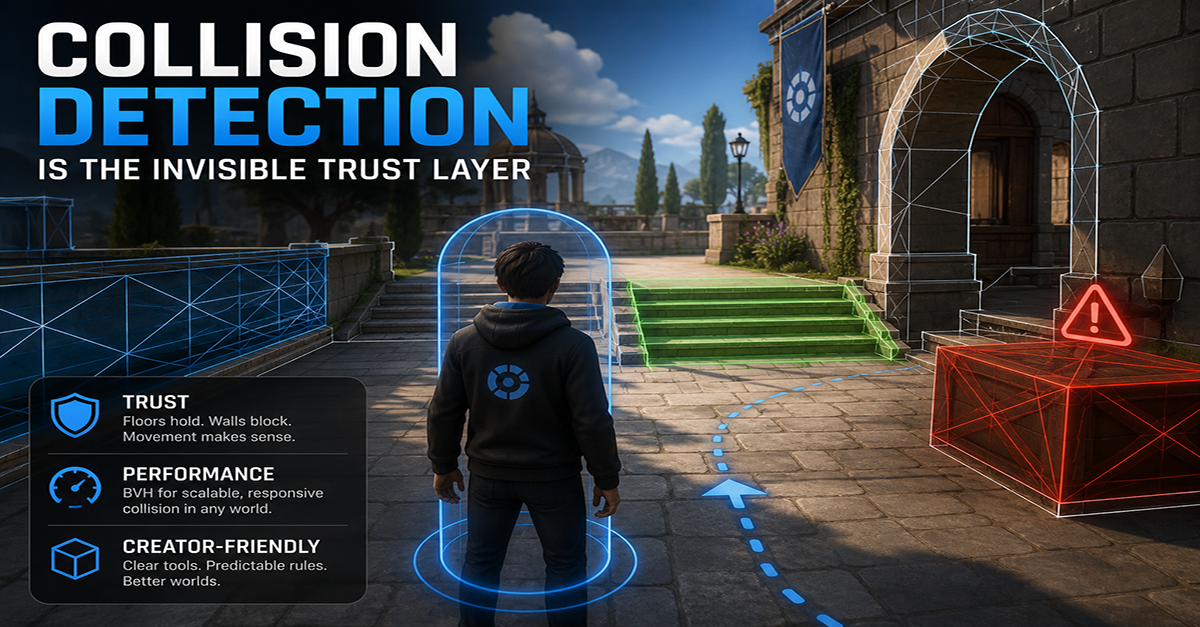
Collision detection is one of those platform features that users usually notice only when it fails. If the avatar walks across a floor, stops at a wall, climbs a small step, or avoids an obstacle, users rarely think about it. The world simply feels solid. But if the avatar falls through the ground, walks through a closed door, gets stuck on invisible geometry, or cannot move over a small edge, the illusion breaks immediately. In that moment, collision detection stops being a technical detail and becomes the user's main experience.
For Cybalounge 2, collision detection is therefore not only about physics. It is about trust. A virtual world needs rules. Floors should support the user. Walls should have meaning. Obstacles should be understandable. Stairs, platforms, and ramps should behave in ways that match visual expectations. When users move through a space, they constantly test whether the environment can be trusted. Most of this testing is unconscious, but it shapes the feeling of quality.
This is especially important in practical use cases. In a training environment, users may need to follow procedures, approach equipment, avoid dangerous zones, or move through realistic spaces. In an educational world, learners may explore a reconstruction, laboratory, museum, or simulation. In a business environment, people may gather in meeting rooms, presentation areas, or digital twins. If the environment behaves inconsistently, the use case loses credibility. Users may still see a 3D scene, but they no longer believe in it as a place.
The challenge is that collision detection can become expensive. A virtual world may include imported models with thousands or millions of triangles. Using the visible geometry directly for every collision check can be too slow, especially in a browser. On the other hand, overly simple collision shapes can feel inaccurate. A wall may block movement before the avatar visually reaches it. A staircase may feel like a ramp or a barrier. A complex object may behave like a large invisible box. The platform needs a balance between accuracy and performance.
This balance is not only an algorithmic question. It is a product decision. The platform must decide what kind of collision quality is necessary for its intended use cases. A highly realistic physics simulation may not be required for a meeting space or learning environment. But basic reliability is required. Users should not need to think about the collision system. The world should feel predictable enough that movement becomes natural.
One useful principle is to separate visual detail from collision detail. A model may be visually complex, but the collision representation can often be simpler. A chair, wall, platform, or building does not need every decorative triangle to participate in movement blocking. The challenge is to create or generate collision structures that are simple enough for performance and accurate enough for user trust. This is especially relevant when creators import external models that were not built specifically for real-time browser environments.
Collision also interacts with the avatar. The avatar has a physical presence in the world, even if simplified. It needs a height, width, ground contact, and a way to detect obstacles. It must know whether it is standing on something, whether it is blocked, whether a step is climbable, and how to respond when the camera path is obstructed. These decisions create the feeling of movement. A good collision system does not only say yes or no. It helps classify the world in ways that support comfortable navigation.
Camera collision is another important part of trust, especially in a third-person view. If an object comes between the camera and the avatar, the user may lose sight of themselves. The system needs a way to detect obstacles and adjust the camera so the avatar remains visible. This is not a dramatic feature, but it has a strong effect on comfort. Users should not have to fight the camera because a wall, tree, or object blocks their view.
The invisible nature of collision makes it easy to undervalue. Visual effects are more obvious. Water, sky, particles, lighting, and avatars attract attention. Collision does not look like much in screenshots. But it is one of the foundations of presence. The user believes in a space when the space resists them in expected ways. Solid geometry communicates that the world has structure. Without that structure, the environment becomes a visual backdrop rather than a place.
There is also a creator experience aspect. If creators build worlds, they need to understand how collision works. They do not necessarily need to understand every internal detail, but they need guidance. Which objects block movement? Which models are only decorative? How are floors defined? How are stairs or ramps handled? What happens when a model is too complex? Can collision geometry be generated automatically? Can it be simplified? The platform should make collision manageable, not mysterious.
The trade-off between precision and performance will remain a recurring topic. More accurate collision usually costs more computation. More simplified collision may reduce realism. In a browser-based platform, this trade-off is even more visible because the same system must run on many devices. The right solution is not maximum precision everywhere. The right solution is practical reliability: enough accuracy to support trust, enough performance to keep the world smooth, and enough transparency for creators to work with it.
Good collision design can also reduce support problems. If creators understand which objects block movement and which are decorative, fewer worlds will contain accidental traps, invisible barriers, or broken floors. The platform should eventually help identify these issues before publication. Collision is therefore not only a runtime feature; it is part of quality assurance for world building.
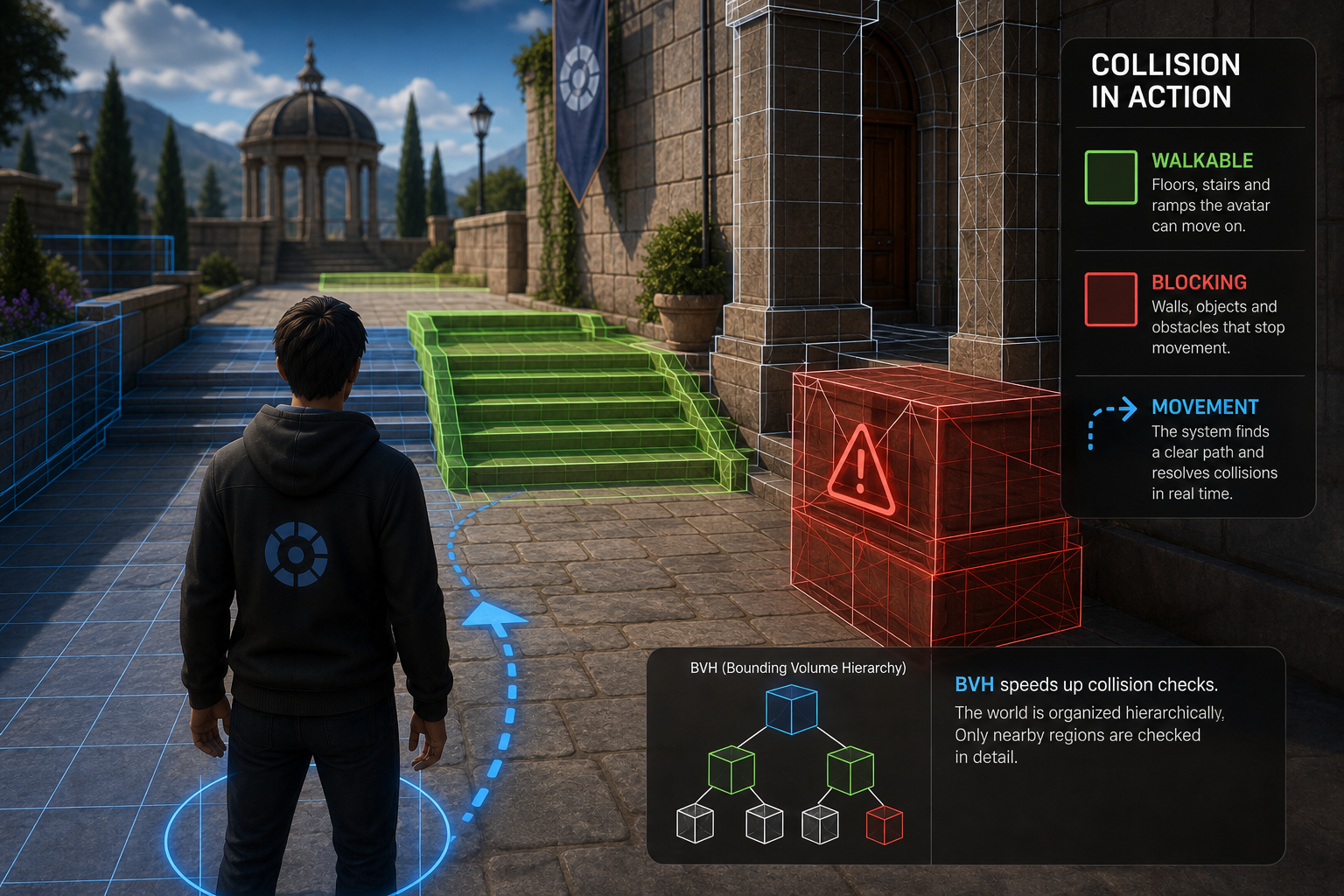
One design decision that belongs into this discussion is the move from simple ray-casting toward a BVH-based approach, a bounding volume hierarchy. At first glance, this sounds like a technical detail, but the motivation behind it is very practical. In a small scene with only a few objects, simple ray-casting can be good enough. The system can ask a direct question: “If the avatar moves in this direction, what does this ray hit?” For prototypes and controlled test environments, this is attractive because it is easy to understand and relatively quick to implement. But as soon as a world becomes larger, more detailed, and more varied, this simple approach can become expensive and imprecise. The system may need to test too many surfaces too often. It may miss important details. Or it may require so many workarounds that the original simplicity starts to disappear.
A BVH changes the way the platform thinks about the geometry of the world. Instead of treating a complex environment as one large collection of surfaces, it organizes the space into a hierarchy of bounding areas. In non-technical terms, it is a way of saying: before checking every detail, first check which larger region is relevant. If the avatar is nowhere near a certain building, tree, wall, or floor section, there is no reason to examine its individual surfaces. This makes collision detection more efficient, especially in larger scenes. It also helps with precision, because once the relevant part of the world is identified, the system can focus its attention there instead of wasting effort everywhere else. For a virtual world platform that should run in the browser and remain usable on normal devices, this matters a great deal. Performance is not only about high frame rates. It is about keeping movement responsive, predictable, and comfortable.
The trade-off is that BVH-based collision detection requires more care. It is not the quickest path. It adds implementation effort, requires testing, and makes the internal handling of world geometry more sophisticated. It also means that creators and developers must think more carefully about static and dynamic objects, optimized meshes, and the way imported models are structured. Not every object benefits equally from the same approach, and animated or highly complex models can introduce additional challenges. But for Cybalounge 2, this felt like the right kind of complexity: not complexity for its own sake, but complexity used to protect simplicity at the user level. The user should not have to think about rays, bounding volumes, or geometry hierarchies. The user should simply feel that the floor is solid, walls behave like walls, stairs can be trusted, and movement remains smooth. That is the real reason behind the decision. The platform accepts more effort internally so that the experience can feel lighter, more stable, and more natural externally.
In the end, collision detection is a promise. It tells the user that the world will behave consistently. It says that floors are floors, walls are walls, obstacles are obstacles, and movement has meaning. When that promise holds, users stop thinking about it. When it breaks, they lose trust immediately. This is why collision detection is not only about physics. It is the invisible trust layer of a virtual world platform.
Now available on Amazon!
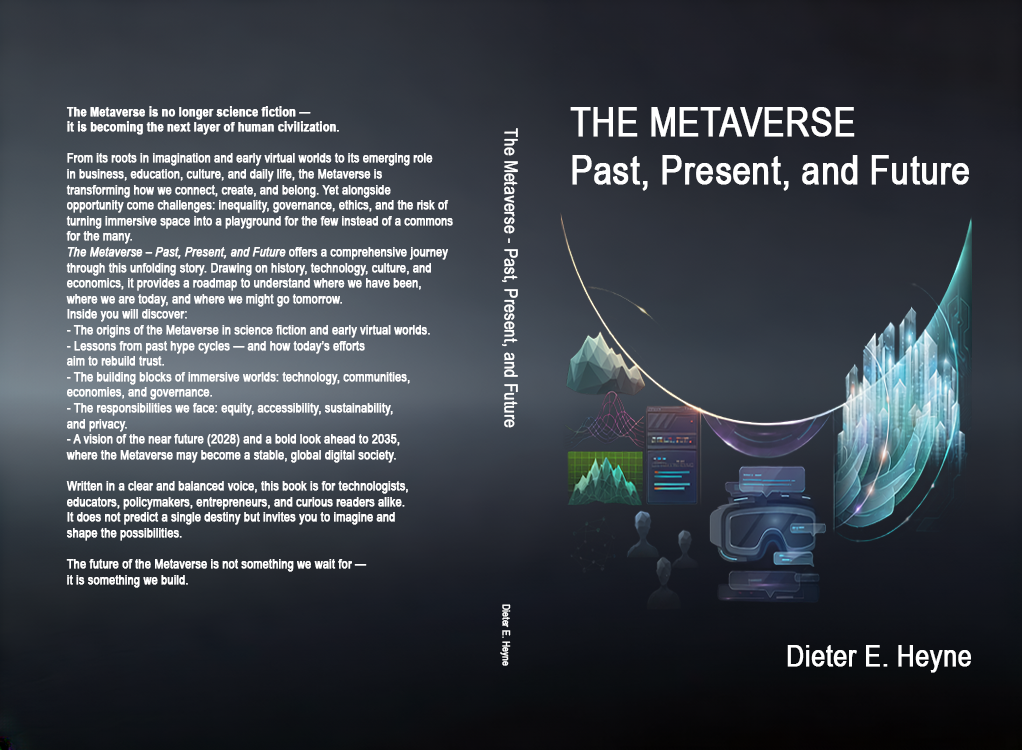
Discover the Metaverse Beyond the Hype
The Metaverse is no longer a futuristic fantasy, it is rapidly becoming a new layer of human society. But what is it really? Where did it come from? And what might it become over the next decade?
The Metaverse – Past, Present, and Future takes readers on a fascinating journey from the earliest virtual worlds and science-fiction visions to today’s emerging immersive platforms, digital economies, and online communities. Along the way, it explores the technologies powering the Metaverse, the opportunities it creates for education, work, and culture, and the challenges of governance, privacy, inclusion, and sustainability.
Looking beyond today's headlines, the book offers a balanced and inspiring vision of how immersive technologies could transform cities, learning, creativity, and daily life by 2035.
Whether you are a business leader, educator, technologist, policymaker, or simply curious about the future, this book provides the context, insight, and perspective needed to understand one of the most important technological and societal shifts of our time.
The future of the Metaverse is not something we await, it is something we create.
About the Author
Dieter E. Heyne is a Metaverse pioneer and lifelong technologist, born in Munich in 1966. With a master’s degree in applied computer science and over three decades of experience as an IT entrepreneur, software architect, and consultant, he has always been at the frontier of digital innovation. His journey into virtual worlds began in 2007 with Second Life and sparked a deep, ongoing exploration of the Metaverse as a space for education, collaboration, and immersive experiences.
Since 2012, Dieter has been developing and refining a web-based virtual world platform, driven by a vision to make the Metaverse accessible, meaningful, and transformative. As a frequent speaker and thought leader at Metaverse events, he shares his insights on how virtual environments can reshape human interaction, learning, and culture. He is the founder and CEO of Metaverse School GmbH, a company dedicated to promoting Metaverse literacy and helping people and organizations understand the power and promise of these emerging digital realms.
Besides talking and writing non-fiction about the Metaverse and Virtual Worlds, this vast knowledge now went into the creation of The Metaverse Enforcers, an ongoing series of high-tech science fiction novels, showcasing the potential development and dangers of the Metaverse in 2053.
About Metaverse School GmbH
Metaverse School GmbH was founded in 2017 by Dieter E. Heyne, who continues to lead the company as its CEO. The company emerged from decades of consulting experience in software architecture, project management, quality assurance, information security, and data protection. Building on this strong technological foundation, Metaverse School GmbH is dedicated to promoting the responsible and purposeful use of immersive 3D environments, for education, collaboration, training, and simulation.
A core mission of the company is to raise awareness of the Metaverse’s potential across business, education, and society. In support of this goal, Dieter Heyne regularly speaks at national and international conferences as well as Metaverse-focused events. Through real-world examples and deep expertise, he demonstrates how immersive technologies can already create meaningful value today.
Disclaimer
Some portions of this content were created or refined with the assistance of artificial intelligence (AI) using tools such as OpenAI’s ChatGPT. The ideas, structure, and editorial direction remain the responsibility of the author. While every effort has been made to ensure factual accuracy and original expression, readers are encouraged to approach speculative or future-facing statements with critical thought.
This series does not represent the views of any specific company or platform and is intended to inspire open discussion around the evolving concept of the Metaverse.
#Metaverse #VirtualWorlds #FutureOfTech #DigitalCommunity #CybaLounge #CL2