 METAVERSE BLOG
 Chapter 05: Choosing Technologies Without Falling in Love With Tools
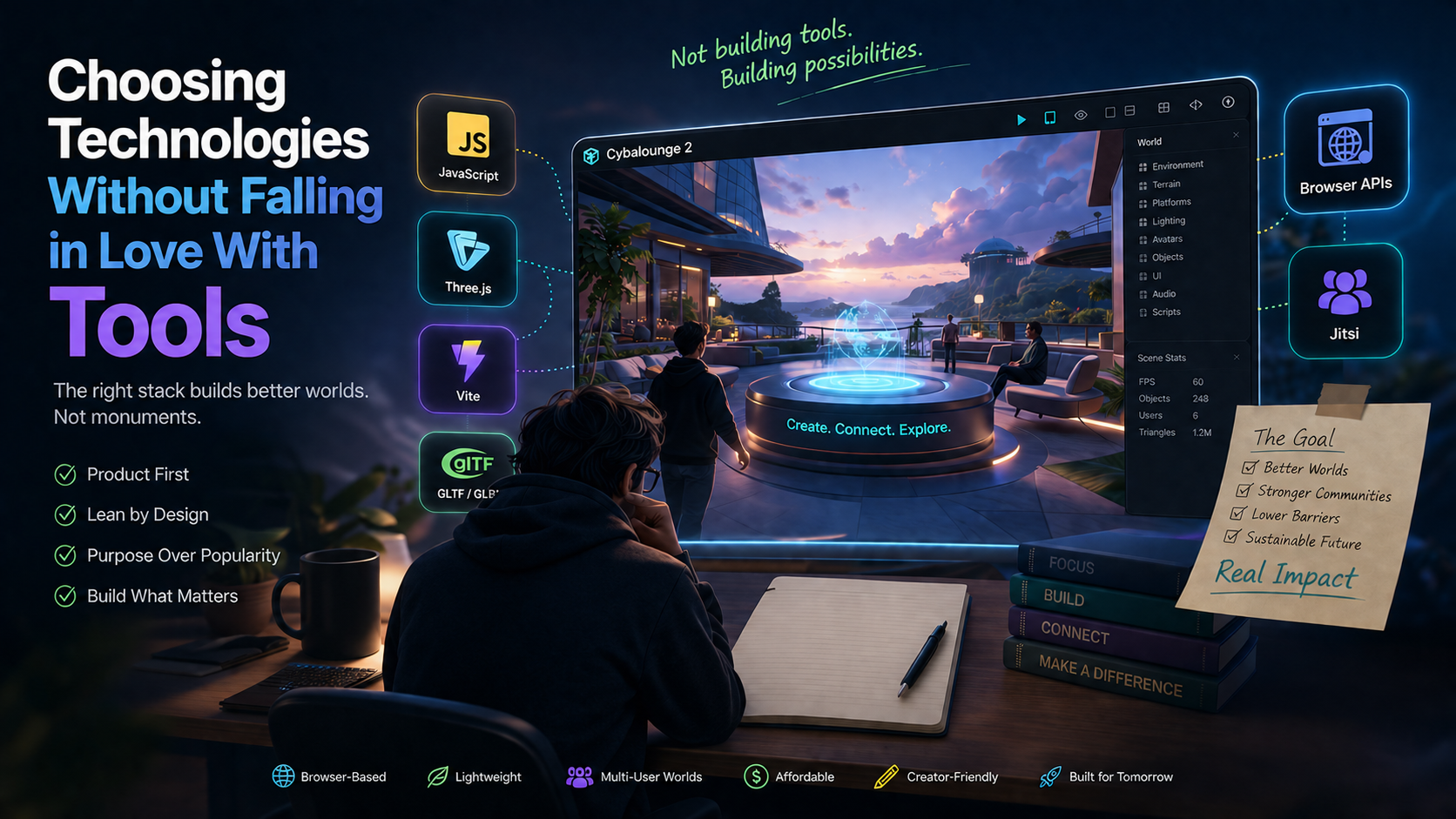 Technology choices are rarely neutral. Developers have preferences, experiences, habits, and sometimes strong opinions about tools. A framework can feel elegant. A language can feel natural. A library can become familiar. An engine can seem powerful enough to solve almost everything. But when building a platform like Cybalounge 2, I try to remind myself that tools are not the product. They are the means by which the product becomes possible.
This sounds obvious, but it is easy to forget. Many projects start with a technology decision and then adapt the product vision to fit that decision. A large framework is chosen, and suddenly the architecture reflects the framework more than the user need. A game engine is selected, and suddenly the product inherits assumptions from games even if the target is education or business collaboration. A backend platform is adopted, and suddenly simple content becomes a database problem. A tool can be useful, but it can also pull the project in a direction that was never intended.
For CL2, the product goal comes first. The platform should be browser-based, lightweight, practical, and affordable to operate. It should support multi-user virtual worlds, but it should not become unnecessarily heavy. It should remain understandable for a small development team. It should allow creators to build and deploy worlds without needing a complex infrastructure. It should be possible to host simple worlds as static content where appropriate. These goals shape the technology choices.
Vite supports the development workflow. It keeps the project modern, fast, and relatively simple. For a platform that should remain understandable, the build system should not become a mystery. Fast feedback is valuable because virtual world development involves a lot of visual iteration. You change something, enter the world, look at movement, lighting, scale, interaction, and performance, then adjust again. A heavy development setup would slow that process down.
JavaScript is a natural foundation because it is the language of the browser. It is not perfect, and like every language it has trade-offs, but it allows the platform to stay close to the runtime environment. With modern JavaScript, the development experience is much better than it used to be. The language is mature enough for structured application development, and the ecosystem offers a wide range of tools without forcing the platform into one monolithic model.
Three.js is an important part of the stack because it provides a practical layer over WebGL. It makes real-time 3D in the browser accessible without hiding every detail. This balance is important. A platform like Cybalounge 2 needs enough control to manage worlds, cameras, avatars, lighting, effects, and performance decisions. At the same time, it should not require writing raw WebGL for every scene. Three.js offers a middle path: powerful enough for serious work, approachable enough to support iterative development.
One important technology decision was not only what to use, but also what not to use yet. WebGPU is a very promising direction for browser-based 3D applications. It offers a more modern path toward graphics and compute performance than the older WebGL generation, and it will almost certainly become increasingly important for demanding browser-native visual experiences. From a purely technical perspective, it would be tempting to jump on it immediately. But Cybalounge 2 is not meant to be a technology showcase. Its first goal is to become a practical, accessible, low-maintenance virtual world platform. For that goal, the safest early choice is to rely on the more established browser graphics path and on a rendering stack that already works reliably across many real-world devices and user environments. The question was not: “What is the newest technology we can use?” The better question was: “What gives users and creators the best chance of entering, testing, building, and operating worlds today?”
That does not mean WebGPU is ignored. Quite the opposite: the architecture will be prepared for a later transition, or at least for a gradual adoption where WebGPU becomes an optional or future rendering path. This is one reason why it is important to keep the platform logic, world descriptions, asset structure, interaction logic, and rendering implementation as cleanly separated as possible. If the world is described in a structured way, and if the renderer is treated as one layer of the platform rather than the whole platform itself, then replacing or extending the rendering backend becomes more realistic. The long-term goal is not to lock CL2 into one graphics technology forever. The goal is to make careful decisions in the right order: build a stable creator and user experience first, keep the internal architecture modular enough to evolve, and move toward newer rendering technologies when they clearly improve the product without making access, maintenance, or compatibility worse.
GLTF and GLB matter because a virtual world platform needs a practical model pipeline. The platform should not invent its own 3D asset format if a strong standard already exists. GLTF/GLB provides a useful bridge between modeling tools and browser rendering. It supports scenes, meshes, materials, animations, and a workflow that creators can understand with the right guidance. Of course, importing models is not the same as using them efficiently. Optimization and conventions remain necessary. But the format gives the platform a sensible foundation.
Browser APIs are another part of the stack, even if they are less glamorous than a rendering library. Audio, video, microphone access, fullscreen behavior, pointer lock, gamepad input, storage, downloads, capture, and other features all shape the platform experience. Staying close to browser APIs means accepting their constraints, security models, and differences. But it also avoids unnecessary abstraction. If the browser already provides a capability, the platform can often use it directly or with a thin layer, instead of adding heavy dependencies.
For communication, Jitsi is an example of a pragmatic tool choice. Voice, video, text, screensharing, and data communication are complex topics. Building everything from scratch would be possible in theory, but it would pull attention away from the platform's core purpose. Integrating a mature communication solution where appropriate allows CL2 to focus on the virtual world experience while still supporting social presence. This is not about avoiding technical work. It is about choosing where custom development creates real value and where integration is more sensible.

The trade-off of this stack is that it stays relatively close to the browser. That creates transparency, but it also means more responsibility. A larger engine or all-in-one platform might provide more built-in systems. It might offer editors, physics, networking, asset pipelines, and deployment patterns out of the box. But it might also bring assumptions, overhead, licensing issues, hosting complexity, or operational costs that do not fit the goal. By staying lean, Cybalounge 2 keeps more control, but it must also make more design decisions explicitly.
This is why technology choices should be evaluated through product questions. Does this tool help lower the entry barrier? Does it support low operating costs? Does it make the platform easier to maintain? Does it fit the creator workflow? Does it reduce unnecessary complexity, or does it add another layer that must be understood forever? Does it make the user experience better, or only the architecture more fashionable? These questions are more useful than asking whether a tool is popular.
The technology stack of CL2 may evolve. Tools change, requirements grow, and new possibilities appear. But the guiding principle should remain stable: tools should serve the platform vision. The goal is not to build a monument to any specific library or framework. The goal is to create practical virtual worlds that people can enter, use, host, and maintain. When the product vision is clear, technology becomes a set of deliberate choices rather than a collection of shiny objects.
Avoiding tool obsession also makes the platform easier to explain. A creator, school, company, or partner does not need to understand every internal detail before they can understand the value proposition. They need to know that the platform is browser-based, lightweight, portable, and maintainable. A lean stack supports that message because it keeps the relationship between architecture and product value visible. Complexity may still exist, but it should not become the first thing people encounter.
Now available on Amazon!
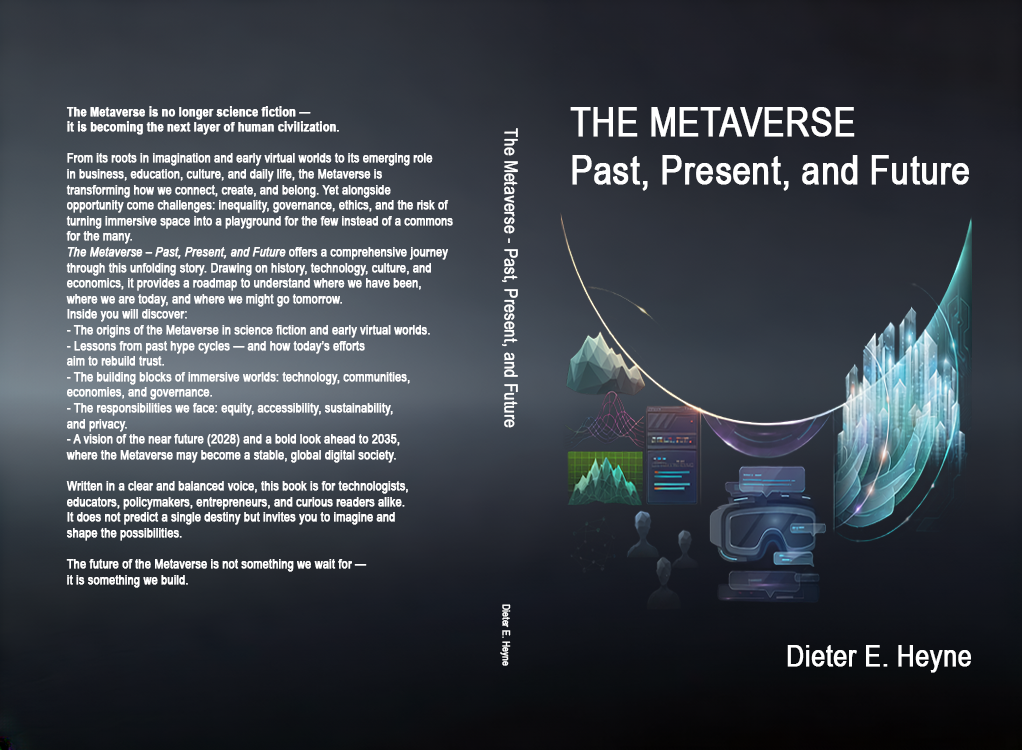
Discover the Metaverse Beyond the Hype
The Metaverse is no longer a futuristic fantasy, it is rapidly becoming a new layer of human society. But what is it really? Where did it come from? And what might it become over the next decade?
The Metaverse – Past, Present, and Future takes readers on a fascinating journey from the earliest virtual worlds and science-fiction visions to today’s emerging immersive platforms, digital economies, and online communities. Along the way, it explores the technologies powering the Metaverse, the opportunities it creates for education, work, and culture, and the challenges of governance, privacy, inclusion, and sustainability.
Looking beyond today's headlines, the book offers a balanced and inspiring vision of how immersive technologies could transform cities, learning, creativity, and daily life by 2035.
Whether you are a business leader, educator, technologist, policymaker, or simply curious about the future, this book provides the context, insight, and perspective needed to understand one of the most important technological and societal shifts of our time.
The future of the Metaverse is not something we await, it is something we create.
About the Author
Dieter E. Heyne is a Metaverse pioneer and lifelong technologist, born in Munich in 1966. With a master’s degree in applied computer science and over three decades of experience as an IT entrepreneur, software architect, and consultant, he has always been at the frontier of digital innovation. His journey into virtual worlds began in 2007 with Second Life and sparked a deep, ongoing exploration of the Metaverse as a space for education, collaboration, and immersive experiences.
Since 2012, Dieter has been developing and refining a web-based virtual world platform, driven by a vision to make the Metaverse accessible, meaningful, and transformative. As a frequent speaker and thought leader at Metaverse events, he shares his insights on how virtual environments can reshape human interaction, learning, and culture. He is the founder and CEO of Metaverse School GmbH, a company dedicated to promoting Metaverse literacy and helping people and organizations understand the power and promise of these emerging digital realms.
Besides talking and writing non-fiction about the Metaverse and Virtual Worlds, this vast knowledge now went into the creation of The Metaverse Enforcers, an ongoing series of high-tech science fiction novels, showcasing the potential development and dangers of the Metaverse in 2053.
About Metaverse School GmbH
Metaverse School GmbH was founded in 2017 by Dieter E. Heyne, who continues to lead the company as its CEO. The company emerged from decades of consulting experience in software architecture, project management, quality assurance, information security, and data protection. Building on this strong technological foundation, Metaverse School GmbH is dedicated to promoting the responsible and purposeful use of immersive 3D environments, for education, collaboration, training, and simulation.
A core mission of the company is to raise awareness of the Metaverse’s potential across business, education, and society. In support of this goal, Dieter Heyne regularly speaks at national and international conferences as well as Metaverse-focused events. Through real-world examples and deep expertise, he demonstrates how immersive technologies can already create meaningful value today.
Disclaimer
Some portions of this content were created or refined with the assistance of artificial intelligence (AI) using tools such as OpenAI’s ChatGPT. The ideas, structure, and editorial direction remain the responsibility of the author. While every effort has been made to ensure factual accuracy and original expression, readers are encouraged to approach speculative or future-facing statements with critical thought.
This series does not represent the views of any specific company or platform and is intended to inspire open discussion around the evolving concept of the Metaverse.
#Metaverse #VirtualWorlds #FutureOfTech #DigitalCommunity #CybaLounge #CL2