 METAVERSE BLOG
Chapter 21: Building Locally, Publishing Simply
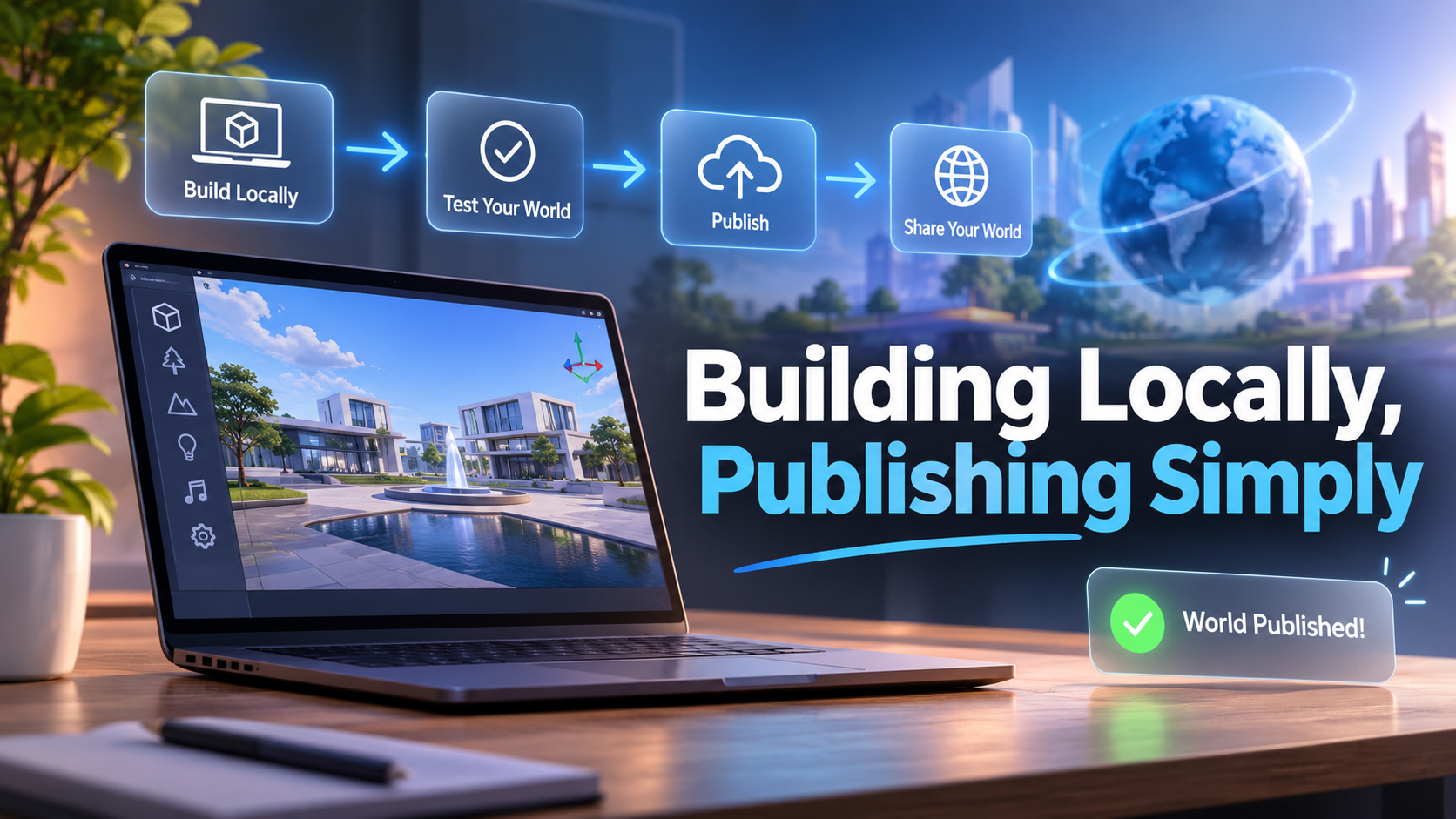
Some of the most important platform decisions are not visually spectacular. They do not appear in screenshots and they do not impress users in the first second. But they shape everything that follows. One of these decisions for Cybalounge 2 is the idea that worlds should be built locally and published simply.
At first glance, this may sound like a step backward. Many modern platforms emphasize cloud-based editing, live collaboration, database-driven content and always-online creation tools. These capabilities can be powerful, and they may become valuable for CL2 in the future as well. But for the foundation of a lightweight virtual world platform, I see a strong advantage in treating worlds as structured content that can be created, tested, uploaded and moved.
The motivation is simple: operational complexity can kill adoption. If building a world requires a heavy backend, a complex database structure, specialized server-side tools and constant administration, the platform becomes harder to host and maintain. Every world becomes tied to the operational state of the server. Backup becomes more complicated. Migration becomes more complicated. Testing becomes more complicated. Small organizations may hesitate before they even begin.
A local-first building workflow changes this starting point. A world can be assembled from assets, models, textures, audio files and a structured description. The creator can test it locally, adjust it, optimize it and only then upload it as static content. This fits the broader philosophy of keeping the backend light. It also supports the goal of low operating costs, because static content is easier and cheaper to host than a constantly changing server-managed world state.
There is a useful comparison to websites. A simple website can be created locally, tested and uploaded to a server. It does not necessarily need a full content management system for every use case. Of course, content management systems are useful in many contexts, but they are not always required. The same thinking can apply to virtual worlds. Not every world needs live editing, database persistence and real-time server-side content manipulation. Many worlds can begin as wellstructured static experiences with optional communication and interaction layers.
This approach gives creators ownership. When a world exists as files and descriptions, it can be backed up. It can be copied. It can be versioned. It can be archived. It can be moved from one server to another. It can be inspected. These properties matter for schools, companies, agencies, cultural institutions and consultants. They reduce dependence on invisible platform internals. They make the world feel like an asset the creator controls.
Local building also supports experimentation. A creator can try ideas without affecting a live environment. They can test different models, lighting setups, spawn points, audio options and object arrangements before publishing. This is important because virtual world design often requires iteration. What looks good in a modeling tool may feel wrong in an actual walkthrough. A room may be too large, a path too confusing, a model too heavy or a light too intense. Local testing allows these discoveries to happen before users are involved.
The trade-off is that live collaborative editing may come later. A local-first workflow does not immediately provide the experience of several creators editing the same world in the browser at the same time. It may not offer instant administrative changes through a web dashboard in the first version. Some users may expect those features. But adding them too early could make the architecture heavier before the core platform has proven its principles.
This is a recurring theme in Cybalounge 2: postpone complexity until its value is clear. A future visual world editor can still be built. A future low-code system can still be added. A future web-based content management layer can still exist. But if the foundation is structured content, those tools can generate or modify understandable world descriptions instead of hiding everything inside proprietary server state. In other words, simple publishing does not block advanced tools later. It gives them a clean target.
For deployment and operations, the benefits are significant. Static content can be served efficiently. Updates can be managed by replacing or versioning world folders. Backups can be file-based. Test and production environments can be separated. A world can be transferred without exporting a database. Hosting requirements remain modest. For a platform that aims for operating costs at or below one dollar per user per month, these details are not minor. They are part of the business model.
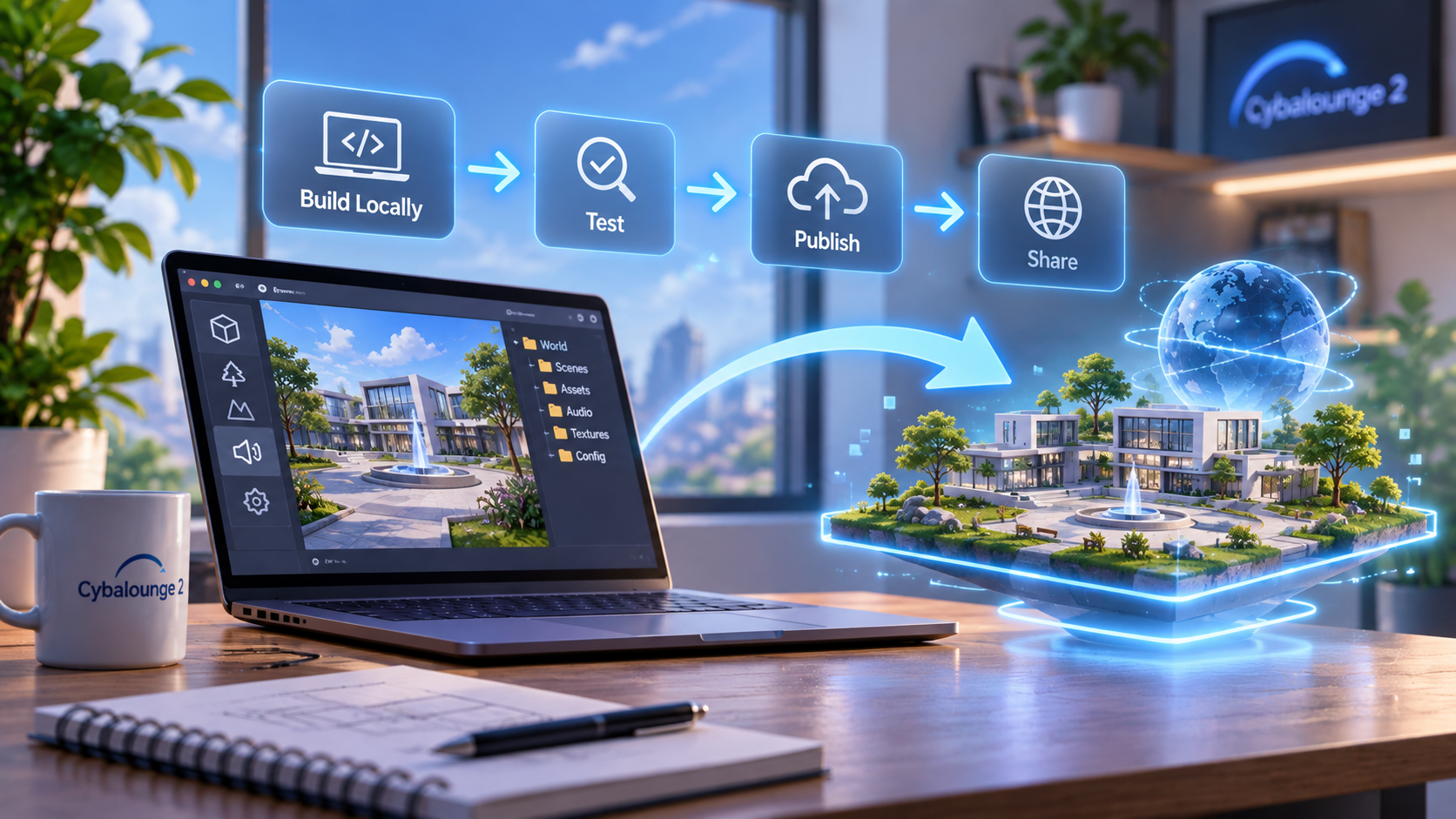
This workflow also encourages better creator discipline. If a world is a structured package, creators must think about organization. Where are models stored? How are textures referenced? How are audio files named? Where is the main world description? Which files are necessary for publication? This structure may seem restrictive at first, but it reduces confusion over time. It makes worlds easier to review and support.
There is also a security advantage. A lighter backend with fewer dynamic editing features has a smaller attack surface. Static content is not automatically safe, but it is easier to reason about than a complex system where users can constantly modify server-side state. If scripting or interactive logic is added later, it can be introduced with clear boundaries. Starting simple makes security decisions more visible.
For educational and business use, simple publishing can be especially attractive. A training provider might build a world for a course, test it internally, then upload it for participants. A school might maintain a small set of learning environments. A city project might publish a digital twin walkthrough. An agency might prepare worlds for clients. In all these cases, the ability to build, test, upload and move content predictably is more important than having every possible live editing feature on day one.
The creator experience should make this workflow feel natural. Documentation, templates, example worlds, validation tools and deployment checklists can help. The platform should not simply say, “upload some files and hope it works.” It should guide creators through a reliable process. Local building is only powerful if publication remains simple and understandable.
Building locally and publishing simply is not a rejection of the cloud. It is a choice about the foundation. It says that a virtual world can be treated as a manageable artifact. It can have structure, ownership and portability. It can be created without making the server responsible for every creative decision.
A world should be easy to build, easy to test, easy to upload and easy to move. That may not sound spectacular, but it may be one of the reasons the platform can become practical.
Now available on Amazon!
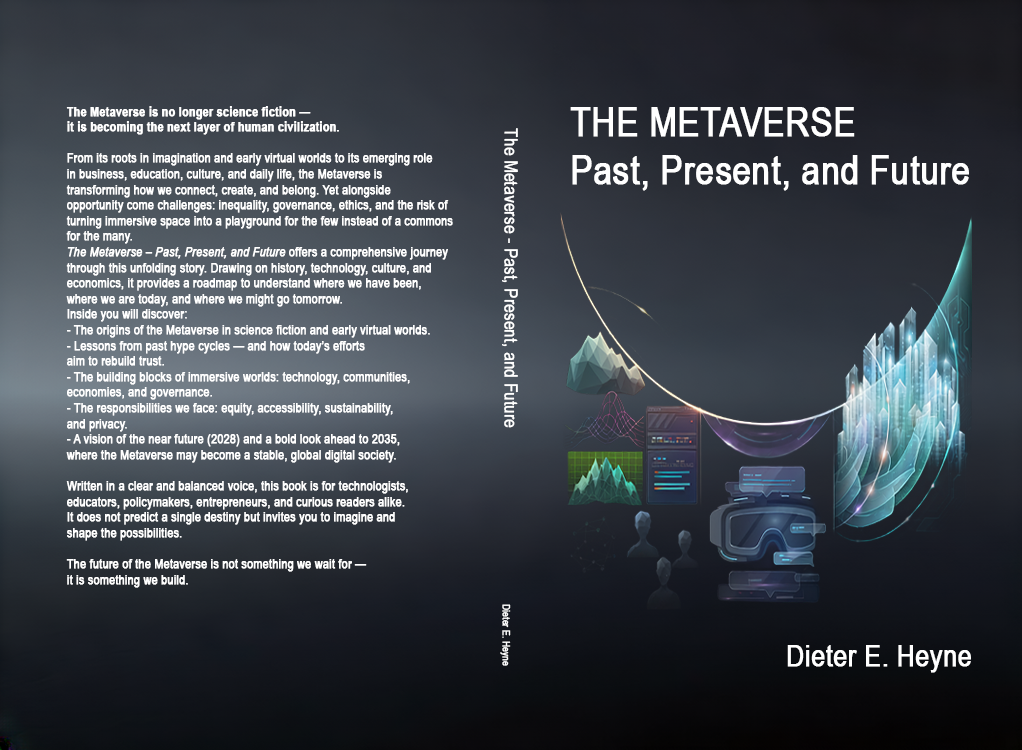
Discover the Metaverse Beyond the Hype
The Metaverse is no longer a futuristic fantasy, it is rapidly becoming a new layer of human society. But what is it really? Where did it come from? And what might it become over the next decade?
The Metaverse – Past, Present, and Future takes readers on a fascinating journey from the earliest virtual worlds and science-fiction visions to today’s emerging immersive platforms, digital economies, and online communities. Along the way, it explores the technologies powering the Metaverse, the opportunities it creates for education, work, and culture, and the challenges of governance, privacy, inclusion, and sustainability.
Looking beyond today's headlines, the book offers a balanced and inspiring vision of how immersive technologies could transform cities, learning, creativity, and daily life by 2035.
Whether you are a business leader, educator, technologist, policymaker, or simply curious about the future, this book provides the context, insight, and perspective needed to understand one of the most important technological and societal shifts of our time.
The future of the Metaverse is not something we await, it is something we create.
About the Author
Dieter E. Heyne is a Metaverse pioneer and lifelong technologist, born in Munich in 1966. With a master’s degree in applied computer science and over three decades of experience as an IT entrepreneur, software architect, and consultant, he has always been at the frontier of digital innovation. His journey into virtual worlds began in 2007 with Second Life and sparked a deep, ongoing exploration of the Metaverse as a space for education, collaboration, and immersive experiences.
Since 2012, Dieter has been developing and refining a web-based virtual world platform, driven by a vision to make the Metaverse accessible, meaningful, and transformative. As a frequent speaker and thought leader at Metaverse events, he shares his insights on how virtual environments can reshape human interaction, learning, and culture. He is the founder and CEO of Metaverse School GmbH, a company dedicated to promoting Metaverse literacy and helping people and organizations understand the power and promise of these emerging digital realms.
Besides talking and writing non-fiction about the Metaverse and Virtual Worlds, this vast knowledge now went into the creation of The Metaverse Enforcers, an ongoing series of high-tech science fiction novels, showcasing the potential development and dangers of the Metaverse in 2053.
About Metaverse School GmbH
Metaverse School GmbH was founded in 2017 by Dieter E. Heyne, who continues to lead the company as its CEO. The company emerged from decades of consulting experience in software architecture, project management, quality assurance, information security, and data protection. Building on this strong technological foundation, Metaverse School GmbH is dedicated to promoting the responsible and purposeful use of immersive 3D environments, for education, collaboration, training, and simulation.
A core mission of the company is to raise awareness of the Metaverse’s potential across business, education, and society. In support of this goal, Dieter Heyne regularly speaks at national and international conferences as well as Metaverse-focused events. Through real-world examples and deep expertise, he demonstrates how immersive technologies can already create meaningful value today.
Disclaimer
Some portions of this content were created or refined with the assistance of artificial intelligence (AI) using tools such as OpenAI’s ChatGPT. The ideas, structure, and editorial direction remain the responsibility of the author. While every effort has been made to ensure factual accuracy and original expression, readers are encouraged to approach speculative or future-facing statements with critical thought.
This series does not represent the views of any specific company or platform and is intended to inspire open discussion around the evolving concept of the Metaverse.
#Metaverse #VirtualWorlds #FutureOfTech #DigitalCommunity #CybaLounge #CL2