 METAVERSE BLOG
 Chapter 09: The Avatar as the User's Anchor

A virtual world begins to feel different from a website when the user has a place inside it. This place is not only a camera position. It is not only a viewpoint. It is a visible and social representation of the user. In Cybalounge 2, the avatar plays this role. It is the user's anchor in the world: the point where identity, movement, orientation, and presence come together.
Without an avatar, a 3D environment can easily feel like a floating camera experience. The user can look around and move, but may not feel embodied. This can be useful for some applications, such as architectural walkthroughs or product views, but it is less suitable for shared social spaces. In a multi-user world, people need to understand not only where they are, but where others are. They need to see direction, distance, movement, attention, and sometimes emotion or intention. The avatar provides these signals.
This is why I do not see the avatar as a decorative feature. It is a functional element of presence. It gives the user a body in the environment. It creates a relationship between the camera and the world. It allows movement to be interpreted as the movement of a person rather than a technical navigation mode. It helps other users recognize that someone is present. Even a simple avatar can transform an empty scene into a shared place.
For CL2, the first goal is not to create the most advanced avatar customization system. That would be an interesting future direction, and an Avatar Studio is definitely part of the long-term vision. But in the early platform, the priority is reliable presence. The avatar should load correctly, move predictably, animate believably enough, cast and receive shadows where appropriate, and support the basic social functions of a shared virtual world. It should give users a sense of being there.
This involves trade-offs. Full customization can be complex. Body shapes, clothing, hair, accessories, animations, facial expressions, and identity options can quickly become a platform within the platform. It may be tempting to build all of that early because avatars are emotionally important. But too much complexity too soon can distract from the core experience. A simple but stable avatar system may be more valuable in the beginning than an ambitious customization system that creates performance, usability, and maintenance problems.
The avatar also influences camera design. In a third-person view, the camera follows the user from outside the body. This can make navigation easier for many users, especially those who are not experienced with first-person 3D environments. It helps users see their own position, direction, and movement. It can reduce disorientation. It also supports a more social feeling because the user sees themselves as part of the scene. For non-gamers, educators, business users, and seniors, this can be more comfortable than being placed directly inside an invisible first-person viewpoint.
Movement is another part of the avatar's role. Walking, running, turning, and stopping are not only mechanical actions. They communicate intention. If an avatar approaches, turns away, waits, or follows, other users interpret that behavior socially. Even when animations are simple, they help make movement readable. A sliding object is less human than a walking avatar. A world with moving avatars feels inhabited. A world with only camera positions feels more like a technical session.
The avatar also supports orientation. In a 3D space, users can easily lose track of direction. Seeing the avatar's body, facing direction, and relationship to the environment helps maintain spatial awareness. This is especially important in larger worlds, training environments, or educational spaces where users may need to follow paths, gather at locations, or interact with specific objects. The avatar becomes a constant reference point.
There is also a social trust aspect. In a shared environment, users want to know who is present. Names, labels, distance, and avatar appearance all contribute to that understanding. The platform does not need to solve every identity question immediately, but it should make presence legible. If someone speaks, moves, or joins a group, others should be able to connect that action to a visible participant. Otherwise, the world can feel confusing or anonymous in a negative way.
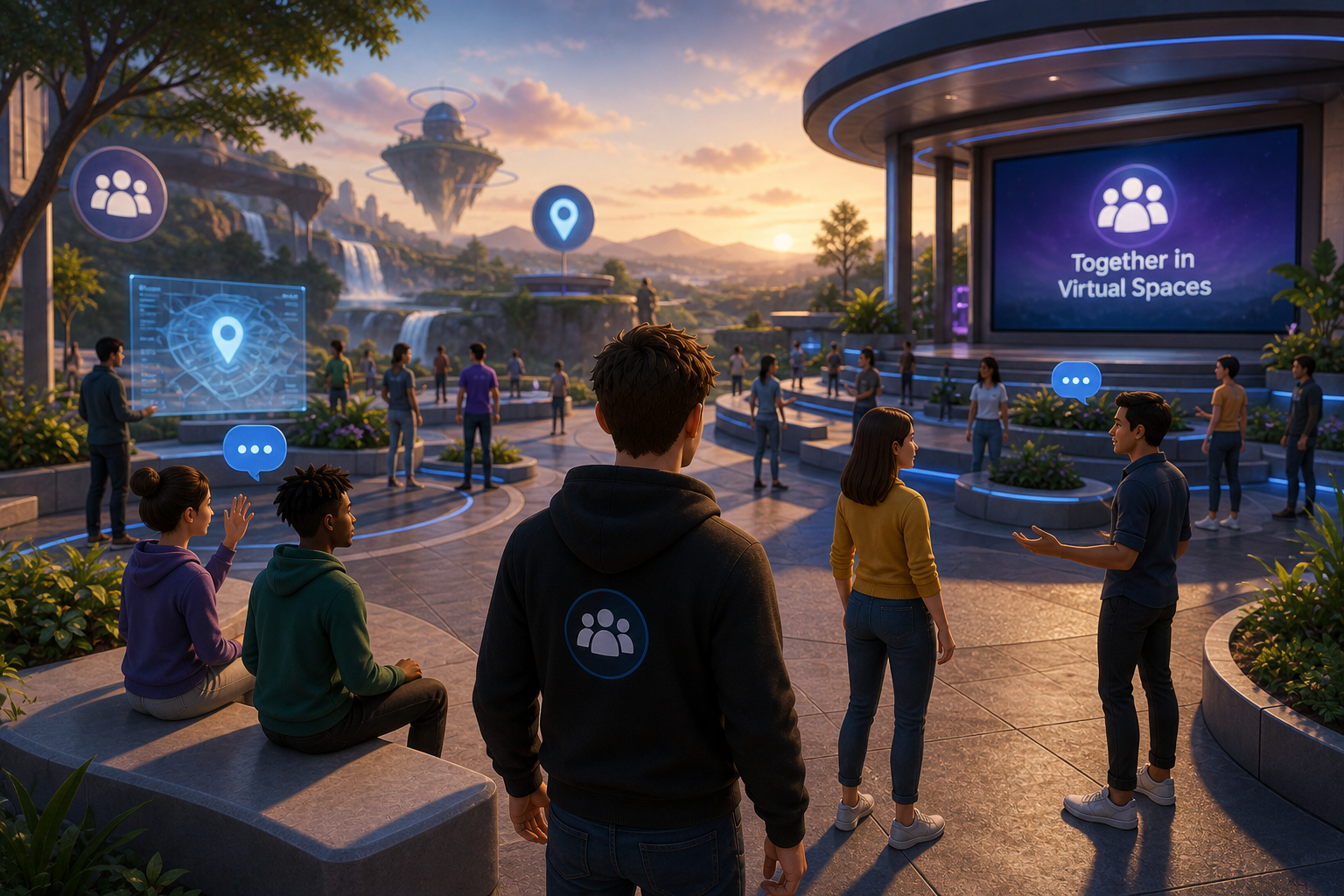
For education and business, the avatar can support roles. A trainer, teacher, moderator, guide, learner, visitor, or presenter may not need a different body, but the platform can eventually use avatar labels, indicators, or visual conventions to support role recognition. This connects the avatar to moderation and safety as well. In shared spaces, it should be clear who can help, who is leading, and who has control over the room.
The avatar is also part of emotional engagement. People often remember spaces in relation to themselves. They remember where they stood, where others gathered, which path they took, what they saw from a certain position. An avatar strengthens that memory because it gives the user a body within the experience. This matters for learning, collaboration, events, and community building. Presence is not only visual quality. It is the feeling of being situated.
Over time, the avatar system can grow. More customization, better animations, expressive gestures, accessibility options, identity profiles, and AI-assisted avatar creation may all become valuable. But the foundation should remain clear: the avatar exists to anchor the user. It is not just a 3D model. It is the bridge between person and place, between movement and meaning, between individual presence and social space. Presence begins when the user has a place in the world.
There is also a practical reason to start simple. Every avatar is part of the performance budget. Detailed characters, complex materials, many animations, and high-resolution textures can quickly become expensive in multi-user scenes, especially within a web browser. A platform that wants to work on ordinary devices needs avatar quality that supports identity without overwhelming the system. The best early avatar is not the most detailed one, but the one that reliably helps users feel present.
This does not mean visual individuality is unimportant. It means the platform should earn customization step by step. First, the avatar must support presence. Then it can become more expressive, more personal, and more adaptable without weakening the core experience.
Now available on Amazon!
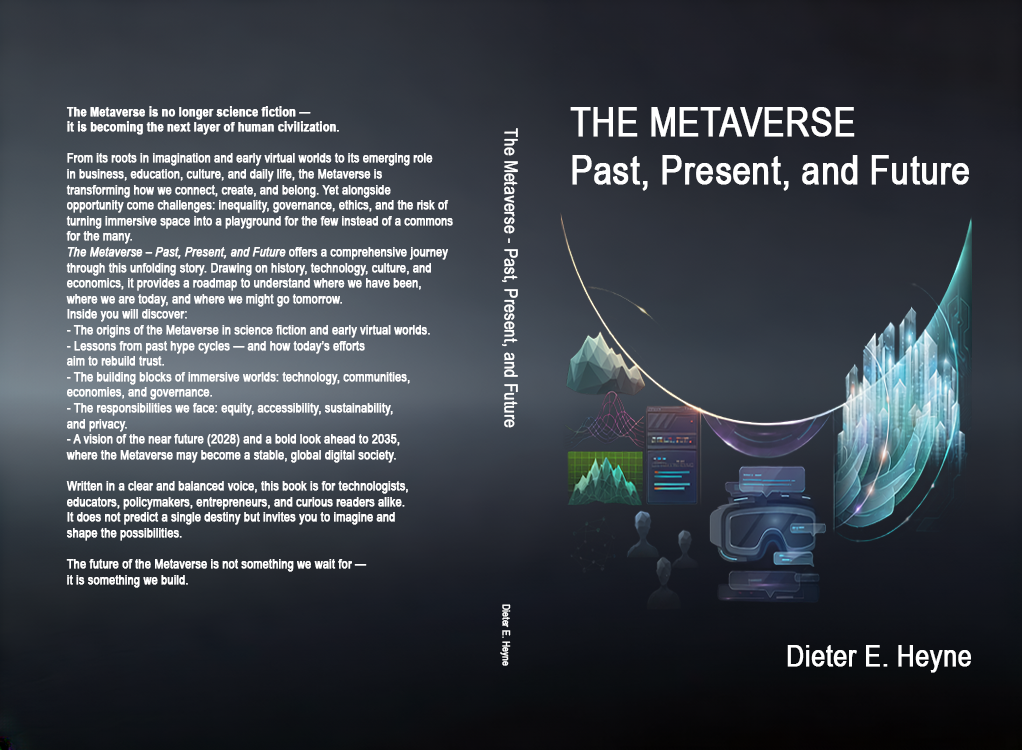
Discover the Metaverse Beyond the Hype
The Metaverse is no longer a futuristic fantasy, it is rapidly becoming a new layer of human society. But what is it really? Where did it come from? And what might it become over the next decade?
The Metaverse – Past, Present, and Future takes readers on a fascinating journey from the earliest virtual worlds and science-fiction visions to today’s emerging immersive platforms, digital economies, and online communities. Along the way, it explores the technologies powering the Metaverse, the opportunities it creates for education, work, and culture, and the challenges of governance, privacy, inclusion, and sustainability.
Looking beyond today's headlines, the book offers a balanced and inspiring vision of how immersive technologies could transform cities, learning, creativity, and daily life by 2035.
Whether you are a business leader, educator, technologist, policymaker, or simply curious about the future, this book provides the context, insight, and perspective needed to understand one of the most important technological and societal shifts of our time.
The future of the Metaverse is not something we await, it is something we create.
About the Author
Dieter E. Heyne is a Metaverse pioneer and lifelong technologist, born in Munich in 1966. With a master’s degree in applied computer science and over three decades of experience as an IT entrepreneur, software architect, and consultant, he has always been at the frontier of digital innovation. His journey into virtual worlds began in 2007 with Second Life and sparked a deep, ongoing exploration of the Metaverse as a space for education, collaboration, and immersive experiences.
Since 2012, Dieter has been developing and refining a web-based virtual world platform, driven by a vision to make the Metaverse accessible, meaningful, and transformative. As a frequent speaker and thought leader at Metaverse events, he shares his insights on how virtual environments can reshape human interaction, learning, and culture. He is the founder and CEO of Metaverse School GmbH, a company dedicated to promoting Metaverse literacy and helping people and organizations understand the power and promise of these emerging digital realms.
Besides talking and writing non-fiction about the Metaverse and Virtual Worlds, this vast knowledge now went into the creation of The Metaverse Enforcers, an ongoing series of high-tech science fiction novels, showcasing the potential development and dangers of the Metaverse in 2053.
About Metaverse School GmbH
Metaverse School GmbH was founded in 2017 by Dieter E. Heyne, who continues to lead the company as its CEO. The company emerged from decades of consulting experience in software architecture, project management, quality assurance, information security, and data protection. Building on this strong technological foundation, Metaverse School GmbH is dedicated to promoting the responsible and purposeful use of immersive 3D environments, for education, collaboration, training, and simulation.
A core mission of the company is to raise awareness of the Metaverse’s potential across business, education, and society. In support of this goal, Dieter Heyne regularly speaks at national and international conferences as well as Metaverse-focused events. Through real-world examples and deep expertise, he demonstrates how immersive technologies can already create meaningful value today.
Disclaimer
Some portions of this content were created or refined with the assistance of artificial intelligence (AI) using tools such as OpenAI’s ChatGPT. The ideas, structure, and editorial direction remain the responsibility of the author. While every effort has been made to ensure factual accuracy and original expression, readers are encouraged to approach speculative or future-facing statements with critical thought.
This series does not represent the views of any specific company or platform and is intended to inspire open discussion around the evolving concept of the Metaverse.
#Metaverse #VirtualWorlds #FutureOfTech #DigitalCommunity #CybaLounge #CL2