 METAVERSE BLOG
Chapter 19: Atmosphere: Why Sky, Water, Weather and Sound Matter
A virtual world can be technically functional and still feel lifeless. The geometry may load, the avatar may move, the controls may work and communication may be available, but the world can still feel like a test scene. It has structure, but no mood. It has objects, but no atmosphere. It has a floor, walls and models, but it does not yet feel like a place.
Atmosphere is the difference between a 3D scene and a remembered environment. In physical spaces, we rarely experience architecture as pure geometry. We experience light, weather, temperature, sound, distance, reflections, shadows and movement. A courtyard feels different in the morning than at night. A training room feels different with silence than with a gentle background ambience. A waterfront location feels different when light reflects on water. A digital twin feels more understandable when the sky, scale and lighting support orientation. These elements do not simply decorate a world. They shape how users feel inside it.
For Cybalounge 2, atmosphere matters because the platform is meant for practical use, not only technical demonstration. A learning environment should hold attention. A virtual event should feel memorable. A senior community space should feel warm and welcoming. A business meeting area should feel calm and professional. A digital twin should feel understandable and grounded. Visual and audio atmosphere can support these goals without turning the platform into a game engine clone.
The design principle is to use atmosphere in service of presence. Sky, water, weather and sound should help users orient themselves, remember the space and feel that it has identity. They should not exist only to impress developers. A day-night cycle, for example, can make a world feel alive, but it can also confuse users if it becomes too dark or changes too quickly. Water can enrich a scene, but expensive reflections may not be justified in every use case. Rain can create mood, but too many particles can harm performance. Background audio can add depth, but if it is too loud or repetitive, it becomes annoying.
This is why atmosphere must be balanced with restraint. The goal is not maximum realism. Maximum realism is expensive, difficult to maintain and often unnecessary. The goal is believable enough. A sky should give the user a sense of openness and direction. Sun and moon light should make the world feel connected to time. Clouds should add depth without introducing visual artifacts that distract from the experience. Water should provide movement and reflection where it adds value. Environmental effects should support the world’s purpose.
Sound is especially powerful because it can change the perceived quality of a world immediately. A space without any sound can feel unfinished, unless silence is intentional. A subtle ambient loop can make a lobby feel inhabited, a learning space feel calm or an outdoor scene feel open. But audio must be user-controlled. In browser-based environments, audio permissions and autoplay restrictions already create technical considerations. More importantly, users have different contexts. Someone may join from an office, classroom or shared home. Background audio should enhance presence, not take control.
Weather and particles provide another example of useful restraint. Rain, snow and dust can make a world feel cinematic. They can also become visual clutter. In a training scenario, heavy rain may distract from learning. In a storytelling environment, it may create exactly the right mood. In a desert simulation, dust near the ground can support realism. In a senior community world, subtle seasonal effects may make the space feel alive. Atmospheric effects should be configurable and purposeful.
The trade-off is performance. Every visual effect competes for resources with rendering, avatars, communication and interaction. A platform that aims to be accessible in the browser and economical to operate cannot treat effects as unlimited. Atmospheric design must respect normal devices. This connects directly to the earlier principle that performance is product quality. A beautiful world that stutters is not beautiful in use. The feeling of presence depends on smoothness as much as visual richness.
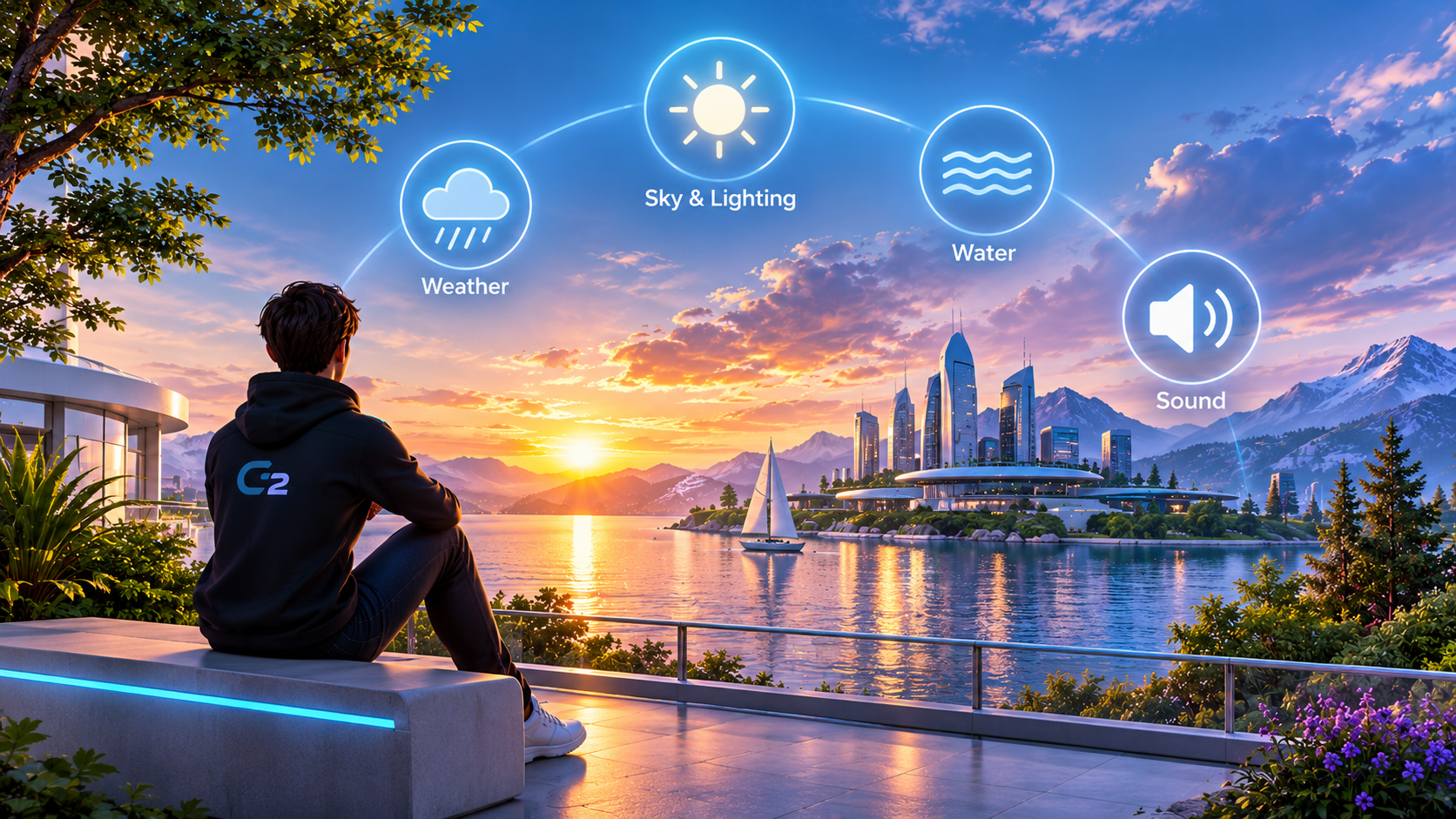
Implementation complexity is another trade-off. Each atmospheric system adds code, settings, edge cases and maintenance. A sky system must handle scale, camera movement, lighting direction, sun and moon visibility, stars and cloud behavior. A water system must interact with light and camera position. Environmental effects must follow the user enough to feel continuous without covering the entire world with unnecessary particles. Audio must handle browser restrictions and user controls. The challenge is to create atmosphere through reusable, understandable systems rather than on-off tricks.
For creators, atmospheric tools are powerful because they allow world identity. The same basic environment can feel like a morning workshop, an evening event, a rainy memory, a calm museum or a futuristic training space depending on light, sound and weather. But creators also need guidance. If every world uses maximum fog, maximum reflections, heavy particles and loud audio, the result will be exhausting. Creator experience should include atmosphere as a design choice, not only a technical option.
Atmosphere also influences memory. People remember places through mood. In education, memory matters. A training scenario with a distinct but not distracting atmosphere can be easier to recall. A virtual onboarding environment can become more recognizable if it has a clear identity. A community space can become emotionally meaningful if it feels stable and welcoming. This is one reason why virtual worlds can offer something different from ordinary web pages. They can associate information with place.
Still, atmosphere should never hide purpose. A world built for learning must remain readable. A world built for collaboration must support conversation. A world built for business should not look like a visual effects demo unless that is the point. The best atmosphere is often the one users notice emotionally before they notice technically. It makes the world feel right.
In CL2, sky, water, weather and sound are not isolated features. They are part of the broader attempt to create immersive spaces that remain lightweight and practical. They must be simple enough to configure, efficient enough to run and meaningful enough to justify their existence.
Atmosphere turns a 3D scene into a place. But the art is knowing how much atmosphere the place actually needs.
Now available on Amazon!
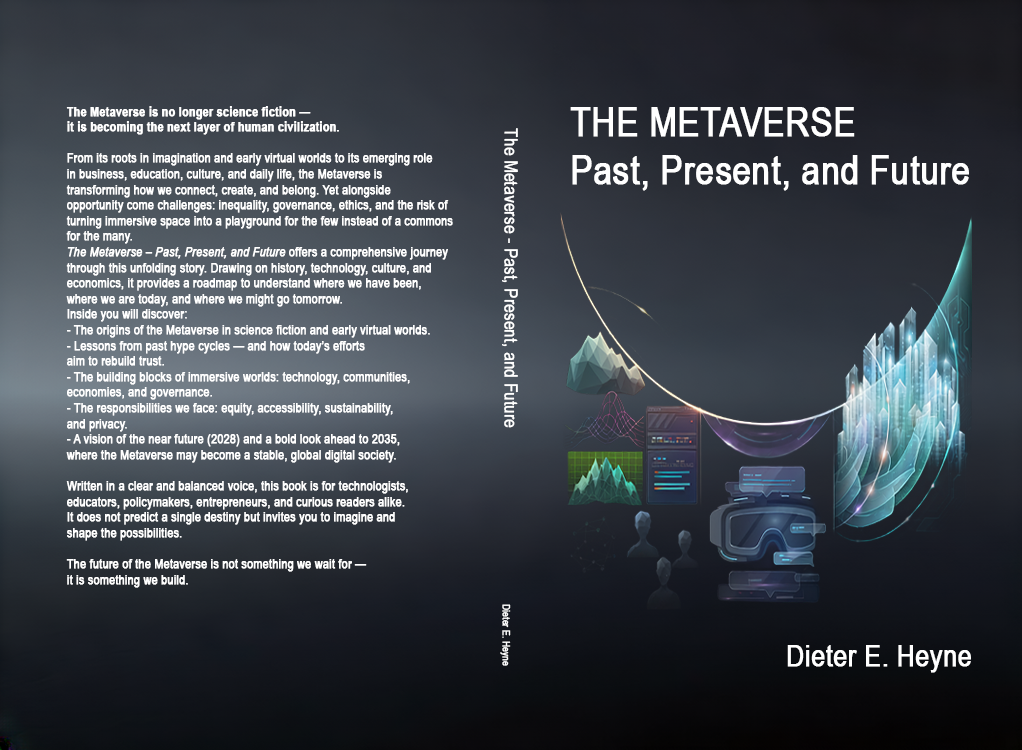
Discover the Metaverse Beyond the Hype
The Metaverse is no longer a futuristic fantasy, it is rapidly becoming a new layer of human society. But what is it really? Where did it come from? And what might it become over the next decade?
The Metaverse – Past, Present, and Future takes readers on a fascinating journey from the earliest virtual worlds and science-fiction visions to today’s emerging immersive platforms, digital economies, and online communities. Along the way, it explores the technologies powering the Metaverse, the opportunities it creates for education, work, and culture, and the challenges of governance, privacy, inclusion, and sustainability.
Looking beyond today's headlines, the book offers a balanced and inspiring vision of how immersive technologies could transform cities, learning, creativity, and daily life by 2035.
Whether you are a business leader, educator, technologist, policymaker, or simply curious about the future, this book provides the context, insight, and perspective needed to understand one of the most important technological and societal shifts of our time.
The future of the Metaverse is not something we await, it is something we create.
About the Author
Dieter E. Heyne is a Metaverse pioneer and lifelong technologist, born in Munich in 1966. With a master’s degree in applied computer science and over three decades of experience as an IT entrepreneur, software architect, and consultant, he has always been at the frontier of digital innovation. His journey into virtual worlds began in 2007 with Second Life and sparked a deep, ongoing exploration of the Metaverse as a space for education, collaboration, and immersive experiences.
Since 2012, Dieter has been developing and refining a web-based virtual world platform, driven by a vision to make the Metaverse accessible, meaningful, and transformative. As a frequent speaker and thought leader at Metaverse events, he shares his insights on how virtual environments can reshape human interaction, learning, and culture. He is the founder and CEO of Metaverse School GmbH, a company dedicated to promoting Metaverse literacy and helping people and organizations understand the power and promise of these emerging digital realms.
Besides talking and writing non-fiction about the Metaverse and Virtual Worlds, this vast knowledge now went into the creation of The Metaverse Enforcers, an ongoing series of high-tech science fiction novels, showcasing the potential development and dangers of the Metaverse in 2053.
About Metaverse School GmbH
Metaverse School GmbH was founded in 2017 by Dieter E. Heyne, who continues to lead the company as its CEO. The company emerged from decades of consulting experience in software architecture, project management, quality assurance, information security, and data protection. Building on this strong technological foundation, Metaverse School GmbH is dedicated to promoting the responsible and purposeful use of immersive 3D environments, for education, collaboration, training, and simulation.
A core mission of the company is to raise awareness of the Metaverse’s potential across business, education, and society. In support of this goal, Dieter Heyne regularly speaks at national and international conferences as well as Metaverse-focused events. Through real-world examples and deep expertise, he demonstrates how immersive technologies can already create meaningful value today.
Disclaimer
Some portions of this content were created or refined with the assistance of artificial intelligence (AI) using tools such as OpenAI’s ChatGPT. The ideas, structure, and editorial direction remain the responsibility of the author. While every effort has been made to ensure factual accuracy and original expression, readers are encouraged to approach speculative or future-facing statements with critical thought.
This series does not represent the views of any specific company or platform and is intended to inspire open discussion around the evolving concept of the Metaverse.
#Metaverse #VirtualWorlds #FutureOfTech #DigitalCommunity #CybaLounge #CL2