A broken lock. A frightened witness. A hurried mistake.
This one leaves nothing.
When a secure data capsule disappears from a WDC logistics hub, the incident looks almost too clean to be real. No alarms. No damage. No panic. The system itself appears to have accepted the transfer as legitimate.
For Metaverse Enforcement Agency investigators Alec Rainer and Riley Voss, that is the first warning.
The second is the route.
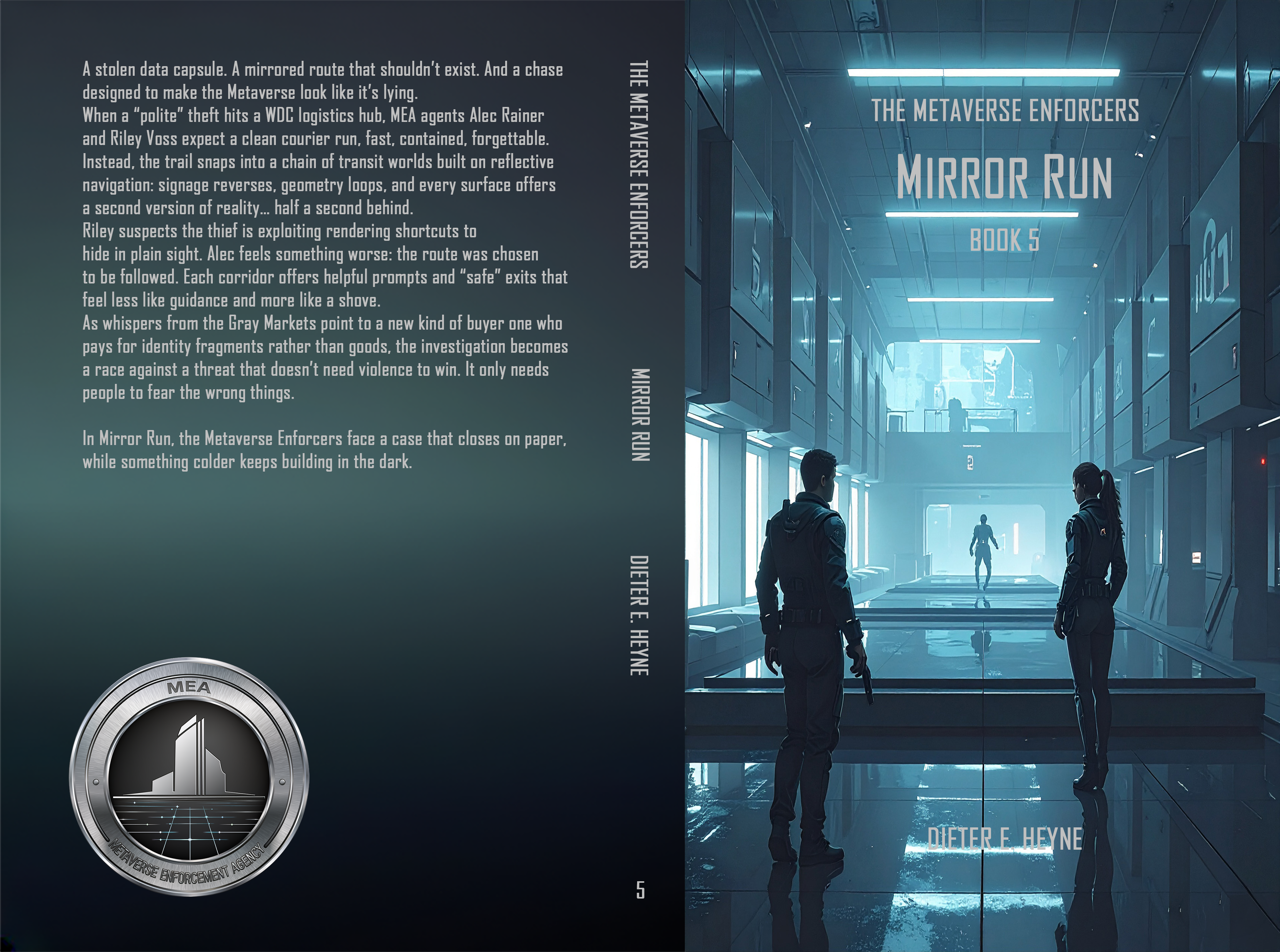
The stolen capsule is already moving through a chain of specialized transit worlds designed for speed, bandwidth efficiency, and compression. They are places built around mirrored navigation, where reflections are not merely decoration but part of the infrastructure itself.
Inside them, reality feels almost right.
Almost.
Reflections move half a second too late.
Signs reverse themselves depending on where you stand.
Corridors repeat with such precision that a wrong turn can become five wrong turns before you even realize you have made the first.
And somewhere among those endless copies, someone is running.
Or wants to appear to be.
Riley sees a technical puzzle: rendering shortcuts, prediction layers, cached movement, and the possibility of hiding an avatar where the system expects nothing more than a reflection.
Alec sees something else.
A chase that feels rehearsed.
Every corridor seems to offer just enough guidance to keep them moving. Every “safe” route feels suspiciously convenient. Every glimpse of their target comes at exactly the right moment to prevent them from stopping and asking the question that increasingly matters:
What if the route was never designed to help the thief escape?
Outside the Metaverse, the case follows them home.
After the events of the Silent School, Alec discovers that anonymity is no longer something his badge can protect. Strangers recognize him. People know his face. Some thank him. Some fear what he represents. All of them remind him that the line between the job and the rest of his life is becoming dangerously thin.
Riley is fighting a quieter battle. Sleep has become another problem she believes she can solve if she only thinks hard enough. The mirrored corridors replay themselves in her mind long after she disconnects, and the difference between vigilance and obsession begins to narrow.
Then Elysia brings a warning from the Gray Markets.
Someone new is buying.
Not weapons.
Not stolen goods.
Pieces of people.
Fragments of identity. Patterns of movement. Reactions. Hesitations. Choices.
And they always pay on time.
As the pursuit drives Alec and Riley deeper into worlds where reflections cannot be trusted and guidance may be more dangerous than getting lost, one possibility becomes impossible to ignore:
Perhaps they are not simply hunting someone through the Metaverse.
Perhaps someone is watching how they hunt.
Studying how quickly they react.
Learning which choices they make when the clock is running.
And waiting to see what happens when every available path looks correct.
The Metaverse Enforcers return in
Book 5: The Mirror Run
Sometimes the most dangerous thing in the Metaverse is not what hides in the dark.
It is the path that seems to know exactly where you are going.
A student returns from class unable to remember Monday.
Another knows she completed her assignments but cannot recall learning the material. A teacher opens her lesson archive and discovers that several weeks have vanished, even though she remembers standing in front of her students, answering their questions and watching them grow more confident.
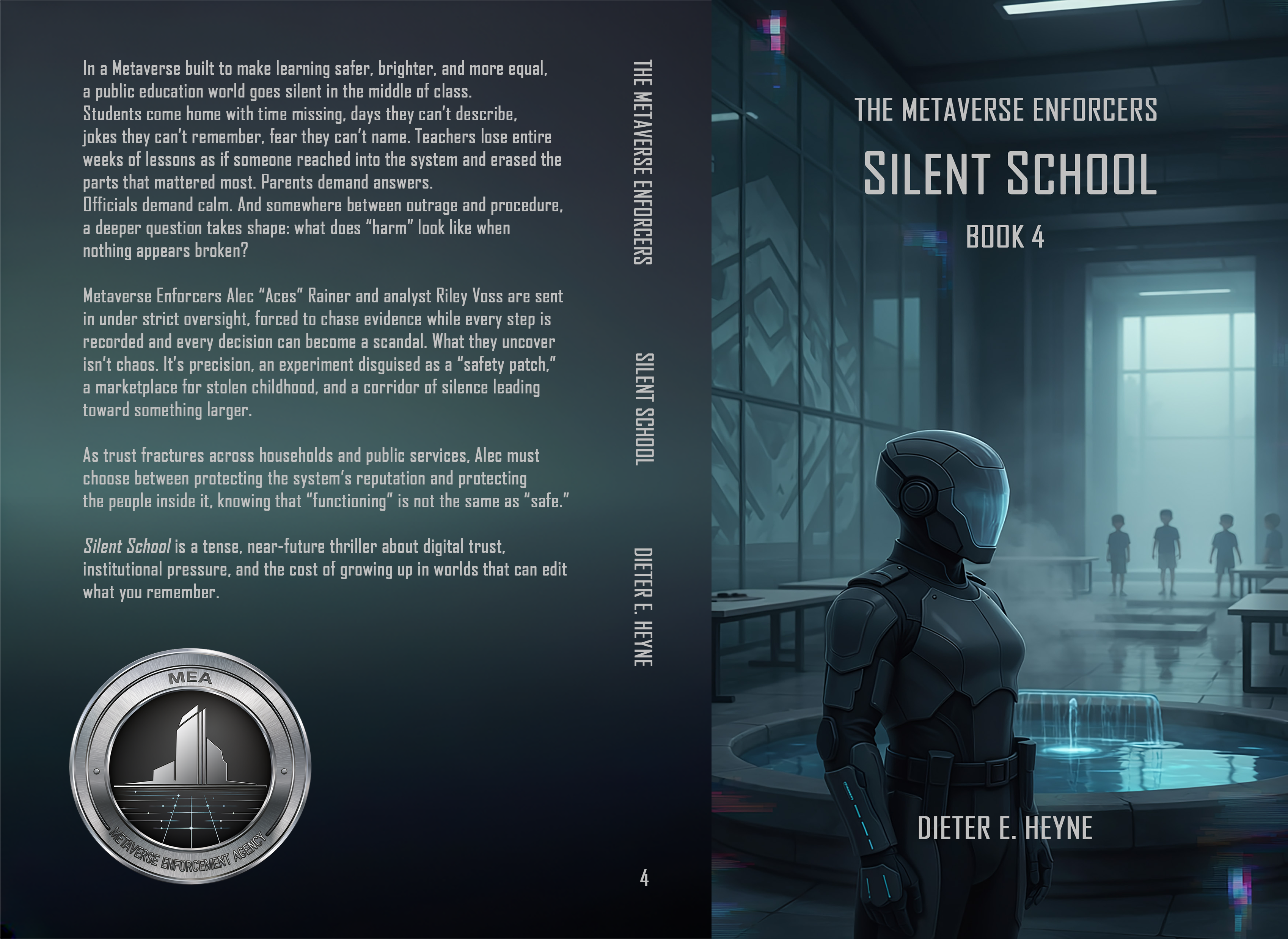
Then an entire public education world falls silent.
The virtual school was created to offer something the physical world could not always provide. It offered equal access, immersive lessons, safe spaces for shy students, and classrooms unconstrained by distance or disability. Parents trusted it. Teachers believed in it. Children entered each morning expecting to explore history, science, and worlds beyond imagination.
Now its gates are locked.
Inside, classrooms stand frozen beneath cheerful murals. Digital fountains flow without sound. Bells that should mark the end of lessons never ring. Students struggle to describe what happened before the silence began, and the harder they try to remember, the further the memories seem to retreat.
Metaverse Enforcement Agency investigator Alec “Aces” Rainer is sent to contain the crisis before public fear turns into panic. But this is no ordinary investigation. Every action he takes is monitored. Every statement is dissected by officials desperate to preserve public confidence. Parents demand names, politicians demand reassurance, and the World Digital Council insists that procedure must come before accusation.
For Alec, the situation is painfully simple: children have been harmed, even if the damage cannot be seen.
For Riley Voss, the school’s systems tell a more disturbing story. Hidden beneath legitimate updates and reassuring safety language, she discovers gaps that are too precise to be accidental. Records exist where ownership should be, but the names are gone. Logs appear complete until examined closely. A harmless-looking educational patch behaves differently depending on the age, stress, and emotional responses of the student using it.
Someone has not merely attacked the school.
Someone has been studying it.
As edited classroom footage spreads across the public feeds, trust begins to fracture far beyond a single virtual world. Families question whether immersive education was ever safe. Schools suspend their programs. Officials respond with tighter controls, broader surveillance, and new restrictions designed to reassure a frightened population.
But fear can build dangerous systems of its own.
To uncover the truth, Alec and Riley must follow a trail through silent classrooms, hidden corridors, legal contracts, and gray markets where pieces of childhood are treated as merchandise. The deeper they travel, the clearer it becomes that the missing memories may be only part of a much larger design.
In the Metaverse, a locked door is easy to recognize.
The most dangerous doors are the ones that have no frame.
And somewhere inside the silent school, something is still listening.
It opens bank accounts, workplaces, homes, medical services, private worlds, and public institutions. It carries a person’s reputation across borders that do not exist on any physical map. In the most heavily regulated environments, an avatar can even hold authority that no human being, server, or corporation possesses alone.
That is supposed to make the system safe.
Until someone discovers how to turn safety into a weapon.
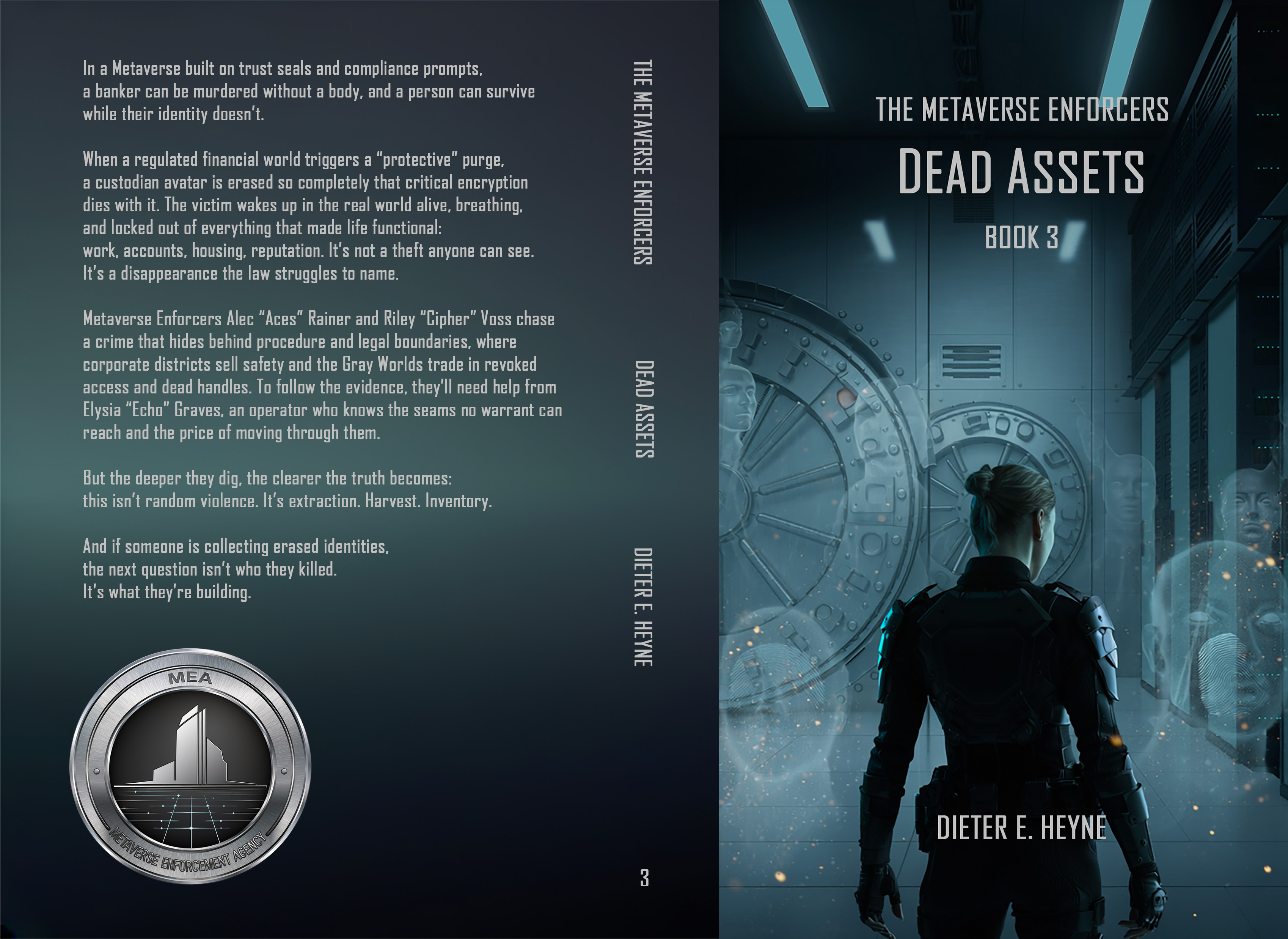
Inside one of the Metaverse’s most secure financial worlds, a virtual banker is erased during what appears to be an automated compliance action. No physical body is harmed. No blood is spilled. The human operator survives.
But their financial identity does not.
Within minutes, a living person becomes a stranger to their employer, their accounts, and the systems that once recognized them. Critical encryption keys vanish with the destroyed avatar, while the institution responsible insists that its protections worked exactly as intended.
For Metaverse Enforcement Agency investigators Alec “Aces” Rainer and Riley “Cipher” Voss, the case presents a disturbing question: What does murder mean when the victim is still alive?
Their investigation leads from the transparent halls of regulated financial worlds into corporate districts where reassurance is designed into every surface. There, smiling service avatars promise security while legal barriers redirect investigators away from the truth. Every doorway requires permission. Every action is logged. Every refusal is presented as protection.
Beyond those polished environments lie the forgotten seams beneath the Metaverse, unfinished maintenance corridors, abandoned access routes, and Gray Worlds where revoked permissions and dead accounts are traded like discarded property.
Those are the places Elysia “Echo” Graves understands.
Operating outside the boundaries that constrain the MEA, Elysia knows that the cleanest systems often hide the darkest machinery. Her routes can take Alec and Riley where no official warrant can reach, but every favor carries a price, and every hidden passage risks attracting the attention of something that does not hunt like a person.
As the investigation deepens, the Enforcers begin to see a pattern behind the erasure. The attack was not a reckless intrusion or a simple financial crime. Someone has learned to manipulate compliance itself—to convince trusted systems that innocent identities are threats that must be removed.
The law sees automated protection.
The victims experience something closer to death.
And in the shadows between regulated worlds, discarded identities may be worth far more than anyone realizes.
In Dead Assets, Alec, Riley, and Elysia confront a form of violence designed to leave no corpse, no obvious culprit, and almost no crime scene. To expose it, they must challenge the rules meant to protect them and uncover why someone would want a person erased but not gone.
Because in the Metaverse, death is not always the end.
In the Metaverse, your avatar is more than a digital body.
It is your face in school.
Your presence at work.
Your voice in a support group.
Your reputation in public.
And when that identity breaks, the consequences do not stay virtual.
After the events of the first case, the Metaverse Enforcement Agency is still trying to prove that immersive worlds can be protected without destroying the freedom that makes them worth entering. Alec Rainer has learned that every intervention is watched, judged, clipped, and questioned. Riley Voss has learned that even the cleanest system logs can hide something darker underneath. And in the Gray Worlds, Elysia “Echo” Graves knows better than anyone that unofficial channels are never as anonymous as they seem.
Then a beloved social world begins to fracture.
At first, it looks like a sudden wave of violence. Avatars lash out in public plazas, classrooms, work lounges, and community spaces. Friends attack friends. Teachers are accused of harming students. Freelancers lose contracts before they can explain themselves. The footage spreads faster than the truth, and the truth is almost impossible to prove.
The logs say the users acted voluntarily.
The users say they never chose any of it.
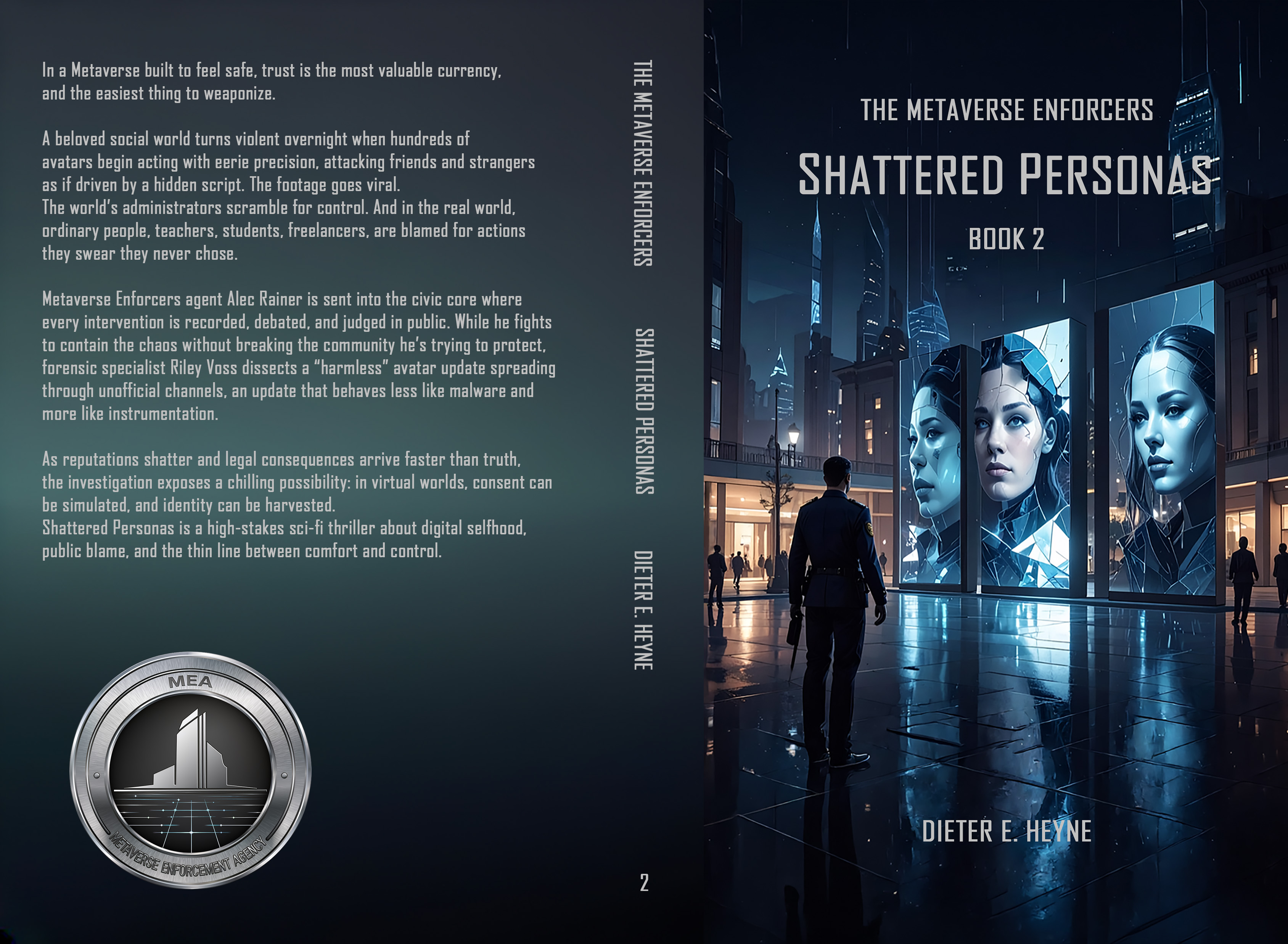
As public blame turns ordinary people into suspects, Alec enters the world’s civic core, a place built on transparency, fairness, and trust. But a transparent world is not always a truthful one. Every decision he makes becomes public record.
Every restraint looks like overreach. Every delay gives the hidden attackers more time.
While Alec fights to protect victims from both physical harm and public condemnation, Riley follows the code trail behind a popular avatar customization update, an unofficial “expression pack” that promised smoother faces, better eye contact, and a more natural presence. It should have been harmless. It should have been cosmetic.
Instead, it behaves like something far more deliberate.
It does not simply corrupt avatars.
It observes them.
It adapts.
It learns.
And deep inside the Gray Worlds, Echo follows the distribution chain through bazaars, hidden mirrors, creator circles, and support kiosks where comfort is sold as safety. What she finds suggests that the attack is not random chaos. It is not even simple sabotage.
Someone is testing how fragile digital identity has become.
Someone is learning how to move people without asking them.
Someone is turning trust into an instrument.
Shattered Personas is the next case in The Metaverse Enforcers, a fast-paced science-fiction thriller about reputation, consent, public judgment, and the terrifying question at the heart of immersive worlds:
If your avatar acts against your will, how do you prove who you really are?
 METAVERSE BLOG